
Hi loyal readers and open government aficionados. Thanks for enduring my two week break; I hope you found the two stand-in articles informative:
https://substack.com/@backroomdealsmirandaspivack/p-200651431
and https://backroomdeals.substack.com/p/michael-steele-talks-with-miranda.
I did have a great time swimming in the ocean and hanging with my family and two adorable granddaughters – a combination that was restorative and head clearing.
I am back at it, writing about government secrecy in all its troublesome forms. And there is much to examine.
Here’s an issue that is gnawing at me – how and when law enforcement agencies, who may be conducting illegal activities, can claim that they can keep the information secret, even when they are in the wrong. The latest permission slip comes from the U.S. Supreme Court, which refused before its long break to review a disturbing case about a bookstore owner’s efforts to get a look at his FBI files.
Nate Buckley is a founder and co-owner of Burning Books in Buffalo, N.Y. Starting in 2012 the FBI began monitoring events at the bookstore and investigating co-owner Leslie Pickering, and eventually Buckley and several others.
The surveillance ended two years later – and no charges were ever filed.
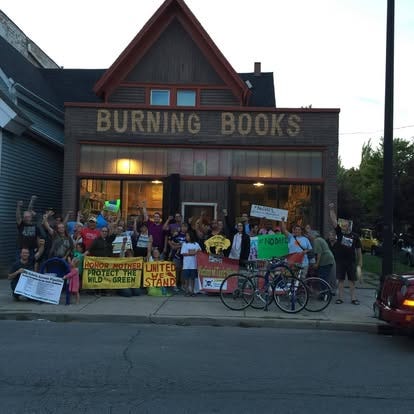
Buckley then began fighting for FBI records that would shed light on the FBI’s activities, a fight that lasted for three years and resulted in almost no information from the FBI. According to the brief filed on Buckley’s behalf at the U.S. Supreme Court by his lawyer Michael Kuzma and a legal clinic at Stanford Law School, the FBI provided only three full pages of information. The other 55 pages that the FBI provided “were either heavily redacted (some to the point where only one word on the page was visible) or withheld altogether.,” according to the brief.
The FBI had appended a form letter that cited a key exemption to disclosure, Exemption 7 of the federal Freedom of Information Act, which covers “records or information compiled for law enforcement purposes,” but also has several caveats which you can read here.
Most states have a similar exemption in their own public records laws. But Buckley believed that the goal of the FBI was part of an effort to intimidate him because he was a well-known and outspoken local activist concerned about climate change, racial inequities, environmental issues, and hunger, among many other issues. Buckley’s lawyers asked the high court to decide this question: does Exemption 7 allow law enforcement agencies to withhold all records or information compiled by a law enforcement agency, if some of them were not compiled for law enforcement purposes?
The Supreme Court on June 29 decided it did not want to answer that question. Without comment, the high court turned down Buckley’s request for review of his case. That happens to the vast majority of cases that come before the Supreme Court from people seeking a real hearing – oral argument and a formal decision. But Buckley’s case was not a typical candidate for a deeper look by the Supreme Court. That is because there is a difference of opinion in the lower federal appellate courts about the very issue of the purpose a law enforcement agency is gathering information. And that is a circumstances that often will pique the Supreme Court’s interest and lead the nine justices to accept a case for a deeper look.
Buckley argued that the FBI did not establish that the records he was seeking were “compiled for law enforcement purposes. He asserted that the records that the FBI was withholding were compiled as part of a campaign to intimidate him so he would scale back his political activity.
Buckley, along with bookstore co-owners Pickering and Pickering’s wife Teresa, had sponsored many events and speakers at their Burning Books bookstore about controversial topics. The FBI surveillance, he said, was a violation of his First Amendment rights to free speech and assembly.
“It was a lot of harassment and stuff like that, “ Buckley told me recently as we were discussing his case and its significance for people trying to get law enforcement records from federal, state and local governments. He pointed out that his activities, which included organizing talks at the bookstore, protesting war, and urging improvement in the environment, were done out in the open. Same for his colleagues and co-owners. “If you want to be an ecoterrorism cell, why would you be doing this out in the open?” Buckley asked during our conversation.
The FBI had received information from two women who knew Buckley and Pickering, and had openly talked about how they were working with the FBI, Buckley said. The FBI investigated claims that there was an eco-terrorism cell operating in or around the bookstore and stepped past the notion that these gatherings were people exercising First Amendment rights to freely express and discuss various issues.
His appeal asked that the FBI be required to provide more of the documents without so much blacked out. Buckley believes the information behind those blacked out sentences would show that at least some of the information the FBI was compiling was not for law enforcement purposes. That view was rejected by a trial court, and the case wound up at the U.S. Court of Appeals for the Second Circuit in New York, which takes cases from lower federal courts in Connecticut, New York and Vermont. That court said that when the federal Freedom of Information Act (FOIA) says law enforcement materials can be held back from the public, it is because “compiled for law enforcement purposes,” can actually mean compiled by law enforcement agencies.
Four other federal circuit courts in the First, Sixth, Eight and Tenth Circuits agree with that interpretation. But three others do not, including the all important D.C. Circuit where most FOIA cases end up. The D.C. Circuit has said that “FBI records are not law enforcement records simply by virtue of the function that the FBI serves,” and instead the FBI must supply more information to a court so that the court could identify a law enforcement purpose in withheld documents. That view is also held by the Third Circuit, which covers Delaware, New Jersey, Pennsylvania, and the Virgin Islands, and the Ninth Circuit, which covers a large swath of California, and Alaska, Arizona, Guam, Hawaii, Idaho, Montana, Nevada, Oregon, parts of Washington, and the North Mariana Islands.
“FOIA requests have uncovered records regarding the FBI spying on peaceful civil-service organizations, ATF surveilling Second Amendment advocates, and DHS monitoring journalists—records that have led to congressional inquiries and internal investigations Under the per se rule, the agencies would be free to refuse to release documents about any of those incidents,” Buckley’s plea for Supreme Court review said.
The Department of Justice, which opposed Buckley’s request for more information, argued that the documents Buckley sought were created “for law enforcement purposes.” The brief noted that “ ‘…an agency record created within an investigation into potential crimes is a record compiled for “law enforcement purposes,” even if it is also created for other purposes.”
The libertarian leaning Cato Institute filed a friend-of-the-court brief at the Supreme Court siding with Buckley.
“Permitting government misdeeds to be shielded from the public based on a broad and atextual reading of Exemption 7 turns the statute on its head. If a law enforcement agency is using the government’s resources and authority for improper purposes, the public is entitled to know. Likewise, the threat that governmental abuses will be made public if they occur can head off any temptation to improperly exercise executive power. At bottom, public access to information about potential abuses of power is an essential tool to stymie those abuses,” the Cato brief said.
For now, the split view among federal circuit courts remains unresolved. So if you are seeking FBI records or other law enforcement records that you think were compiled for something other than a legitimate law enforcement purpose, your best bet is to file in the trial court in the District of Columbia or somewhere in the Ninth Circuit, where the judges will at least ask the law enforcement agency to give some details for withholding documents it says were compiled for law enforcement purposes.
Buckley, of course, was disappointed that the Supreme Court refused to hear his case. But he said there was some cause for hope about others’ interest in unmasking what he called “the government surveillance state.” The Stanford Law School litigation clinic had reached out to help him at the Supreme Court. Maybe the case will prompt others to take an interest in ensuring that the government is working for the people, not against them.
If you want to read more about government secrecy and the harm it does to democracy and your community, you can order my book Backroom Deals in Our Backyards: How Government Secrecy Harms Our Communities and the Local Heroes Fighting Back from my publisher https://thenewpress.org/books/backroom-deals-in-our-backyards/ Use discount code backroom30
Thanks for reading Backroom Deals Miranda Spivack! This post is public so feel free to share it.
No posts
Comments
Nothing yet. Say the first thing.
Sign in to join the conversation.