

If you enjoy my writing and are inclined to do so, please buy me a coffee, or:
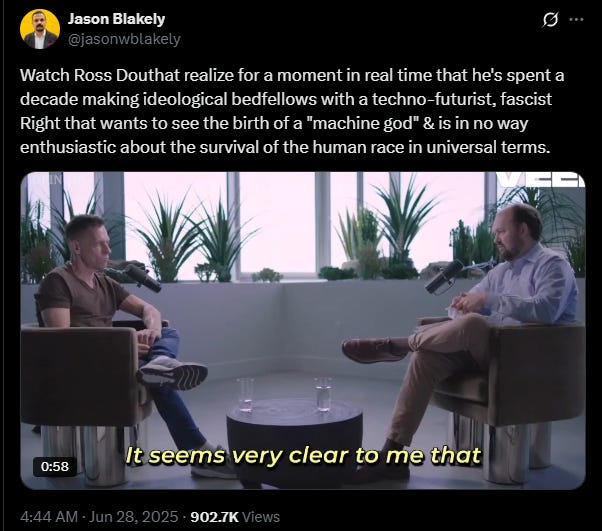
Just as many in my X feed were blowing up over the interview between Thiel and Douthat, in which Thiel apparently can’t decide whether he wants humanity to survive and appears to want to radically transform humanity—body, heart, and soul—by merging us with his dystopian technology, I was caught up in my own short interaction of a similar kind.
The person I was talking to (on X) was Hunter Ash, a somewhat controversial detransitioner who now leans heavily into hereditarianism, transhumanism, and tech futurism. He is, essentially, a right wing progressive and thus equally as delusional and radical (maybe more so?) as any other kind of progressive.
Bear with me as I walk through our brief conversation, I promise you, it’s “interesting”.
To start us off, he tweeted that he completely agrees with Thiel:
“Of course we want to improve ourselves. Of course we want to achieve mastery over our flesh. Of course we want to advance so far that one day we might not be recognizable as human.
It was that last bit that caught my eye. Why must we so surely want to “no longer be recognizable as human”?
I asked, as politely as possible, whether the same psychological dysfunction that once drove him to want to change sex and no longer be recognizable as his own natural human sex might be the same dysfunction driving his desire to transform and mutate humanity in general:
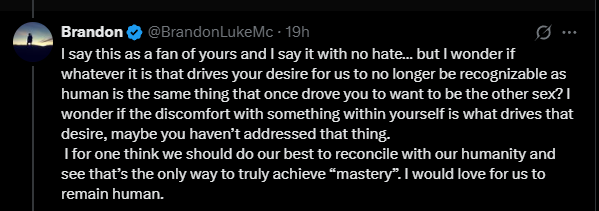
Because Ash is a good dude, open to debate, he took the question well, but in my view, basically affirmed my point:
That’s a fair question, but I don’t think this belief of mine relates to that specifically. I think I have strong reasons for supporting transhumanism that I can defend, but if we want to psychologize it I think “having an alien psychology” and “not wanting to feel trapped” are better candidates. I don’t like or relate most people, and I want to be free of their constraints
He admits that yes, he experiences some sort of psychological distress in relation to his own and everyone else’s humanity. He feels “alien” and “trapped” and that he wants to free us from the “constraints” of our humanity.
In response, I pointed out to him that:
“In the same way that progressives want to “free us from the constraints” of biological sex—or stigma, or standards of conduct that maintain society—in order to benefit a small minority of dysfunctional people at the expense of the majority who benefit from those constraints, I think trans-humanists like yourself do the same thing.
Your desire to free yourself of natural human constraints that you personally find aversive (and again, I still maintain that the desire appears to be essentially the same as your desire to change sex), will only serve the small number of others like yourself, but will radically harm and undermine most healthy and functional humans.”
I assert here that he is doing exactly what the trans activists do, in attempting to deconstruct norms and concepts and constraints by which billions of people are well-served, in order to ease his own and his kind’s (who are like 0.1% of the population) pathological discomfort with their own humanity. I argued that this is exactly what progressivism does in my review of Mary Harington’s book:
Progressives, in their blind utopian desire for deconstruction and deregulation (strangely only of Western culture, though), breach every fortress our culture has built around the vital protective cultural norms that got us here. They do so in order to “liberate” the tiny portion of people who are “marginalized” by those norms, but they do so, also, at the cost of widening a breach through which the ravenous forces of marketisation and bureaucratisation [and big tech] can swarm and swallow up the now defenseless majorities who once relied on those cultural norms and methods of meaning-making.
In response to my tweet, he takes a somewhat fantastical turn, saying that his transhumanist desire is not rooted in his own discomfort with his humanity/biology, and he asks me whether I think that “the future of intelligence in the universe is bipedal apes?”

I tried one more time to point out the connection between his transhumanism and his transsexualism:
To me it seems like you’ve simply shifted the discomfort with (and desire to change) your human body, to a discomfort with (and desire to change) all of humanity, based on your sense of being “alien” and “trapped”. The same psychology underlies it, you just shifted it slightly.
And I follow up by saying that yes, the future of intelligence is still likely us “apes”:
Yes, I think the transhumanist agenda won’t change that. All that will change is that intelligence in the universe will be a bunch of tech/AI-augmented bipedal ape technocrats who rule over a bunch of tech-augmented bipedal ape serfs whose bargaining power and independence has been undermined by technology, and who have been entirely alienated from their own humanity, living in artificial environments and engaging with technology that doesn’t suit their psychology. We see it happening now.
Again, this echoes what Mary Harrington argued in her book, and what I wrote about it in my review:
Time and again, with insight and clarity, Harrington (who isn’t conservative and doesn’t argue that we should be blindly traditionalistic) shows how “the universal solvents of freedom and equality [and technology] can only do their work by liberating us from ‘embedded’ life in a web of given social relations”. It is one’s embeddedness in these social relations, maintained by codes, concepts, norms, and regulations, and lifestyles which provide most of the meaning, joy, and purpose to human life. And it is these which are breeched by the progressive forlorn hopes, thereby leaving us open to the shock troops of the market and bureaucracy to flood in and capitalize on and regulate our humanity.
They “prise [us] free from [our] web of social relations" and “reframe “embodied nature as a series of supply and demand problems”, promising utopia “while delivering yet another carcass for the market [and the state] to pick over”. Thus, leftist progressives are the accidental cheerleaders of everything they claim to be against.
This same argument can be made against not only social progressivism, but technological progressivism.
At this point Ash completes his turn into the fantastical and begins to sound like a schizophrenic patient, or a science fiction fan who took 4 grams of shrooms two hours ago:
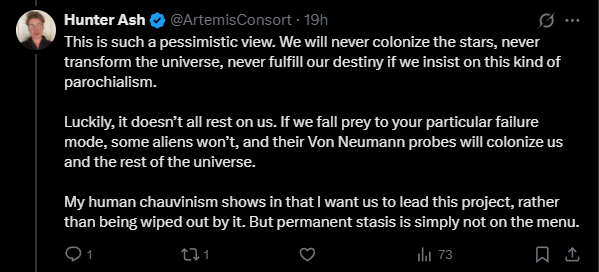
He asserts with absolute certainty that it is our ‘destiny” to colonize the stars and transform the universe (whatever that means).
Unbelievably, he then says that if we don’t, an alien empire will do it first, and an army of von Neumann probes will wipe us out.
I respond by asking how he knows that it’s our destiny to do this universe stuff. Based on what?
It seems much more reasonable to focus on the flourishing of humans, in our natural environment for which we physically and psychologically adapted (or for which we were designed—there’s not much difference in consequence). The tech augmented world does not appear to bring human flourishing, aside from the few truly consequential medical advancements.
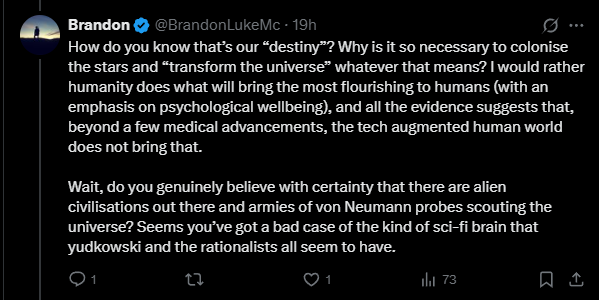
I asked, incredulously, if he genuinely believes he exists in a race against time with some alien empire and their self-replicating probes, to colonize the stars.
In response, he only gets more delirious, pivoting to a concern about the sun’s (and thus Earth’s) inevitable destruction:
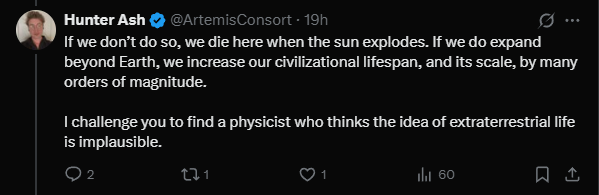
I respond, again, incredulously:
When the sun explodes in like 50 million years or something? What a weird thing to prioritize and base your worldview on, as opposed to a more realistic focus on the wellbeing of the next immediate generations of humans. We don’t need to rush some accelerationist program to address a threat so far off. What a weird way to think!
By the way, I looked it up, the sun won’t meaningfully explode for literally billions of years.
These people’s whole political/ideological project is based on prioritizing threats literally billions of years in the future, at the expense of real flesh and blood humans, and the next few generations.
It’s the thinking of a schizophrenic—preoccupied with some existential science fiction threat, worry about self replicating probes and the sun’s death. What are we doing here? They’ve spent too much time watching sci-fi and marvel movies.
He then simply replies:
Sorry for having vision
To which I reply:
That’s not vision, that’s fantasy. That’s millions of years away. That’s borderline schizo level of thinking, to base your present choices on so abstract a threat.
If, as Brackish Waters, Barren Soil says, rationalists have “spreadsheet brain”, then these tech accelerationists have sci-fi brain. They sound like apocalyptic cultists, or scientologists, who believe the end of the world is imminent and that in order to defeat the aliens we must all renounce our humanity and merge with machines and escape with Xenu into the stars.
But it’s all rooted in their own psychopathology. They’re people with a suite of pathologies, who can’t relate to themselves or to other humans in a normal way. And they’re the ones leading us down this path towards a dehumanized world of technology and pathology. All the evidence points to technology (again, apart from a few medical breakthroughs) largely just making us sadder, lonelier, crazier, dumber, more disembodied and alienated.
I think Ash perfectly embodies the overlap between the left and right wing progressives, their shared core. He was once trans; now he’s a transhumanist. His underlying thinking and psychopathology has not meaningfully changed. All progressives have a shared core ideology.
Edit: Just thought I’d add here, as another example of the pathology of these “progressive” people. Deep Left Analysis’ misanthropic take on the potential death of humanity:
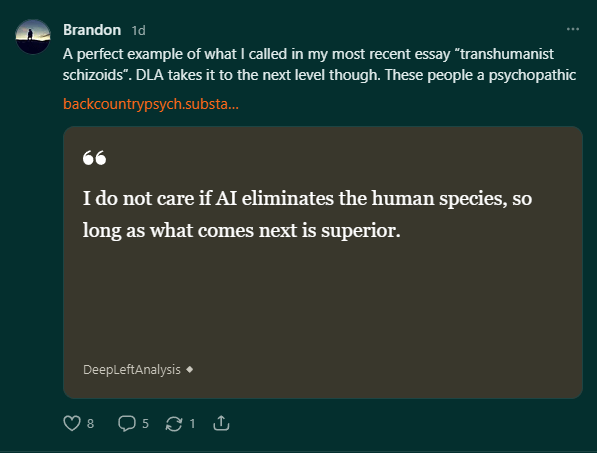
I for one think that our development of technology should be measured, should be conscious, should be patient, should only be pursued where it will actually serve humanity and our wellbeing, not based on the fantasies of the minority of mentally unwell people and the billionaires. No amount of technological augmentation will fix what ails them.
Colonizing the starts and divesting ourselves of our humanity won’t lead to human flourishing. Humans evolved (or were designed, if you wish) to live in certain kinds of environments, with embodied connections and symbiotic relationships with those environments, with certain people around us to which we also have close ties, completing tasks which have direct feedback on our evolved biology and neurology.
We were never meant to colonize the stars. We are meant to simply sit on a hillside or river bank, with loved ones around us. To look up and marvel at them from down here, at home.

Thanks for reading Backcountry Psychology! Subscribe for free to receive new posts and support my work.
If you enjoy my writing and are inclined to do so, please consider giving me a tip! Or at the very least, please like and restack this post.
Thanks!
No posts
Comments
Nothing yet. Say the first thing.
Sign in to join the conversation.