
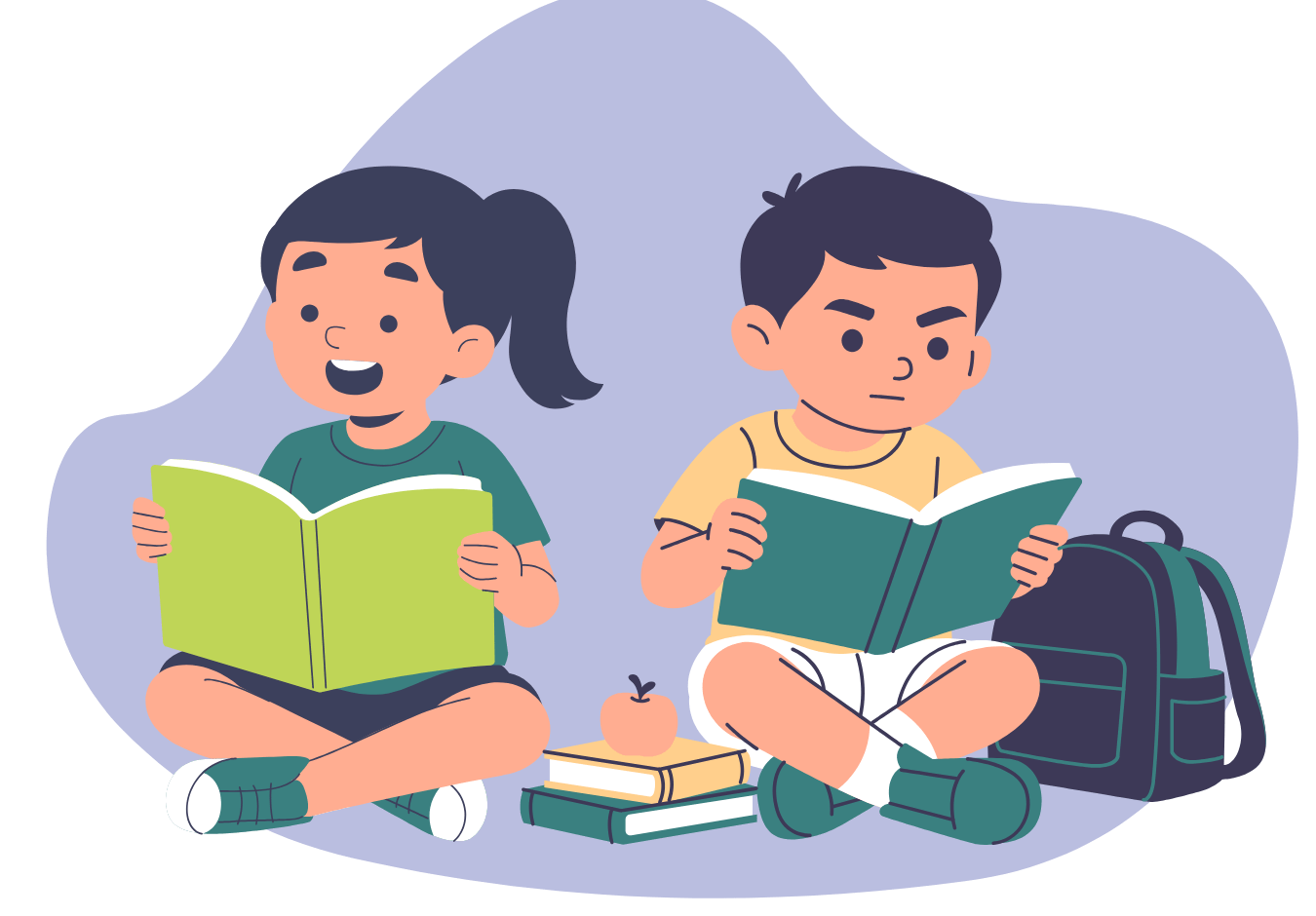
There has been a lot of hand-wringing lately about why boys do not read, or keep reading, as readily as girls do. Some of that concern is fair. Too much of it, though, slides quickly into gender essentialism. The argument goes something like this. Boys’ brains are different, boys cannot handle the same kinds of books, boys need pictures and comics because prose asks too much of them. Then that argument gets folded into larger anxieties about boys’ academic struggles and men’s outcomes, until a real literacy problem becomes a story about biology instead of access, expectations, and the books available to them.
Graphic novels and comics are wonderful. But treating them as the only reasonable destination for boys is not generosity. It is a failure of imagination.
As a children’s librarian, I have another theory about why boys stop reading.
Middle-grade chapter books have failed them.
I am in and out of enough elementary school classrooms to say this confidently: in the early grades, the reluctant-reader-versus-confident-reader divide seems to be distributed fairly evenly across gender. There are little boys who love books and little girls who avoid them. There are little girls who tear through chapter books and little boys who do the same. But sometime around fourth grade, or around age ten, something begins to shift.
That is when boys start raising their hands during my Summer Reading Challenge stump speech to announce, “But I hate reading everything.”
So why does this become a gendered problem?
Because, for better or worse, there is a far stronger selection of early chapter books and middle-grade books featuring female protagonists and girlhood concerns. I can point excited young female readers toward historical fiction, fantasy, contemporary realism, friendship stories, family stories, and school stories without breaking a sweat.
But if a fifth-grade boy comes to me and says he wants a story about “a boy like me on a basketball team or something,” I become hard-pressed to find him the kind of book he is asking for. Maybe I can find a book with a 2003 copyright date that feels like the ancient past to him. Maybe I can find one book that matches his description. But when he finishes that one, I struggle to hand him another.
For better or worse, the contemporary fictional boys middle-grade readers know best answer to the names Big Nate and, famously wimpy kid, Greg Heffley.
These boys are in middle school. They have phones. They play video games. Their plots revolve around friendship, school, sports, siblings, parents, and everyday social disaster. They are easy to recognize. Their problems feel familiar. Many boys, including reluctant readers, gobble these series up.
A recent Guardian article reported on a study of UK and Irish schoolchildren that found boys ages 11 to 14 were overwhelmingly clustered around Diary of a Wimpy Kid, while girls the same age were reading across a wider range of authors and genres. The point is not that Diary of a Wimpy Kid is bad. Quite the opposite. Those books are funny, accessible, recognizable, and beloved for a reason.
If a child is reading Wimpy Kid, wonderful. Let him read it. Let him laugh. Let him finish books. Let him feel like a reader.
The problem is not the book he loves. The problem is what happens next. Where does the eleven-year-old boy go when he still wants humor, school, friendship, family chaos, and everyday problems, but he is aging out of the series that made him feel successful?

Too often, the answer seems to be that he has nowhere obvious to go.
Or rather, the shelf offers him several options that may not fit.
He can go to fantasy. He can go to mythology. He can go to dystopia. He can go to a very serious realistic book about trauma, grief, bullying, injustice, or identity. He can go backward to books written for younger children. Or he can be handed “tried and true” realistic fiction that adults remember fondly, but that now feels increasingly like historical fiction to a contemporary child.
Fantasy has dominated middle grade for good reasons. Children love magic. They love quests. They love monsters, powers, secrets, prophecies, and impossible worlds. I am not interested in scolding children for loving those things.
But fantasy is not universally inviting.
Fantasy often asks the reader to learn a new world before the story can fully begin. There may be invented words, maps, magical rules, political systems, family histories, prophecies, pantheons of gods, monsters, portals, and lore. For a confident reader, this can be thrilling. For a reluctant reader, it can be a wall.
Some children do not want a new world. Some children want their world.
They want annoying siblings, weird neighbors, group projects, sports practices, friendship fights, class pets, talent shows, bad haircuts, crushes, summer boredom, family vacations, and the particular horror of realizing everyone at school saw the thing you wish they had not seen.
That is not small. That is childhood.
And childhood is dramatic enough.
So here comes the obvious question. What happened to realistic contemporary books about boyhood?
In my opinion, the publishing world has pushed these books aside, creating a self-fulfilling prophecy it may not even recognize as its own.
Publishers Weekly reported in 2022 that concern erupted after authors heard Barnes & Noble would initially stock fewer new middle-grade hardcovers, with shelf space concentrated around expected bestsellers. Barnes & Noble denied a simple “proven authors only” policy, but acknowledged a broader shift toward more selective buying.
That matters because the shelf is not neutral.
When the middle-grade market softens, retailers become more cautious. When retailers become more cautious, shelf space goes to safer names. When shelf space goes to safer names, new books have a harder time becoming known.
And when new books have a harder time becoming known, the market mistakes invisibility for lack of demand.
A funny, realistic, contemporary novel for boys may never get the chance to find the child who would love it. Parents do not buy the book because they do not see it. Children do not ask for it because they do not know it exists. The book does not sell, so fewer books like it are acquired. Fewer are acquired, so fewer are stocked. Fewer are stocked, so fewer children find them.
Then adults look at the empty space where those readers should be and wonder why they stopped reading.
The danger is not that children love bestselling graphic novels too much. The danger is that too many children finish the books they love and then cannot find the next thing that feels possible or interesting to them.
Graphic novels’ greatest strength is that they give many children stories they want in a format they can access. They are not lesser books. They are not fake reading. They are not literary vegetables covered in cheese so children will swallow them. They are books. Often very good books.
But graphic novels should not have to carry the entire burden of contemporary childhood.
There should also be prose books waiting nearby. Funny ones. Fast ones. Illustrated ones. Short ones. Longer ones. Books that let a child move from Wimpy Kid to something slightly older without feeling like he has been shoved off a cliff.
This is where the ladder breaks for many boys.
We have early chapter books. We have heavily illustrated series. We have graphic novels. We have fantasy epics. We have older classics. We have serious award contenders.
But where is the abundant, current, funny, realistic prose fiction for the ten-, eleven-, and twelve-year-old boy who wants to read about a kid like himself?
Where is the next rung?
Adults love to say children need to move on. But move on to what?
If a boy has spent years reading funny illustrated books about school, family, and friendship, what do we hand him next? A wizard? A chosen one? A demigod? A dystopian government? Another book published two decades ago where the emotional themes may still be true, but the social world feels increasingly foreign?
This is where the “tried and true” realistic books become complicated.
Adults often use the word timeless when we talk about books we loved as children. Sometimes we are right. Some books really do hold up beautifully. But children are not reading our nostalgia. They are reading the book in front of them.
They notice when no one has a phone. They notice when the slang feels wrong and no one they know speaks that way. They notice when the school culture does not match theirs. They notice when the parents behave differently, when the neighborhood freedom feels unfamiliar, when the pacing feels old, when the humor belongs to another generation.
A realistic book can have timeless emotional truth and still feel dated. At a certain point, contemporary realism becomes accidental historical fiction.
That does not make those books bad. It does mean they may no longer function the way adults think they function. A book that felt like a mirror in 1998 may feel like a window now. That is not a failure of the book. Time moves. Childhood changes on the surface, even when the deep feelings remain.
Children still want independence. They still feel shame. They still fight with friends. They still worry about belonging. They still want to be brave. They still want to be seen.
But the conditions around childhood change.
Technology changes. Parenting norms change. School culture changes. Humor changes. The amount of freedom children have changes. The way children communicate changes. The way they experience embarrassment changes. The way they are watched, scheduled, protected, and exposed to danger changes.
If realistic fiction does not keep renewing itself, the realistic shelf starts to tell children that ordinary childhood stopped being interesting twenty years ago.
That is a terrible message.
It is especially terrible for boys, because boys already receive so many subtle messages that reading is not really for them.
Despite the best efforts of many teachers, caregivers, librarians, and parents, the cultural message many adolescent boys receive is that quiet or academic activities are somehow suspect. Reading is treated as feminine. Studiousness is treated as uncool. Sitting still with a book becomes the opposite of whatever performance of toughness, confidence, or “alpha” masculinity a YouTuber told them they are supposed to inhabit.
That cultural message, coupled with the missing middle-grade books we so desperately need, creates a slippery slope.
It leads boys to publicly declare that they hate reading everything. That they do not like books. That reading is for younger children who still like pictures. And sometimes that is because the last book they remember loving was illustrated, funny, familiar, and possible.
So my plea is simple: we need to start writing, publishing, buying, reviewing, shelving, and recommending more books about ordinary contemporary boyhood.
Give me basketball practice. Give me the weird group chat. Give me the disastrous sleepover. I want books that include the embarrassing school assembly, the brother who will not leave you alone, the friend who suddenly starts acting differently, the teacher who sees too much, the dad who tries too hard, the mom who says no, the classmate who somehow becomes your friend.
And most of all I want the story of the ordinary day that turns into a story.
We need books for the boys who are not waiting for an owl from Hogwarts. We need books for the children who do not want Camp Half-Blood. We need books for the reader standing in the middle-grade section, not refusing to read, but waiting for the shelf to offer him a place to go.
Middle grade is not dead. But the realistic middle has gone thin.
And if we want boys to keep reading, we have to stop acting surprised when they stall at the last books that made them laugh, made them confident, and made them feel invited.
The next rung on the reading ladder has to be there.
Right now, too often, it is missing.
Want me to critique your book? Become a founding member. Founding members will receive a 60-minute video critique call for their manuscript, illustrations, or book dummy.
Sources & Further Reading
“Teenage boys in UK ‘stuck’ reading primary-level books while girls’ tastes expand” — The Guardian
“Teenage reading: (Re)framing the challenge” — National Literacy Trust
“Children and young people’s reading in 2026” — National Literacy Trust
“Daunt Addresses Furor over Middle Grade Fiction Buying Policy” — Publishers Weekly
“Turning the Tide on Middle Grade Books” — Publishers Weekly
Comments
Nothing yet. Say the first thing.
Sign in to join the conversation.