
If you are a reader and consider yourself an expert in the world of books, you are probably well aware of the trend cycle of publishing. Every year, there are a handful of books declared superior in every way to all other books ever printed, and you must preorder that book now. Enough people usually listen to generate the traction these books need to become bestsellers and inspire gushing online discussion and adoration.
Then, as predictably as the first wave of praise, comes the backlash. Sometimes it’s as simple as, “I hated this book. Who is with me?” Sometimes it’s more extreme. Quotes get taken out of context. Fictional narrative arcs are extrapolated to their most terrifying possible conclusions, and then the book is condemned for promoting something it never actually spoke on. And sometimes, of course, the criticism is well deserved.
For all of the above reasons, I usually wait at least a few months after publication to read heavily discussed books. I don’t like reading a book publicly and having someone run up to me with the hot take they just heard on TikTok. I like being able to approach a book at face value and make up my own mind from there.
And ever so often, a book makes that waiting period feel especially wise.
Mac Barnett is a New York Times bestselling picture-book author and the Library of Congress’s ninth National Ambassador for Young People’s Literature. I doubt he needs much further introduction, because many of you probably already subscribe to Looking at Picture Books, the Substack he shares with Jon Klassen. If you still can’t quite place him, he wrote Sam and Dave Dig a Hole, Triangle, and A Polar Bear in the Snow, among many, many other fabulous books.
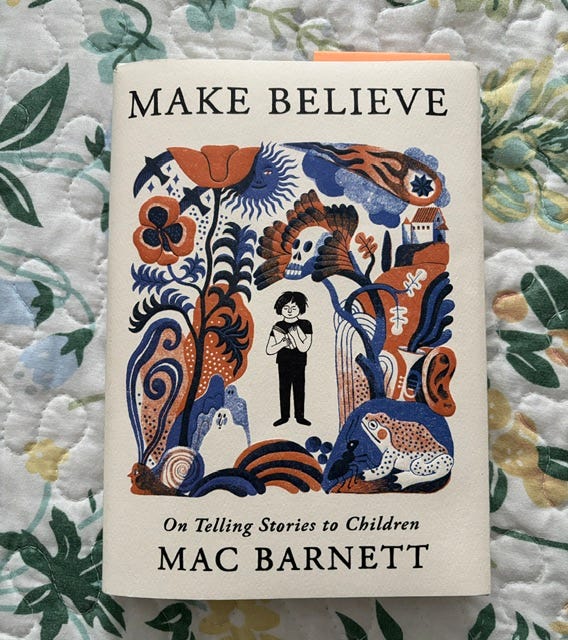
In May of this year, he also published his first book for adults, Make Believe. According to the cover’s tagline, it is a book about “telling stories to children.”
I had been aware of Make Believe well before it was published. Plenty of people were eager to read it, and there was particular excitement among writers and illustrators who hoped Barnett might finally reveal some elusive “secret” to writing a bestselling book for children.
But almost as soon as the book entered the world, the conversation became less about what Barnett had to say and more about whether he had transgressed so terribly that he needed to step down as National Ambassador for Young People’s Literature and spend the rest of his life on an apology tour to every other children’s author.
Within weeks, Make Believe had acquired exactly the sort of discourse that usually makes me put a new release back on the shelf for a while: enthusiastic praise, sharp criticism, arguments revolving around a single quote, and increasingly expansive claims about what Barnett was, or was not, actually saying.
So I waited and did my best to ignore the conversation until things got quiet again.
After finally reading Make Believe, I am happy to report that, in many ways, it is a very good book. If you love giving books to children, spend part of your day reading to children, or ever plan to write or illustrate for them, I think you should read it. My first instinct when I finished was to flip back to page one and start again.
I agree with so much of this book. (Is it too soon to joke that I agree with 94.7 percent of it?)
Which is precisely why I find myself in the strange position of also saying that there were nuggets of wisdom buried inside some of the criticism. I can see how some readers arrived at their objections in completely good faith. At the same time, people whose opinions I respect have wholeheartedly declared this one of the best books they have ever read.
I don’t think either reaction requires the other to be wrong.
What I want to add to the conversation around Make Believe is a little nuance, because nuance is exactly what this book, and the discussion surrounding it, needs.
I could never hate a book that says, “Children’s books are real books; kids are ideal readers, especially of literary fiction.” That sentence left me grinning from ear to ear with genuine glee.
Unfortunately, brilliant passages like that sometimes share space with boneheaded ones like this: “Our expectations—and our esteem—are generally higher for the professionals who serve children.”
I’m sorry, but I know far too many people working professionally in early childhood care, schools, social services, and yes, even medicine who would very much like a word.
This became my central frustration with Make Believe. I could go page after page practically shouting, “Yes! Finally, someone is saying it!” only to encounter a sentence so poorly conceived or underexamined that I struggled to understand how it survived the editing process.
The most notorious example, if you managed to miss the discourse, is this:
“But I have a nagging fear that children’s literature suffers from a slightly higher crud percentage than literature as a whole. So I now offer Barnett’s addendum to Sturgeon’s Law: Maybe more like 94.7 percent of kids’ books are crud.”
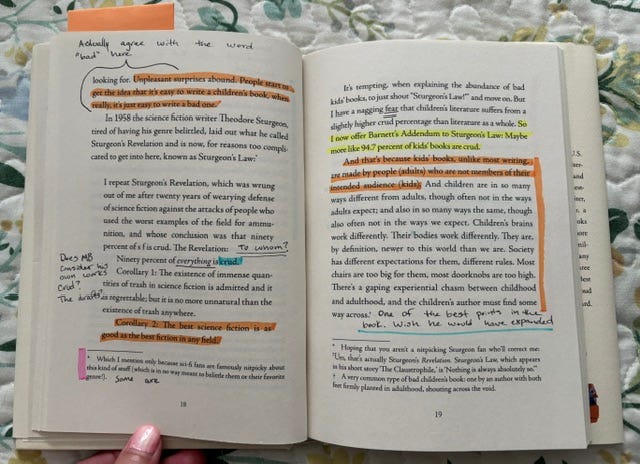
This is the sentence that upset many authors and illustrators. I don’t blame them.
And contrary to one common defense of Barnett, I don’t think the larger context magically transforms the sentence into something else. He called an enormous percentage of children’s books crud. There is no clever bit of close reading that makes those words disappear.
But this is where I want to depart from much of the criticism.
The interesting question to me isn’t whether the correct percentage of crud is 90 percent, 94.7 percent, 70 percent, or 12.3 percent. I have no desire to map bad children’s books onto a corkboard and start connecting them with red yarn.
My question is much simpler. How did this sentence make it into the finished book?
Because Make Believe contains beautiful sections, ideas, and observations. I genuinely believe I will be a better librarian for having read it. There are many people to whom I would enthusiastically recommend it.
But it is not an infallible book, and some of its weaknesses are significant.
The first is simply that Make Believe is extraordinarily short.
The physical book itself is unusually small for adult nonfiction, measuring roughly 7.4 by 5.25 inches, and it runs only about ninety pages. Perhaps the dimensions are an intentional nod to children’s books. Perhaps they simply make an extremely short manuscript feel more substantial as a physical object. Either way, this is a slight book.
Barnett is also very fond of footnotes. Sometimes those footnotes are fascinating and genuinely enrich the text. Other times, I found myself wondering why, exactly, I was reading an aside about how he learned to tie his shoes. Long footnotes appear on page after page, eventually giving the book a faint whiff of a college paper whose author has discovered several creative strategies for reaching the required page count.
By my rough estimation, the main text is comfortably under twenty thousand words.
The problem is not that short books are inherently bad. Some ideas need twenty thousand words. Some need two hundred thousand. The problem is that several of Barnett’s ideas clearly needed more room than he gave them.
Expanding Make Believe could have forced him to think through some of his arguments more carefully: to establish a thesis, define his terms, anticipate objections, and follow ideas to their logical conclusions instead of dropping something as provocative as “94.7 percent of kids’ books are crud” and then blithely wandering into an allegory about children’s books published in a fictional dystopia.
And this is where I begin to wonder whether Make Believe suffered from a problem that can occasionally follow very successful people into the publishing process:
Did anyone feel empowered to tell Mac Barnett that Mac Barnett might be wrong?
I obviously wasn’t in the editorial meetings. I don’t know what was suggested, challenged, cut, added, or argued over. But the finished book often reads like a manuscript that could have benefited enormously from someone saying, “Wait. Explain this. Do you actually mean that? How does this fit with what you said ten pages ago?”
Because the lack of development doesn’t just produce the occasional spectacularly ill-considered sentence.
It leads directly into the other two problems I kept encountering throughout the book. Barnett contradicts himself with surprising frequency, and, perhaps more importantly, I am still not entirely sure who Make Believe thinks it is talking to.
Nowhere is that lack of interrogation more apparent than when Barnett begins talking about children themselves. Again and again, Make Believe insists (correctly, I think) that children are full human beings with individual tastes, inner lives, and meaningful relationships to art. But Barnett does not always seem willing to follow that idea all the way through. He grants children the complexity of genuine readers, then occasionally talks about the books written for them as though their value can be sorted into a remarkably simple binary: good art or crud.
Barnett repeatedly asserts that children’s books are a genuine form of art and literature. I agree. More people need to hear it. But if children’s literature is art, then children must also be allowed to encounter it as individuals. With different tastes, preferences, attachments, aversions, and ideas about what is meaningful.
There are books that hold one child completely spellbound and cause another to dissolve into frustration. There are illustrators some children faithfully follow from project to project, while another child will reject the same art style on sight.
Barnett himself writes, “Kids are human beings right now, with rich interior lives. They deserve entertaining stories and meaningful art.”
Again, I agree wholeheartedly.
But surely part of acknowledging those rich interior lives is recognizing that what one child finds meaningful may leave another completely cold. And yet, a mere eight pages later, Barnett is willing to label the overwhelming majority of the art created for those children “crud.”
That poorly conceived binary takes us to some strange places.
I once had a little girl burst into wailing sobs and scream, “I hate that book!” when I happily presented Sam and Dave Dig a Hole at storytime.
So, is Sam and Dave Dig a Hole now crud?
She had, after all, just used her rich interior life to declare a preference.
The obvious answer is no. Sam and Dave Dig a Hole is a good book. It was simply not a good book for her.
Every child has books they adore and books they dislike. They interact with books and art much the same way adults do: “I like this one.” “I don’t like that one.” “That’s my brother’s favorite, but please do not make me hear it again.”
That doesn’t mean there are no standards of craft or quality. Of course there are. But sweeping almost all of children’s literature into one enormous bucket labeled “crud” sits strangely beside Barnett’s insistence that children themselves deserve to be regarded as complex, discerning readers. If children are individuals, then the ways they encounter the art made for them will be individual too.
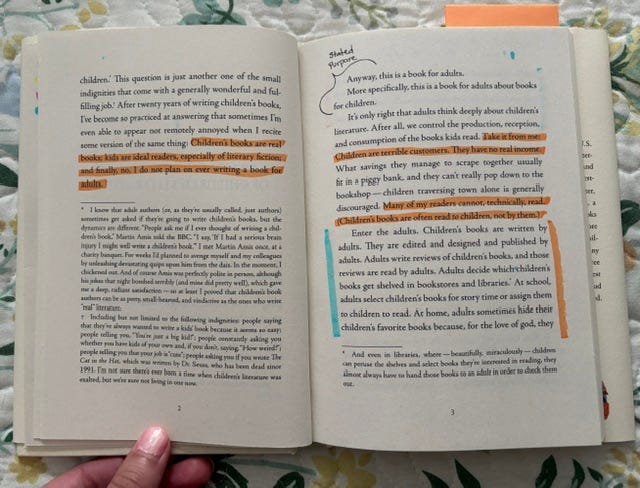
That uncertainty about how Barnett understands his readers leads to my final problem with Make Believe. I am still not entirely sure who this book is actually for.
Barnett has described it simply as a book “for adults,” but that raises more questions than it answers. Does he mean literally any adult who happens to pick it up? Adults who regularly interact with children and children’s literature? Librarians, teachers, parents, and booksellers? Adults who hope to write or illustrate for children? Or people who are already working professionally in children’s publishing?
Those are very different audiences, with very different levels of experience, knowledge, and investment in the subject. I also suspect this is one reason Make Believe has generated such dramatically different reactions.
I can easily imagine this book giving a general adult reader an entirely new framework for thinking about children’s literature. If you have always assumed that a “good” children’s book must teach a clear lesson, Barnett’s insistence that children deserve art, ambiguity, humor, beauty, and stories that exist simply because they are worth telling may be genuinely transformative.
But a conscientious children’s author or illustrator may experience the same book very differently. Someone who has spent years thinking seriously about children, craft, publishing, and the artistic value of their work may reasonably bristle when one of the most prominent figures in the field casually dismisses almost all children’s books as “crud.”
Neither response seems particularly mysterious to me.
The problem is that Make Believe rarely slows down long enough to acknowledge that it is speaking to readers who may be entering this conversation from radically different places. Barnett sometimes writes as though he is introducing a general adult audience to the idea that children’s books can be serious art. Elsewhere, he seems to be speaking from inside the professional world of children’s literature to people who already share his assumptions.
A longer, more focused book might have been able to do both. This one sometimes tries to speak to everyone and, in doing so, occasionally fails to speak clearly to anyone.
And yet, after all of this criticism, I still recommend Make Believe.
There is real wisdom in this little book. There are passages I expect to return to again and again, ideas that sharpened the way I think about children’s literature, and sentences that articulated things I have believed for years but never quite managed to put into words myself.
I meant it when I said I think I will be a better librarian for having read it. Its flaws are frustrating precisely because the best parts are so good.
I hope Make Believe is not the last time Mac Barnett writes for adults about children’s literature. In fact, I hope someday he comes back to the subject with a much longer book and a much narrower audience. I would love to read Barnett writing specifically for librarians, teachers, authors, illustrators, or anyone else who already accepts his central premise that children’s books are real books, children are real readers, and the art we create and choose for them matters.
Give him the space to define his terms. Make him defend the provocative claims. Let him contradict himself and then work his way out of the contradiction. Give an editor permission to ask, “Wait, do you really mean that?”
Because underneath the arguments about percentages and crud, Make Believe contains an idea worth fully embracing. Children deserve good art because children themselves deserve to be taken seriously.
On that, Mac Barnett and I agree completely.
Want me to critique your picture book? Become a founding member.
Important Note: Mac Barnett has apologized.
I ordered a copy of Make Believe in July and read it three times. It is a flawed text, but also a rich one. I will probably return to it again, and may even write more about it here.
On my third read-through, I annotated heavily because I still wasn’t entirely sure what my central criticism was. By the time I finished, the pattern of what was bothering me had become much clearer, and I was ready to begin writing.
The images included in this essay are photographs of my own annotations on selected pages of the book.
The argument, analysis, and writing are my own. This essay would not exist without the time I spent reading, annotating, drafting, revising, and developing my ideas.
No posts
Comments
Nothing yet. Say the first thing.
Sign in to join the conversation.