
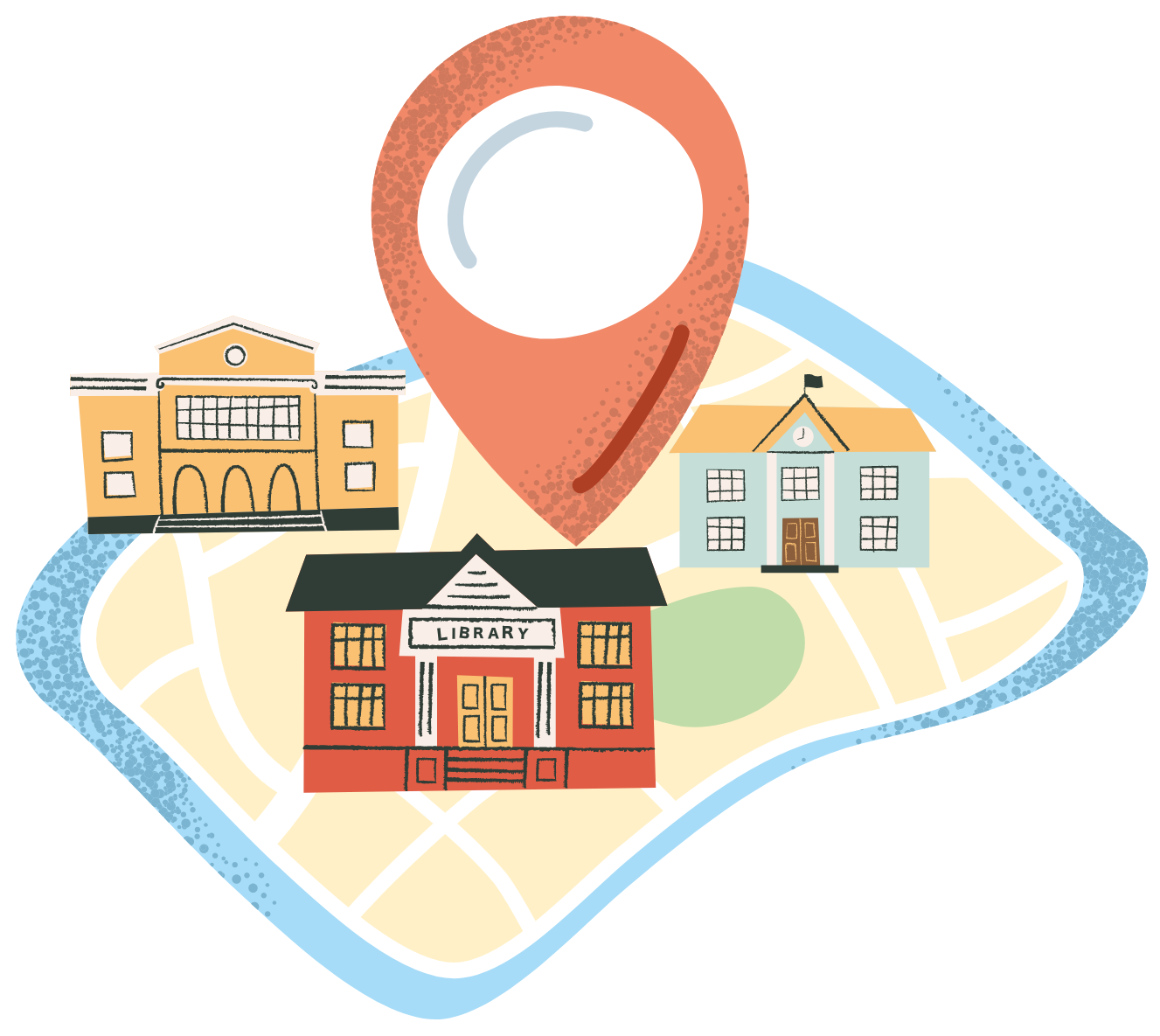
“I’m sorry, I just don’t understand, and this seems very odd…” The voice trails off on the other end of the phone before picking up again with something between urgency and annoyance. “It’s just that I have never had to pay for a library card before.”
This is a conversation I have dozens of times a week, and I suspect many of my fellow public librarians have some version of it with similar frequency.
There is, however, something genuinely lovely buried inside the frustration.
Public libraries are such a longstanding American institution that many people have come to regard access to one almost as a fact of civic life. You move to a new town, get a new driver’s license, figure out where the grocery store is, and somewhere along the way you walk into the local library and get a card. The assumption is that one will be waiting for you.
So when someone tells me that they have never had to pay for a library card before, I hear more than a complaint. I hear evidence of the goodwill public libraries still hold. This person has lived their life believing that wherever they went, there would be a library there for them.
That is a beautiful assumption.
It is also, financially speaking, an illusion.
A public library card may be free at the point of use, but a public library is not free. Someone paid for the building. Someone buys the books, maintains the databases, replaces the computers, pays the librarians, cleans the bathrooms, repairs the roof, and keeps the lights on.
Somewhere, somehow, money changes hands long before a patron receives a card for zero dollars.
Which raises a surprisingly complicated question: Who funds your public library?
Most people can probably answer, vaguely, taxes. But which taxes are we referring to? City taxes? County taxes? A dedicated property-tax levy? Does the library receive an appropriation from local government every year? Can its board levy taxes independently? Does the state contribute? Who controls the budget? Can citizens intervene in any way?
And what happens when you live just a few miles beyond the invisible line surrounding the people who paid for it?
That last question is often the real answer to the person on the telephone. Their old library may have been supported by a countywide tax. Their new library may be funded primarily by residents of one municipality. They have not suddenly encountered a library that decided arbitrarily to charge admission. They have crossed from one public-finance arrangement into another without ever knowing that such arrangements existed at all.
I knew, as a librarian, that funding structures differed from place to place. But I wanted to understand how different they were, so I set myself what initially seemed like a straightforward research project. I wanted to find out how public libraries are funded in all fifty states.
Almost immediately, the question fell apart.
There is no single “California model” or “Texas model.” States establish laws, permissions, restrictions, aid programs, and tax structures, but individual communities build libraries within those frameworks. One state can contain municipal libraries, county systems, independent library districts, nonprofit arrangements, and hybrids of several kinds.
Two libraries separated by a short drive can both have PUBLIC LIBRARY carved over their doors while answering to different governments and relying on completely different streams of money.
The more I looked, the less interesting my original question became.
The better question was: What kinds of public-library systems has America built?
To answer that, we first have to abandon the idea that anyone ever sat down and designed an American public-library system.
They didn’t. We inherited one. Or rather, we inherited thousands of them.
Long before public libraries existed in anything like their modern form, Americans already understood the obvious problem with books. They were useful, desirable, and very expensive.
Benjamin Franklin offers one of the clearest early examples.
In 1731, Franklin and members of the Junto, his Philadelphia discussion and mutual-improvement group, established the Library Company of Philadelphia. Instead of every member attempting to assemble a private collection, they pooled their money and built a much better one together.
It was enormously influential. It was also very definitely not free.
The Library Company was a subscription library. Members paid to belong and gained access to a collection none of them could easily have afforded alone.
But inside that arrangement was the seed of something larger. Access to books did not need to depend upon one person being wealthy enough to own them all.
The next question was how wide the circle could become.
Franklin himself helped complicate the wonderfully contentious question of which American library gets to call itself the first public one. After the Massachusetts town of Franklin was named for him, residents reportedly asked their namesake to donate a church bell. According to the town’s history, Franklin decided “sense” was preferable to “sound” and sent books instead. In 1790, the town voted to allow all residents to borrow them.
Franklin Public Library consequently claims the title of the first public library in the United States.
And I rather like that the claim comes with an asterisk.
The books began as a gift. The library was not yet the familiar tax-supported municipal institution we know today.
That ambiguity is not an annoying historical technicality.
It is the story.

Americans were slowly developing answers to questions that now seem inseparable. Who owns the books? Who gets to use them? Who governs the collection? And, most importantly, who keeps paying once the original donation is gone?
Peterborough, New Hampshire, offered an answer much closer to the modern public library.
At its town meeting in 1833, residents approved a library owned by the people, open to everyone in town, and supported through taxation. Peterborough Town Library consequently describes itself as the nation’s first free, tax-supported public library.
Its books did not begin in a grand marble building. They spent time in a general store, a post office, and a pharmacy.
The innovation was not the building. The innovation was the bill.
Peterborough had accepted a proposition still at the heart of public-library funding today. Access could be free to the individual because the cost had been distributed across the community.
The books were not free. The librarian was not free. The library card was not free.
The community had simply decided these were things worth paying for together.
A subscription library asks:
Do you personally want access badly enough to pay for it?
A tax-supported public library asks:
Do we think everyone should have access badly enough that we are willing to pay for it collectively?
Once you make that conceptual leap, the modern public library becomes possible.
Then came Boston.
Established by the Massachusetts legislature in 1848 and opened in 1854, the Boston Public Library became the first large, free municipal public library in the United States. Today, FREE TO ALL is literally carved into its Copley Square building.
Boston represented another jump in scale.
Here was a major city treating a library not merely as a charitable collection but as a civic institution, helping create the expectation that libraries were something government could establish, support, expand, and eventually spread through neighborhood branches.
Private philanthropy remained important, but the public library was becoming something a city might actually be expected to provide.
That expectation spread. The mechanism did not.
One town established a library. Another authorized a tax. A women’s club collected books. An association raised money. A state legislature granted municipalities permission to support libraries. Communities found whatever room they could afford and hoped someday to build something better.
By the late nineteenth century, Americans increasingly agreed that communities should have libraries without reaching anything like a national agreement about how those libraries should be funded.
Then Andrew Carnegie entered the story.
Carnegie is so closely associated with American libraries that the history is sometimes compressed into a simple sentence. A rich industrialist gave America its libraries.
That is true on some level. It is also misleading.
Between 1886 and 1919, Carnegie funded 1,679 library buildings in American communities.
But he generally was not offering to fund the libraries forever. He was mainly offering to build them.
To receive a Carnegie grant, communities had to participate in the bargain. They generally needed to provide a site and promise ongoing public support, commonly equal to ten percent of the building grant each year.
In other words, Carnegie might give you the building. Your community had to agree to keep the library alive.
That condition may be one of the most important details in American library history. His philanthropy did not replace the developing expectation of public support. It reinforced it.
Someone still had to buy the books. Someone had to pay the staff. Someone had to heat the building after the dedication speeches were finished and Carnegie’s check was long gone.
And sometimes residents objected.
Some communities resisted the ongoing financial obligations attached to Carnegie grants. But that obligation was part of the point. A library could begin with private generosity; its survival required a community willing to assume responsibility for it.
A private fortune could put up the walls. Local public money had to keep the doors open.
By the early twentieth century, that idea had taken root across much of the country. Not that the federal government should operate a national network of libraries. Not even that every state should finance libraries the same way.
The emerging consensus was much looser. Communities should have public libraries, and communities should find a way to support them.
And find a way has been doing extraordinary work ever since.
The descendants of those early experiments are everywhere.
Take the King County Library System in Washington. Despite the name, it is not simply a department of county government. It operates as an independent special-purpose district, somewhat like a fire or school district, and property taxes dedicated to the library provide the overwhelming majority of its revenue.
Cross the country to South Carolina, and Richland Library relies on a county tax appropriation to support its basic operations. Private fundraising supplements that money, but the distinction is important. Public dollars sustain the basic institution; philanthropy expands what it can offer.
Kentucky provides another variation. Many library boards possess taxing authority of their own, allowing them to adopt property-tax rates for their districts rather than depending entirely on annual appropriations from a general local-government budget.
Massachusetts retains a strong municipal tradition while adding state support. Cities and towns fund their libraries locally, while State Aid to Public Libraries rewards municipalities that maintain required levels of local funding.
Ohio pushes the state-local partnership further through its Public Library Fund, an ongoing stream of state funding distributed through counties to eligible public libraries alongside whatever local funding they receive.
And then there is Hawaiʻi.
Hawaiʻi essentially looked at the rest of America’s enthusiasm for local variation and declined to participate. All fifty-one branches belong to a single statewide public-library system governed and budgeted as a state agency.
A patron walking through any of these doors encounters something instantly recognizable. Books. Computers. Librarians. Storytimes. Study rooms. A circulation desk.
Behind that desk, however, these libraries rest on remarkably different financial and governmental structures.
One depends heavily on a dedicated property-tax district. Another receives a county appropriation. Another relies primarily on municipal funding with state aid layered on top. Another benefits from a substantial statewide funding stream. Hawaiʻi places almost the entire structure at the state level.
And that matters.

Most of us (even people who consider themselves reasonably informed about local government) do not know how our public library actually works.
We know we pay taxes.
But ask someone who owns their library, who approves its budget, whether its board can levy taxes, or what would legally have to happen for its funding to be reduced, and the answers become murkier.
That ignorance is understandable.
The public library is unusually good at hiding its deepest inner workings. Average users know that the library is a beautiful building full of books, computers, and helpful librarians. And getting a card at the front desk feels less like entering into a complicated public-finance arrangement and more like simply being welcomed inside.
Nothing about receiving that card tells you whether your library is funded by a city, county, independent district, dedicated levy, state appropriation, or some combination of them.
But those differences can determine how secure, or vulnerable, a library is.
A library supported by a dedicated tax may be insulated from some annual competition inside a city budget. A library dependent on yearly appropriations may compete with roads, parks, police, and every other public service when revenues tighten. A county system may draw from a broader tax base than a tiny municipality. Meaningful state aid can provide another layer of stability.
No arrangement makes a library automatically safe. Every structure simply places the pressure somewhere different.
And that starts to matter very quickly when someone proposes cutting taxes, changing a levy, reducing an appropriation, altering a state-aid formula, reorganizing a district, or otherwise changing how the library is funded.
It matters even more when a library becomes the subject of a political fight.
In those moments, saying I support libraries is good. Knowing how your particular library is funded is better.
If your library depends on a city appropriation, the city officials controlling that appropriation matter. If it operates as an independent taxing district, a different set of officials, laws, and elections matters. If state support is substantial, a vote dozens of miles away at the state capitol may determine what eventually happens at your neighborhood branch.
And if free cards are available only to residents inside a particular taxing boundary, that invisible line may determine who walks away with a library card and who is asked to pay.
Which brings us back to the person on the phone.
“It’s just that I have never had to pay for a library card before.”
They are not really encountering a library-card policy. They are encountering their local tax structure. They simply do not know it. And until that moment, they never needed to.
That may be one of the great successes of the public library. When everything works, the bureaucracy disappears. Patrons do not need to understand tax districts, mill levies, statutory formulas, appropriations, or intergovernmental agreements before walking through the door.
They simply experience the result, a place that feels as though it belongs to everyone.
But there is danger in allowing the bureaucracy to disappear completely.
If we believe libraries simply exist, then changes to the funding that sustains them can sound abstract until the consequences arrive.
A reduction in a city appropriation becomes shorter hours. A tax change becomes an unfilled position. A cut in state support becomes fewer databases, fewer materials, or delayed maintenance. A line on a map becomes the person standing at the desk discovering that the library they thought belonged to them technically does not.
Those consequences do not always arrive under a giant sign saying This Is About Your Library.
The repercussions may be buried in a city budget. They may appear on a county-board agenda. They may be tucked into a state bill with an obscure and boring title.
You do not need to become an expert in municipal finance to support your library.
But you should probably know a few things. Who governs it? Where does most of its money come from? Who has the power to increase or decrease that money? Is its funding dedicated to libraries, or does it compete within a larger government budget? Does the state meaningfully contribute?
And perhaps most importantly, who do you need to talk to when something changes?
There is no single American public-library funding system hiding underneath the institutions we casually call the public library. There are thousands of local agreements, state laws, tax structures, historical compromises, and political choices producing institutions similar enough on the surface that most patrons never have reason to notice the differences.
That diversity can be a strength. It allows communities to build systems around their geography, government, resources, and priorities.
It can also create enormous inequality and vulnerability. Local wealth varies. Political structures vary. Two communities may value their libraries equally and possess dramatically different capacities to support them.
Which means loving libraries in the abstract is not quite enough.
The American public library has largely depended upon communities deciding that access to books, information, technology, expertise, space, and one another is worth paying for collectively.
The great illusion of the “free” library card is that nobody paid for it.
The far more remarkable truth is that somebody did, and, in most places, that somebody was your community. So, if we want the card to remain free at the desk, we should probably know who is paying the bill.
Sources & Further Reading
National Park Service — Carnegie Libraries: The Future Made Bright
Institute of Museum and Library Services — Public Libraries Survey
Kentucky Department for Libraries and Archives — Tax Rate Setting
Wayne A. Wiegand — Part of Our Lives: A People’s History of the American Public Library
Abigail A. Van Slyck — Free to All: Carnegie Libraries & American Culture, 1890–1920
American Library Association — Public Library Research and Statistics
Public Library Association — National Data About Public Libraries
How This Article Was Written
I really do deal with near-daily confusion over why my city-funded library is “arbitrarily” asking someone to pay for a library card simply because they are a nonresident. Because of the way our local boundaries are drawn, there is a large population living literally across the street from my library who must pay for a card because their property taxes do not support it. I have personally learned an astonishing amount about local bureaucracy, zoning, taxation, and government simply by learning who can, and cannot, get a library card.
I initially set out to answer what I thought was a fairly simple question. What is the most common way to fund a public library? I assumed I would find a handful of major trends, group states and library systems together, and be done with it.
Very quickly, the spreadsheet I was keeping began to look like something only the Unabomber could be proud of.
That mess, however, pointed me toward the much more interesting story. Public library funding is often hyper-specific. Two libraries that look nearly identical from the patron side of the desk may be supported by entirely different combinations of revenue. And many enthusiastic library users have no idea that this is how the system works.
So instead of trying to identify the “normal” ways to fund a library, I wanted to explain why there really isn’t one and why that matters.
The images in this article were created by me in Canva by collaging and arranging existing artwork. No images were generated using artificial intelligence.
The argument, analysis, and writing are my own. This essay would not exist without the time I spent researching, drafting, revising, and developing it.
Comments
Nothing yet. Say the first thing.
Sign in to join the conversation.