
There is a point in a growing business where effort stops being the limiting factor.
The business is doing things. It has a website. It has some form of CRM, even if people do not trust it. It has sales conversations. It has marketing activity. It has customers. It has operational processes. It has tools. It may even have dashboards.
And yet, growth still feels harder than it should.
Leads appear and disappear. Follow-up depends on people remembering. Pipeline reviews feel like archaeology. Website changes happen without sales input. Marketing activity gets judged by surface numbers. Operations only discovers the shape of the promise after the deal is done. Customer growth happens when someone has time rather than because the system was designed for it.
That is the condition b10 is building against.
Not a lack of effort. A lack of connected commercial architecture.
Subscribe for free and receive our latest Commercial Transformation articles directly in your inbox
Most businesses name the problem after the place where the pain is most visible.
If the website is not producing enough enquiries, it becomes a website problem. If the CRM is unreliable, it becomes a CRM problem. If the pipeline is inconsistent, it becomes a sales problem. If reports are unclear, it becomes a dashboard problem. If everything is manual, it becomes an automation problem.
That naming feels practical. It is also dangerous.
A CRM can be cleaned without fixing the sales process. A website can be rebuilt without fixing positioning. A campaign can create more leads without fixing follow-up. An automation can remove manual work while making a weak process move faster. A dashboard can make poor data look more official.
The problem is not that these fixes are useless. The problem is that they are often applied before the commercial engine has been diagnosed.
b10 has published ACE because the Commercial Transformation category needs structure.
Commercial Transformation cannot remain a loose phrase for “improving growth”. It needs a working model for how commercial systems are diagnosed, designed, connected, automated, operated and improved.
ACE is b10’s answer to that.
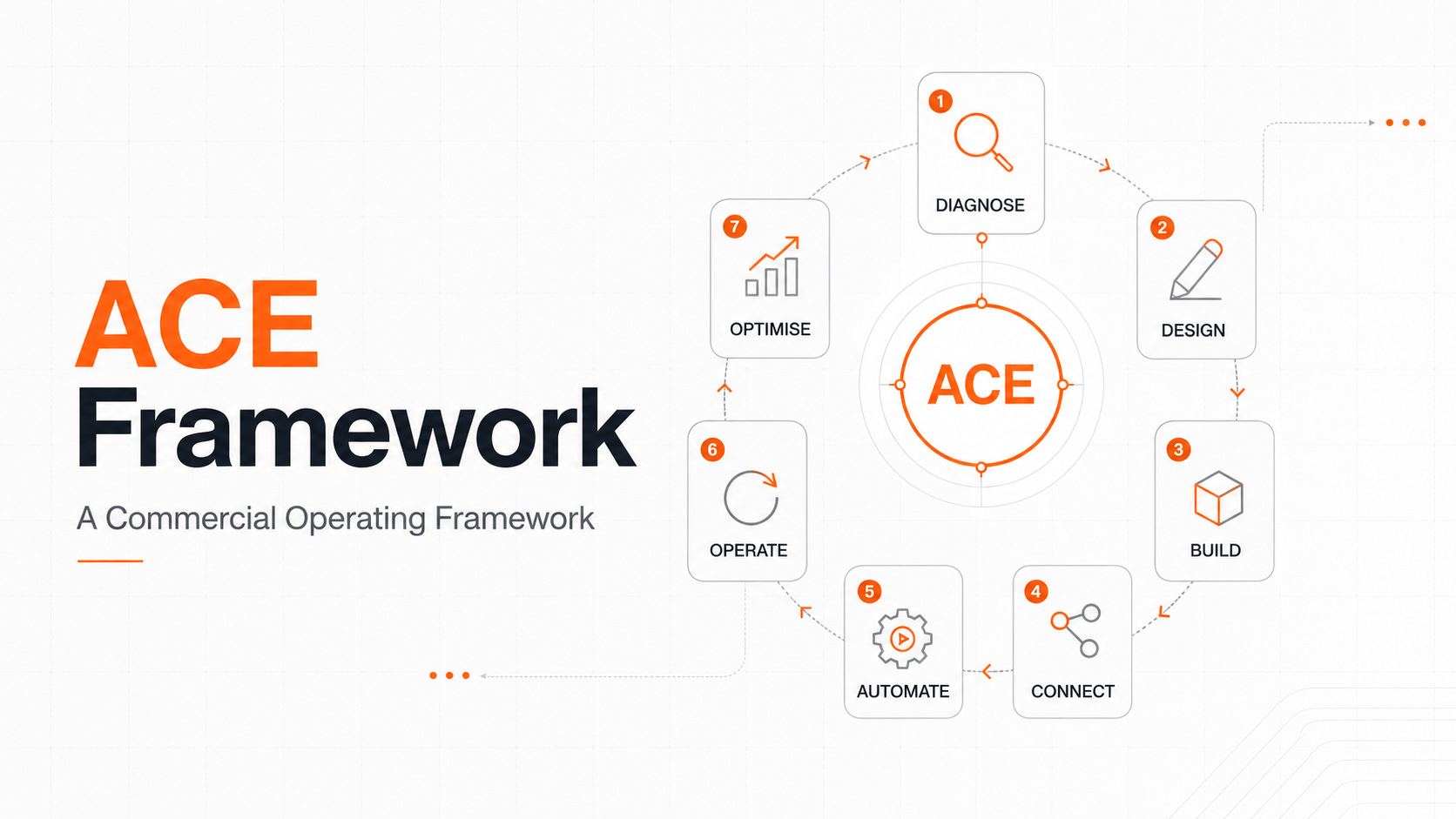
The Autonomous Commercial Engine is b10’s framework for building connected, measurable and increasingly autonomous commercial engines. It connects the systems that create, capture, convert, fulfil and grow customer value.
The important part is not the acronym. The important part is the operating logic.
ACE says the commercial engine has seven connected systems: Market Clarity, Demand Capture, Marketing Operations, Sales Operations, Commercial Operations, Customer Growth, and Automation and Intelligence. It also says the engine needs content logic, feedback loops and operating rhythm. Otherwise, it becomes another collection of assets that gradually drift apart.
The word autonomous will attract attention, and it should. But it also needs discipline.
Autonomy does not mean “let AI run the business”. It does not mean removing human judgement from pricing, qualification, proposals, customer promises or strategic decisions.
In ACE, autonomy means something more useful and more defensible: governed reduction of avoidable manual intervention.
That means the system should not rely on a founder chasing every lead, a sales manager interpreting every missing field, an operations lead manually reconstructing every handoff or a marketer guessing what happened after the form fill.
Some workflows should move automatically. Some risks should escalate. Some data should reconcile. Some follow-ups should trigger. Some reports should become decision prompts. Some learning should change the system.
Human ownership remains. Manual dependency reduces.
One important distinction: CTI and ACE are not the same thing.
CTI, the Commercial Transformation Index, diagnoses commercial maturity across the 10 commercial domains, benchmarking your commercial maturity against the industry. It is the diagnostic authority layer.
ACE is the Commercial Transformation Framework for what happens next. It translates diagnosis into design, build, connection, automation, operation and optimisation.
That sequence matters because the business world is full of unused audits and poorly diagnosed implementation projects. CTI without implementation risks becoming insight without change. Implementation without diagnosis risks becoming activity without priority. ACE connects the two.
The market has already moved beyond isolated channels, even if many suppliers still sell that way.
Buyers do not experience your business as departments. They experience the journey. They move from search to website, from website to form, from form to follow-up, from follow-up to sales conversation, from proposal to decision, from decision to onboarding, from onboarding to value, from value to renewal or expansion.
Every weak handoff becomes friction. Every unclear promise becomes risk. Every disconnected tool becomes delay. Every manual dependency becomes a constraint.
The businesses that scale with control will not be the ones with the most tools. They will be the ones with the clearest commercial operating model.
ACE gives b10 a stronger authority asset. It turns the company’s positioning into a structured framework. It connects b10’s vision, CTI, managed services, transformation, partner ecosystem and our operating-system layer.
More importantly, it gives buyers a clearer way to understand what b10 actually does.
b10 is not trying to be another website agency, CRM reseller, marketing agency or generic consultancy. Those labels don’t fit. The work may include website, CRM, marketing, sales process, operations and automation, but the point is the connected commercial engine.
That is the category b10 is building.
Before a business buys another isolated fix, it should ask one question:
Are we solving the real problem, or are we treating a symptom of a disconnected commercial engine?
If the answer is uncertain, start with diagnosis.
Then build the engine.
Here’s to your success,
The b10 Team
Subscribe for free and receive our latest Commercial Transformation articles directly in your inbox
Comments
Nothing yet. Say the first thing.
Sign in to join the conversation.