
There is a certain kind of software announcement that is easy to dismiss. A new AI assistant. A summarisation feature. A little icon appearing in a dashboard promising to save minutes on a task nobody enjoys doing.
Close CRM releasing Chloe Ai Sales Agent is not quite that.
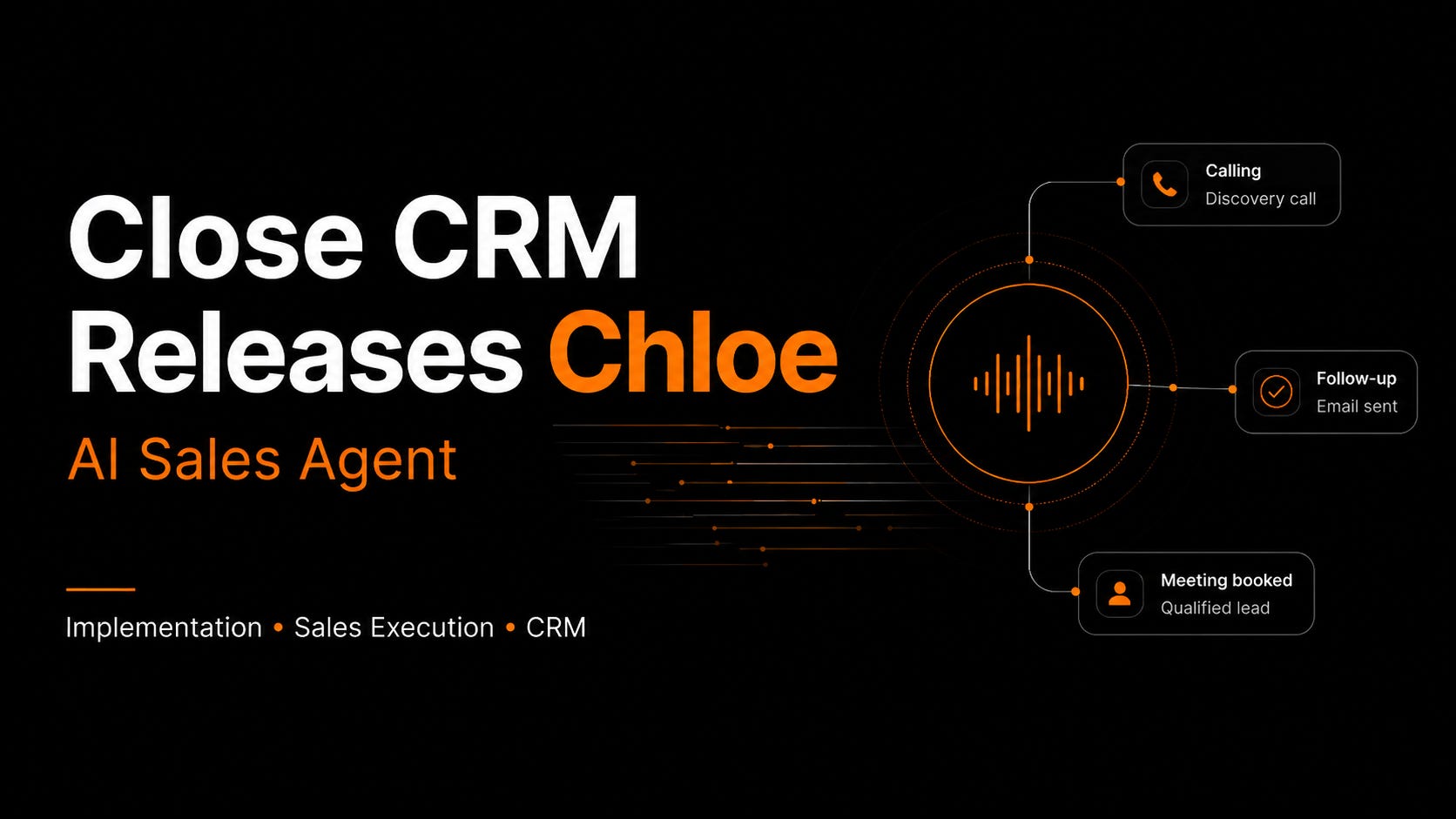
On 3 June 2026, Close CRM released Chloe Ai Sales Agent, its AI sales teammate embedded in Close CRM. Close now presents Chloe as available across its plans. The headline capability is voice: Chloe can call supported U.S. and Canadian contact numbers, run qualification conversations and book meetings. Close also describes Chloe as able to enrich information, update CRM records and support pipeline interaction through Chloe Chat.
There are launch statistics worth noting.
Close reports that 238 businesses tested Chloe during beta;
that the agent made 780,915 calls,
reached 104,251 real prospects and customers,
and completed more than 6,424 hours of conversation.
Those figures do not tell us what any one business will achieve. They do tell us this is no longer a prototype hidden behind a roadmap slide.
Try Chloe Ai Agent Free.
During checkout, use code CHLOEPARTNER30 for 30% off for three months. Offer is good until June 30, 2026, for all new customers.
The old bargain with a CRM was fairly simple. Put enough information in and you would get better visibility out. Store the lead. Track the call. Move the deal. Report on the pipeline. That bargain has always been compromised by one issue: people have to do the activity and record it consistently.
A founder can know the CRM is incomplete and still have no time to fix it. A sales director can see dormant leads and still not have enough rep capacity to revisit every one. A seller can intend to follow up immediately and still get dragged into a live opportunity or customer issue. Opportunity leaks through delay, not because anyone deliberately decides to waste it.
Chloe Ai Sales Agent changes the bargain. Close is no longer merely asking the sales team to update the system. It is making the CRM part of the executing sales capacity.
There is a tempting interpretation: more calls, less workload, quicker meetings. Those things may be valuable. But the more commercially serious interpretation is that a system capable of acting makes weak sales architecture more consequential.
Consider a human sales rep. A good rep can detect that a lead is inappropriate, that an answer requires care, that the buyer is not ready or that a promise would be difficult to deliver. They may still make mistakes, but they carry judgement into the conversation.
Now give a sales system the capacity to perform conversations at scale. The questions that once lived informally in a rep’s head must become explicit: which contacts are appropriate; what qualification means; what outcome should change a stage; when the buyer should speak to a person; what information should be captured; what success should look like after the meeting is booked.
The better the execution capability, the less acceptable it becomes to leave those questions unanswered.
Try Chloe Ai Agent Free.
During checkout, use code CHLOEPARTNER30 for 30% off for three months. Offer is good until June 30, 2026, for all new customers.
When a new platform capability launches, the software is usually the visible part. The harder part is the system around it.
In the case of Chloe Ai Sales Agent, that means contact eligibility and call-destination support first. Close’s product and pricing pages state that Chloe is available across Close plans, while its Help Centre currently restricts Voice Agent calls to U.S. and Canadian contact numbers. For a local business, that distinction matters: Chloe can be part of the CRM decision now, and may support suitable lead flows, but domestic local voice-agent calling should not be promised yet.
Then comes qualification. What is Chloe there to achieve? Re-engage an appropriate dormant enquiry? Make contact with a recent inbound lead? Collect defined first-stage information before a human consultative call? Each scenario needs its own questions, outcomes, escalation and measurement.
Then comes handoff. A booked meeting is only useful when the right person receives the right context and acts promptly. An interested prospect cannot arrive at the edge of an automated process and find the human organisation asleep behind it.
Finally comes measurement. Calendar volume is easy to admire. Revenue quality is harder and more important. Were the meetings appropriate? Did they progress? Did the organisation sell work it could deliver well? Did the customer remain? Commercial systems should be judged by retained value, not noise that looks good for a week.
I have been building b10 around a straightforward position: revenue stops scaling efficiently when the systems behind growth are fragmented.
A company does not usually have a CRM problem in isolation. It has a journey problem. Demand is captured in one place, handed to another, followed up inconsistently, recorded incompletely, converted with variable discipline and then rarely connected back to customer quality. The tools may all exist. The engine does not.
That is why Close CRM and Chloe are relevant to commercial transformation. A native AI sales agent can reduce fragmentation in one very important area: sales action and CRM context. It can help connect a signal of interest to a conversation and a documented next step. But it remains one system in a wider commercial engine.
b10’s implementation role is not simply to recommend software. It is to help determine whether the commercial use case is sound, whether the process is ready and how the technology should be configured, controlled and measured in the system that ultimately turns first click into recurring revenue.
Try Chloe Ai Agent Free.
During checkout, use code CHLOEPARTNER30 for 30% off for three months. Offer is good until June 30, 2026, for all new customers.
For an eligible organisation already using Close CRM, or seriously considering it, the sensible route is not to release Chloe across an entire database. It is to choose one controlled use case.
Define a suitable cohort. Confirm the contact basis and geography. Write the qualification logic. Decide the human handoff. Configure Close fields, outcomes, workflows and calendars around the real sales process. Test conversations. Start small. Listen to the calls and read the outcomes. Then ask whether the agent is creating commercially appropriate movement.
This is not cautious because AI is weak. It is cautious because the commercial promise matters. Every call tells a prospect something about the organisation behind it. Scale should be earned through relevance and control.
Close’s launch makes one trend clearer: CRM platforms are moving from storing commercial history toward performing commercial work. That will affect how small and scaling teams design sales roles, processes, data, governance and technology decisions.
The winners will not simply be businesses that deploy the newest features. They will be businesses that know which activity should be automated, which relationships remain human, and how every action connects to revenue that is worth winning and capable of being retained.
That is the real promise of an AI sales agent inside a CRM. Not more automation for its own sake. More commercial capacity, governed by a system that knows what good looks like.
Try Chloe Ai Agent Free.
During checkout, use code CHLOEPARTNER30 for 30% off for three months. Offer is good until June 30, 2026, for all new customers.
For supported deployments, b10 can support Close CRM and Chloe workflow design, setup, human handoff and commercial measurement.
Here’s to your success,
The b10 Team
Subscribe for free and receive our latest Commercial Transformation articles directly in your inbox
Comments
Nothing yet. Say the first thing.
Sign in to join the conversation.