

Let’s just start with the numbers because we should talk about it before we get to the who and the why.
TL;DR
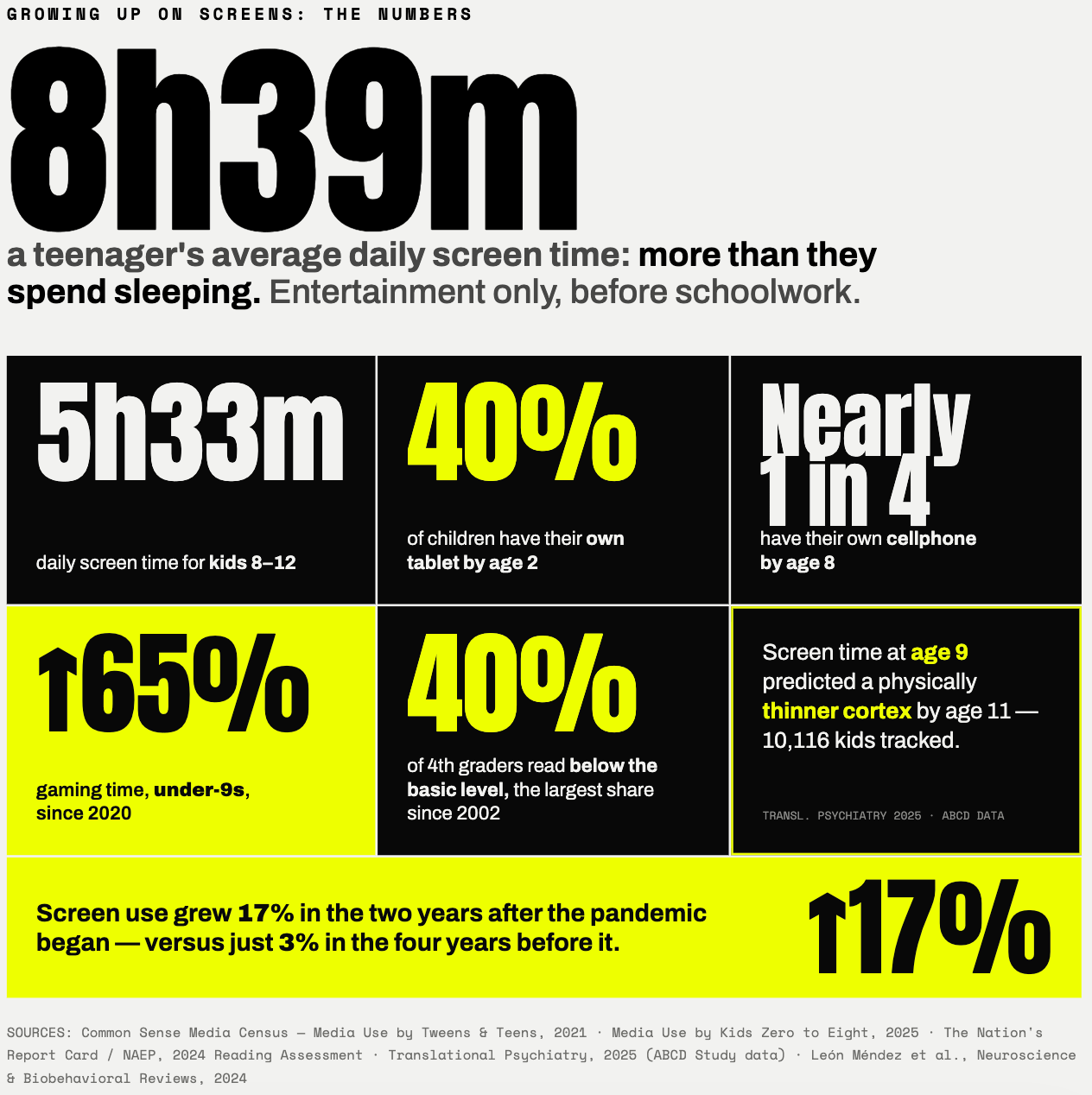
That's up 17% for both groups in the 2 years after the pandemic started. For context, screen use grew 3% for tweens and 11% for teens across the whole 4 years before it. Something broke in 2020 and it didn't unbreak.
40% of children now have their own tablet by age 2. Nearly 1 in 4 have their own cellphone by age 8. Screen time for the under-8s is around 2.5 hours a day, but what they're doing with it has shifted toward short-form video across TikTok, YouTube Shorts.
Reading is going the wrong way, and has been for over a decade. 40% of 4th graders are now reading below the basic level. 1/3 of 8th graders are below basic too, the highest in the history of the test. Below basic at 8th grade means a 13 or 14 year old likely can’t identify the order of events in a story, or its main idea, or a character’s traits.
Even teacher I speak to says a version of the same thing. Students who can’t sit through a 40 minute lesson. Students who, when handed a short story, ask if there’s a video version.
TikTok @juud2smoovv
Forget the single scary anecdote. A load of brain studies are harder to ignore.
A systematic review pulling 2024's brain-imaging studies together found that internet and smartphone overuse in young people tracks with impaired prefrontal function, with alterations showing up in the dorsolateral prefrontal cortex, the executive machinery that lets you focus, wait, and resist the next hit.
Then there’s the The Adolescent Brain Cognitive Development (ABCD) study , the largest of its kind - 11,000+ American kids scanned and tracked for 10 years.
Researchers took 10,116 children at ages 9 to 10, measured their screen time, and scanned them again 2 years later. Higher screen time at the start predicted measurably thinner cortex in specific regions 2 years on, including areas at the front of the brain, plus a rise in ADHD symptoms. Screen time at age 9 predicting a physical change in the brain by age 11.
What’s scary is that the prefrontal cortex is the last region of the human brain to finish developing, it’s still under construction into the mid-20s. So this is interference with the wiring while it’s still being developed, when it’s most vulnerable, aimed at the system that makes someone able to function as an adult. Are we in a simulation, or?
To be fair to the science: most of this is association, and researchers are careful to say so. But the ABCD data is longitudinal, meaning it follows the same children over time. The screen time came first, the thinner cortex came after.
Then there’s gaming. Time spent gaming among children under 9 jumped 65% between 2020 and 2024, to an average of 38 minutes a day. Five to eight year olds went from 40 minutes to 64. Most of it happens on phones and tablets. And that teen figure again: 8 hours 39 minutes a day, every day on entertainment screens, before a single minute of schoolwork. Run it across a year and it's over 3,100 hours (101 days). More annual hours than a full-time job (which is about 2,080 hrs).
This data is publicly available, and the companies responsible for it have been filing record earnings reports.
SOURCES: Rideout, V., Peebles, A., Mann, S. & Robb, M. B. (2022). The Common Sense Census: Media Use by Tweens and Teens, 2021. San Francisco: Common Sense Media. | Common Sense Media (2025). The Common Sense Census: Media Use by Kids Zero to Eight. | NAEP / The Nation's Report Card, 2024 Reading Assessment (National Center for Education Statistics) and National Assessment Governing Board commentary. | Su, C., Teng, B., Zhou, H., Geng, F. & Hu, Y. (2023). Prefrontal suppression in short-video viewing: unravelling the neural correlates of self-control. | León Méndez, M., Padrón, I., Fumero, A. & Marrero, R. J. (2024). Effects of internet and smartphone addiction on cognitive control in adolescents and young adults: A systematic review of fMRI studies. Neuroscience & Biobehavioral Reviews. | Association of screen time with attention-deficit/hyperactivity disorder symptoms and their development: the mediating role of brain structure (2025). Translational Psychiatry, using data from the Adolescent Brain Cognitive Development (ABCD) Study.

In 2021 Frances Haugen walked out of Meta with internal documents showing the company knew its platforms were damaging teenage mental health. And the decision was made to continue. I don’t know how you look at that and call it anything other than what it is.
In 2023 another Meta whistleblower, Arturo Béjar, sat in front of the US Senate and told them the company had ignored the sexual endangerment of children on its platforms.
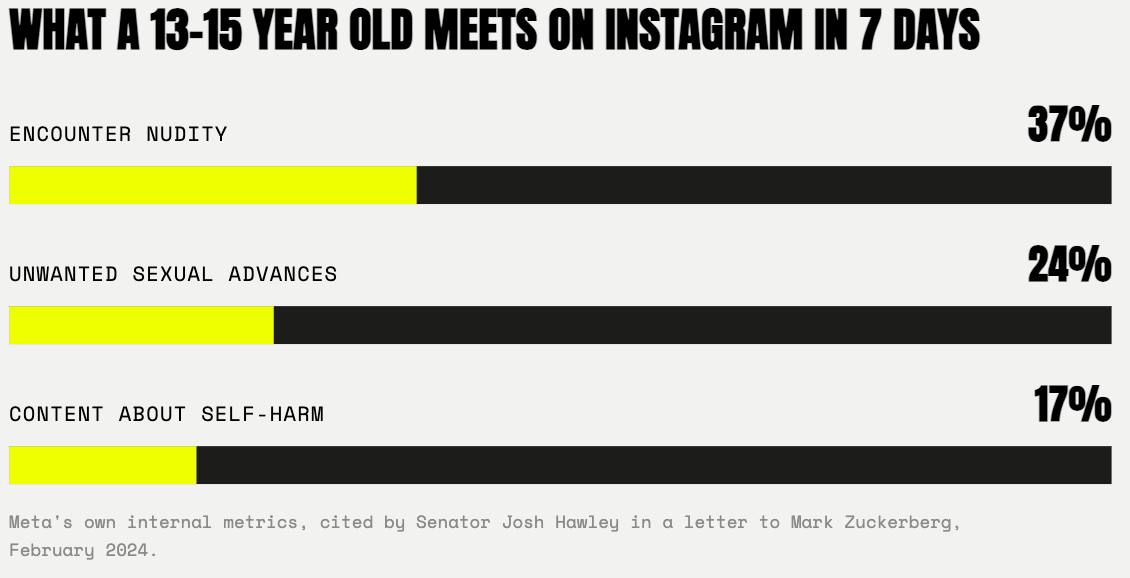
In February 2024, Senator Josh Hawley wrote to Zuckerberg citing Meta’s internal metrics: in any 7-day window, 24% of Instagram users aged 13 to 15 receive unwanted sexual advances. 37% encounter nudity. 17% encounter content about self-harm.
Hawley’s line to him was this: “You were made aware of these extraordinary statistics directly by your employees and did not respond.”
This March, after a 7-week trial in Santa Fe, a jury found Meta liable on every count. Misleading the public about platform safety. Concealing what it knew about child sexual exploitation. And “unconscionable” trade practices that unfairly took advantage of the vulnerabilities and inexperience of children. New Mexico became the first state in the country to beat a major tech company at trial on child safety.
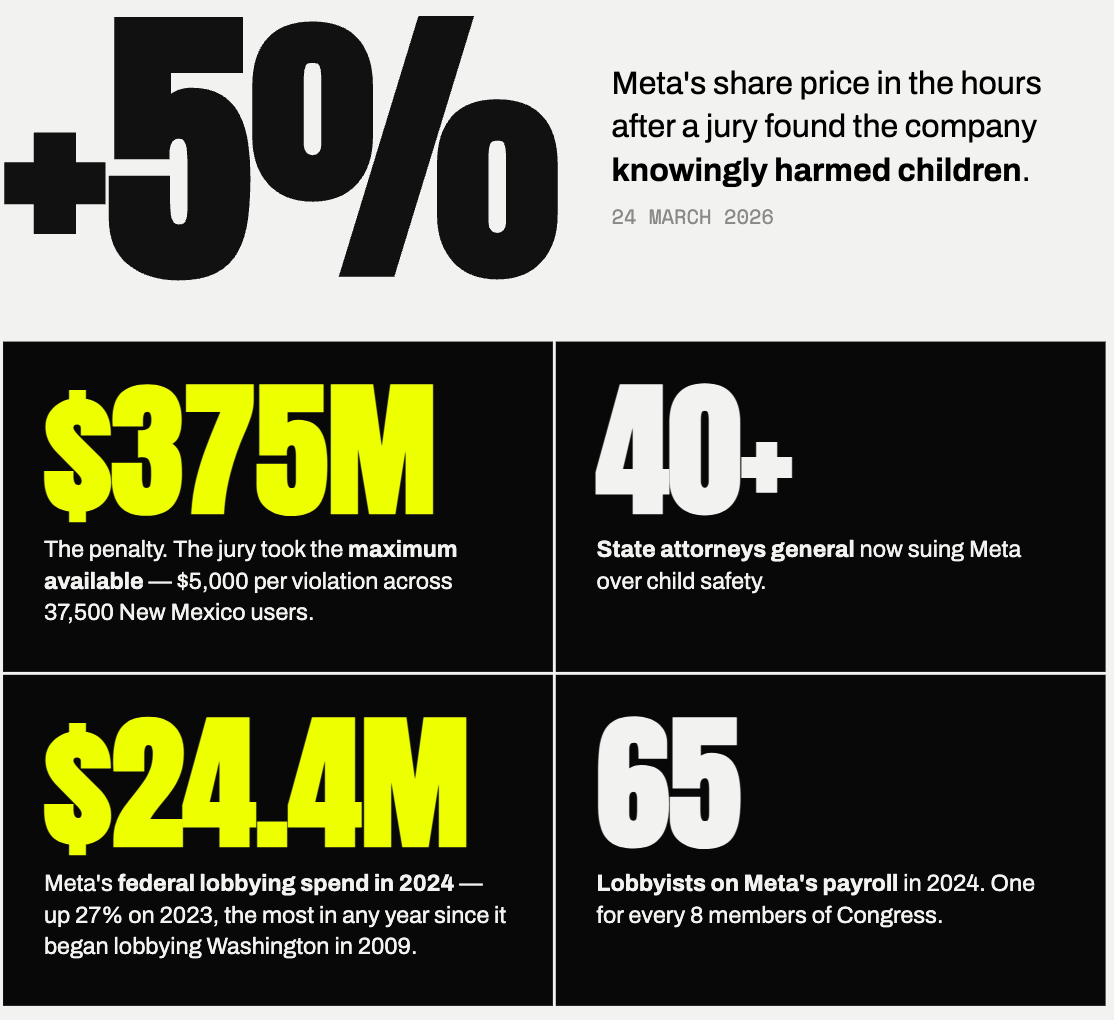
The penalty was $375 million. New Mexico had asked for $2.1 billion. Meta is valued at around $1.5 trillion. And in the hours after the verdict landed, Meta’s stock went up 5%. Please, deep that number, because it’s the whole essay. A jury found the company knowingly harmed children, and the market’s response was to buy.
Meta is appealing, which will surprise absolutely nobody.
Meta spent $24.4 million on federal lobbying in 2024, +27% on the year before. That bought 65 lobbyists, one for every 8 members of Congress. Last year it went up again, to $26.3 million.
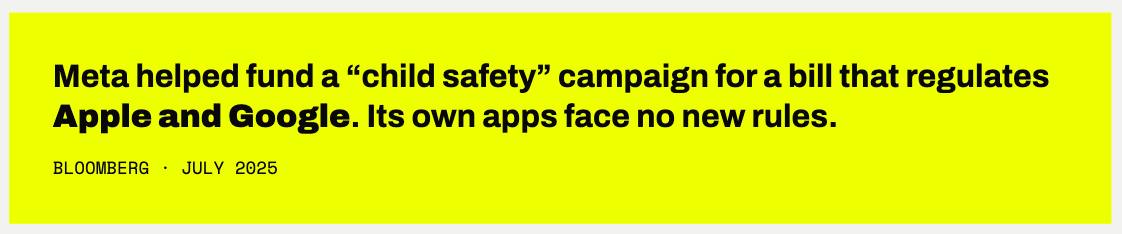
And then there’s the part that takes audacity to the max. According to Bloomberg, Meta helped fund the Digital Childhood Alliance, a coalition of conservative groups campaigning for the App Store Accountability Act. Bloomberg cited 3 people familiar with the funding. Meta didn’t deny it, saying only that it had “collaborated with” the group. The Alliance’s own website lists Meta as a supporter of the bill.
The bill requires Apple and Google to verify ages at the app store. It requires nothing new of social media platforms. Meta’s competitors build the machinery and pay for it. Meta’s apps face no new obligation at all. A child safety bill, funded in part by the company, that regulates everybody except the company… make it make sense.
Zuck sat in front of Congress and apologised to parents whose children had been harmed.
I don’t want a libel claim so I’ll leave the alien lizard theories where I found them. But what I will say is that no one who genuinely cares about the future of humanity or our kids could build this thing, watch the research come in, bury it, fund lobbyists to protect it, and then show up to Congress with a sorry and microbangs for a haircut. Whatever Zuck is, he is not building for us. And the machine keeps running regardless. Heck, we’re all feeding this machine.
SOURCES: State of New Mexico v. Meta Platforms, Inc., First Judicial District Court, Santa Fe, verdict 24 March 2026 | New Mexico Department of Justice press release, 24 March 2026 | Associated Press, CNN, Al Jazeera, Source New Mexico, coverage of the verdict, March 2026 | Senator Josh Hawley, letter to Mark Zuckerberg, 1 February 2024 | Issue One, analysis of federal lobbying disclosures, January 2025 | Bloomberg, reporting on Meta and the Digital Childhood Alliance, July 2025 | Digital Childhood Alliance, App Store Accountability Act FAQ | Frances Haugen, Senate testimony, October 2021 | Arturo Béjar, Senate testimony, November 2023
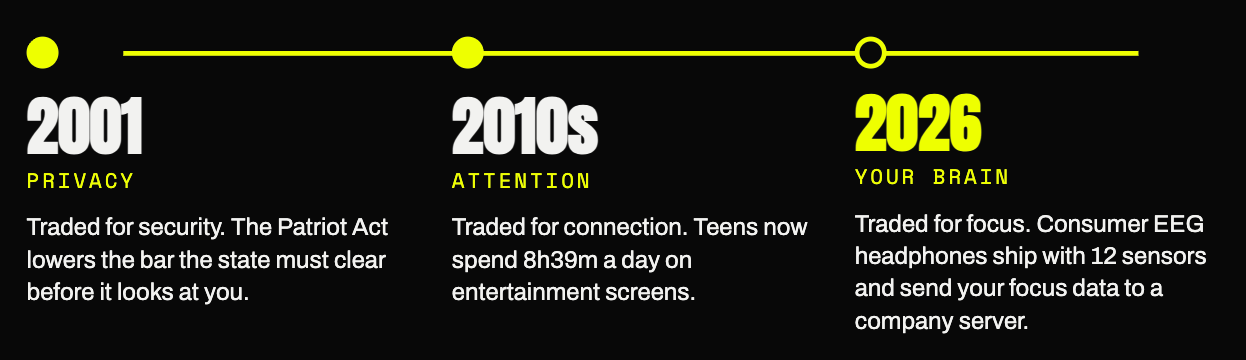
After September 11 2001, the US government passed the Patriot Act. And I get it, I understand the context. But underneath the national security language it lowered the bar for what the state had to prove before it could look at you. Before, surveilling an American meant meeting the standard of probable cause. After, there were a set of new powers and weaker parameters. You weren't presumed private anymore, the state was presumed to have access.
That logic is the ground everything in this essay was built on. The tech companies brought the same trade to the consumer market, and became so embedded in daily life that opting out felt impossible.
Neurable already sells high-end headphones with 12 EEG sensors built into the ear pads. They track your focus levels, mental fatigue and cognitive strain. The app reports back on your Anxiety and Brain Age. It’s marketed as a wellness tool for people who want to work smarter.
Read their FAQ and they tell you what happens next. Your focus data sits on the headphones during a session, then goes over Bluetooth to the app, and then to Neurable’s servers.
Meanwhile Meta is decoding brain activity into text. Their Brain2Qwerty system reached 61% average word accuracy in June, with 78% for the best participant, reading sentences directly out of neural signals as people typed them.
Now the caveats, because they too matter.
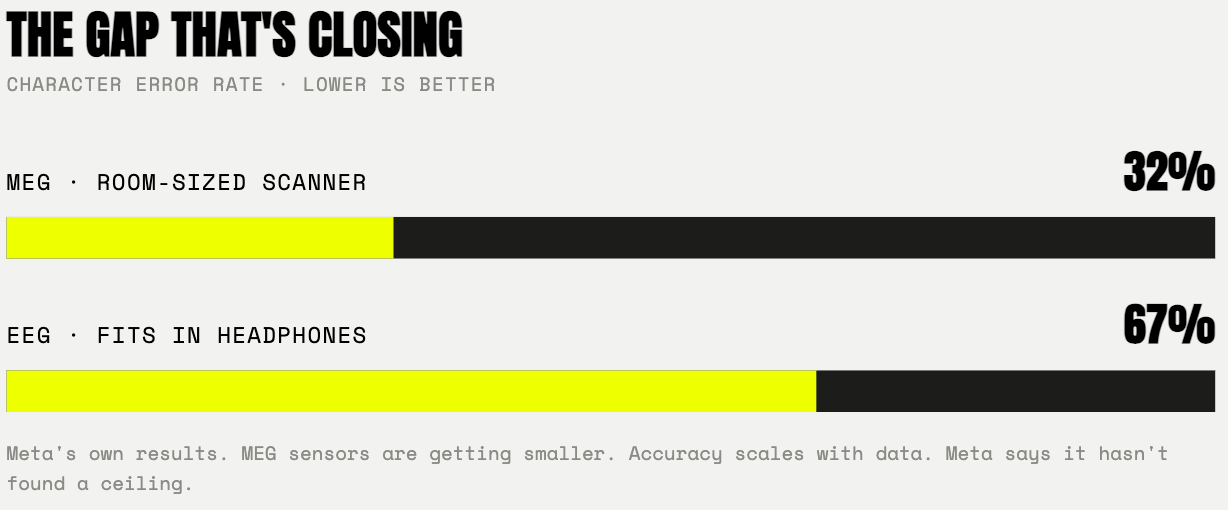
The machine doing this is a scanner the size of a room. Meta calls it inaccessible to most patients. The EEG version, that fits in headphones, is about twice as error-prone by their own numbers. And it works by reading the motor cortex while someone physically types. Meta is explicit that it hasn't been tested on imagined typing, and it doesn't decode inner speech.
Because of what Meta says next. Accuracy scales with the amount of training data, and they haven’t found a ceiling yet. MEG sensors are getting smaller, some are already wearable, and companies like Cerca Magnetics are building them. Meta is telling you how far the line goes.
Except that’s not even a prediction anymore. Neurable has a product page at neurable.com/products/adhd. It’s already here, and it’s already aimed at exactly the children I’m screaming about.
And for UK parents, this stopped being hypothetical in April. The Children’s Wellbeing and Schools Act passed into law, and with it a Single Unique Identifier for every child. The government confirmed that it’ll be your child’s NHS number. Shared across local authorities, NHS trusts, schools, police forces, probation services and youth offending teams.
The pilot has been running in Wigan since April 2025, matching school census records against children’s social care data and the NHS database that holds every NHS number in the country. The Department for Education is drafting the guidance that decides how all this actually gets used.
What happens to families who become vulnerable to information-sharing for immigration enforcement purposes? No clue.
The infrastructure is built, and the rules for using it are being written this summer, while everyone’s on holiday.
SOURCES: USA PATRIOT Act 2001, and ACLU analysis | Neurable, MW75 Neuro LT product specifications and FAQ, neurable.com | Meta AI, "Brain-to-Text Decoding: A Non-invasive Approach via Typing," Nature Neuroscience, February 2025 | Meta AI, "Accurate Decoding of Natural Sentences from Non-Invasive Brain Recordings" (Brain2Qwerty v2), June 2026 | Children's Wellbeing and Schools Act 2026 | Liberty, written evidence to the Public Bill Committee, February 2025 | UK Parliament, written statement HCWS115, 16 June 2026 | Department for Education, Single Unique Identifier pilot
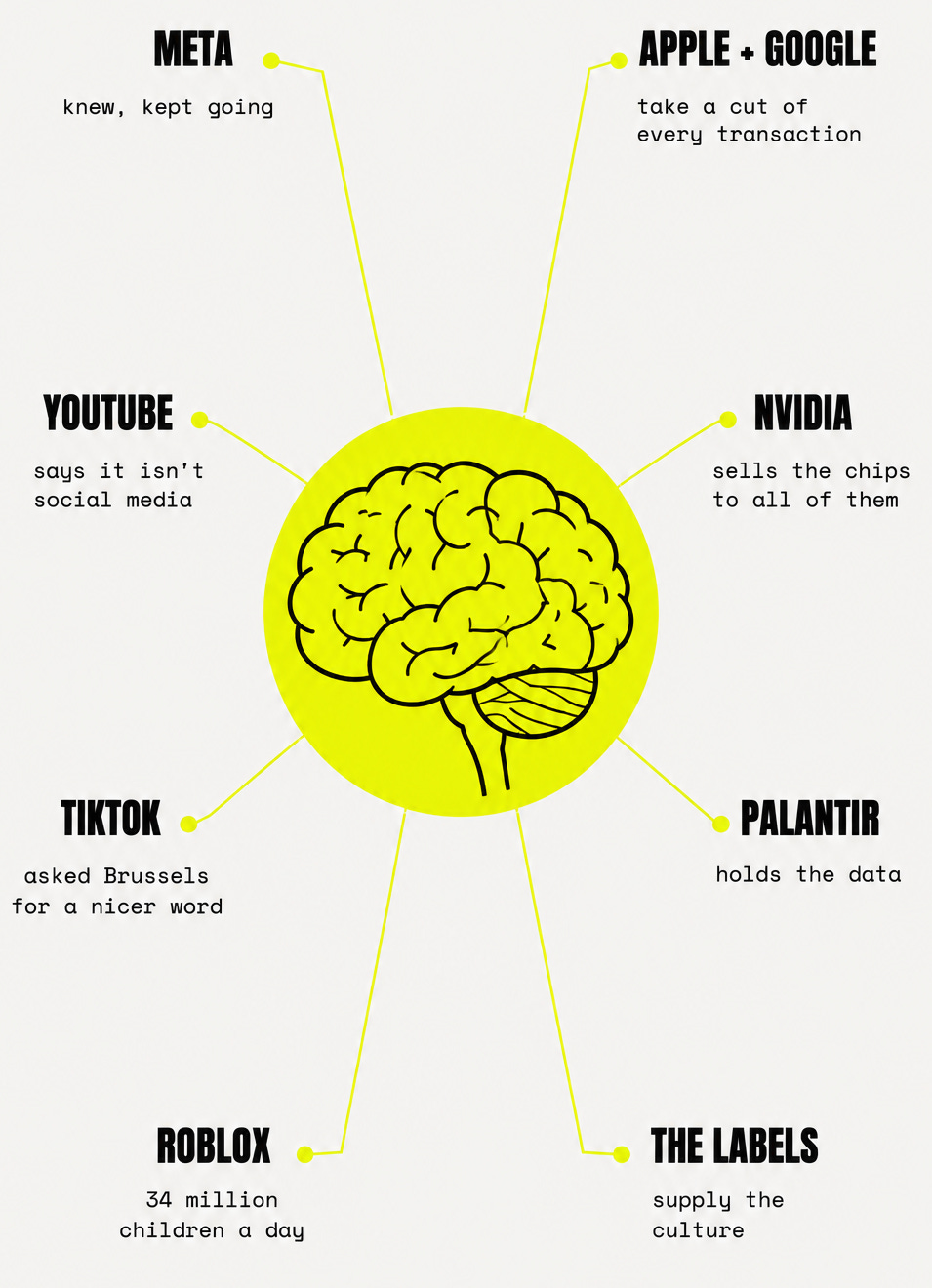
Meta is the most obvious and we have covered them. This goes much deeper than Zucks congressional apology tour.
TL;DR:
Start here, because your child probably did.
This March, a Los Angeles jury found Meta and Google’s YouTube liable for designing their platforms to hook young users without concern for their wellbeing. The plaintiff, Kaley, logged onto YouTube when she was 6 years old, she added Instagram at 9. She’s 20 now. The jury decided the companies acted with malice, oppression or fraud.
A few days ago, on 15 July, YouTube filed its appeal. Their argument is that YouTube isn’t a social media platform.
They’ve done this before and it worked once. Australia’s original under-16 ban left YouTube out on educational grounds. They later reversed it, once a survey showed 37% of minors were encountering harmful content there.
When the UK announced its ban in June, YouTube was named alongside Snapchat, TikTok, Instagram, Facebook and X. The definition was written to catch platforms by what they do: user-to-user, posting, algorithms. Only YouTube Kids was excluded.
The rest of the pattern is settlements. YouTube settled the second California test case on 23 June rather than let a jury see it. Meta, Snap, TikTok and YouTube together paid a Kentucky school district $27 million to avoid trial. More than 3,300 addiction cases are now pending in California state court alone.

In October 2025, TikTok filed its submission to the European Commission’s Digital Fairness Act consultation. They argued for the term “persuasive design” over “addictive design,” on the audacious grounds that the science on digital addiction is still evolving and screen time is a poor proxy for harm.
It didn’t work. The Commission issued preliminary findings that TikTok’s addictive design breaches the Digital Services Act. Finding TikTok had failed to properly assess how infinite scrolling, autoplay, push notifications and a hyper-personalised recommender could harm minors, and said the design shifts users into “autopilot mode.” They also found TikTok had ignored indicators of compulsive use, including how much time minors spend on the app at night.
TikTok’s response was that the findings are meritless and it will challenge them through every means available.
Then there’s the trial that never happened. A California case over child harm was about to start in January 2026, the one where internal documents would have gone in front of a jury, on the record, TikTok settled the day before. Snap did the same, the documents stayed sealed.
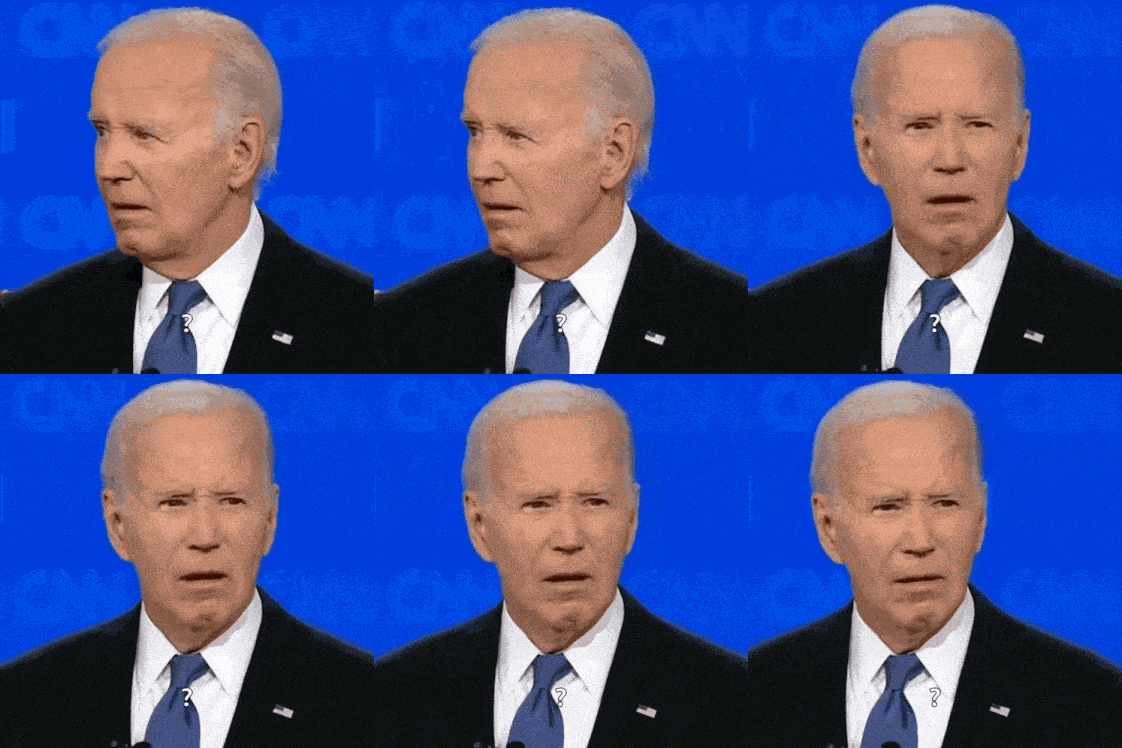
In 2025 researchers created an account registered to a 5 year old. It gained immediate access to dating, romance and voice chat experiences with no verification and no parental consent. In February 2026 Fairplay researchers using under-13 test accounts encountered sexual references and racial slurs within minutes of being on the platform. Insert parental gasp, here.
In 2019, Roblox filed 675 reports of child exploitation with the National Center for Missing and Exploited Children. In 2024 it filed 24,522.
Families suing Roblox allege the platform designed what lawyers are calling a “foreseeable grooming pipeline,” with weak age verification, pathways for adults to communicate with children, and a virtual currency that gave predators another lever to manipulate kids already motivated to earn it. Arkansas’s attorney general has sued Roblox and Discord together, alleging they lied to the public about how safe their platforms were.
Then there’s the money. When your child spends a pound on Roblox, roughly 25p reaches the person who built the game. Roblox keeps about 25p. And about 25p goes to Apple, Google and Xbox for the privilege of the transaction happening on a phone.
Many of those creators are children. In 2025 Roblox took $4.9 billion in revenue and paid out $1.5 billion to creators, which sounds generous until you look at the distribution. The top 100 developers averaged $6 million each. Most never reach the 30,000 Robux minimum needed to cash out at all. So they build, the platform keeps the engagement, and the money never converts into anything.
To top this all off… Roblox is being sued by its own investors, who allege the company misled the market about how its facial age-check rollout would hit growth. Shareholders are in court arguing that checking children’s ages is a material risk to the share price. Make it make sense.

Which brings me to the two names nobody puts on this list.
Every Robux, loot box, V-Buck, battle pass, skin and limited-time offer bought on a phone anywhere pays a toll to Apple or Google. On Roblox, the app stores take about as much as Roblox itself does.
They didn’t build the addiction but they sure do own the thing it’s sold on, and they charge by the transaction.
And go back to Meta bankrolling the Digital Childhood Alliance to push age verification onto the app stores. That fight looks like a debate about child safety but it’s in fact a commercial dispute between two parties who both profit from the same child, arguing over who pays for the admin.
A growing share of gaming revenue comes from children spending real money on virtual items through systems designed to obscure the actual cost. (loot boxes / randomised rewards). The intermittent reward model, which is the same psychological mechanism behind slot machines, deployed legally to children through Fortnite, FIFA Ultimate Team, Call of Duty. Through skins, battle passes and limited-time offers, are designed to create urgency in a brain that hasn’t finished developing yet. The whole business model depends on it working this way.
In January 2025 the FTC settled with Cognosphere, (developer of Genshin Impact), for $20 million. The charge was that they deceived children about the true cost of in-game transactions and the odds of winning rare prizes, while marketing to kids through anime graphics, child-like characters and influencers popular with young audiences.
Epic Games, who make Fortnite, paid $520 million in 2022. That included the largest children’s privacy penalty the FTC had ever issued.
These are the cost of doing business. The revenue from doing it was significantly higher.
Nobody is putting Nvidia in this conversation and they absolutely should be.
Nvidia's GPUs power the recommendation algorithms. They power the AI systems that make every platform smarter and faster at keeping children engaged for longer. They power the games. The chips that make the machine run faster and more precisely are Nvidia chips. Nvidia builds what makes the platforms possible, and they are selling to every single company on this list simultaneously, at record margins, while the entire conversation about harm to children stays focused on the apps and never reaches the infrastructure underneath them. That's a very convenient place to be.
Palantir builds targeting software for militaries and data infrastructure for ICE. Their CEO Alex Karp says college is no longer a reliable training ground, and in 2025 the company hired 22 recent school leavers directly through something it called the Meritocracy Fellowship. The pitch was “get the Palantir degree.” The ad copy said “Skip the debt. Skip the indoctrination.”
Last December FedScoop noticed a Palantir reference on a US Education Department website tracking foreign funding in universities. An hour later the page showed a Palantir login screen. A couple of hours after that, the logo had been swapped for a government one. The department won’t say what Palantir is being paid.
Coventry City Council signed a £500,000 contract with Palantir in early 2025 to run AI across children’s services and SEND, transcribing and summarising social workers’ case notes. Trade unions raised ethical objections, it was reviewed and renewed at £750,000.
Go back to what I told you about the Children’s Wellbeing and Schools Act. Every child in England is getting a Single Unique Identifier, and the government confirmed that it’ll be their NHS number.
So the company that builds deportation infrastructure for ICE, and targeting systems for militaries, holds the contract for the platform where NHS data lives.
And this year the government made your child’s NHS number the key to everything else: their school records, their social care file, whatever the police and youth offending teams hold on them.
Here we were thinking they were moving closer to children’s institutions, they’re already inside, holding the dataset the government just turned into every child's permanent ID.

And before anyone files this under tech problem, the entertainment industry runs on the same incentives.
Yung Miami built a career glorifying the City Girl lifestyle: scamming, finessing, act up, period. Ngl, it’s catchy. Then Jason Lee asked her on his show whether her own daughter could be a City Girl and the answer was immediately NO. “I want her raised totally different.” A school girl, level-headed, on a whole other wave. The product is for your daughter, not hers. I wonder why.
That pattern repeats across the industry. Scam rap is a whole subgenre now, bank fraud tutorials over a beat streaming in the millions. Drill glorifies the same violence its own artists keep dying from. Labels sign it, they’re getting rich, and the algorithm serves the most extreme version of it to the youngest audience, because extremity is engagement and engagement is revenue. The executives greenlighting all of it send their kids to schools with phone bans.
I mean the music used to compete with everything else in a child’s life, like the radio edit or the watershed. Now it arrives algorithmically served on a continual loop, to 9 year olds with no context and no counterweight. Artists and labels are manufacturing the same stupid the algorithm rewards. The culture and the platform feed each other. Both get paid. This is a separate essay.

I’ve spent this whole essay writing about Them and Us. Us being parents. Them being everyone making money off our kids.
On this one, I’m Them.
That’s not a confession I planned to make, but it landed on me somewhere in week three of the research, which is its own kind of embarrassing.
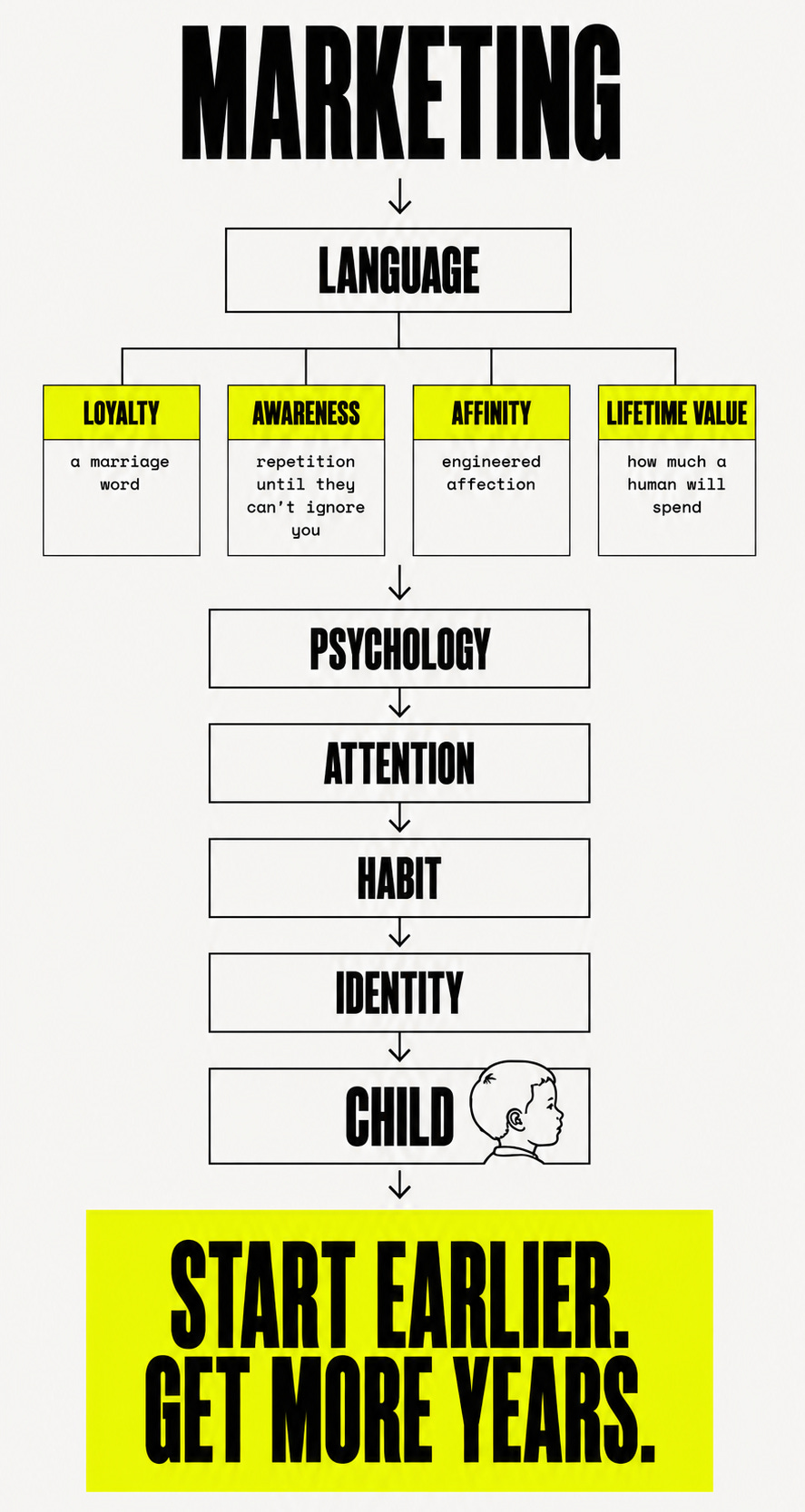
How it works from the inside: Marketing feels good to do. For real. You’re helping someone find a product that’s better than the one they’ve got. You’re helping a business grow and pay its people. Both of those things are true, and they’re why nobody in it ever feels like the bad guy.
Then look at the internal language of marketing.
Now put a child in it. If a person is worth a fixed amount over their lifetime, and you reach them at 8 instead of 28, you’ve bought yourself 20 extra years of them. The maths rewards going younger. The maths has no floor.
TikTok told the European Commission to call it persuasive design. YouTube told a judge it isn’t social media. We say lifetime value. Everyone involved has a nicer word for it.
The briefs landing on my table now say “how do we reach Gen Alpha.” I want you to understand the tone of that question, because it isn’t sinister. It’s curious. It’s warm. We want to speak their language, we want to understand them, we want to get it right. Marketers feel this is innocent. A room full of people who think they’re helping never stops to ask what they’re doing.
I’ll be straight about where I actually stand. I’m not doing active work marketing to Alphas. When I’ve worked on kids’ brands before, we marketed to their parents. There was a gate, an adult had to desire and decide.
That gate is slowly evaporating. These kids have a device now, an algorithmic profile and a card saved on the account.
In the Meta story, employees raised alarms and executives chose growth. In my industry there’s not really an alarm to raise. Nobody’s job is to say no… It would kind of defeat the purpose.
So what do I do with that.
I don’t have a clean answer. I’m not going to perform an exit from an industry I’m still in. I’ll take briefs next week, and some of them will be for brands your children know.
What I’ve got is that I can see it clearly. For example I have always had a hard ‘no’ to doing any work on gambling or alcohol brands. I can say no to a specific thing. And I can stop calling calling kids consumers.
I won’t claim to have all the answers here. But be real with me in the comments.
SOURCES: Associated Press, CNN, NPR, CalMatters, coverage of KGM v. Meta and Google, Los Angeles Superior Court, verdict 25 March 2026 | Fortune, YouTube notice of appeal, 15 July 2026 | CNBC, YouTube settlement of second bellwether case, 24 June 2026 | GOV.UK, "Social media to be banned for under-16s," 15 June 2026 | Reuters and Australian Government, YouTube added to under-16 ban, July 2025 | European Commission, preliminary findings on TikTok's addictive design, 6 February 2026 | TikTok, submission to the Digital Fairness Act consultation, October 2025 | National Center for Missing and Exploited Children, Roblox CyberTipline reports, 2019 and 2024 | Judicial Panel on Multidistrict Litigation, MDL No. 3166, N.D. Cal. | Roblox SEC filings and Developer Exchange documentation, 2025–2026 | Federal Trade Commission, settlement with Cognosphere (Genshin Impact), 17 January 2025 | Federal Trade Commission, settlement with Epic Games, 2022 | FedScoop, December 2025 | Inside Higher Ed, AAUP statement, 19 December 2025 | The Nerve, Coventry City Council FOI, April 2026 | Computing, Coventry Palantir contract, 2025 | Campaign Against Arms Trade, Palantir company profile
Something I noticed reading all of that back. Every one of those organisations is getting better at this.
TikTok didn’t fight the addiction charge, it lobbied Brussels to change the word. YouTube isn’t disputing the verdict, it’s telling a court it isn’t social media. Meta didn’t oppose child safety legislation, it funded a child safety campaign that regulates Apple and Google instead. Roblox’s own shareholders are in court arguing that checking children’s ages threatens the share price. Coventry’s council reviewed its Palantir contract after the backlash, then renewed it 50% larger.
The UK Online Safety Act exists, though enforcement has been slow. The EU’s Digital Services Act is the most meaningful regulation globally, and Big Tech mobilised its entire lobbying apparatus against it.
Then in June 2026, credit where it’s due, the UK actually did a thing. Starmer announced a full social media ban for under-16s: TikTok, Snapchat, YouTube, Instagram, Facebook, X, plus blocks on livestreaming and stranger messaging, with Ofcom enforcing and the fines landing on platforms rather than parents. Great, right?
Question though. Banned, and replaced with what, exactly?
Because a ban only answers half the problem. If it works as designed, millions of British children get handed back five and a half to eight and a half hours a day.
The sh*t just gets inherited by whatever’s nearest. YouTube Kids, which is exempt. Gaming, which is deliberately outside it. The VPN or the inevitable black market.
Oh, and then, within weeks of the announcement Starmer resigned.
I want the ban. I’m glad it’s coming. But a ban with nothing behind is only part of the job done.
SOURCES: Corporate Europe Observatory, 2026 | UK Government / NPR, June 2026 | NPR, June 2026 | BBC / CNBC, June–July 2026
They’ll run hospitals (if the bots don’t get there first). Make policy, sit on juries. Lead militaries, govern countries. Raise the generation after them.
With attention spans that were shortened before they turned 10. Reading levels that declined year on year through their entire childhood. Dopamine systems calibrated by engineers to need constant novelty. Emotional regulation skills that were never allowed to develop, because boredom got replaced with content from the age of 2.
We’re watching a generation delivered to us pre-damaged, pre-distracted, pre-monetised, and already being prepared for the next phase of extraction waiting for them in adulthood. But the earnings reports look great.

On one side you have the most well-funded, technically sophisticated, legally protected institutions in human history, with teams of behavioural psychologists, product designers and data scientists whose entire job is to keep your child’s attention for one more minute. They have decades of research and they own the algorithm. They have the lobbying budget and the government relationships. And they have the patience of companies playing a very long game.
On the other side you have parents. Most of whom are tired and uninformed. Most of whom are also on their phones and probably learned about TikTok from their kids and still don’t fully understand how Roblox’s economy works, or why their child is begging for Robux, or what Discord is actually being used for in the background while the homework is supposedly happening.
I’ve already told you I’m on the wrong side of that line for a living. It doesn’t make the line imaginary, it does mean I’ve seen how it gets drawn.
And I’m not saying any of this to make anyone feel bad. I’m saying it because the only way through is to close the gap, as deliberately as it was designed.
You’ll hear me telling parents to stay on top of emerging tech. Know who built the platforms your kids are on, what the algorithm is optimised for and how your specific child is using them. Because saying “I hate social media” or “bloody Fortnite” and leaving it there is a terrible strategy. Your child is inside those platforms right now, often unsupervised, and the people who built them know far more about your child’s behaviour than you do. That imbalance needs to close.
A parent who stays uninformed leaves their child disarmed and unsuspecting in an environment engineered to exploit just that.
I know technology is going to evolve and of course it has to. Progress is real and so much of it is brilliant. But evolution is not exploitation, and we don’t have to accept that the price of a connected world is our children’s cognitive development. We get to push back on that. We have to.
The companies aren’t going to stop voluntarily and governments are moving slowly. So in the gap between what should be happening and what is, it falls to us. Parents, educators, communities, people who actually give a damn about what kind of humans we’re sending into the future.
Don’t let anyone make you feel hysterical for caring about this, because the people calling you hysterical often have a financial interest in your silence.
Your kids need you paying attention more than they need you to be cool about it.

No devices before 10. The American Academy of Pediatrics recommends no more than an hour a day for ages 2 to 5. The data suggests even that is generous.
No social media before 16. Australia passed it into law in November 2024. You can make it a household rule today without waiting for your government to catch up.
Physical books, daily. The reading crisis is reversible. Phonics-based instruction, sustained practice and books in the home are the documented path back. It requires consistency and it requires you to be more interesting than a screen, which is hard, but often doable.
Boredom on purpose. Unstructured time without a device is where executive function, creativity and emotional regulation develop. Protect it like it’s the most important part of their day, because developmentally, it is.
Tell them what’s actually happening. Gen Alpha is the first generation that can probably understand the mechanism of their own manipulation, if you explain it clearly and honestly. They’re not passive. Some of them, given the information, will make different choices. Give them the information and respect them enough to have the conversation.
And the big one: look at your own screen. The research on parental device behaviour and its effect on children’s development is just as damning as the research on the platforms. You can’t outsource this to Ofcom.
Age verification with real consequences behind it. Not the current opt-in theatre where a child clicks a box saying they’re 18 and the platform considers the matter closed.
Use the New Mexico template. For 20 years, Section 230 has been the shield that stopped every attempt to hold platforms responsible for what they do to children. New Mexico’s attorney general sued Meta under consumer protection law, for misrepresenting safety and knowingly deploying addictive design. Section 230 protects a platform from liability for what its users post, it doesn’t protect a company from lying about its own product. The jury found for the state on every count, and 40-plus attorneys general now have the blueprint. This is the one thing that’s actually working, and it’s working right now.
School phone bans enforced as policy. Not suggested as guidance that individual schools interpret however they like.
Regulate attention as a public health resource. The industries extracting it from children should face the same scrutiny as industries that pollute air and water. The harm is documented and understood, we just need the regulatory framework.
Fund research into reversal. What does it actually take to rebuild attention, reading capacity and emotional regulation in a child who’s had 8 years of algorithmic exposure? We don’t know, because we haven’t funded it seriously. How to undo what thas been done remains largely unanswered.
Get active. Get informed and stay informed. Show up to the school meetings, read the research, understand the platforms, make the rules and hold them. Write to your representatives. Join the lawsuits, support the advocacy groups, talk to other parents. Make some damn noise.
This is one of the most important fights of our generation and most of us are quite literally scrolling through it.
Ayo
The Wedge Framework find your position before you find your voice
The Culture Engine the system I use to analyse D2C brand strategy and digital culture
The Operator Control System the full bundle for running your content operation
No posts
Comments
Nothing yet. Say the first thing.
Sign in to join the conversation.