
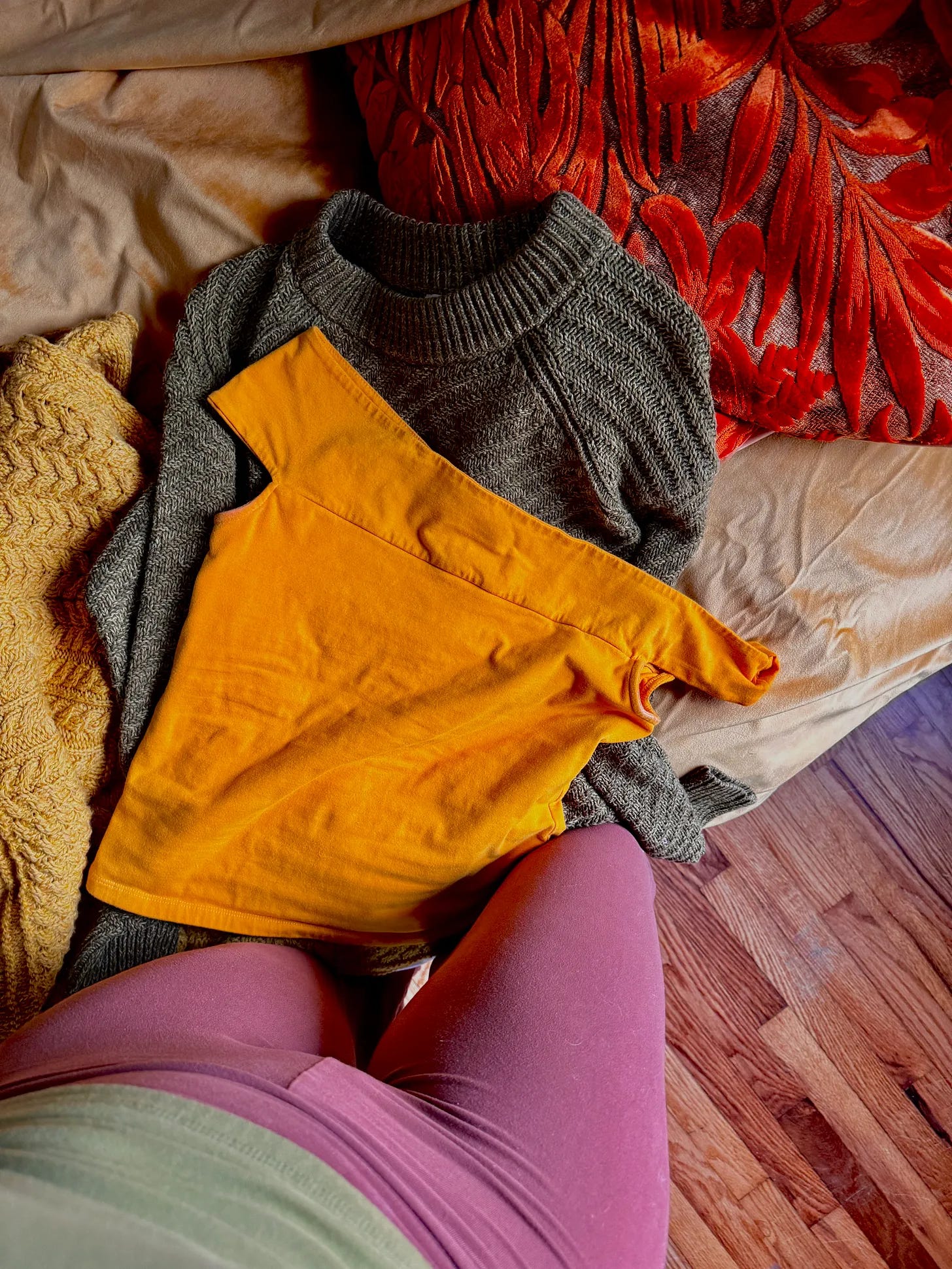
I want to tell you about a sweater.
It’s avocado green, that shade the seventies loved, woven from lighter and darker yarns twisted together, so it has this depth to it, kind of like light moving through leaves. I thrifted it a few years back and now it’s the first thing I reach for once it gets cold. Nothing special to look at, honestly, but every time I put it on I notice the same thing.
My shoulders drop a little, and I catch myself in the mirror thinking, oh, there you are. As small as that sounds, and I’ve started to wonder if that’s its own quiet bit of glamour, the old kind, the kind witches used to work with.
It’s not just the green either. Rust does something similar, makes my whole face look sort of sun warmed even in the middle of winter. So does a warm brown, the color of wet bark or strong tea, the kind of brown that makes people compliment me almost every single time.
I’m apparently a True Autumn. I figured that out on my own at first, deep in a color analysis rabbit hole, staring at a closet of things that never quite sat right on me. Then my husband gave me a professional color analysis for my birthday, just for fun, and they landed on the exact same thing.
The more I paid attention, the more I started noticing how different colors made me feel, not just how they looked. Some left me feeling more like myself. Others just kind of made me look ill. I started sorting my closet, moving certain things to the front, letting others drift toward the back, and only later did I realize I was sorting by how alive each piece made me feel rather than by season or occasion.
It got me thinking: what if the colors we wear are a profound form of ancestral magic, a vibrant inheritance cast over our sight through the generations?
Here’s a little thing you can try, if you’re curious. Turn your wrist over, palm up, in decent light. Look at your veins for a second. Some people run blue under there, some run more green, and a lot of us are some in-between mix that’s hard to read at all. Veins are a start, but they’re not the whole story.
The way I actually figured mine out was simpler. Hold up something white next to your face, then something cream. See which one your skin seems to like better, which one makes you look a little more awake. Then try silver jewelry against gold. Usually one wins pretty clearly. If white and silver do more for you, you’re probably leaning cool, which puts you closer to Summer or Winter. If cream and gold do it, you’re probably warm, closer to Spring or Autumn.
That’s roughly your undertone, and from what I understand, it doesn’t really shift over your life. You might tan or go pale with the seasons, but underneath, the same base color is there. It comes from your blood, your pigment, whatever got passed down to you.
From there it’s mostly just narrowing things down, and this is the part I get the most questions about, so let me slow down here.
Warm or cool only splits you in half.
Getting to your actual season means looking at two more things: how much contrast your own coloring naturally has, and how bright or how soft your particular version runs.
Contrast is just the gap between your lightest feature and your darkest one. Someone with pale skin and near-black hair has a lot of contrast, someone with skin and hair that sit close together in depth has very little, and most of us land somewhere in between.
High contrast tends to point toward Winter if you’re cool, or the deeper end of Autumn if you’re warm.
Low contrast tends to point toward Summer if you’re cool, or the lighter end of Spring if you’re warm.
It’s not exact, more like a compass than a map, but it’s usually enough to tell you which side of your temperature you actually live on.
Brightness is the other piece, and it’s a little harder to see in yourself, so this is where a mirror and lots of patience come into play.
Clear, saturated colors either make you look lit from within or they overwhelm you completely, no middle ground. Muted, dusty colors either soften you beautifully or drain you into looking washed out. Try one true bright color and one true muted color, in your temperature and nowhere else, and watch which one your face argues with and which one it agrees with. That argument is the intensity of your season announcing itself.
The intensity of the color is more dependent upon the contrast of your other features and which colors allow you to shine rather than outshine you. If you were to place them behind you as the background, they should make you more visible; you should be the first thing that you see, not the other way around. A color that outshines you is a color doing its own work instead of yours. A color that lets you shine is working with you in a co-creative process.
One more thing I’ve noticed.
This seems to shift a bit as we get older. My mom is a Spring, and when she was younger she could wear the really bright, saturated stuff. These days the lighter, softer end of Spring suits her more. Still a Spring, just a gentler version of it now.
At some point, people who study color noticed that our coloring tends to cluster into a few families, and somebody decided to name them after the seasons. Spring, Summer, Autumn, Winter. Not about your personality, just the mix of tones in your skin and hair and eyes.
Springs tend to run bright and warm.
Daffodil, new grass, coral, that first blue of the sky in early morning, the yellow of a butter dish left in the sun. There’s a kind of eagerness to it, an energy that hasn’t been asked to settle down yet. If you talk to Springs, or if you are one, there’s often a similar quality underneath the coloring: quick to laugh, quick to start things, drawn to novelty the way a plant is drawn to a window. Not flighty exactly. Just unwilling to sit still in the dark too long.
Summers lean soft and cool.
Rose, lavender, sea glass, that hazy blue right before dark, the gray of a beach in fog. Gentle, but not weak. I don’t think soft and weak are the same thing at all. Water can be soft too, and water carved every canyon we’ve ever stood in awe of. The Summers I know carry that same unhurried steadiness, a calm that isn’t passive so much as patient, the kind of person who waits out a storm rather than argues with it.
Autumns, my crowd, run warm and a little more muted.
Rust, olive, cinnamon, marigold going a bit brown at the edges, the deep gold of a field after it’s been cut. Like something that’s been sitting by a low fire a while, taking on its smell and its warmth both. Autumn energy gathers in, holds heat, takes its time getting anywhere. We’re the ones still stirring the pot an hour after everyone else has left the kitchen, and somehow that never feels like falling behind.
Winters are cool and clear and a bit dramatic.
True black, icy white, then jewel tones cutting through the dark, sapphire and garnet and the deep green of holly. Nothing washed out about it. Winter doesn’t do halfway. The Winters I know tend to carry that same precision, a clarity that can read as sharp until you realize it’s just honesty without the softening most of us add out of habit.
I keep wondering about this part in particular. If you already know your season, does the temperament of it feel like you? Not just the colors but the whole disposition, the eagerness or the patience or the banked warmth or the cut-glass clarity? Or does your coloring run one way and your nature run entirely another, so that the two don’t match at all?
I don’t have an answer.
I just notice that mine seems to line up, the gathering-in of Autumn showing up in how I move through a day as much as in what I wear, and I’m curious whether that’s common.
Wearing your season will often prompt people to say that your skin looks vibrant and that you appear to have had a good nights sleep, but if you wear the wrong season you can look kind of tired and hallow even when you’re not.
We usually go looking for that pattern in herbs or moon phases, not in a closet. Maybe it deserves a little more attention?
Here’s a something special that I love.
Before “glamour” meant lipstick and red carpets, it was an old Scottish word for casting a spell over someone’s sight. It’s actually related to “grimoire,” believe it or not, back from a time when any kind of hidden knowledge got called magic. And in the old stories, glamour didn’t change what a thing actually was. It changed how it was seen. Rags could look like silk. A face could wear whatever it needed to.
Fashion borrowed the word a long time ago and never really gave it back.
I want to take back.
Getting dressed is a type of daily magic, if we choose to weave a little intention into the process. Most mornings we do it half asleep, barely looking, but I’ve started to think of it as a small working. Wearing your own colors might be the simplest bit of glamour there is; no altar required, just deciding how you’ll be seen that day.
Can I say a slightly harder thing here?
A lot of us were taught to dress so we wouldn’t be noticed too much. Safe colors, nothing loud, because somewhere along the way it started to feel unsafe to stand out. I did that for years without really clocking it. Beige because beige doesn’t ask anything of anyone.
I’ve noticed that wearing my own colors kind of undoes that a little. My face feels more present, people seem to actually see me, and I see myself more too.
There’s a particular kind of loneliness in being looked at without being seen, and I think a lot of us have lived there longer than we’d like to admit.
If any part of your work, spiritual or otherwise, depends on being witnessed, on taking up a little space, then finding your colors is an essential part of that practice.
We usually talk about the Wheel of the Year like it turns the same for all of us. Same festivals, same rhythm. But if each of us carries a season in our own coloring, maybe our power and its flow shifts with those seasons?
Come October, the hills around here turn rust and ochre and that low golden color, and for those few weeks it’s like the whole landscape is wearing my palette back at me. I’ve always felt more like myself in autumn, and I used to just chalk that up to preference. Lately I wonder if it’s something closer to resonance, like that’s the stretch of the year where my inside and the outside actually match up.
And that makes me wonder about other things too.
Are we more energetically aware during our own season, more tuned in, like the static clears for a while? Does magic move with less resistance when the whole world outside is speaking your color?
Is there such a thing as a peak season for your own particular work, a stretch of weeks where the current just runs a little easier?
It might all mean nothing. I hold that possibility too. But there’s something in the considering of it that feels important, whether or not I ever land on an answer.
I’d love to hear your take in the comments, if you feel like sharing:
Do you know your season? If not, what colors get you the “you look so rested” comments?
Is there a time of year you feel most like yourself?
The rest of this post, including a small ritual to help you find your season and a short working for each of the four, is for paid subscribers.
Comments
Nothing yet. Say the first thing.
Sign in to join the conversation.