
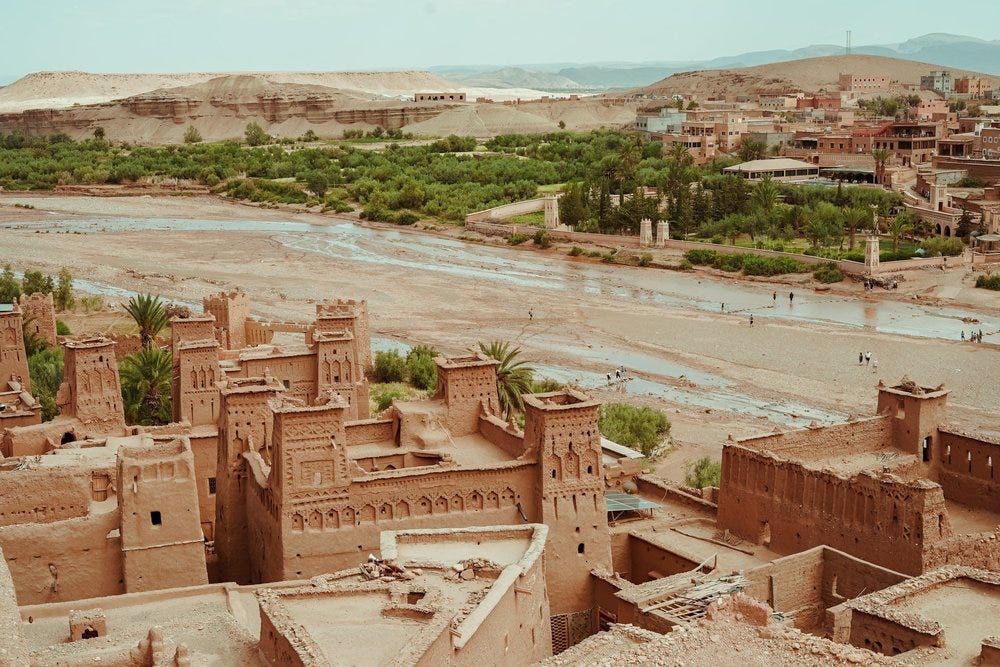
Morocco has been, for the better part of a century, the country other people’s writers go to when they need to be somewhere else. Mark Twain came through in 1867, on the way back from the Holy Land. Edith Wharton arrived in 1917 by motorcar, with the cooperation of the French colonial administration, and produced In Morocco three years later. By the 1950s, Tangier — at that point an International Zone, governed by committee and lightly governed at all — had become a literary capital of nowhere in particular: Paul and Jane Bowles, Tennessee Williams, Truman Capote, William S. Burroughs, Allen Ginsberg, Jack Kerouac. The country also has its own canon, written from inside, increasingly translated, and very much worth reading.
Six books, then, before you fly south.
Burroughs wrote Naked Lunch in Tangier between 1953 and 1957, in a small room at the Hôtel Villa Muniria, on a diet — in roughly equal proportions — of majoun and the hallucinations majoun produced. The protagonist is the junkie William Lee. The structure is non-linear by design; the chapters, Burroughs noted, can be read in any order. The prose is closer to dispatch than narrative. It is not a comfortable read. It is the book the rest of the Beat presence in Tangier was, in some sense, downstream of. Read it for the city the rest of the list will then complicate.
Eight essays drawn from the travel writing of Paul Bowles, the American composer-turned-novelist who first arrived in Tangier in 1931, moved there permanently in 1947, and stayed until his death there in 1999. The collection ranges across Sri Lanka, Turkey, Mexico, India — but the long shadow is Morocco, where Bowles spent fifty-two years recording, translating, and quietly disappearing into. He is the foundational expatriate of Moroccan literary tourism. Read this before The Sheltering Sky, not after.
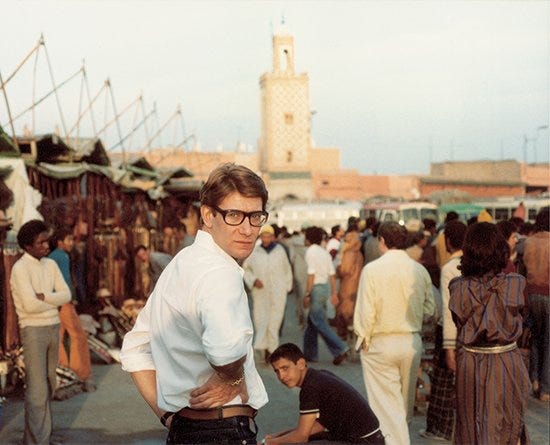
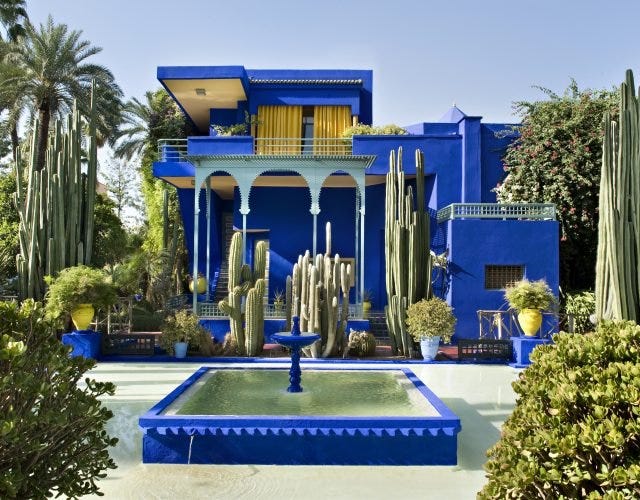
A double biography of Yves Saint Laurent and Karl Lagerfeld, set largely in Paris but with several long, well-reported chapters on Saint Laurent’s Marrakech: the 1966 trip with Pierre Bergé that turned into the purchase of Dar el-Hanch the following year; the second house, Villa Oasis, next door; the eventual rescue, with Bergé, of the Jardin Majorelle, which the two of them spent the rest of their lives restoring.
Once I grew sensitive to light and colours, Saint Laurent later said of the city, I noticed the light on colours… on every street corner in Marrakech, you encounter astonishingly vivid groups of men and women in caftans of pink, blue, green, and purple.
Drake’s chapters are the reason that quote travels.
A short novel by the Tangier-born scholar Anouar Majid. The narrator, Lamin, a young university student, meets an elderly man named Si Yussef in a Fez café. Over the course of twelve days, until Yussef’s death, the older man tells the younger his life story, and the novel becomes a quiet inquiry into memory, faith, and what is owed between generations. Often the first novel readers of contemporary Moroccan fiction are pointed to. There are reasons.
Lalami, born in Rabat in 1968 and a Pulitzer finalist for her 2014 novel The Moor’s Account, is one of the most accomplished Moroccan-born writers working in English. Conditional Citizens is her first essay collection. The argument, in brief, is that American citizenship is unevenly distributed — that the rights, protections, and liberties on offer are functions of who one is, not what the papers say — and that the gap between the formal and the informal definitions of belonging is the country’s defining political problem. Personal, sustained, sharper than the genre usually allows. The book that will probably push you to pick up Lalami’s fiction next.
Capote’s first work of non-fiction. A slim, slightly mannered collection of nine travel essays, of which the most useful for current purposes is Tangier — eighteen pages on the Petit Socco, the cafés of the medina, and the cast of European drifters Capote met in 1949. He was twenty-five. The piece is gossipy, sharp, occasionally unkind. It is the closest the column will come to a beach read. Pack accordingly.
For the second suitcase. In Morocco (1920) by Edith Wharton, dated but rewarding for the train-and-motorcar texture. The Sheltering Sky (1949) by Paul Bowles, the obvious next step after the essays above. Hope and Other Dangerous Pursuits (2005) by Laila Lalami, her first novel, set in Tangier and Casablanca. Three more, when you come back.
No posts
Comments
Nothing yet. Say the first thing.
Sign in to join the conversation.