
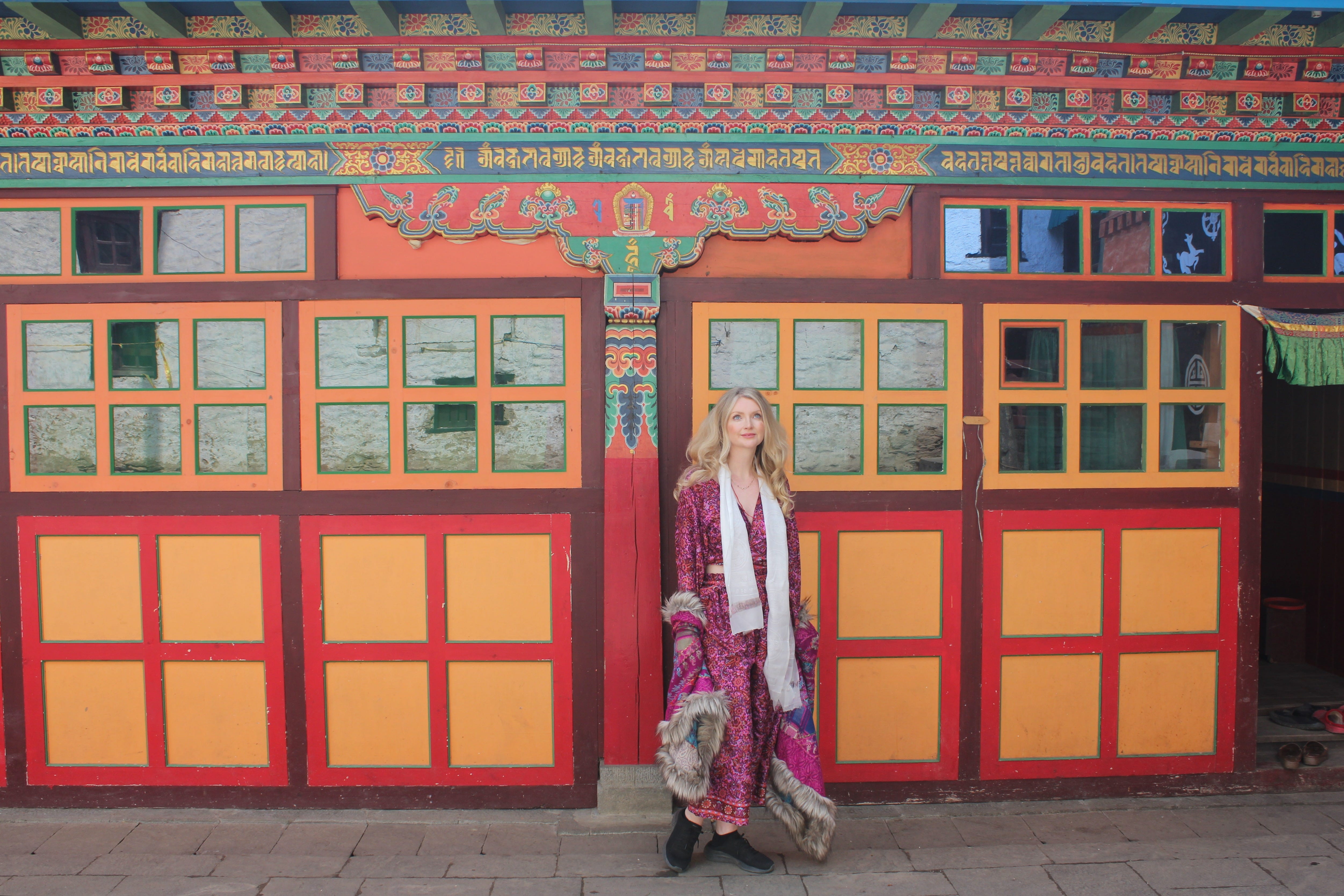
There are places where the veil feels thin, where the air shimmers with something just beyond reach. The Celts called them thin places—where the boundary between the material and the divine dissolves, where time folds, and the self blurs into something vaster. I’ve walked through many lands, but two places have whispered to me in a way that felt ancient and electric, as if my bones remembered them before I arrived: the Sacred Valley in Peru and Dharamshala in India.
The concept of thin places is deeply rooted in Celtic mythology. Peter Gomes, a Harvard theologian, describes them as sites where "the visible and invisible world come into their closest proximity," often found in landscapes like mountains and rivers, but also in profound human experiences of suffering, joy, and mystery. The Celts believed these places were doorways, places of transition where the ordinary dissolves into something extraordinary.
Sarah Blanton writes that thin places "pull me out of the shallow fray of my frantic life to rest in a centered awareness". These landscapes strip away the distractions of modern life, revealing something vast, something that has always been there, just waiting for the right traveler to pause long enough to see it.
We just ran a trip with the inspiring activist Nathalie Kelley and local Peruvian guide Abel with travellers who traversed the Andes into Machu Picchu. Before the trip, during a recording of the Three Places podcast, Nathalie said that Machu Picchu was that place for her. A Thin Place that transformed her perspective.
The Sacred Valley in Peru is a place where mountains inhale clouds and exhale mist, where the past does not sit behind you but presses against your skin, alive and listening. The Incas built here not just for defense or dwelling but in alignment with the sky, their stones breathing in celestial patterns. I walked through the terraces of Moray, where the earth dips in concentric steps, a sacred amphitheater of unknown origin. Some say it was an agricultural laboratory, a place of growth. But standing there, I felt the hush of something older, something that moved in spirals rather than straight lines, something that understood time differently. In the mornings, the Urubamba River ran silver, carving its way through the valley floor like a vein. I dipped my fingers in and let the cold sting through me, as if to be baptised in a place where gods still wandered.
Dharamshala sits curled in the folds of the Himalayas, where the prayer flags snap in the wind and carry whispered mantras up into the sky. It is a place of seekers, of exiles, of those drawn by an invisible thread. The Dalai Lama is one such exile. Monks in crimson robes shuffle down narrow streets, spinning prayer wheels that flicker in the light, setting prayers into motion. The air is thick with juniper smoke and the murmur of chants, a hum that vibrates through your ribs if you stand still long enough. In McLeod Ganj, I walked the path that loops around the monastery, past ancient trees and altars built from stacked stones.
Both places hold a stillness that hums, an absence of noise that is not empty but full. In the Sacred Valley, the silence is the echo of the Andes, vast and knowing. In Dharamshala, it is the hush of devotion, of a people who have carried their faith across borders and into the high reaches of the world. I have never believed that thin places must be quiet or still, only that they hold something more than what can be seen. In these places, the air itself becomes a thread between worlds, and if you stand there long enough, you feel the weave of it pulling you through.
To step into a thin place is to step into a liminal space, where the known world loosens its grip, and something ineffable rises in its place. Perhaps that’s why these places call to seekers, why they hum in the bones long after we leave. Because in these moments, however fleeting, we touch something beyond ourselves, and for a brief instant, we belong to it.
No posts
Comments
Nothing yet. Say the first thing.
Sign in to join the conversation.