

I’m queue jumping to see the Dalai Lama. Karma will be my judge. This is no concert crowd: no one flinches when I push in. The ladies behind me in the female queue just smile.
You can arrange a private audience with the Dalai Lama, or you can attend his rare public teachings. My preference? The public teachings. You get to see the kind of people that Buddhism and faith in the Dalai Lama produces.
Why did I jump the queue? I had already waited in line hours, only to reach the front and be told what no one had said: no phones allowed. I had a choice: run back to the hotel, and miss the teaching, or hide my phone under a rock. I chose the latter. Men loiter around the perimeter, selling plastic beads and soft drink cans and bags of nuts. I found a suitable rock near an unremarkable tree and say a prayer for my phone. I assume it will be gone on return.
Talk about a lesson in letting go.
Back into the queue I go, morally justified in jumping it, but realising that may not translate. No one judges me. Your actions have their own karma. While in the queue, there were a few times I thought I was being pushed, only to turn around and find an old woman, half my size, who has attached to your jacket for support so they don’t fall.
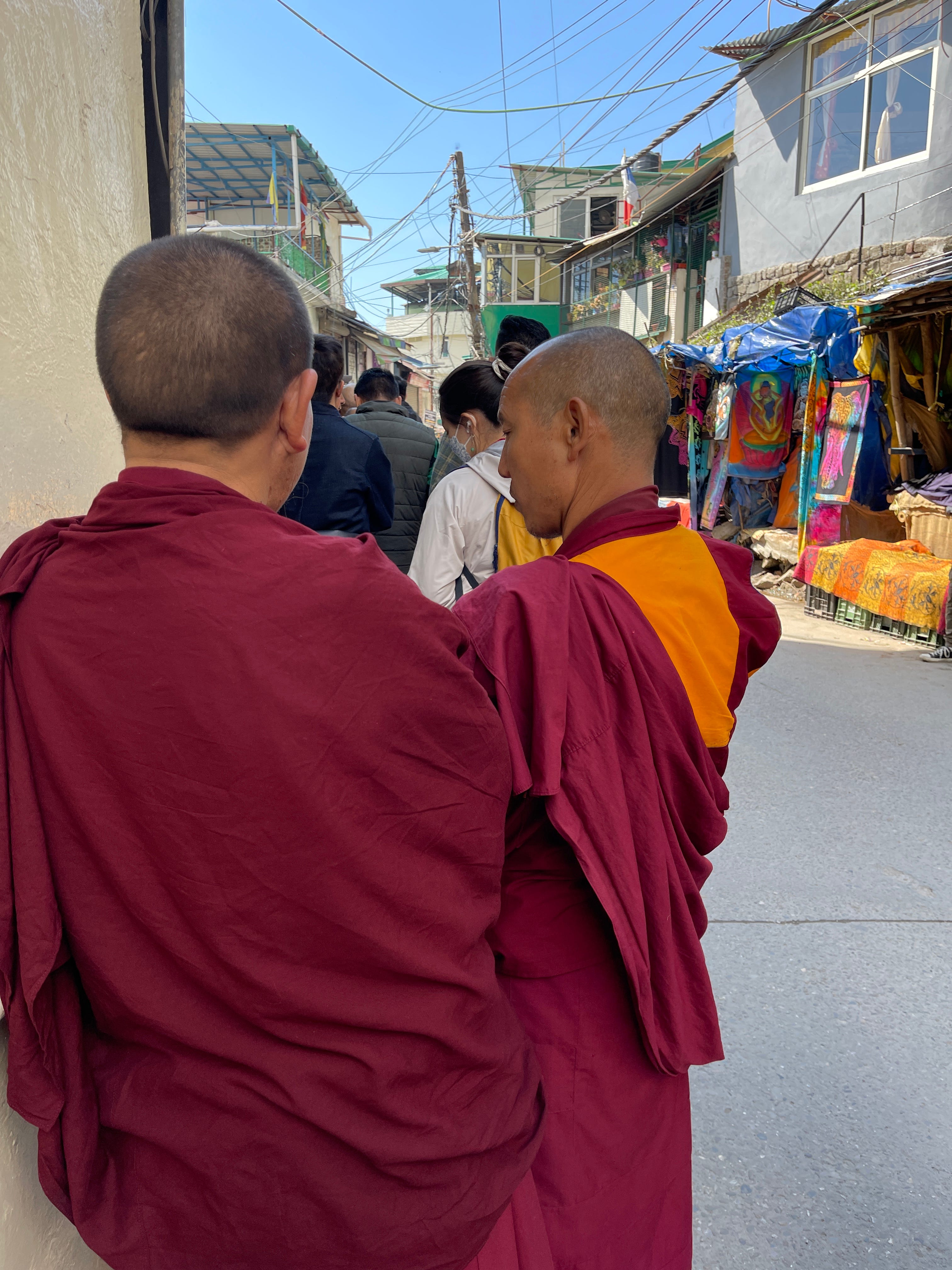
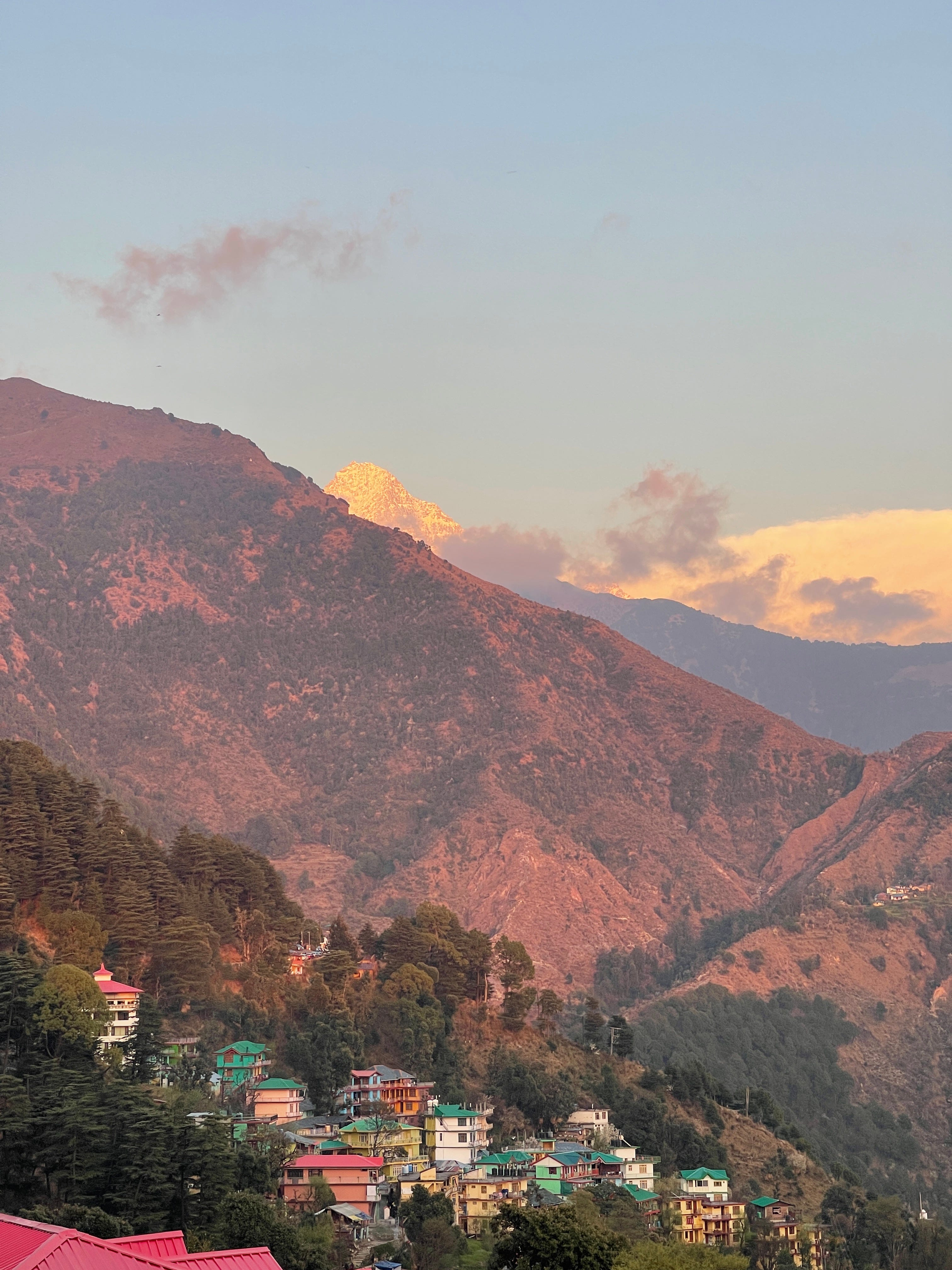
We are in the far north of India, Dharamshala. Dharamshala is a place of exiles, where faith and resilience shape the landscape as much as the Himalayas themselves. The town sits in a cradle of cedar-covered mountains, its narrow streets tangled with prayer flags that snap in the wind, sending whispered mantras into the sky. Wellness cafes spill the scent of turmeric lattes and fresh momos onto the streets, while monks finger prayer beads as they pass. It is a liminal space—a home for those seeking something they cannot name.
He enters the room with a large yellow umbrella, adorned with a tall yellow hat curled like a feather or a horn. Not everyone can see him. There are thousands of us sat on the ground, on cardboard and cushions. Just the sight of his saffron gown electrifies the room. Monks prostrate on the ground, Tibetans tear up. Foreigners raise prayer hands to their forehead and close their eyes.
The Dalai Lama does public teachings once a year, generally in March. On the first day, we find a space in the stage, sitting cross legged on a direct parallel line to the Dalai Lama. We bought an FM radio to hear the translation, but forgot the headphones.
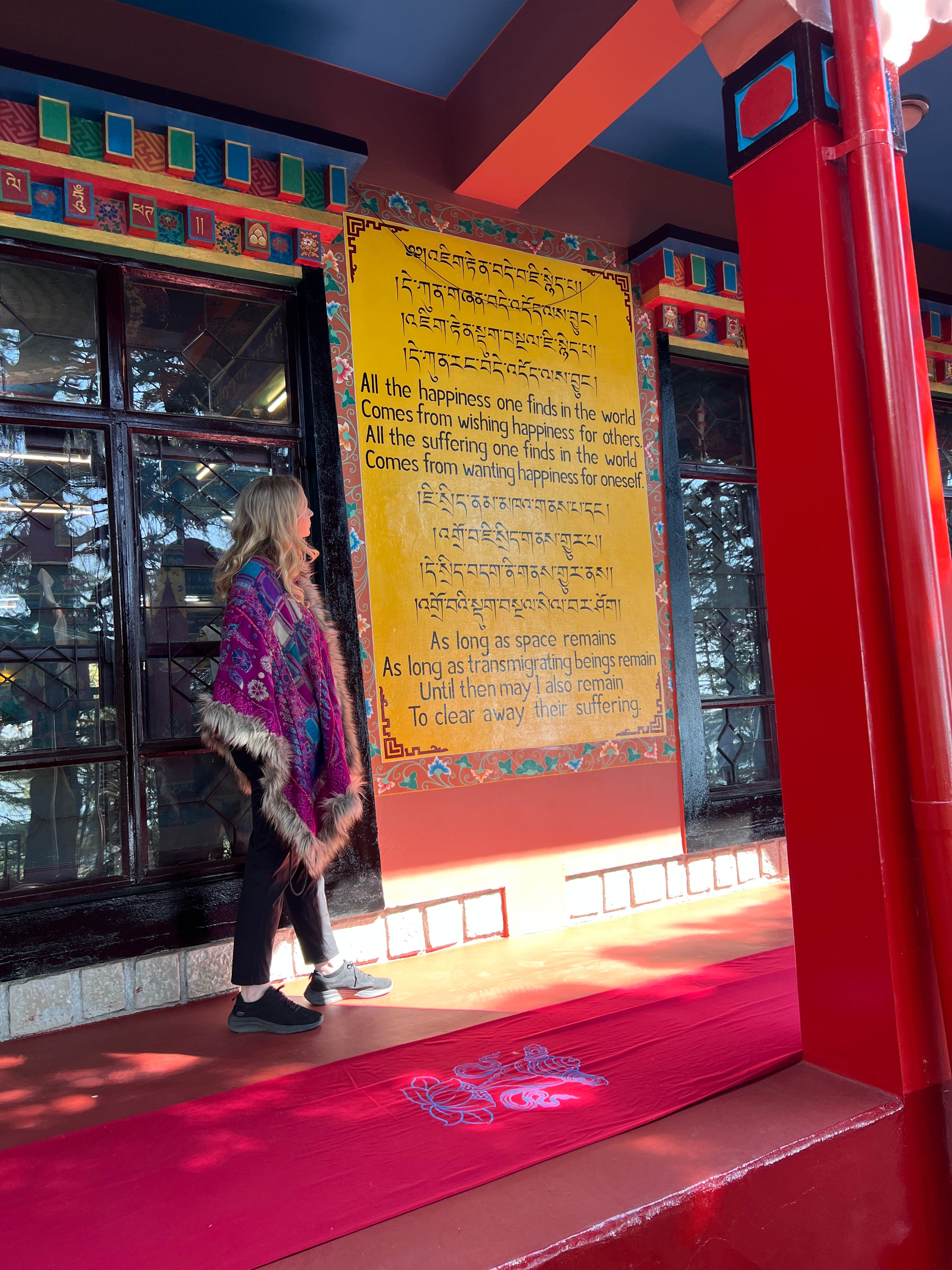
So Justin and I lean in to one another to her the static and the English translation over the tinny speaker, trying not to disturb the experience for the maroon robed monks all around us. Noticing our strain, suddenly a packet comes via a chain, handed from monk to monk, via around ten people. It’s headphones!
Justin has a bad back and struggles to cross his legs, so the monk allows him to lean against a pole, and keep asking him how his back is.
That afternoon, we sit amongst nuns, in the same pole position. The nuns find a spare cushion in the cramped quarters and send it along, physically pushing it behind his back to prop him up against the pole.
The central teaching from the Dalai Lama today: Stop self cherishing, for that is the root of all human suffering. Instead channel boddhichitta and think how you can help others.
The true win of a religion or belief is exemplified by the people who practice it, and never have I felt as held and as happy as sitting cross legged among monks with prayer hands and tears as they saw their inspiration.
The Dalai Lama tells us there are two ways to be happy. Englightenment via bodhichitta and appreciating the emptiness of being.
He make the teachings accessible. Read the scriptures, he says, but use logic first.
He tells of his personal story of exile. How the Chinese warlords knew that he was the reincarnation of the 13th Dalai Lama. There were three candidates. One boy died. The other boy was scared and shy of the questions, and when offered sweets, took a handful. The Dalai Lama answered all of the questions, and new things about the 13th Dalai Lama that he couldn’t have known. He was 3 or 4 years old (but if the 13th had just died, how is that possible? Was he born with the same soul?). The Chinese warlord offered him sweets, and the Dalai Lama took one for his mother and one for himself.
I see this teaching amongst the crowd too. The monk sat beside me has been chanting mantras for more than an hour before the Dalai Lama appeared. A lady near me offers a bag of hard pastries with cheese in newspaper. I take one, but am not hungry, so pass it to the monk on my left knee. He is so appreciative. He snaps it in half and offers it back to me. I decline, but this sharing is the spirit and energy we find ourselves in over the multi-level temple complex, filled with the energy of kindness.
The monks come out with large tins of yak butter tea and rice, and manage to serve everyone in the complex, the many thousands, stepping between crowded knees. We all help each other in spreading the food and tea.
I see the Dalai Lama on a threshold: in a few weeks I learn I am pregnant. In a few months I will settle down to a permanent base and home, and end to travelling for 16 months.
And under that rock, once the day is over, my phone sits, waiting patiently.
Comments
Nothing yet. Say the first thing.
Sign in to join the conversation.