
“AI Will Be as Common in Healthcare as the Stethoscope.”
Dr. Robert Pearl, former CEO of the Permanente Medical Group and clinical professor at Stanford University
Welcome to The ‘Med AI’ Capsule Newsletter—your go-to source for exploring how AI is transforming medicine! Whether you're a medical professional 👩⚕️, a tech enthusiast 💻, or simply curious 🧠, The 'Med AI' Capsule is for you! Stay ahead of the curve with the latest trends, insights, and updates in the rapidly evolving world of AI in medicine. 🚀
In today’s capsule:
5 QnA Primer
4 Research Picks
3 Learning Resources
2 Worth-Attending Events
1 Industry Spotlight, and more..
Time to Read: Around 8-10 minutes.
💬 5 QnA Primer
The concept for today is AMIE (Video): real-time audio-visual AI for clinical consultations.
Q1: What is AMIE (Video)?
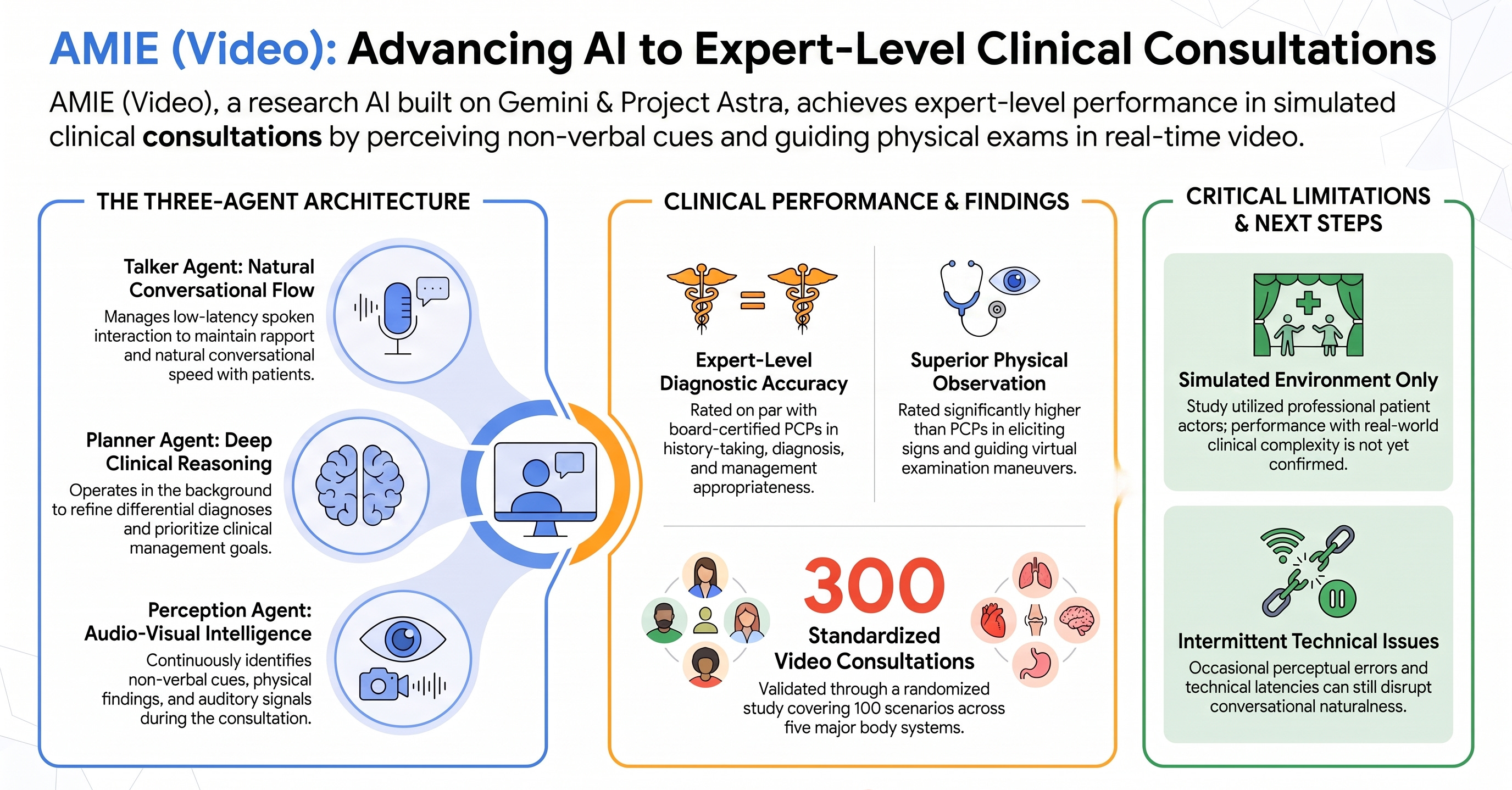
AMIE stands for Articulate Medical Intelligence Explorer. It is a research medical AI system designed by Google to conduct real-time video consultations. Built on Gemini and Project Astra, AMIE (Video) processes spoken dialogue, visual and auditory information, non-verbal clinical cues, and virtual physical-examination manoeuvres while performing diagnostic reasoning.
Q2: Why is video-based interaction important for clinical AI?
Clinical consultations rely on visual and auditory cues—such as gait, discomfort, and breathing—as well as guided physical examinations. Text-only systems cannot capture these cues directly, forcing patients to describe symptoms in writing and potentially losing clinically important information.
Q3: How does AMIE (Video) combine conversation, perception, and clinical reasoning?
AMIE (Video) uses three parallel agents: a talker for natural patient interaction, a planner for ongoing clinical reasoning and care planning, and a perception agent for interpreting visual and auditory clinical cues. This architecture enables smooth conversation while reasoning and perception continue simultaneously.
Q4: How was AMIE (Video) evaluated?
Researchers ran a multi-arm randomized OSCE study using video consultations across 100 clinical scenarios. 15 trained patient actors completed 300 standardized consultations comparing AMIE (Video), AMIE (Text), and video consultations with 10 board-certified primary care physicians. An independent panel of 20 experienced primary care physicians scored the consultations using standard clinical rubrics and case-specific criteria.
Q5: What did the study find, and what are the important limitations?
AMIE (Video) performed about as well as primary care physicians on core clinical tasks and did better at detecting physical signs and guiding virtual exams. Users also preferred the video interface over text. But the study used simulated cases with trained actors, so it shows promise rather than proven real-world clinical usefulness.
Further Reading
Palepu A, Schaekermann M. Advancing AMIE towards expert-level audio-visual clinical consultations. Google Research Blog, August 11, 2026.
🔬 Research Picks
Awareness, Perceptions, and Concerns among medical students regarding Artificial Intelligence integration in Healthcare: A Comprehensive Analysis | Niger Med J.: This cross-sectional study of 356 Indian medical students found that they had moderate awareness of AI in healthcare, but limited formal training. Many were concerned about job displacement, data privacy, diagnostic errors, and a possible loss of empathy in care. Still, over half viewed AI as valuable and supported adding it to the medical curriculum. The main limitations were self-report bias, WhatsApp-based sampling that may limit generalisability, and a questionnaire that may not capture enough variety.
Artificial intelligence in electrocardiogram-based prediction of heart failure: a systematic review and meta-analysis | Front Cardiovasc Med.: This systematic review and meta-analysis found that AI models using 12-lead ECGs can predict future heart failure with moderate-to-good accuracy (pooled AUROC 0.76), performing similarly to traditional risk scores across diverse ethnic groups; however, substantial study heterogeneity, limited external validation, potential bias, and a lack of prospective clinical-utility evidence mean that AI-ECG should currently complement—not replace—established risk assessment.
Comparative accuracy of artificial intelligence versus manual interpretation in detecting pulmonary hypertension across chest imaging modalities: a diagnostic test accuracy meta-analysis | Front Artif Intell.: This meta-analysis of 12 studies involving 7,459 patients found that AI-assisted chest imaging substantially improves pulmonary hypertension detection compared with manual interpretation. Although results were generally robust, significant variability and observational study designs limit certainty. Clinical adoption will require standardized methods, external validation, explainable models, and prospective trials demonstrating improved patient outcomes.
Implementation of AI for predicting antibiotic resistance patterns: A hospital-based study | Bioinformation.: This hospital-based study found that machine-learning models can predict antibiotic resistance from routine clinical and laboratory data; Random Forest performed best, achieving 90.5% accuracy and an AUC-ROC of 0.94, with microbial species, BMI, fever duration, and age as important predictors, supporting AI-assisted antimicrobial stewardship while highlighting the need for larger, standardized, and clinically validated datasets.
P.S. Each research pick title links to the original paper—do explore yourself for deeper insights, methodologies, and study limitations.
✨ Industry Spotlight
Evidenceo is an India-built medical intelligence platform focused on evidence-grounded clinical practice. Its core products include a cited medical encyclopedia, a doctor-facing evidence agent, and hospital deployments, all designed so every answer can be traced back to its sources.
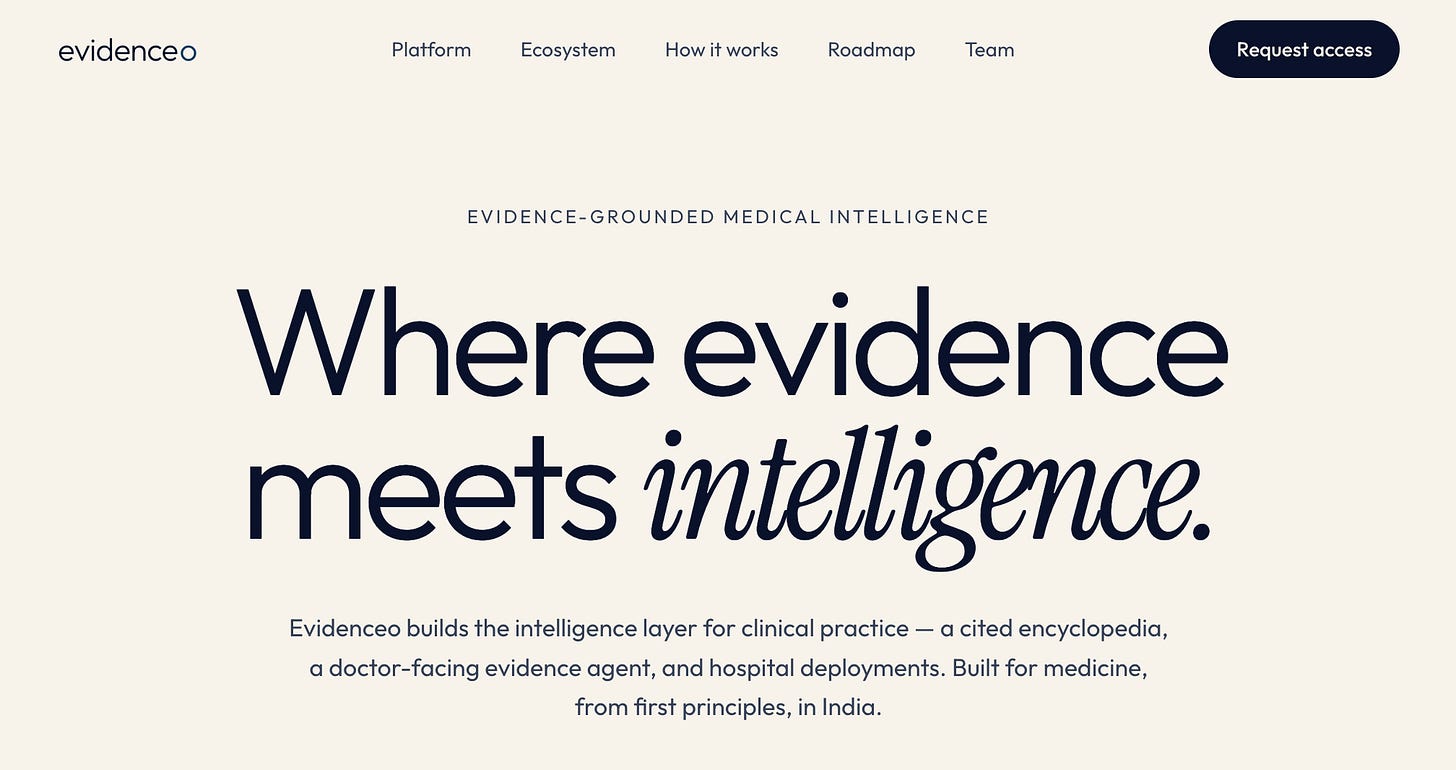
Unlike conventional generative AI tools, Evidenceo is designed around a retrieval, grounding, verification and citation workflow. Its systems use authoritative sources, link each factual claim to the exact supporting reference, identify gaps in available evidence, and subject safety-critical information—such as dosing, contraindications and drug interactions—to clinician review before publication.
*This ‘Industry Spotlight’ is editor-picked, not sponsored. Mention reflects interest, not endorsement.
📚 Learning Resources
This session, titled "Deployment Best Practices: From Validation to Phase IV Trials," explores the critical, ongoing challenges of maintaining Responsible AI in healthcare after a system is deployed.
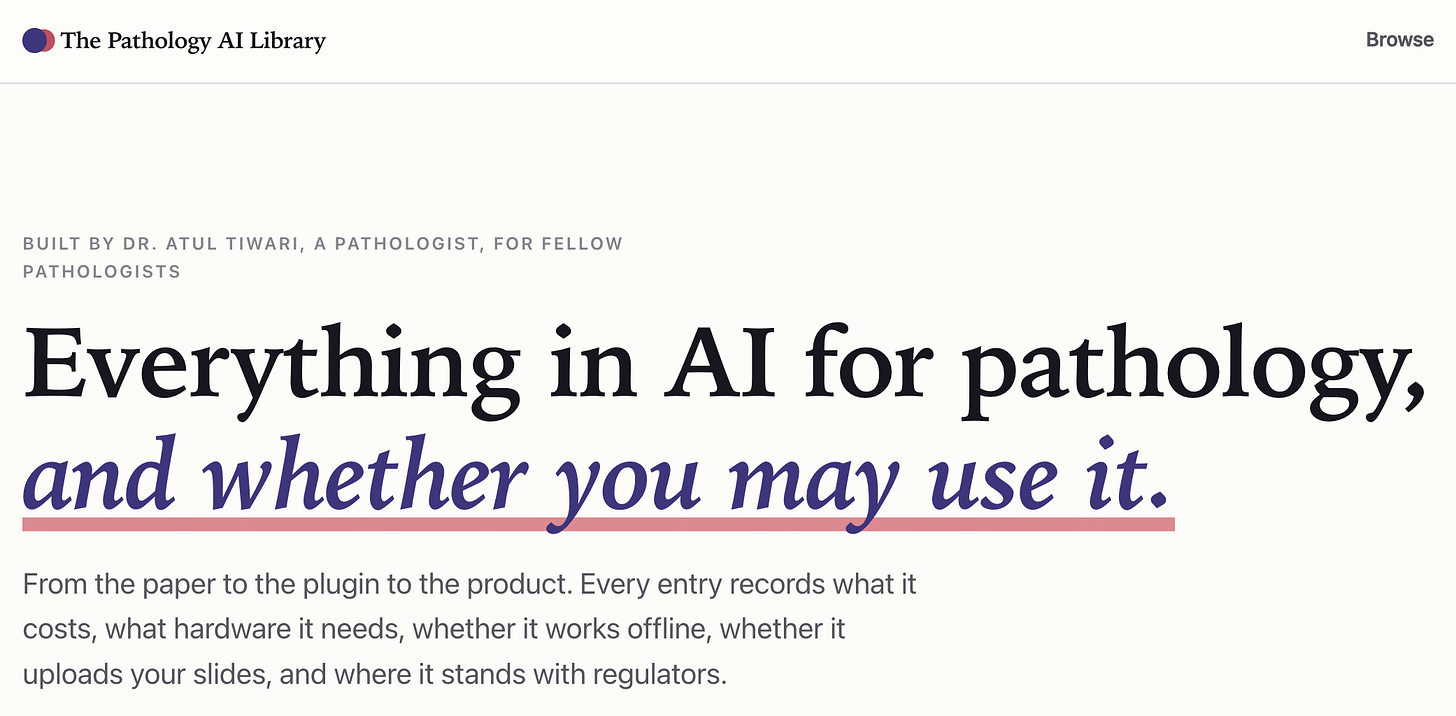
The Pathology AI Library—a continuously updated, curated catalogue of AI tools, models, datasets, and regulatory guidance for digital pathology, built by Dr. Atul Tiwari (a pathologist) for fellow pathologists.
Latest issue of the BrainX Waves newsletter, highlighting Generative AI for Responsible Evidence Synthesis in Health Professions Education, recent BrainX community activities, open medical datasets, and featured publications.

🧑💻 Worth-Attending Events

Your feedback is crucial to me, as it helps me understand your interests and improve my offerings. I would appreciate it if you could take a few minutes to share your thoughts about what you’ve enjoyed and what you think I could do better.
Let’s wrap it up with some latest news updates! 📰
Stanford researchers used AI-designed genomes to create self-replicating bacteriophages, highlighting potential medical applications alongside serious bioweapon and biosecurity risks.
Union Health Minister of India released a knowledge paper calling for faster, responsible AI adoption in India’s MedTech sector, with five priorities including better diagnostics, stronger regulation, and improved data/ reimbursement systems.
CDSCO (India) has clarified that AI and software-based medical devices will be regulated under existing Medical Devices Rules, with risk-based classification, clinical validation, cybersecurity and post-market monitoring requirements.
Stay tuned for the upcoming issues of my newsletter to explore the latest breakthroughs and dive deep into the transformative power of artificial intelligence, shaping a healthier future. 🚀
Disclaimer: The content in this newsletter was partly curated and summarized using AI, which can make mistakes. Please check all important information at your end. For any issues, please reach out at avneeshkhareonline@gmail.com.
Thanks for reading The 'Med AI' Capsule Newsletter! Subscribe for free to receive future issues in your inbox and support my work.
Comments
Nothing yet. Say the first thing.
Sign in to join the conversation.