
(If you have received this by email, please click on the title to read the latest version. I often correct typos and continue to edit my essays after publishing the first version).
A reader wrote to me recently, saying: ‘I had never believed it possible that there’d be another genocide, and that the world’s politicians would allow it to happen without doing everything they could to stop it.’ This reader is understandably shocked — not only by Israel’s livestreamed genocide, but by the silence of world leadership in the face of it. I completely empathise with her feelings. But the grim reality is that the world’s deafening silence in the face of Israel’s atrocities in Gaza, the West Bank and Lebanon is not the exception. It’s the rule.
This non-exhaustive list of mass atrocities and genocides since the Second World War is sobering.
Thanks for reading Avigail Abarbanel’s Fully Human Essays! Subscribe for free to receive new posts and support my work.
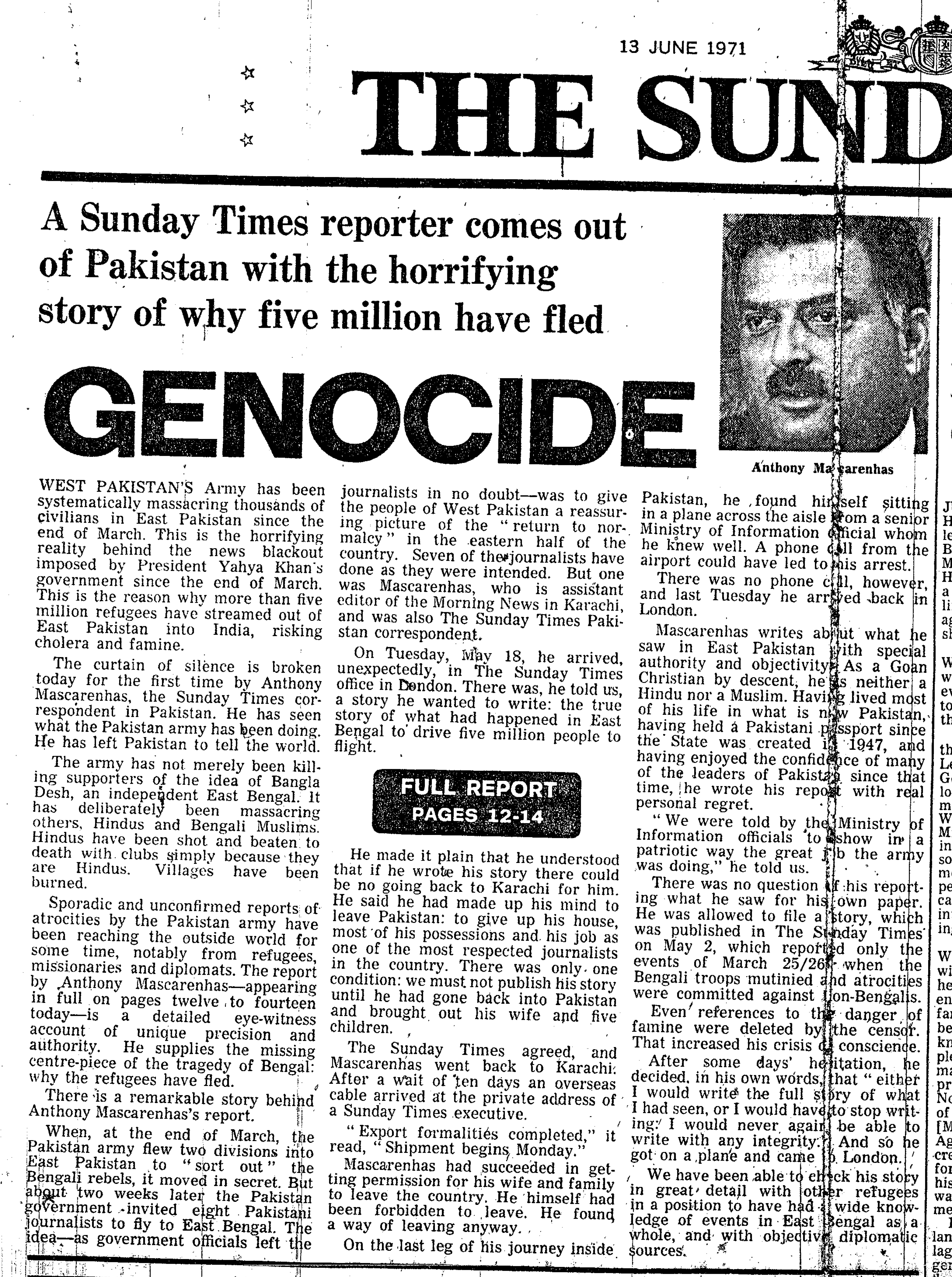
Bangladesh, 1971 — mass killings by Pakistani forces during the independence war. Death estimates range widely: 300,000–3 million. Some governments have contested the idea that this event can be formally classified a ‘genocide’. But the word genocide has been widely used by scholars.
Cambodia, 1975–1979 — Khmer Rouge killings, roughly 1.5–2 million dead. Legally recognised as genocide by a UN-backed tribunal (ECCC).
East Timor, 1975–1999 — Indonesian occupation. A UN-sponsored truth commission found mass killings amounting to at least 100,000+ deaths, with some scholars applying the genocide label to specific periods (esp. 1975–1980).
Guatemala, 1981–1983 — Maya genocide, part of the broader 1960–1996 civil war. A UN-backed truth commission found acts of genocide against Maya communities.
Iraq, 1986–1989 — Anfal campaign against Kurds, including the Halabja chemical attack (1988). Recognised as genocide by several national parliaments and courts.
Bosnia, 1992–1995, particularly Srebrenica, July 1995 — legally established as genocide by both the ICTY and the ICJ.
Rwanda, April–July 1994 — approximately 800,000 Tutsi and moderate Hutu murdered in around 100 days, internationally recognised as genocide.
Darfur, Sudan, 2003–2005 onward — declared genocide by the US government in 2004. The ICC issued genocide charges against Omar al-Bashir — President of Sudan 1993 to 2019.
Yazidi genocide, Iraq/Syria, 2014 — by ISIS. Recognised as genocide by the UN, EU, US, UK, and others.
Rohingya, Myanmar, since 2016 — recognised as genocide by the US government (2022) and is the subject of an ongoing ICJ case (Gambia v. Myanmar).
Uyghurs, China, 2017–present — the US, Canadian, UK, and other parliaments have made genocide determinations. China disputes this.
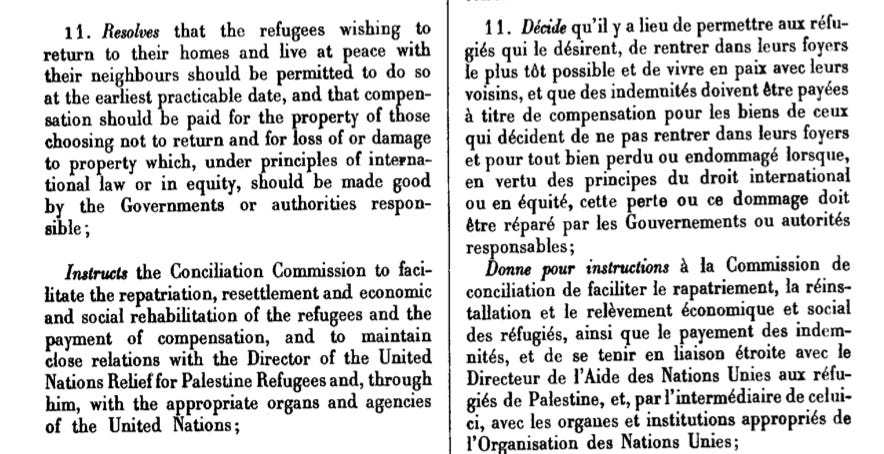
The Nakba, 1948 — Around 700,000–750,000 Palestinians were forcibly expelled during the 1947–1949 period. UN General Assembly Resolution 194 (III), adopted in December 1948, affirmed in Article 11 that refugees wishing to return to their homes ‘should be permitted to do so at the earliest practicable date’, with compensation for those who chose not to return or for loss of property.
The UN specifically instructed its Conciliation Commission to facilitate that repatriation. As you would expect from a settler-colonial project that has always intended to remove the non-Jewish indigenous people of the land and replace them — Israel completely ignored this.
Either by ignorance or deliberate deceit, the UN General Assembly treated the expulsion of the Palestinians as a consequence of war, after which the victors would presumably allow the refugees to return and live alongside them. But the UN Resolution never left the matter entirely to Israel’s ‘good will’. It provided for quite specific international intervention, even naming the bodies that would facilitate the return of the refugees.
What happened to that provision? Why wasn’t it enforced?

In the same year the international community pretended to care about Nazi Germany’s crimes, it established the Convention on the Prevention and Punishment of the Crime of Genocide. That same year, the fledgling, self-declared Israeli settler-colony systematically and deliberately ethnically cleansed more than half of the Palestinian population. It committed massacres and gang rapes1, destroyed 500 Palestinian villages and towns, countless homes, and public buildings, looted, stole Palestinian land, and condemned the people and their descendants to statelessness in refugee camps or displacement around the world. Their descendants remain stateless or in refugee status across the region, including in Gaza, to this day.
How does the world allow this to happen, over and over again? One mechanism, above all others, secures the world’s collusion and silence: the dehumanisation of victims.
Israel is not content merely to remove every last Palestinian from historic Palestine and erase them as a people. Like the Nazis before it — not content merely to kill those they deemed undesirable in their ‘racially pure’ state — Israel wants to erase its victims’ very humanity, in the eyes of the world.
Without bystanders and collaborators, perpetrators would find it extremely difficult to commit the crimes they do. If they can weaken support for their victims and secure the silence and collusion of others, they can act with impunity, unchallenged and unopposed. One of the main tools for securing silence, indifference, and support for atrocities is the dehumanisation of victims. All colonial and settler-colonial regimes have used it. We see it closer to home in the UK’s anti-immigrant — or rather anti-human — right-wing community delusional yearning for Britain’s imperial past. These people, who don’t see colonialism as an atrocity and who feel nothing for its victims, routinely dehumanise asylum seekers and immigrants. But nowhere is dehumanisation more lethal today than in Israel’s annihilationist assault on the Palestinians.
A March 2025 survey found most Jewish Israelis support the mass expulsion of Gaza’s population, and nearly half endorsed killing every inhabitant of a conquered city, as in the biblical conquest of Jericho. This is not a public reluctantly enduring what its government does in its name. Dehumanisation is what makes the callousness toward Palestinian life possible, what enables widespread torture, and what secures impunity for the perpetrators.
We have always dehumanised victims to justify to ourselves why we harm people, or why we do so little when we learn of the harm done to them. As a reactive, primitive species, we have always treated victims appallingly. Looking at deeds rather than words, our track record throughout history is dire. For a species with such potential, we keep placing the worst among us in charge. They do what you would expect, which build and sustain the destructive, cruel systems that taint and destroy everything good about life and humanity.
So the world failing to intervene to save the Palestinians from annihilation, and the sadistic cruelty that underlies it, is in fact the norm, not the exception. This is what we do. This is our real legacy. Humanity dehumanises repeatedly and consistently, which allows it to continue committing atrocities with impunity, in full view of everyone. Our history is soaked in our own blood, and our record proves we don’t care.
A note on paid subscriptions
Substack encourages writers to activate paid subscriptions. When people pay for subscription or make a one-off donation Substack take a small cut. I am grateful to the readers who have pledged money for monthly or yearly subscriptions, but I have no intention of monetising my work and this is not enabled on my page.
I don’t want to turn my writing into an obligation, but even more importantly, I don’t believe in a tiered system where those who can pay get preferential treatment over those who can’t, such as the right to comment, or privileged content. This hierarchy of ‘worthiness’, especially based on such an arbitrary principle like how much money people have, couldn’t be further away from my values.
If you do feel moved to support my writing, please use the ‘buy me a coffee’ button below. If you haven’t seen it before, it is a way of offering a donation to freelance writers. Payments are processed securely by Stripe on the ‘Buy Me A Coffee’ site. Donations can be made anonymously.
My writings will always remain free to all.
Thank you for reading my work!

Thanks for reading Avigail Abarbanel’s Fully Human Essays! Subscribe for free to receive new posts and support my work.

Comments
Nothing yet. Say the first thing.
Sign in to join the conversation.