

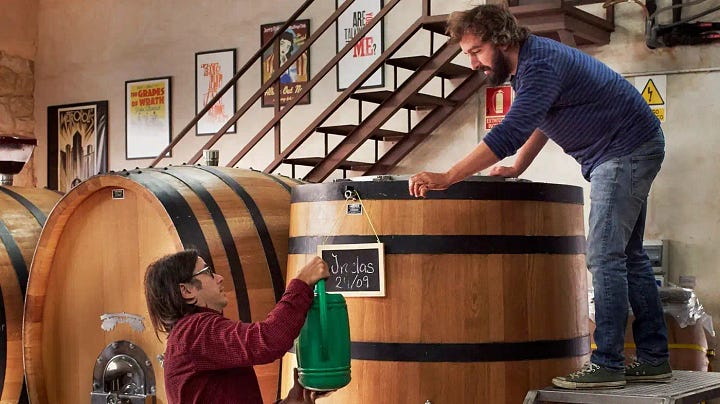

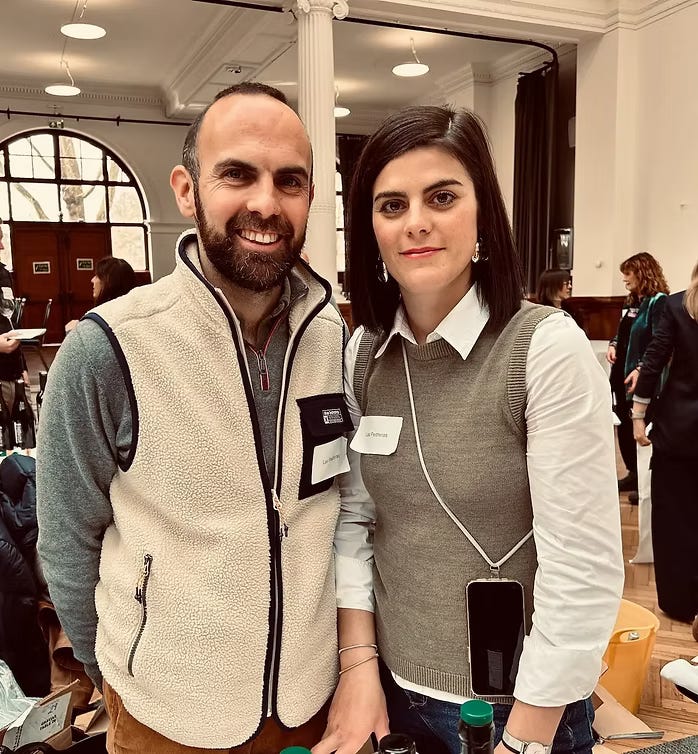
Daniel Landi grew up in what felt like the back of beyond. Despite being only 45 minutes’ drive south west of Madrid, the area around the small town of Méntrida, nestled in the Sierra de Gredos mountains, was not a prosperous place. Few young people stayed. When Landi planted his first vineyard in 2001, even fewer dreamt that the old Garnacha vines on this poor soil would ever produce anything but basic table wine. Landi, who started making wine in 2004 for his family’s wine estate, Bodegas Jiménez Landi, says, “I grew up feeling that Garnacha was worthless.”
Fast forward 25 years to a room in London’s Soho, where a packed audience of the British wine world’s great and good, Jancis Robinson MW in attendance, are listening to Dani and his collaborator Fernando García talk about their wines from the Sierra de Gredos and their Comando G project. There is a buzz to the gathering not quite like any I can recall: the closest wine comes to the presence of rock stars.
It was an emotional moment for some of the seven other Gredos producers present. “l’m making big efforts to not cry,” confessed Vinícola Méntrida’s Curro Bareño, while other producers were visibly nervous. More than one spoke only poor English. But the wines did not disappoint.
The interest of these new-wave Garnachas – light, fresh, mineral, elegant – was enough in itself to make this an unmissable tasting. But I was just as interested in the whole phenomenon: how a cult wine is made, unbacked by big money in the style of, say, starry Californian projects. Instead, Sierra de Gredos Garnachas emerged from the wastelands of rural Spain, the depopulated heartlands of España vacía (empty Spain) through sheer hard work, determination and bloody-mindedness on the part of a handful of pioneers, first and foremost Landi and García.
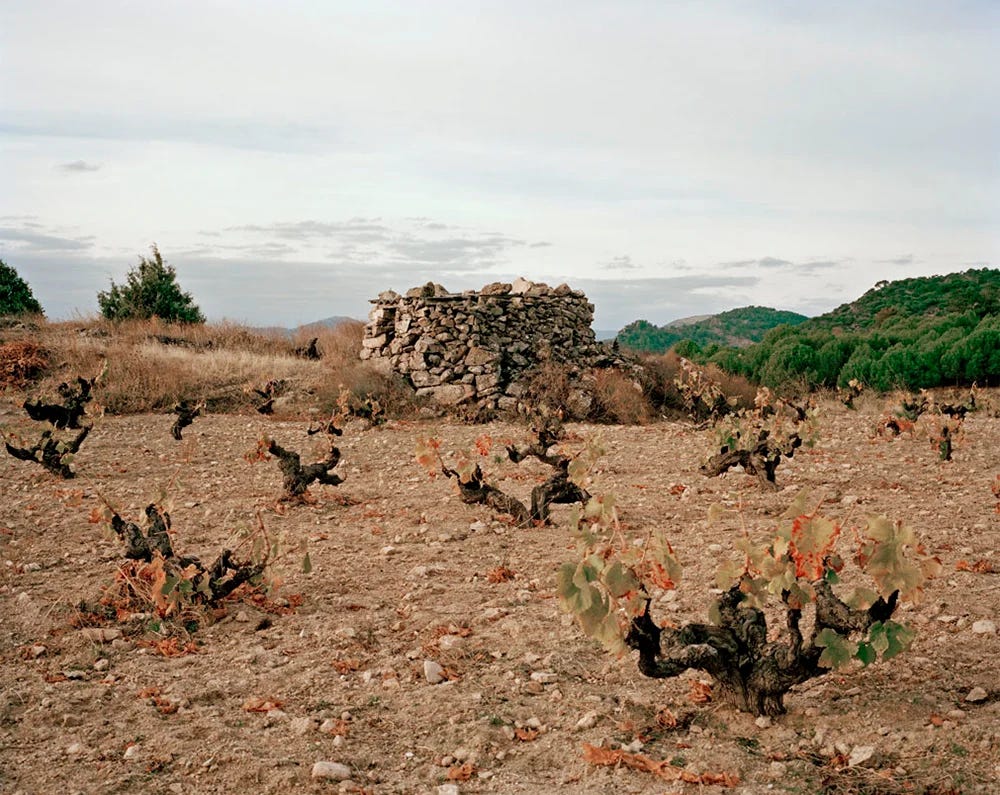
Indeed in the case of Sierra de Gredos, it is not so much about a cult wine – though certainly Landi and García’s wines are that – as a cult status to the whole area and the producers who have embraced its new style. All of the winemakers present last week, and others in the region, focus on Garnacha, though also cultivate other grapes. Their plots of bush vines are mostly ancient – many 50-80 years old – and at high altitudes up to 1200 metres. Most can only be worked by hand or with horses, and are cultivated organically or biodynamically. Burgundy is a lodestar for Landi and García, who seek to draw out their own region’s myriad variations between plots of soil, altitude and aspect. And their wines are 100 per cent whole-bunch fermented, adding to their freshness, and only very gently pressed.
This marks about as big a turnaround for a wine region as is possible to imagine. In the late twentieth century, Sierra de Gredos was a backwater dominated by cooperatives making bulk wine. It straddles three denominaciones – DO Cebreros, DO Vinos de Madrid, and DO Méntrida, while all the wines from here can also be labelled with the lesser classification of Vino de la Tierra de Castilla y León. Large numbers of vineyards had simply been abandoned – testimony to rural depopulation and the decline of the local wine industry from the 1980s. While Rioja modernised in the 1960s-70s, there was little new investment in Méntrida, which continued to churn out bulk red wine of precisely the kind whose Spanish domestic market was declining.
The first new wine producer in the area was in fact the ubiquitous Telmo Rodriguez with his Pegaso estate in Cebreros, from 1999. Then Landi and García met at university in 2005 while studying oenology and in 2008 founded Comando G (the “G” stands for Gredos, Garnacha and granite, the predominant local terroir.) They sought out old vineyards, and swam against the tide with their reinterpretation of Garncacha, then regarded here as in much of Spain as a workhorse red grape. They worked the first ten years with no salary – “we were completely exhausted,” says Landi. Finally their wines started to win critical acclaim, getting their first 100-point score from Robert Parker’s Wine Advocate in 2018, when the magazine’s Luis Gutiérrez declared Landi’s Rumbo al Norte 2016 one of his wines of the year.
“All the wines were getting rave reviews, because they showed the best of low-intervention winemaking,” says Doug Wregg of importer Les Caves de Pyrene, organiser of last week’s tasting. “The wines were less extractive, more elegant, more floral, more mineral, more energetic, and less about the power and the oak veneer.” Pegaso technical director Aitor Fernández puts the style down to the area’s poor soils, low rainfall and hot summers: “All this means that the Garnacha ripens with edges.”
But the Sierra de Gredos wines are also the leading edge of a wider stylistic trend in Spanish wine.
Rioja set the pace in Spain from the mid-nineteenth century, not only the best-known wine region but also establishing winemaking norms. Primary among these was the use of oak barrels, itself an idea borrowed from Bordeaux. Most Riojas are still classified first according to how much time they have spent in barrel, rather than exactly where they’re from. Thus, beyond the basic classification of Joven (“young”), there is, for red wines, Crianza (at least one year in barrel and one in bottle before release), Reserva (at least one year in barrel and two in bottle) and Gran Reserva (at least two years in barrel and three in bottle. I wrote about this last year.)
This system was then borrowed lock, stock and, er, barrel in the late twentieth century by Ribera del Duero and other Spanish regions including Navarra and Penedès (the time required in oak for Crianza is less in some of them). Even in places that didn’t adopt the classification system, the gospel of new oak barrels remained strong, notably in Priorat, the Catalan region which, alongside Ribera, was the rising star of the 1980s and 90s. And with that often went quite aggressive extraction in macerating red wines. The result: big, tannic, oaky wines – brooding monsters, indeed, in the case of a number of Priorats.
This started to change with a generation of Spanish winemakers questioning the reliance on oak. Rafael Cambra, a talented winemaker from the south of Valencia province, once told me how, when he first trained and worked in Rioja the 1990s, “Priorat was the model,” and so when he started his own winery, he used oak barriques. But, he says, “We’ve realised the wines don’t need new oak. You need balance to age wines, not extraction and power.”
The contrasting styles are often labelled “Mediterranean” (for old style, more extracted, oakier wines) and “Atlantic” (for lighter, fresher ones) – though that is obviously an over-simplification. But in Rioja, a growing band of winemakers are making wines that emphasise terroir first and use less oak – such as Roberto Oliván at Tentenublo and Arturo de Miguel at Artuke. Meanwhile in Priorat, working with Garnacha, Sara Pérez of Clos Martinet started experimenting with the use of larger barrels, concrete and clay amphorae instead of 250hl barriques. And in the Sierra de Gredos, Landi and García championed the new style of Garnacha with even more emphasis on freshness and minerality, indeed almost like a Pinot Noir in many of the new renditions of it.
What is fascinating to me – and the thing that makes Spain one of the world’s most exciting wine scenes at present – is the openness to new ideas and experimentation. Partly it is the effect of a new generation of winemakers starting to make wines over the past 15-20 years. Partly it is the influence of lower-intervention styles of winemaking. Yet there are also younger winemakers in Bordeaux and Champagne, for example – and there is no serious stylistic innovation there. Perhaps the Bordelais and Champenois found a winning formula and just stuck to it; Spanish winemakers have had to work harder to get noticed.
I’m glad that they have been in Sierra de Gredos. It’s easy to become cynical about the hyping of cult wines and obsession with international critics’ scores, amid the antics of the current annual en primeur circus. But Comando G built their name and a new reputation for their region the hard way, and their wines are what they’re reputed to be. They richly deserve their success.
A Pie de Tierra “Fuerza Bruta” 2024, Méntrida – David Villamiel and Aitor Paul make wine from plots of forgotten, 90 year-old Garnacha bush vines. Light, with herbal notes, quite firm tannins but elegant (The Sourcing Table have the 2023, £27.60.)
A Pie de Tierra “El Surco” 2024, Méntrida – this wine wasn’t at the tasting but canny Wine Society Spanish buyer Harriet Kininmonth has just snapped up an allocation. Quite pale, elegant, peppery with firm tannins (The Wine Society, £18.)
El Reventón 2023, Cebreros – Adrianna Catena, of the famous Argentine winemaking family, and collaborators acquired Landi’s El Reventón vineyard and since 2023 have made wine here. At 960m of altitude and planted 1943, this is extreme mountain viticulture, producing no more than 2,500 bottles a year. Smoky, herby, firm tannins; elegant and long (Uncorked, £69.95.)
Las Pedreras “Pelito Lindo” 2023, Cebreros – this husband and wife team are winemaker Bárbara Requejo, who has worked in Bordeaux, New Zealand and elsewhere, and Guzmán Sánchez, a chef whose family owned organic vineyards in the Sierra de Gredos. They make a maximum of just 1,300 bottles of this from old-vine Garnacha. Fragrant, sweet fruit, ethereal and long – one of the most impressive wines at last week’s tasting (importer Graft Wine doesn’t appear to have this in retail outlets yet - look out for it on select restaurant wine lists.)
Rico Nuevo “Barrera de Sol” 2021, Cerebros – Juan Andrés Martín makes wine from 80 year-old vineyards; Landi was his mentor. This is an earthy wine, herby, elegant and balanced, yet somehow wild (Museum Wines, £42.98.)
Comando G “Rosa Premier” 2017, Méntrida, en magnum – a rarity served as a treat at the tasting, and indeed this vintage and bottle format isn’t available in the UK. Very pale, its colour fading to an orange-brown already; fragrant, elegant, balanced and very long (Brunswick Fine Wines, Atlas Fine Wines and other have other vintages, from £40.79.)
Aside from the Gredos tasting, the past week has featured a fair cross-section of the kind of trade tastings I attend. Most of the time I’m looking for ideas and/or researching for particular stories – which you read the results of in this Substack. But to give you more of an idea of the raw material, this is what I’ve been tasting.
Tim Atkin MW’s The Best of South Africa – Tim started off as a wine journalist but in recent years has moved more into producing big reports on a series of wine regions – and hosting large trade tastings based on some of them. He’s an expert on South Africa and very well connected – so this tasting promised to be a great showcase, which it was. It was huge, though – over 350 wines – and I’ve got to a point where I just can’t physically handle tasting more than about 80 tops. So I was extremely selective and tasted about 30 wines.
Favourite wine tasted: Reyneke Estate Syrah 2023, Polkadraai Hills, Stellenbosch – I love Johan Reyneke’s biodynamic wines, though didn’t taste this one when I visited his winery last year. Bright, dark fruit, black pepper, crunchy but well balanced tannins, long – a serious Syrah (The Wine Society, Elementary Wine, James Nicholson and elsewhere, from £28.)
Sainsbury’s Spring/Summer 2026 press tasting – I’ve started going to supermarket tastings again, in response to reader demand, but it’s a frankly thankless task. Sainsburys is generally viewed by wine critics as somewhere near the middle of the pack: not as promising as Waitrose, not as grim as Lidl. This tasting was in fact pretty dreadful, though at least they had nice cheese and other snacks.
Worst wine tasted: Taste the Difference Non-Alcoholic Shiraz 2025 (£6.50) – never let it be said that I am close-minded in my tastes: I’ve never tasted a drinkable non-alcoholic still wine but thought I’d check to see if maybe the technology had improved a bit. It hasn’t: this was utterly revolting. To call it paint stripper doesn’t do justice to the nasty fecal notes. Avoid.
Best wine tasted: Taste the Difference High Altitude Malbec 2023, Mendoza (£13.75) – this is made by Pamela Alfonso at Alta Vista, a big French-owned Argentine winery, who are OK. Sweet bramble fruit, vanilla and a lick of oak, soft tannins. It wouldn’t really be my choice though I’d happily drink it.
Bordeaux En Primeur 2025 – wine writer Henry Jeffreys recently wrote that he detects a softening of Bordeaux producers’ arrogance, more actively courting journalists, and on the strength on this tasting I’d agree. Organised by wine consultancy Winelister, it showcased the current en primeur 2025 wines of 18 top Bordeaux producers – unusual since you normally have to go there to taste these now. Even more unusually, they each showed a mature vintage alongside the 2025s – mostly 2000s, though some others, such as Château Phélan Ségur’s 1990. Sadly, I was left a bit cold by most of them, which wasn’t what I was expecting from the likes of Château Lafite Rothschild 2000 en magnum et al. Most of the 2025s were surprisingly approachable for their age; conversely, the tannins were still pretty firm on the older vintages. But the two sweet wines on offer were utterly glorious.
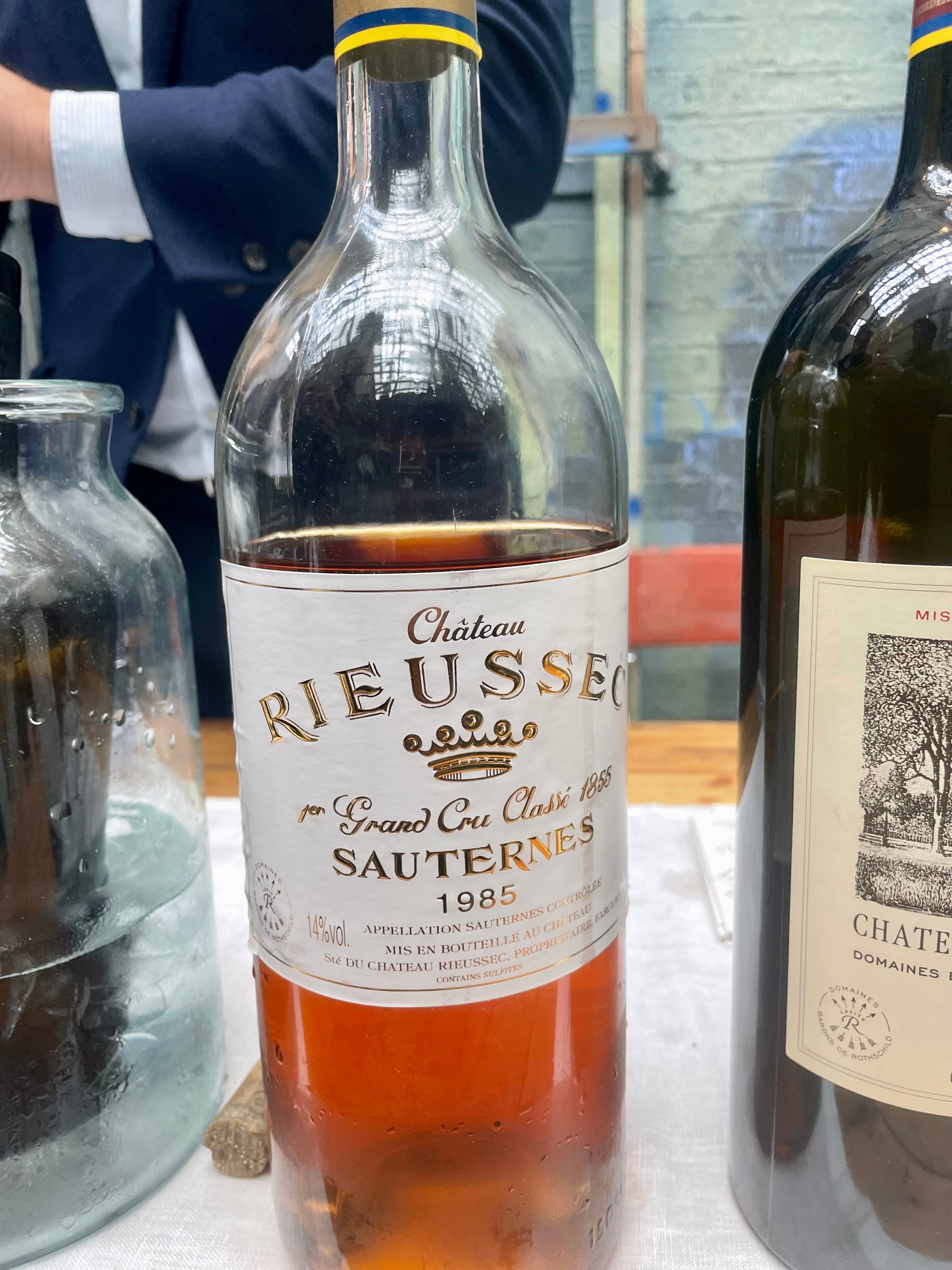
Best wine tasted: Château Rieussec 1985, Sauternes, en magnum – its colour darkened a deep amber, this is an astonishing wine: deep, rich layers of flavour, caramel, butterscotch, yet still a seam of acidity. So long: just goes on and on. Wow! (Matteo Lupi Wines, £83.40 for a 75cl bottle.)
Transparency declaration: Tim Atkin MW is a friend and also employs me to write a regular column on his website.
No posts
Comments
Nothing yet. Say the first thing.
Sign in to join the conversation.