
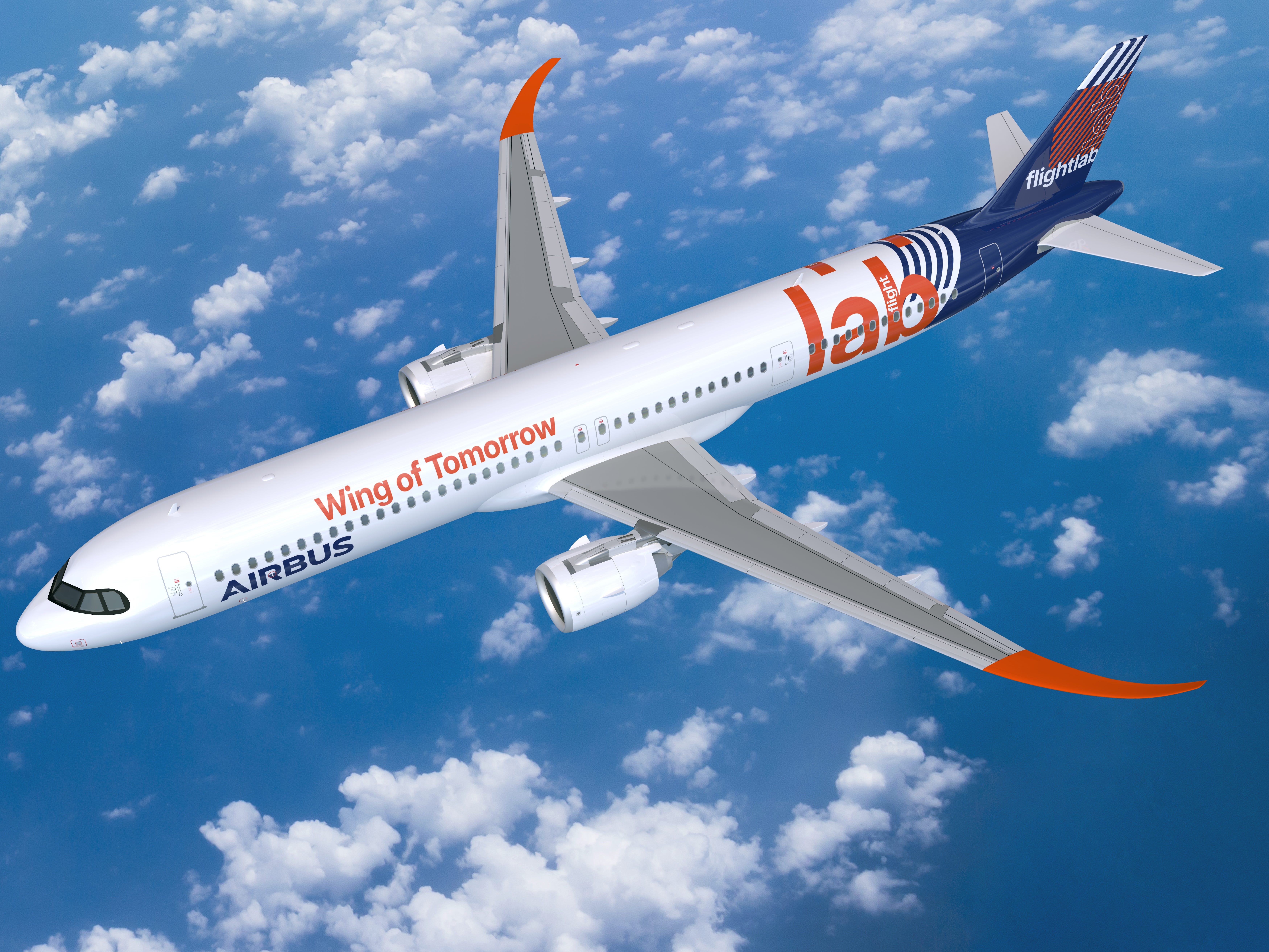
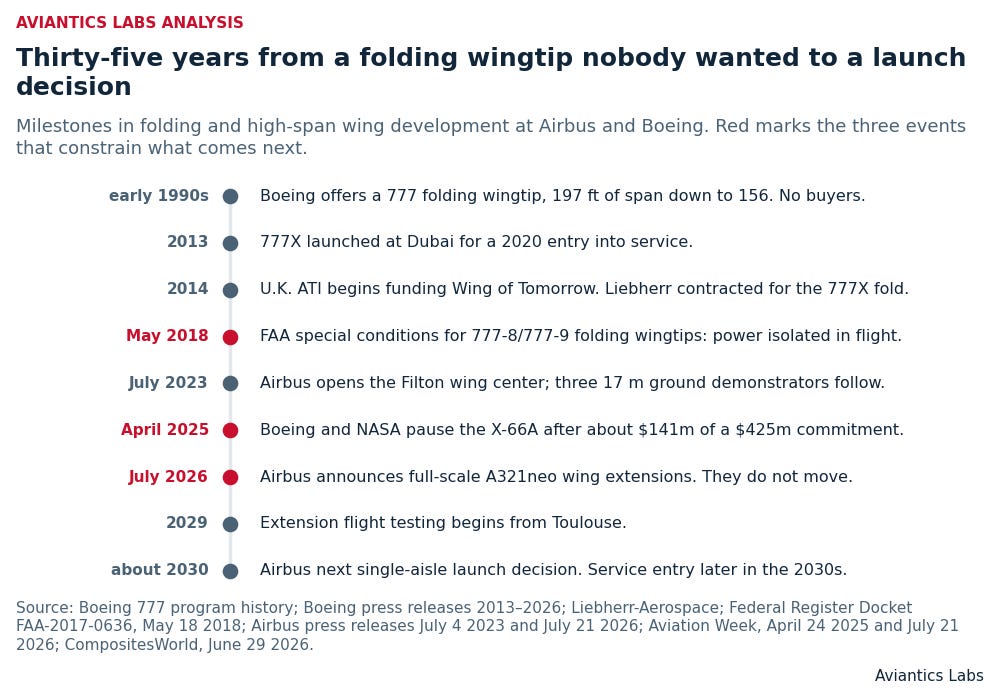
On July 21 at Farnborough, Airbus said it would spend three years designing, building and flight-testing full-scale wing extensions for an A321neo. Each extension runs several meters. They get comprehensive instrumentation, they fly out of Toulouse, and they do not move.
The release is explicit about that last part. The extensions “replicate a folding wing in the fully extended position during a flight.” Airbus is going to flight-test a folding wing without flying a fold.
Most of the coverage read the announcement as Airbus getting on with the next single-aisle, which it is. The more interesting question is what the program has been cut into, and where each half is being flown. Span goes on the A321neo. The hinge goes on a business jet at Cazaux, in southwestern France, remotely piloted, by the end of this year. Neither aircraft is the production configuration, and the gap between them is where the next narrowbody’s largest unanswered question lives.
Boeing has been here — different wing, different aircraft class, different reason. Boeing is also the only manufacturer on earth that has built a folding wingtip for a production airliner, taken it through a regulator and put real flight hours on it. What that process produced is a Federal Register document from 2018, and it does not point where Airbus is going.
36.00 meters is the ceiling of ICAO aerodrome reference code C, which runs from 24 meters up to but not including 36, and Airbus prints the A321neo at 35.80. Twenty centimeters of headroom. The FAA’s equivalent, Airplane Design Group III, runs to 118 feet against a published 117.45, which is about six and a half inches, and Airbus’s own airport compatibility documentation puts the A321neo in that box.
Twenty centimeters is the entire design freedom the world’s best-selling airliner family has in the lateral dimension, and it has been that way since the aircraft entered service in 1988.
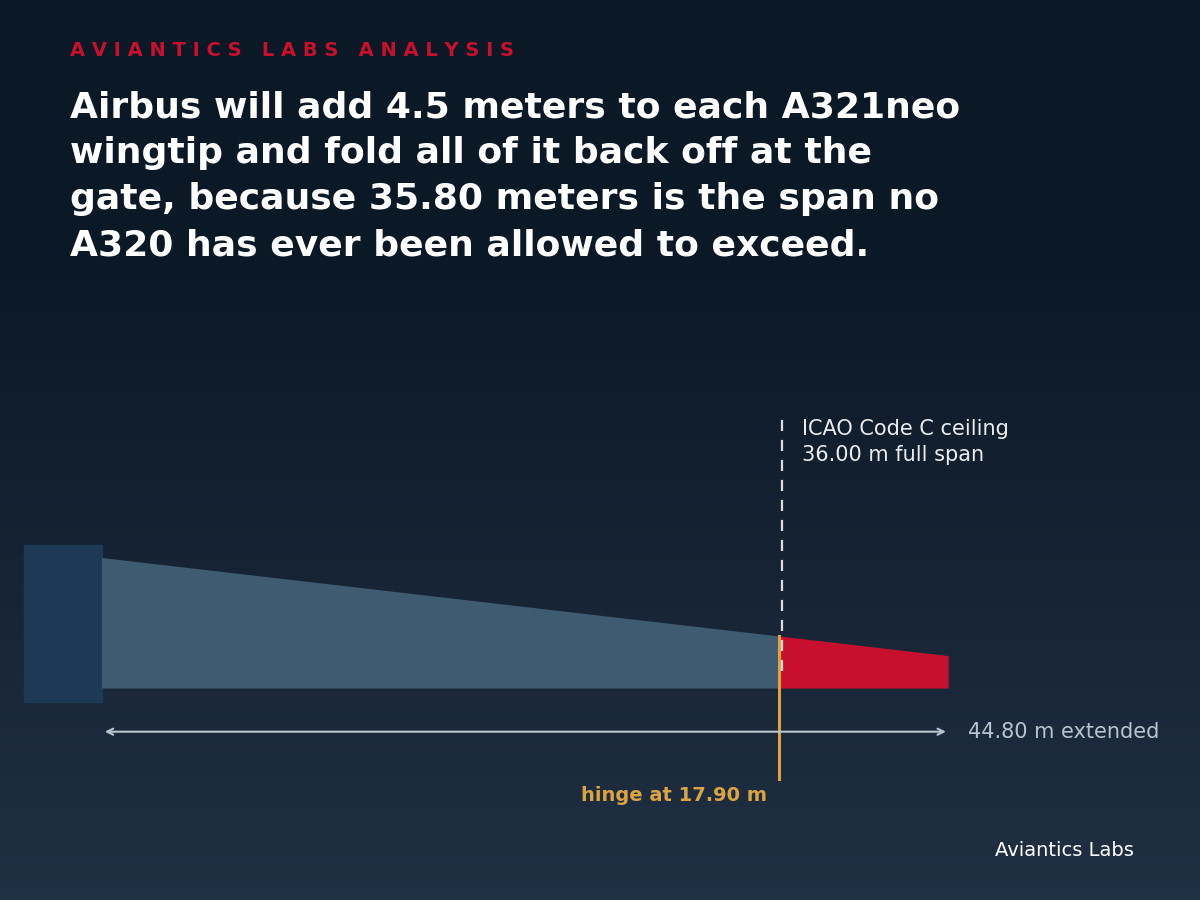
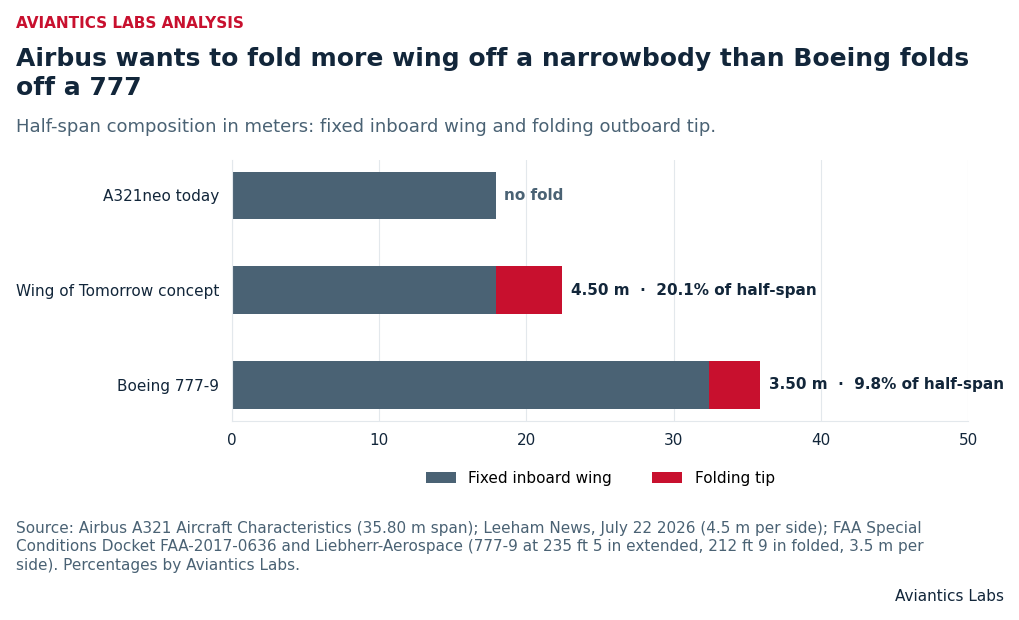
Airbus’s answer costs 4.5 meters per side, per Leeham News reporting on the Farnborough announcement. Add nine meters to 35.80 and the wing spans 44.80, which lands in Code D and is useless at approximately every gate the A320 family currently uses. Fold 4.5 meters off each tip and the number returns to 35.80. Not approximately. Exactly the span the aircraft has today.
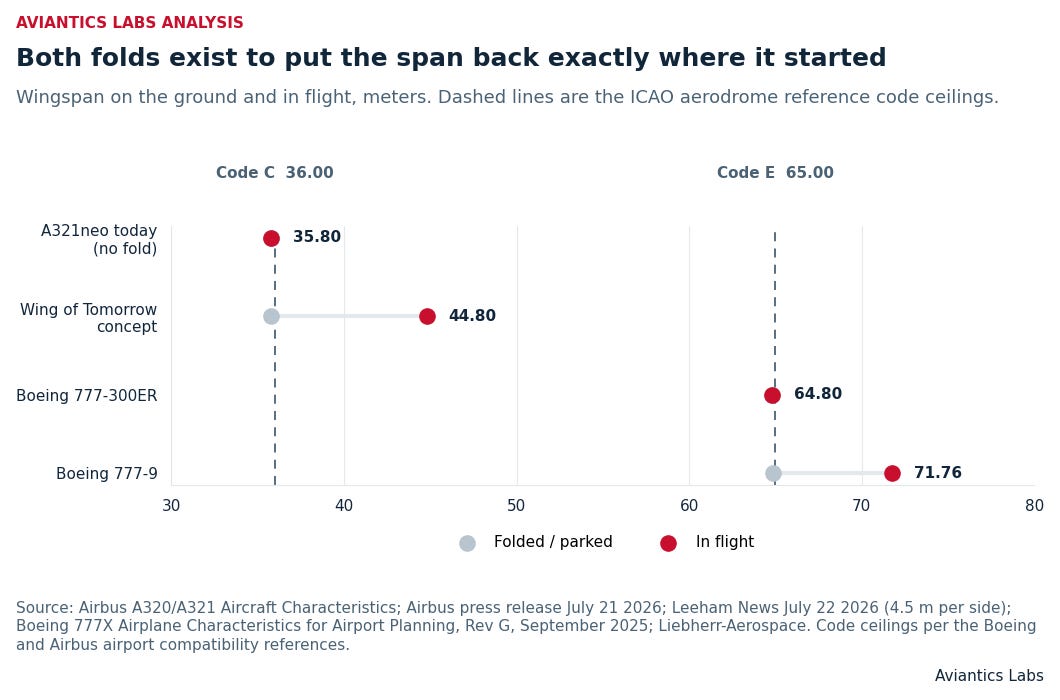
Boeing did the same arithmetic one code letter up. Its airport planning data gives the 777-9 as 235 ft 5 in extended and 212 ft 9 in folded, or 71.76 and 64.85 meters. Liebherr-Aerospace, contracted in December 2014 to build the actuation system, puts the reduction at 3.5 meters per side. Code E runs to 65 meters. Fifteen centimeters of margin, and a folded span within five centimeters of the 777-300ER it is meant to replace.
The direction of that comparison is worth holding onto. Airbus’s fold removes nine meters of wing in total, Boeing’s just under seven, off an aircraft with roughly twice the span.
Two manufacturers, two decades apart, both engineering a mechanism into a wing so that a number in an ICAO table can stay where it is. The fold is not an aerodynamic device on either aircraft. It is an infrastructure device, and it exists because the alternative, which is asking airports to rebuild stands, taxiway fillets and hangar doors, is not something an airframer can ask for and get.
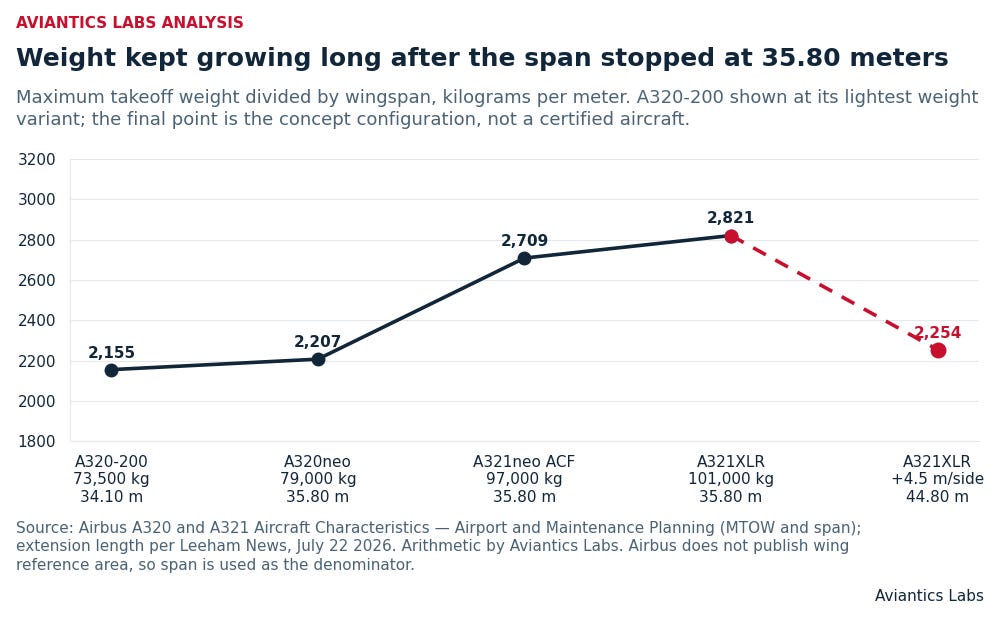
What the span lock has cost Airbus is visible in the weights. Divide maximum takeoff weight by wingspan and the A320-200 in its lightest weight variant leaves the factory at 2,155 kilograms per meter of span, at 73,500 kg and 34.10 meters on Airbus’s published airport planning data. The A321XLR does it at 2,821 kg per meter, at 101,000 kg on the same 35.80-meter wing the A321neo flies. That is a 31 percent increase in weight carried per meter of span across the life of the family, absorbed by making the wing work harder rather than by making it longer.
The A321XLR is what a span-locked narrowbody looks like when the market keeps asking for range. Fit the extensions and the figure drops to 2,254 kg per meter, roughly where the A320 started.
Airbus has decomposed the wing into two problems and is flying them on two different aircraft, and the decomposition is the most disciplined engineering decision in the announcement.
Problem one is span. High aspect ratio buys drag reduction, since induced drag accounts for more than 30 percent of an airliner’s total on Airbus’s own framing of the eXtra Performance Wing, and it costs structural weight, flutter margin and handling qualities that get harder to predict the further out the tip goes. That problem goes on the A321neo. Fixed extensions, full instrumentation, a real transport-category airframe underneath.
Problem two is the hinge, and it goes on a Cessna Citation VII, which Aviation Week reports spans roughly 66 ft including 6-ft movable tip sections at an aspect ratio above 15:1. Airbus says assembly is nearing completion and that a maiden flight, remotely piloted, is planned by the end of 2026.
The two-step target is on the record. Aviation Week has reported the Wing of Tomorrow configuration at 45 meters of span and an aspect ratio of 14, and the semi-aeroelastic hinge version at 52 meters and an aspect ratio of 18. Set that against a current A320 wing the same publication has described at aspect ratio 9 in one account and 10:1 in another. That gap tracks which wingtip device is fitted — 34.10 meters with fences, 35.80 with sharklets — rather than any disagreement about the wing.
Now line up the numbers. Thirty-five point eight plus nine is 44.80, which is the 45-meter configuration. The A321neo campaign buys step one, and step one only.
Step two is the 52-meter wing at aspect ratio 18, the one that needs a hinge doing work in cruise rather than sitting locked. It rides on a business jet with two-meter tips and nobody on board. Airbus has published nothing about the scaling path from a Citation VII wingtip to a 22-meter narrowbody semi-span.
The extensions are also not the only variable in play. Leeham News reports the production wing as thinner and higher in aspect ratio than today’s, with the engines repositioned closer under the wing and laminar flow in the mix, built in carbon fiber. The A321neo campaign holds every one of those constant and moves span alone.
There is a good argument for doing it exactly this way. Testing one variable at a time is how flight test is supposed to work, and stacking a novel hinge onto a novel planform onto a novel structure is how programs generate findings nobody can attribute to anything. Airbus is buying clean data. The price of clean data is that the integrated configuration, meaning long span and moving tip and full scale and transport category all at once, does not fly at all before the launch decision.
Airbus is targeting that decision around 2030, with entry into service in the second half of the 2030s. Flight testing begins by 2029, per Aviation Week. The campaign announced at Farnborough consumes almost precisely the window between now and the board paper. Read it as an evidence file with a deadline rather than as research.
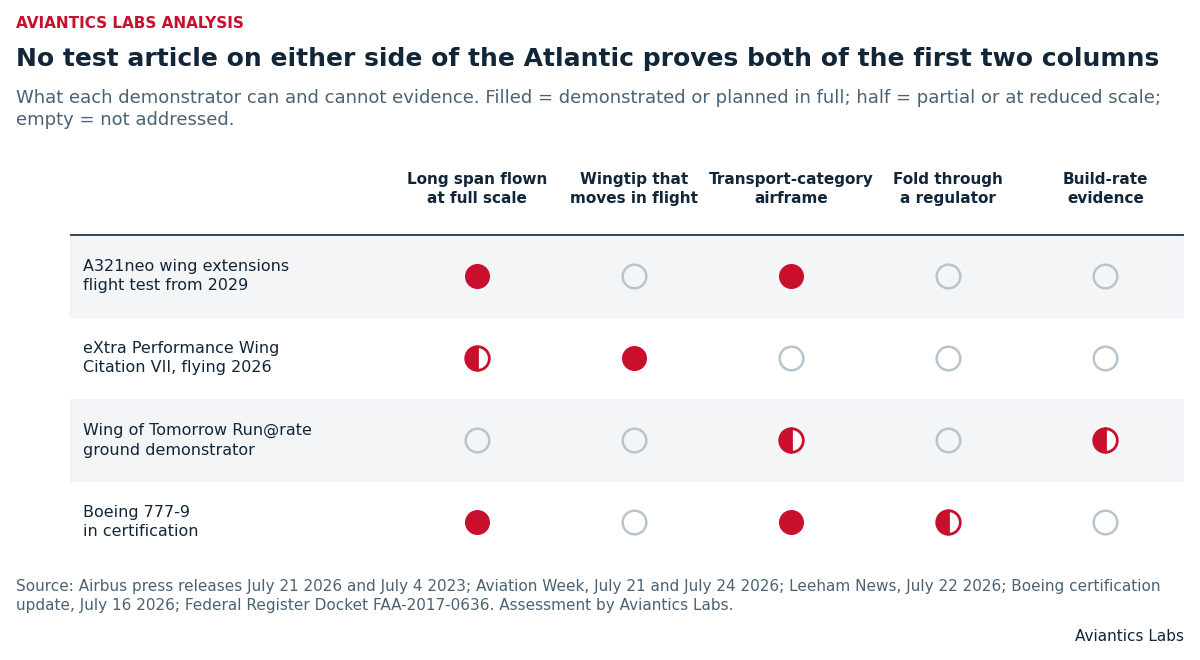
May 18, 2018. The FAA published special conditions for the Boeing 777-8 and 777-9 under Docket FAA-2017-0636, because folding wingtips were a novel or unusual design feature for which the existing airworthiness standards had nothing to say. The document is short. It is also the only regulatory precedent anywhere in the world for a folding wingtip on a commercial airliner, and every substantive line of it is written to make the wingtip stop moving.
The requirements, in the FAA’s own construction: more than one means must alert the flight crew that the wingtips are not properly positioned and secured before takeoff. A dedicated system must prevent takeoff if they are not. It must not be possible to unlatch the latches with the locks in the locked position. The wingtips must be safeguarded against unlocking from the extended, flight-deployed position in flight, including after the failure of any single structural element. All airplane power initiating wingtip folding must be automatically isolated prior to flight and must not be restorable in flight.
That last clause is the one that matters. The certified 777-9 wingtip is not a control surface, not a load-alleviation device, and not something a crew can command airborne. It is a piece of structure the aircraft is required to render electrically inert before it leaves the ground. EASA followed with its own special condition, D-21-9, on the same airplane. The FAA set a ground-gust requirement of 65 knots horizontal from any direction, and The Air Current has reported the tips as capable of withstanding 82 knots, so treat 65 as the regulator’s floor and 82 as what Boeing built to.
Airbus’s endgame requires the opposite behavior. The semi-aeroelastic hinge is powered for takeoff and landing and then declutched in flight, so the tip flaps freely in gusts and the joint passes no bending moment into the wing box. That is the entire mechanism by which a 52-meter span stops costing what a 52-meter span should cost in structure. Aerodynamic gain without the weight penalty, as Airbus has put it. It works only if the wingtip is free to move at altitude, in turbulence, at cruise Mach, for the whole flight.
We read the 2018 special conditions as an asymmetry Airbus has not yet had to answer. Not a prohibition. Special conditions are written per type, nothing stops the FAA or EASA from issuing a different basis for a wingtip designed to move in flight, and Airbus and its research partners have been publishing on semi-aeroelastic hinge simulation, including at AIAA SciTech in 2025. The asymmetry is in where the burden of proof sits. Boeing’s certification argument was that the tip cannot move once airborne, and it was granted on that basis after roughly seven years and four dedicated flight-test aircraft. Airbus’s argument has to be that a tip which moves continuously in cruise is safe anyway — freeplay, flutter, asymmetric flap, jammed-hinge failure cases, and whether a crew can do anything about any of it. That is a harder file. The only precedent on the shelf was built to prove the reverse.
There is a commercial reading here too, and it is not the one Boeing would have picked. Liebherr built the first wing-folding system in commercial aviation and, per FlightGlobal reporting on June 11, 2026, is now looking at further folding-wing opportunities on the back of a trend toward higher-aspect-ratio wings. The hardware, the certification precedent and the operating data all sit on Boeing’s side of the ledger. All three are for sale.
In Boeing’s original drawings, the outer stretch of each 777 wing was hinged to fold upward at the gate. A Boeing engineer, John Quinlivan, set the numbers down for a NASA composites conference. The aircraft spanned nearly 197 feet, he wrote, and was offered with a wing-tip folding mechanism that would reduce the span to 156. Forty-one feet of wing, roughly twenty a side, designed to disappear on the ramp. The paper is dated 1993.
The pitch was gate flexibility for airlines that wanted a widebody at stands built for something smaller. No customer took it. Boeing carried the option and then dropped it, and no 777 has ever been built with one.
Two decades later the company built a folding wing anyway, on an aircraft where neither the span nor the gate was negotiable. The technology was never the obstacle. What changed is that the span the fold bought became worth more than the mechanism cost, and airlines rather than engineers are the ones who run that calculation. Airbus is now making the same bet in a class where the mechanism is cheaper in absolute terms and the span it protects is worth vastly more, because Code C is where the entire narrowbody network lives.
“The size and shape of the wing calls for composites.” That is Bruno Fichefeux, Airbus head of future programs, speaking to Aviation Week on July 24, 2026, and it settles the material question while opening a considerably larger one.
Airbus has built three full-scale Wing of Tomorrow demonstrators at Filton, each 17 meters. One is a static article for structural test, one is fully equipped for systems work, and the third is called Run@rate. Airbus described that one’s job in 2023 as testing industrial capability and automation technologies to assess how it can build wings at the scale and speed it requires. Run@rate is the program. The other two are the physics.
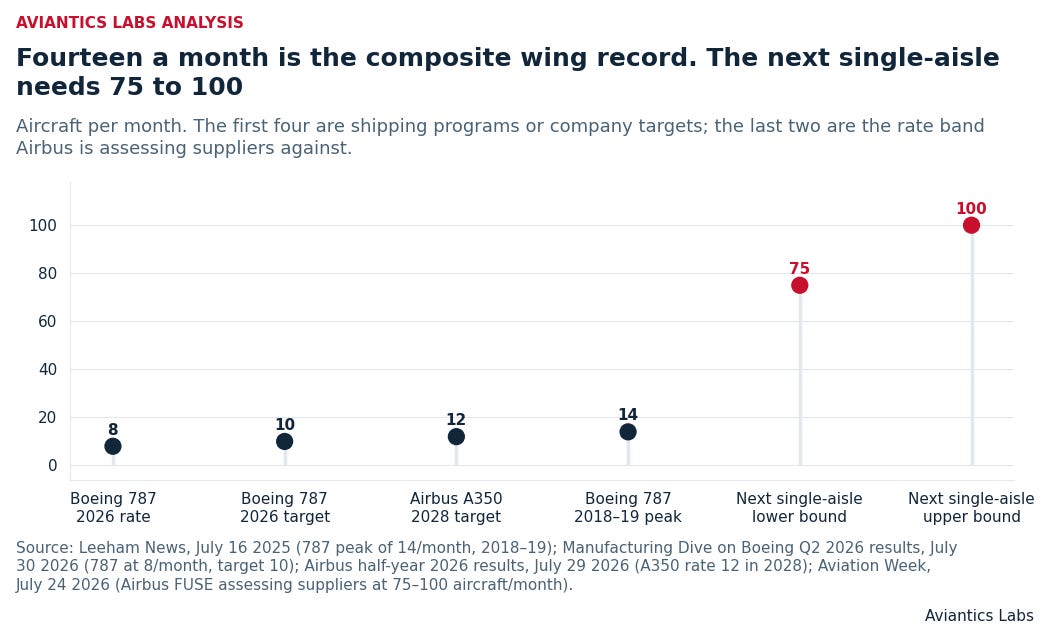
The scale it has to build at is not a secret either. Airbus told the market at half-year 2026 that it expects to reach a rate of between 70 and 75 A320 Family aircraft a month by the end of 2027, stabilizing at 75 thereafter. Its future supplier engagement exercise is assessing partners against production rates of 75 to 100 aircraft per month, per Aviation Week on July 24, 2026.
Set that against what a composite wing has ever actually been built at. The 787 peaked at 14 aircraft a month across Everett and Charleston in 2018 and 2019, on Leeham News figures, and is running at 8 a month in 2026 against a target of 10. The A350 is targeting rate 12 in 2028. Those are the two highest-volume carbon-fiber wing programs in history, and together they clear the mid-twenties.
A next-generation single-aisle at 75 to 100 a month therefore needs composite wing output somewhere between five and seven times the all-time high for a single program, with a hinge, an actuator, a latch and a lock built into the outboard section of every one of them. The supply base knows it. CompositesWorld quoted Aernnova’s Miguel Angel Castillo in June 2026 saying manufacturability at high rate is the central driver for the next single-aisle, and the technology list being pitched, from thermoplastics and automated fiber placement through hot drape forming and resin transfer molding, is a list of ways to get autoclaves and hand labor off the critical path.
The funding line tracks the same shift. Wing of Tomorrow had drawn £117 million from the U.K. Aerospace Technology Institute as of July 2023. By July 2026 the figure was £227 million. The U.K. roughly doubled its position in three years, and it did so while the program’s public output moved from aerodynamics toward build strategy. Airbus says the three demonstrators have carried more than 100 manufacturing and assembly technologies between them.
Aerodynamics gets the press release. The factory decides the airplane.
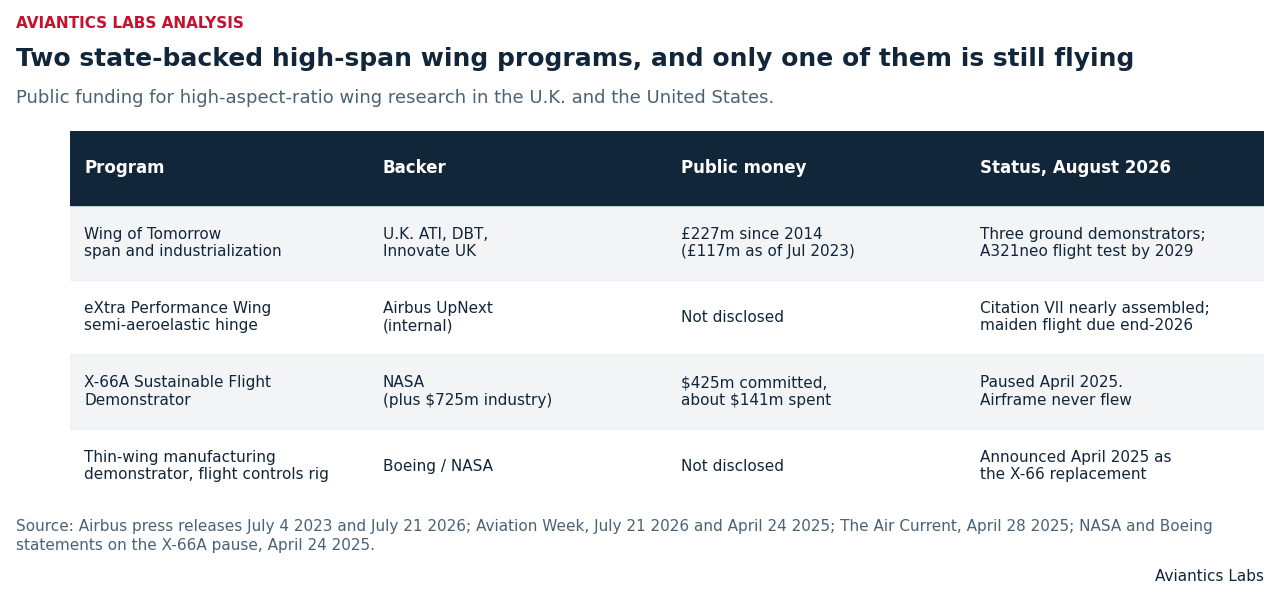
NASA committed $425 million to the X-66A and spent about $141 million before the program stopped. Boeing announced the pause on April 24, 2025, with the airframe unflown and a 2028 flight target abandoned. The engineers went to the 777X and the 737 MAX.
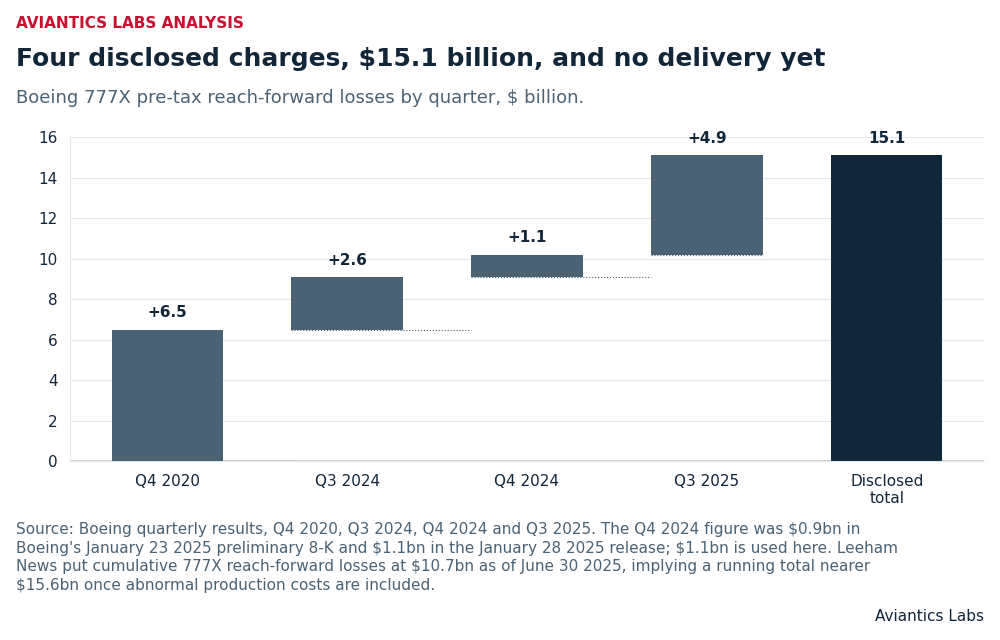
Judged as wing research that is a poor return on U.S. public money next to what the ATI got for £227 million. Judged as triage it is hard to argue with. The 777-9 was launched in 2013 for a 2020 entry into service and is now targeting first delivery in 2027. Boeing has taken $6.5 billion in reach-forward losses on the program in Q4 2020, $2.6 billion in Q3 2024, roughly $1.1 billion in Q4 2024 and $4.9 billion in Q3 2025. Leeham News put the cumulative figure at $10.7 billion as of June 30, 2025, which puts the running total in the neighborhood of $15.6 billion. A company carrying that is not wrong to pull people off an X-plane.
The money bought something. Boeing reported in July 2026 that the 777-9 had passed 4,800 flight hours across roughly 1,700 flights on four dedicated test aircraft, with the full-scale fatigue article beyond one lifetime, and CEO Kelly Ortberg told investors on July 28 that more than 55 percent of certification testing was complete. Nobody else has that data set for a folding wing, and nobody else will have one for a decade.
What Boeing said it would do instead of flying the X-66 is the part worth attention. Chief technology officer Todd Citron told Aviation Week the wind tunnel work had confirmed the thin wing’s aerodynamic benefits, and that Boeing intended to build a thin-wing manufacturing demonstrator together with a flight controls rig. Strip the framing away and Boeing traded a flying demonstrator for a factory article and a control-law bench, which happen to be the two things Airbus’s program is thinnest on evidence for. The Run@rate wing has never flown. The control laws for a free-flapping tip have never been shown at scale.
Boeing’s own position on the next narrowbody has moved the other way. Ortberg said at Farnborough on July 20, 2026 that it would take a couple more years to get where the company wants to be, and told Bloomberg the market is not quite ready for a new airplane. Bloomberg read that as a next-generation jet arriving at the end of the following decade. Airbus is targeting a launch decision around 2030 and service entry in the second half of the 2030s. The two are closer together than the noise around them suggests.
At a European narrowbody stand the whole turn runs 25 minutes, and the aircraft does it five or six times a day. A 777-9 on a long-haul rotation folds and unfolds perhaps twice, with ground time measured in hours and a maintenance base at one end of it.
On that arithmetic, which is ours and not Airbus’s, the same class of mechanism accumulates something like three times the actuations per year on a single-aisle, with no schedule buffer to absorb a fault. The Air Current has reported the 777X fold cycle at 20 seconds, with automatic deployment at 50 knots groundspeed on landing. Twenty seconds is nothing on a widebody taxi-in. It is not nothing when the mechanism is dispatch-critical in both directions, because an aircraft that cannot extend cannot take off and an aircraft that cannot fold cannot reach the stand. Measured against half-span, the tip Airbus wants to hinge is 20.1 percent of the wing. Boeing’s is 9.8.
No reliability target for a narrowbody wing fold has been published by anyone. That number, whenever it appears, will tell operators more about the next single-aisle than the aspect ratio will.
The Farnborough campaign is not a research program. It is the evidence file for a 2030 launch decision, and it is built to close the aerodynamic question while leaving the two questions that actually determine whether the wing folds, the hinge and the rate, to a business jet and a ground rig.
Which means the 2030 decision has a fallback nobody is discussing. If the semi-aeroelastic hinge does not produce a certification file EASA will accept, the extensions being built at Filton describe a perfectly viable airplane on their own. Forty-five meters, aspect ratio 14, a fold that stays locked in flight and does nothing but fit the gate. The 777-9 solution, scaled down. The tell will be whether Airbus is still flying the Citation VII after 2029. If it stops, the wing of tomorrow is Boeing’s wing of 2018 with a better factory behind it.
Analysis by Aviantics Labs · avianticslabs.com
Sources: Airbus press release, “Airbus launches new flight test programme for Wing of Tomorrow,” July 21, 2026; Airbus press release, “New technology hub to accelerate next-generation Airbus wings,” July 4, 2023; Airbus half-year 2026 results, July 29, 2026; Airbus A320 and A321 Aircraft Characteristics — Airport and Maintenance Planning; Airbus ICAO/EASA aerodrome reference code and FAA airplane design group compatibility data; Aviation Week (Guy Norris), “Airbus Launches Extended Wingspan A321neo Test Program,” July 21, 2026; Aviation Week, “Airbus X-Plane Will Test Inflight Folding Wingtips”; Aviation Week, “Airbus Advances Propulsion, Wing Tests Ahead Of Single-Aisle Decision,” July 24, 2026; Aviation Week, “Boeing Puts X-66 On Ice But Will Continue Thin Wing Studies,” April 24, 2025; Leeham News (Scott Hamilton), “Airbus to begin testing the Wing of Tomorrow on an A321neo,” July 22, 2026; Leeham News, “Boeing takes $4.9bn charge in 3Q against 777X,” October 29, 2025; Leeham News, “Boeing ponders 16/mo production rate for 787,” July 16, 2025; Federal Register, “Special Conditions: The Boeing Company Model 777-8 and 777-9 Airplanes; Folding Wingtips,” Docket FAA-2017-0636, May 18, 2018; EASA Special Condition D-21-9, “Folding Wing Tip”; The Air Current, “How the 777X’s folding wing tips work”; FlightGlobal, “Liebherr eyes further folding-wing opportunities,” June 11, 2026; Liebherr-Aerospace 777X folding wing tip actuation case study; CompositesWorld, “Composite aerostructures suppliers pitch thermoplastics, automation for next narrowbody,” June 19, 2026; Boeing, “Certification progress reported on 737 MAX models, 777-9,” July 16, 2026; Boeing second-quarter 2026 results, July 28, 2026; Boeing quarterly results, Q4 2020 through Q3 2025; Bloomberg, “Boeing Says Next-Generation Jet Likely Coming End of Next Decade,” July 20, 2026; Boeing 777X Airplane Characteristics for Airport Planning, Rev G, September 2025; John Quinlivan, “Design and Manufacturing of the Boeing 777 Composite Empennage,” NASA Third Advanced Composites Technology Conference, 1993 (NTRS 19950022610); T. Wilson et al., “Overview of Semi Aeroelastic Hinge Simulation Research at Airbus,” AIAA SciTech 2025 Forum, DOI 10.2514/6.2025-0712; FAA Advisory Circular 150/5300-13A; Boeing airport compatibility reference, aircraft design group table
Comments
Nothing yet. Say the first thing.
Sign in to join the conversation.