
Hello Friends,
If you have read the companion piece on the Becoming Noble Substack, you know the Churchill family’s three-century run on Prestige Finance — the wartime currency, the entail, the Gems Collection, the imperial banking syndicates. Most readers, when they picture what that system produced, stop at the physical result: Blenheim, Capability Brown’s grounds, the rooms built by war currency that served as staging ground for two centuries of deals. But for most people this is where the analysis stops because, in all probability building a family seat, especially a magnificent 1,000 year house like Blenheim, is beyond your means.
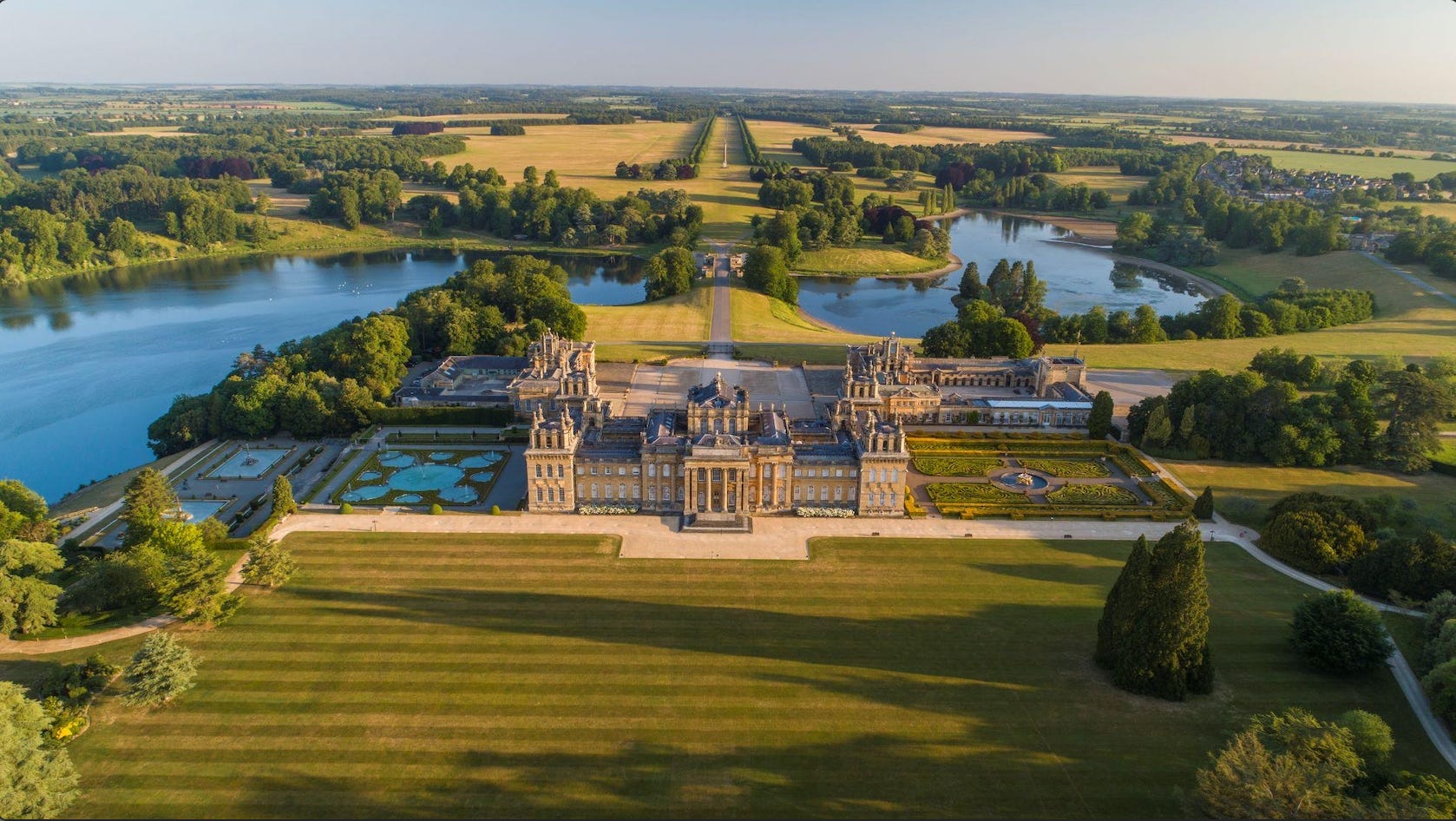
But rather than trying to recreate Blenheim in one glorious, capital-intensive framework, what if we analyzed it functionally? What was the family seat for? What did it do?
The surface answer is that Blenheim (like all of its contemporary estates) was an income-producing asset — rents, timber, tenants, pastures, £20,000 a year the family could pledge against loans. While this is not all it was (there was also a training and prestige asset function), the income function is also the most easily replicable for founders in the modern era, and it has a direct modern equivalent.
The Dynasty Trust Is Your Modern Entail
That modern equivalent is a diversified portfolio of high-quality dividend-paying equities and/or fully managed income-producing real estate held inside a properly drafted dynasty trust. It is structurally the same kind of asset the great houses of Prestige Finance borrowed against for three centuries. It is at least as legally protected, administratively simpler, and within reach for a lot more people than the physical seat ever was.
The Prestige Finance loop requires four things from its income-producing core: a non-alienable core the family cannot fumble away; a predictable, pledgeable income stream; a multi-generational legal wrapper; and a credit story that lets the family borrow against the income without ever liquidating the corpus. A dynasty trust holding a diversified dividend equity portfolio delivers all four, with off-the-shelf 21st-century legal plumbing, in any jurisdiction that has abolished or extended the rule against perpetuities.
The non-alienable core is the trust corpus. Beneficiaries do not own it. Their creditors, ex-spouses, and bankrupt grandchildren cannot reach it. The trustee must preserve it across generations. That is not a metaphor for an entail; it is the same legal outcome, expressed in modern trust law.
One of the key things that I want to highlight is that this is a place for genuinely passive investments that throw off income without the children of the family doing anything at all. This is NOT the same as giving a child business experience working for the family trust in a legacy asset. In stock ownership this can be easily delineated, the family business that is closely held by the trust is clearly different from passive ownership in dividend producing stocks. Real estate can be more blurry, but for purposes of the model I strongly recommend, and as I will discuss in future posts, SEPARATING OUT the training, social, and the core financial flow, is a key part of a legacy family’s success.
Because of this many families focus entirely on the income stream from the dividend flow of a basket of trust-grade companies. On any serious time horizon, that yield plus steady dividend growth across recessions looks structurally similar to — and is in fact more diversified than — the rents and timber of the Churchills’ estate. A global dividend portfolio spreads productive-land risk across hundreds of the most durable cash-generating enterprises on earth. This is not a worse version of the Churchill income stream. It is an objectively better one.
The legal wrapper is the trust document, drafted by a competent trusts-and-estates attorney — a more flexible instrument than an act of Parliament.
Pledge the Income, Never the Corpus
The single most important operating principle of a dynasty trust is the one almost every modern family that sets one up gets wrong.
Most families use their “Dynasty Trust” to fund ventures from its own funds. The trust writes a check into the new restaurant. Co-invests in the cousin’s startup. Backs the brother-in-law’s real estate deal. Every time it does this the corpus is exposed. If the deal goes bad, the trust loses principal. Do it enough and the dynasty trust becomes a slow-motion distribution machine with extra paperwork. The corpus will be gone in a generation and the family will be back to square one, wondering where the money went.
The Churchill model is the exact opposite, and it is the one to copy. The Dukes of Marlborough did not sell Blenheim to fund the next venture. They could not. The entail forbade it. What they did was pledge the income from Blenheim — sometimes years, sometimes decades of it — as security for borrowing, and deploy the borrowed money into the venture. If the venture failed, the creditors took the income for the agreed term, the family ate beans for a while, and the underlying asset survived intact. When the term expired, the income came back and the loop could start again. The corpus was never at risk. Only the cash flow was.
Translated into modern terms: a properly drafted dynasty trust should allow each beneficiary to pledge their pro-rata share of the trust’s expected income for a defined period — say, up to twenty years — as collateral for borrowing in their own name, while the corpus of the trust itself is permanently insulated from those pledges. The beneficiary borrows. The bank takes a security interest in the future income stream. The corpus is untouchable. If the venture fails, the bank gets the income for the remaining term, the beneficiary lives on whatever else they have, and the trust itself is unimpaired. When the twenty years are up, the income flows back. The family recovers. The asset compounds. The lineage survives the bad decade.
This single rule — pledge the income, never the corpus — is the operational heart of Prestige Finance in modern trust law. It lets a family take real risk without taking lineage-ending risk. Build the trust to enforce this rule structurally, in the document itself, before any beneficiary is in a position to argue otherwise.
How Big Does the Trust Need to Be?
The practical question: how much capital does this take?

As a working rule, the structure starts functioning like a full income-producing core at around $10 million in dividend producing stocks (real estate tends to require a higher asset amount in my experience) if you are funding it from existing wealth. To be clear, funding a trust at a $10MM level will require a larger net worth to allow you to keep the assets you will need to fund your lifestyle. Below that, the administrative, legal, and trustee costs eat too much of the yield and the line of credit is too small to do useful prestige-finance work. Above it, the math gets interesting fast. If you do not have $10 million you can afford to place into trust right now, the most common on-ramp is a properly structured life insurance policy on the founders, sized so the death benefit alone capitalizes the trust.
Another interesting point is that properly managed portfolios (of either real estate or dividend stocks) can and should grow from good management. If you are particularly gifted at management of a key asset, consider creating a fund within the trust, and devoting your efforts to growing that bucket as much as possible before you pass on. This can be particularly true for long-term real estate development where the payoff after 10-15 years can almost function similarly to an insurance payout (but one that doesn’t require you to die).
A well-constructed dividend portfolio at the 10MM level throws off a meaningful cash yield — the modern analogue of a Churchill drawing £20,000 a year off the family seat. That income services the line of credit. The line of credit funds the prestige capital. The prestige capital generates the social activity. The social activity produces the private deals. The loop closes. And all of it can happen before the family ever acquires the physical seat that will, one day, be the training ground for the grandchildren.
A good financial advisor, even one with no explicit familiarity with any of this, usually knows when a client is ready for a passive investment structure of this type. Many advisors and CPAs have arrived at materially the right answer through a combination of tax-code diligence and 400 years of cultural osmosis.
A Brief Note on Aristocratic vs. Democratic Technologies
The Becoming Noble piece touched on this distinction. It is worth developing further, because it explains why the loop above is gaining relevance rather than losing it.
A democratic technology is any tool where a competent user and a master user produce essentially the same output. A firearm is the archetype: the same number of bullets come out no matter who pulls the trigger. Printing presses, power looms, assembly lines, and the 20th-century office job all belong here. Once you cross basic competence, the machine standardizes the result. There is no meaningful payoff for mastery beyond competence, which is why industrial societies pay competent workers reliably and have no natural place for the virtuoso.
An aristocratic technology is the opposite: the gap between competent and master is enormous, training takes years or decades, payoffs are delayed, and the apprentice does not produce enough value to pay for himself. Horsemanship was an aristocratic technology. Pre-press scribal copying was an aristocratic technology. Weaving, metalwork, masonry, and all the great crafts were fundamentally aristocratic technologies. So, today, are fiat currency management, nuclear power, chip development and fabrication, mass media, and — the big one — AI. Aristocratic technologies have minimal rewards for mere competence and heavily reward character, judgment, and fully developed mastery. They do not fit inside a democratic institution, and they do not produce reliable outputs under democratic management.
How Do You Build a Great House? You Need an Aristocratic Technology.
As I have been saying on this substack since the beginning: you cannot build a great house on top of a democratic technology. You can get rich on one. You can have a good career on one. You can raise competent children on one. But you cannot build the kind of multi-generational structure — the kind of family that owns its own property, keeps its own children, and serves its community across centuries — on a technology where mere competence is rewarded and true mastery does not pay. Great houses exist because they are the optimal social form for producing low-time-preference, high-character, high-trust people who can run aristocratic technologies. Take away either the technology or the structure and society collapses into short-term, rent-seeking behavior within a few generations.
Every enduring lineage has some central technology at its core. The knights had horsemanship and the bladed arts. The monastic scholarship lineages had the faithful copying of ancient texts. The master guilds had the high end of their craft. A family without such a technology can accumulate wealth in one generation and lose it in the next. A family with one can fumble for decades and still come back, because the underlying capability is still there.
So the first question for any would-be founder is not what business should I start or what school should I send my children to. It is: what aristocratic technology will sit at the core of our house? For most founders today, the answer is Prestige Finance itself — layered on top of whatever underlying craft (operating, investing, building, governing) you already have. The dynasty trust is where that answer becomes a structure.
The Pattern, In Five Steps
This is the loop, in its most universal form, that every aristocratic technology in history has rewarded. The substrate changes — knights, financiers, whatever AI-era operators come next — but the steps do not. They are the same five things the great houses of three centuries ago ran, the same five things the most durable institutions of today run, and the same five things you will run if you intend to found a house that lasts.
1. Start with a skill in an aristocratic technology. Pick a domain where mastery actually pays, where training takes a decade, where character and judgment compound into outcomes no machine can standardize. For most founders today that means Prestige Finance layered on top of whatever underlying craft — operating, investing, building, governing — you already have.
2. Generate personal prestige by demonstration. Not by claiming it. Not by branding it. By doing the work in public, on real stakes, in a way the people whose opinion matters can verify. Prestige comes from a visible, costly, irreversible demonstration that this is the kind of person one wants in the room.
3. Curate key social bonds with other virtuous players. Not a network. Not a following. A small, deliberately built circle whose character you trust, whose judgment you respect, and whose long-term interests are aligned with yours. Host them. Travel to them. Lend to them. Marry into them. Be the convener, not the attendee. The room you build is more valuable than any single deal inside it, because the room will be there for the next deal too.
4. Pursue tactical wins that build, and do not compromise, the brand. Not every opportunity is worth taking. The discipline is to ask, every time, does this win compound the family name, or does it spend it? Take the ones that compound. Walk away from the ones that spend. Across decades, this single discipline is the difference between a great house and a one-generation success story.
5. Give your sons and daughters the spiritual and economic foundation to do the same. The whole point of running the loop is to hand the next generation a working machine — relationships with family, professionals, and community they have seen modeled well, so the flywheel keeps turning after you are no longer turning it. A great house is a covenant across generations. Step five is the covenant.
The Challenge
What I am describing is not a get-rich scheme. It is a posture toward capital, toward relationships, toward your own name, and toward time. It assumes you are building something that has to be legible to someone who is not yet born. It assumes the real room is more valuable than the digital one. It assumes that the thing you buy today — the trust, the portfolio, the restored building, the library, the cellar, the horse — is being bought as infrastructure for a convening function that will run for the next fifty years.
We are at a peculiar moment. The aristocratic technologies are coming back, the online attention economy is eating itself, the institutions that trained the managerial class are collapsing, and the rooms where things actually get decided are getting smaller and more exclusive. The subsidies that used to produce aristocratic operators have been withdrawn, but the economy itself is now rewarding the skills those subsidies used to train. You can step into this shift as a spectator, or you can step into it as a founder — quietly, deliberately building the income-producing core of a great house today, and the family seat that will house it tomorrow.
The great houses of the past did not know what was coming either. What they knew was how to host, how to lend, how to borrow, how to keep the core asset safe, and how to exercise restraint in the obligations they attached their name to in a way that made it worth something. Three hundred years later we are still using one of their names as shorthand for the 20th century. If you are the founder or the scion of a house that intends to still be here in 2326, you can and must master the well-established aristocratic technologies, like Prestige Finance, and the emerging aristocratic technologies reshaping the world all around us. There is a lot of uncertainty, and deep fear of a permanent underclass, where you spend the rest of your life going to someone else’s table, on someone else’s terms, hoping the host remembers your name when the allocations get made. But if you have the vision, the virtue, and the ambition to build a great house, there has not been a better time in four centuries.
What the Engine Is Actually For
The income-producing core described above is the foundation, but only the foundation. Return for a moment to the question we set aside at the top: what was the family seat actually for?
The income function was the surface answer. Those with slightly more insight note that it was a training tool — the environment in which a Churchill learned to be a Churchill. Where a boy watched his father host, watched gardens get commissioned, watched syndicates negotiated on the terrace, watched a guest bring information that became an allocation that became a dinner that became a marriage. The family seat, and the townhouse in London that served the same function, was where the next generation learned the pattern by watching it run.
But the seat was also the first prestige asset. It was a physical demonstration of the family’s generational skill in managing complex financial obligations across time. Visitors felt attraction, envy, even awe. Even family members who did not live there could leverage the reputation of a building that communicated what its members were too polite to ever say. Winston Churchill, though he never lived at Blenheim, used the prestige of his family seat to secure the most advantageous deal of his life: his marriage.
Recognizing this three-fold purpose — income, training, and prestige — reframes the modern problem. The primary difference between successful legacy families and the shirtsleeves-to-shirtsleeves crowd is the willingness to work together to preserve and use a core prestige asset. Most families put “a beautiful house the family could entertain at” far below “each child getting the largest house they can afford in the suburbs.”
There is a hierarchical status game embedded in this. When the family as a whole has access to a core asset, someone is going to control that access, some will pay for it, some will use it, and those will not always be the same people at the same time. You cannot make family members equal. Some will contribute more. Some will rank higher. You must make peace with that if you want your family to thrive in the aristocratic, perhaps neo-feudal, world we are entering.
Which is why character matters. The story your family tells itself, the way it trains its children, the character it demonstrates in public — this is the test. By demonstrating that you can manage your household well, you show yourself worthy of assignments in the broader world of finance and government, which are perpetually short of people for high-character, high-trust, low-time-preference roles.
The Gentry had a unique situation where their core asset provided ALL THREE functions, and that is likely not replicable today. But as we have discussed there is a clear modern alternative to the protected income producing function, the engine. But an engine alone is not enough, likely by itself it creates trust fund babies. So how do you give your children access to a prestige asset, and how does a family govern that access together without fracturing the thing it is trying to build?
We will get into that in the next post.
No posts
Comments
Nothing yet. Say the first thing.
Sign in to join the conversation.