
“He who is unable to live in society, or who has no need because he is sufficient for himself, must be either a beast or a god.”
-Aristotle, Politics, Book I, Chapter 2
Recently the Economist published a provocative image as the headline of its article which is undoubtedly AI generated. “The Mythos moment. Can five men be trusted with AI?” I have not reproduced the image here due to the litigiousness of that institution. But AI describes it as “five tech founders are rendered as Greek statuary, casually holding laptops above an indistinct sea, while a small figure on the shore looks up.”
The cover is meant to mock, to imply arrogance and hubris on the part of the AI founders and to suggest that the proper response to that hubris is institutional restraint. What the Economist’s editors do not seem to recognize is the role they are setting themselves up to play in the social drama the image anticipates. They have drawn the founders as demigods; as Prometheus stealing fire from the heavens. The tone of the article is implicitly demanding that Elon, Altman and Dario be chained to a rock so that an eagle can devour their livers on a daily basis. Presumably those worthies at the Economist have not asked themselves what happens to people who make a habit of chaining demigods.
This Substack is reader-supported. To receive new posts and support my work, consider becoming a free or paid subscriber.
Another interpretation of the image is that we are about to, and in some sense are already having, a Renaissance. A Renaissance, in the sense relevant here, is the flowering of productivity and creativity that accompanies a new set of technologies producing wealth outside the constrained order of the prior social arrangement. The most recent example was the Italian Renaissance, whose innovations in books, banking, navigation, measurement, mechanical arts, and urban production led to the Industrial Revolution.
The AI era will produce a Renaissance in the same technical sense, a reshaping of who gets to do what and who lives where on the strength of which technologies, and the institutional structures that will define the next century will be very different from the ones the Economist is gesturing toward. To be clear, I think that on the whole, and once the dust has cleared, things WILL be better, basic goods will be cheaper and/or higher quality, formerly intractable diseases will be cured, and human lifespan will (on average) increase, just as it has for the previous Renaissances that upended Western Civilization. But that does not answer the question of what shape our world will have and how many of our current structures will collapse (remember the collapse of seemingly impregnable structures is what causes all that dust!)
There are three points I want to make in this essay.
First, the modern democratic experiment did not escape Aristotle’s old cycle. Aristotle’s cycle says that democracy leads to tyranny because “the people” (the voting majority) will demand a more and more powerful state to oppress the productive and redistribute their stuff. A very unusual combination of technologies in the last Renaissance meant that the increases in productivity that came from new technology actually pushed power down the hierarchy (leading to the idea of the Renaissance Man). However, empowering the people did not actually produce the kind of social uplift that the Enlightenment thinkers hoped for and in any event those “democratic” technologies have run their course and now increasingly struggle to provide basic services. In the light of that fragility, the AI Renaissance (any Renaissance) will break that order. AI here is the avalanche that broke the camel’s back. But the central government’s ability to continue to produce basic services, food, power, water, communications, education (especially for the STEM fields necessary to keep the technical system going) is heavily compromised and needs to be replaced with SOMETHING.
Second, AI is an aristocratic technology in the sense that it rewards deep mastery rather than mere competence, and mastery is always concentrated in a fairly narrow band of the population. Average users will see an increase in productivity in 50% to 1.5X, while peak users may see 10X, 50X, or even 100X increases. This means that the floor (the productivity of the bottom 90%) will rise only slightly, while the ceiling, (the productivity of the top performers) will go up MUCH MUCH more. This will tend to push power up the hierarchy. To be clear we have seen (and integrated) similar technologies in the West before, and the rumors of the “permanent underclass” assume that people will not respond rationally to new incentives (which has never been true before). This does not mean that there will not be better and worse solutions that will be implemented.
Third, if AI is aristocratic in the sense described, the Great House will become the most economically and civilizationally important institution of the coming dispensation. By Great House, we mean the multi-generational household built around wholistic formation, mission, and covenantal obligation. What has functioned for most of the democratic-industrial period as a defensive shelter against entropy will, in the AI Renaissance, function as a productive engine for forming the kind of people civilizations have historically required when concentrated capability has had to be channeled toward responsible ends.
Democratic Technologies and the Myth of the Renaissance Man
Before we can talk about what is likely to happen, we have to discuss the most recent time that a Renaissance happened, and the assumptions that it left us with. The Italian Renaissance, starting in the 15th and 16th centuries, sparked by the firearm, the printing press, and the textile mill, along with an assorted set of improvements in chemistry is what laid the foundation ultimately for industrialization and the modern world. The dominant character of that Renaissance was the Renaissance Man, the sovereign individual who, armed with books, scholarship, and access to the ideas the medieval order had reserved for clerics, could in principle better himself through education and rise to any station. The dream was framed in deliberate opposition to the medieval ideal that placed each person in a divinely ordained calling fitted to his nature, and the political program that followed from it was that any man given the printing press and the school could fix any problem at any level of any organization. The expectation was that everyone would rise up and attain to the level of minor aristocrats, and the British Gentry and the American colonies (where there was something like 97% literacy rates) really looked like that might be achievable for a bit.
The reality conformed less to the dream and more to the ancient pattern of governmental shifts laid out by Aristotle. The aspiring Renaissance Men turned out, in the aggregate, to be populists with low tastes and low capacity. Bettering oneself turned out to be hard, perhaps even miraculous, and when reality failed to conform to the expectation, the Renaissance Striver class turned to the government to fix it. The government was happy to oblige. Five centuries later, roughly nine out of ten descendants of the West are wage-slaves with less ownership opportunities (but MUCH more comfortable chains) than the slaves of the major textile centers of Imperial Rome, the principal upgrade being that the gladiatorial games and pornographic rites of our modern Empire can now be streamed from anywhere. They are even, in a magnificent historical irony being subject to violence and denied the right to self-defense against remarkably similar barbarian populations. Philosophers and social scientists have made much of the fact that we did not escape Aristotle’s cycle. The cycle says that monarchy decays into tyranny, tyranny into aristocracy, aristocracy into oligarchy, oligarchy into democracy, and democracy into a kind of disordered mass rule that begs for a new monarch to restore order. This is clearly true, but I want to highlight how it was a shift in the underlying technologies that we use that drove much of this outcome of the modern democratic experiment.
Aristocratic and Democratic Technologies
One of the things I am doing on this Substack is making the argument that our society was designed for democratic technologies but is now wholly dependent upon aristocratic technologies for its core tech base. The reason I use the democratic and aristocratic terminology (despite much pushback) is because there are two possibilities for any technology and they have dramatically different requirements in what management structure is required to use and monetize the technology without violating our moral intuitions.
The first type of technology is one that requires (or benefits from) the mobilization of MASSIVE amounts of unskilled or “generally educated” labor. Most of these technologies in the last 400 years involved machines that rewarded competence, with very little additional compensation for skill above the competence mark. This meant very short training times (always under 2 years, and frequently less than 6 weeks), before the worker was able to “pay for himself.” This ability to do economically beneficial labor in a relatively short time (almost always in circumstances when MASSIVE amounts of capital had been invested in some “means of production”) is what created the concept of “entry level jobs.” As I have discussed previously, the “entry level job” is a historical anomaly.
When the underlying tech base has these core features the moral way (and the verdict of history would seem to suggest) the most EFFECTIVE way to mobilize the large amounts of labor necessary to scale the industrial projects (and to pay for all that sunk capital), is to give the workers broad and largely equal voting rights in the core institutions that govern their life. Those voting rights are restrained only by a thin and very unpopular financial elite who focus on the narrow goal of getting their money back (and insulating it from the inflation of modern fiat currencies) rather than taking any interest (or any responsibility) for how society at large is governed.
We should note that “generally educated” is a term of art, and one that has been stretched further and further as our current governance structures attempt to retain power on top of a tech base and less and less resembles the scenario for which they were created. There are REAL differences between a scenario where “generally educated” implies a high school diploma v. a bachelors degree. With sufficient social effort, that difference was capable of being papered over by a combination of lowered college entrance standards and the slopification of office work. When “generally educated” began to mean (as it has indeed begun to mean) a Masters degree or Ph.D. that proposition creates an the underlying imbalance that is much more resistant to being papered over. The idea of a mass labor force of Ph.Ds is a jarring one and folks, like the intrepid Eric Weinstein, start asking what is going on. But I am getting ahead of myself.
Because there is ANOTHER type of technology. And that is any technology that requires highly specialized personnel with deep mastery and/or institutional knowledge. Bonus points if only a relatively small percentage of the population can master it, it takes a long time to master, or if the technology requires idiosyncratic or individualized instruction. One of the key features of an aristocratic technology (this being the inverse of the entry level jobs effect) is that there is usually no short-term economic benefit to the group that employs the trainee during the long, difficult, and uncertain training process. We are uncomfortable with technologies that fit this profile because they imply a hierarchy and a social structure for managing that hierarchy that conflicts with our way of life.
The virtuous way to manage these types of technologies is to allow the peak operators, the men (and to be clear it is overwhelming men in point of fact) who have completed that long, difficult, and uncertain training process to have control of the education, financial, and social institutions that are training the next generation. This is not, to put it mildly, what we have done.
What exactly is a Machinist?
I should note that one of the problems with understanding our situation is that we gave names to technologies when they were in a democratic phase, and we have now mostly automated away all of the democratic uses of those technologies. Take the quintessential “competent machine user,” the machinist or lathe operator. In Henry Ford’s day, machinists were doing rote, repetitive work where they received a piece in EXACTLY the same condition, and made EXACTLY the same cuts every single time. Simple jigs could be used, and while attention to detail was critical, the work was not one that was that hard to learn or required much in the way of IQ. Indeed surprisingly low IQ individuals with high degrees of conscientiousness could pull their weight on the line or factory floor.
Today however, all such jobs have been ENTIRELY automated, and a 20-year machinist or lathe operator is a treasured artisan used to recreate by hand parts for specialized machines for which an industrial supply chain largely no longer exists. One of the reasons that these “master machinists” are so treasured and so valuable is that there are essentially no junior machinists, the rote repetitive work that built the deep mastery over their tools is now done by inputting CAD instructions into a computer. As I said earlier this “lack of entry level jobs” is a key indicator of an aristocratic technology stack, and we were VERY far down that path in most industries long before AI was a glimmer in Andrej Karpathy’s eye.
But we still THINK of machinists and “factory jobs” as things that reward mass labor, that “anyone with a high school education” should be able to learn to do in 2 years or less, and be relatively highly compensated for, certainly enough to afford housing, spouse, and children. We think of them as technologies that push power DOWN the hierarchy, and assume that any collection of power UP the hierarchy must be illegitimate and “corrupt.” We assume that democratic social structure with their ability to incorporate and persuade the largest possible set of actors to voluntarily participate in the system will produce the best set of outcomes. That WAS the case in Henry Ford’s America, it is not the case now. But our system has been able to obscure, to “manage,” the differences between the “machinist” of Henry Ford’s day, and the
“Machinist” CAD user on the one hand, and the master lathe operator on the other, roles which have very little in common with each other and almost nothing to do with assembly line lathe operator upon whom our assumptions about the right social management structure are based.
As it stands the ONLY way to get another master machinist is to give an existing master machinist a group of trainees (the guild records from the medieval period suggested 3-8) and to HEAVILY incentivize (with social and political power if necessary) that master machinist to turn at least one of those trainees into a master machinist. Given that these autistically optimized master craftsman are not generally the best teachers, this is usually done by trying to get the trainees to imitate their master in EVERY respect, physically, mentally, emotionally, spiritually, rather than by having a narrow curriculum.
One of the things that I want to drive home here is that scale of this problem is far larger than AI. In the current scenario our system is increasingly dependent on a very narrow class of producers who grow essentially all of the food, produce essentially all of the power, run essentially all of the key machines, maintain the industrial systems nobody else understands, and invent basically everything. The US military is increasingly the same families; in 2012-2013 86% of the Air Force, 82% of the Navy, 79% of the Army, and 77% of the Marines were were from “military families” with close relatives serving before them. Oil companies and their employees famously are a world unto themselves. I have served oil industry clients and I can tell you from personal experience that even the traditional relationships between engineering schools and the oil industry is tense if not fractured. Again, the recognition that general education pathways are not serving our producers is a discussion had if at all in hushed tones, because the political implications are obvious.
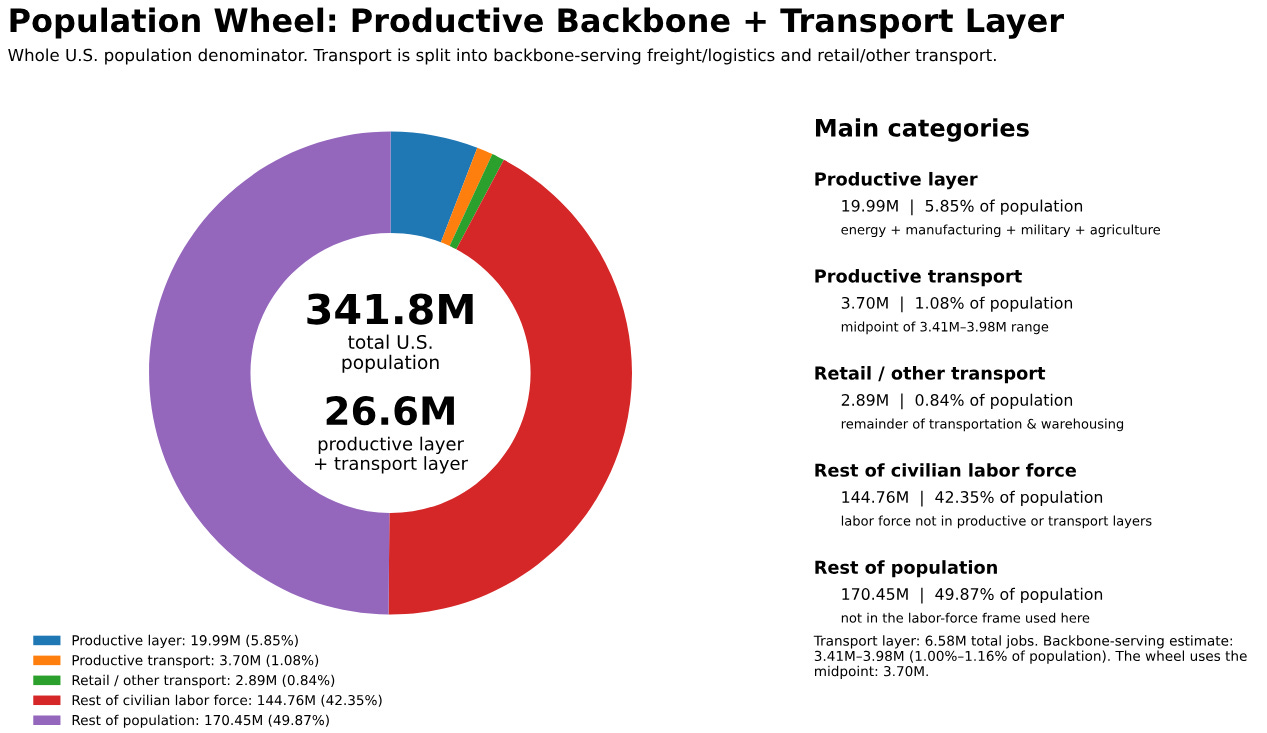
Democracy sits tenuously atop this concentrated productive class. The supply chains for nuclear power plants, the oil and gas, fighter jets, semiconductor fabrication, satellite networks, grid-scale transformers, and other high-consequence technologies are not coterminous with society at large. They are narrow, technical, and intensely personal, carried by operators whose judgment and culture is increasingly incompatible with pop culture, public opinion, or large-scale credentialing systems.
This structural incompatibility makes contact with society at large a source of drag, delay, and liability. The farmer, engineer, founder, machinist, soldier, oil rigger, grid operator, and plant manager increasingly meet the public in forums such as hearings, lawsuits, compliance departments, which they quite correctly interpret as a humiliation ritual. Given the timing of this shift (largely during the Cold War) the first generation of this artificial control may have been done with good intentions by relatively competent people. But it is now essentially a series of moral denunciations issued by people who cannot perform the productive work being governed. We are a corpulent state, and our bones are creaking under the strain.
So how have we maintained “our democracy” in the midst of the hollowing out and undermining of the core pieces of our democratic tech base? How have we retained the symbols of democratic power, even when the natural state of technologies would give rise to a new aristocratic class? Well by implementing the solution that Aristotle says democracies ALWAYS engage in when they grow corrupt, which is to turn to a monarch to suppress the rising aristocrats and maintain the privileges of a less and less competent democratic mass.
Now, “our democracy” prides itself on being a “no kings” system, but an analysis of our legal system shows an interesting continuation of the most important of the monarchic privileges. The distinctive characteristic of a monarch was his ability to shield his personal assets from liability by claiming sovereign immunity. And where does that power lie now? Well with essentially every government actor down to the lowest police officer and bureaucrat.
The invention of the Westphalian nation-state gave the state itself (along with all of its smaller subsidiary corporations states, counties, cities, etc) this privilege. You can be an incredibly wasteful city manager or mayor leaving the taxpayers burdened with millions or billions in debt, and walk away scot free with no personal liability for your actions. Again, only kings enjoyed such privilege in the ancién regime. Over the last ~150 years we have even extended a form of sovereign immunity to every director and CEO of a corporate structure through corporate limited liability. Initially, this extension of limited liability was seen as a de facto monopoly, and was limited to corporate entities that were pursuing a clear governmental purpose and required a full deliberative act of the king or sovereign legislature in question.
But now, through statues of general incorporation and the ability of corporations to own other corporations, this has become widespread. While in theory piercing the corporate veil is possible, unless there is gross criminal behavior, a la Enron, those responsible walk. This commonality of experience, the ability to foist poor decision-making off on the people, while paying no price other than the loss of their position, has become the defining feature of the so-called managerial class. These people, raised at the same handful of schools, paid on the same compensation curves, and bound by the same career-survival logic are the collective monarch of our corporatist age, and their insulation from personal liability has produced more and more incompetence the longer we have run this experiment. If you wish you could call them oligarchs, many of them often become so. But they become so because they can make ANY decision, implement ANY policy, and so long as they can justify it in terms of “fortifying our democracy” it will be supported, and upheld, and they will bear NO personal responsibility for the downstream consequences to the economy, the legal system, or the objective stability of the system itself. This is why you see references to the managerial consensus and why they take such pains to present themselves as neutral impersonal actors. These people collectively are inhabiting a role which earlier societies limited to one person at a time.
This is because monarchs are plunderers who do not actually produce anything, which is problematic even when the monarchy is small (usually one man as Hobbes articulates) and works best when there there is a broad productive democratic class who are available for plundering (successful aristocrats generally spend much of their power becoming more and more plunder-resistant). It is catastrophic when there are entire legions of these leaches, whose only justification is that they preserve the increasingly irrelevant forms of “our democracy.” To be clear I use irrelevant in the sense that the modern democratic form does not (and structurally cannot) actually produce the food, power, water or any of the basic services needed to sustain the population.
The centralized monarchical (managerial) consensus uses its power in the way sovereigns have always used their power, to suppress the productive aristocratic class. The suppression is largely symbolic in the sense that it does not lead to the democratization of power. It is, however, an incredibly effective tool for preventing the successful producers from implementing ANY kind of social or political change. They are, and they are constantly reminded that they MUST remain, subservient to the managerial class who are insulated from all personal liability for their actions. The symbolic suppression flatters the masses into crying for the state to accrete to itself more power which is the entire point of the exercise. And to be clear, without this constant and omni-present State redistribution of social, political, and economic power, there would be an IMMEDIATE imposition of hierarchies that would make the tribal corruption of voting systems in Africa look like amateurs. This is the entire function of our democratic order. It is the core purpose and justification of our regulatory state.
The AI Renaissance is going to break that order. As I said in the intro, AI is the avalanche, the landslide that broke the camel’s back. Other technologies started off as largely democratic and social inertia has kept those assumptions in play while leading to “personnel shortages” that will surprise no one who has studied the laws of supply and demand. But the speed of AI adoption will in my view change the balance of power between the productive elite (aristocrats) and the managerial elites (the oligarchs, collective monarch) in ways that cannot be managed without banning the technology itself. While there will be some group of AOC-IQ level persons who will attempt to ban the data centers and then the models themselves, the serious players in our system appear very cognizant of what will happen if we ban AI and China, or even Russia does not. The compliance apparatus that has kept the old order intact will not survive the gap that AI will open between productive elites and the rest of the labor market. I, of course, frame that gap by saying that AI is a very Aristocratic Technology, maybe the most aristocratic we have ever seen.
AI as an Aristocratic Technology
My thesis is that Aristocratic technologies reward an operator’s dedication to mastery. So what are the notable features of AI.
According to ChatGPT:
The IMF has warned that if AI complements high-income workers and raises returns to capital, productivity gains could disproportionately increase the incomes of high earners and asset owners, worsening inequality. Harvard Business School research found that generative AI boosts productivity but does not turn novices into experts, implying that people with existing expertise may be better able to convert AI assistance into high-quality output. Surge AI CEO Edwin Chen has argued that AI could turn the old “10x engineer” into a “100x engineer,” especially because it benefits already high-performing engineers by removing low-value work. GitHub CEO Thomas Dohmke similarly argued that AI can “10x” individual developers and make teams dramatically more productive, while still requiring deep engineering knowledge. Sam Altman has predicted that AI could enable a one-person billion-dollar company, which is a vivid example of the productivity ceiling rising far more than the average worker’s output. Anthropic CEO Dario Amodei argued that powerful AI could accelerate biological discovery by at least 10x, compressing 50–100 years of progress into 5–10 years, which supports the idea that elite labs and researchers may gain enormous leverage.
Now, there are also claims that AI raises everyone below a certain threshold up to its automated standard. While reports conflict, let us say that this is able to allow EVERYONE in the bottom half of the population to behave at a 100 IQ level. This would be an enormous improvement in the general quality of life for those people. But this is because they are being managed by AI. It is the AI doing the top level work, and the person is more or less feeding information into the AI. Now this might result in an increase in their personal productivity in 1.5-2X for the lowest band of the population. (Please note, I will argue below that this may NOT have the economic impact those folks are hoping for). It will result in marginally 25%, 50% increases in productivity for the current average performers. But it will result in 10X, 50X, 100X increases in productivity at the high end, and as we have seen in the AI developer compensation reporting that results in truly STAGGERING economic rewards.
What does all of this mean? The floor for average users will rise modestly while the ceiling for skilled operators will rise dramatically, and the gap between a skilled operator using AI and an unskilled operator using AI will be substantially larger than the gap between two operators with no AI at all.
There is a metaphor, and one I use with caution, because there is an immediate and tempting way to use this incorrectly. I have set out at length the broader argument for why the unique character of horse-riding aristocracy is never coming back in Chivalry Is Dead. But in many ways I believe that the economic and social impact of AI will be similar to the impact of the warhorse.
The horse was the technology that defined European aristocracy for the better part of a thousand years. Horses came with key asymmetries: Access to elite breeding lines, the capital required to maintain a war-grade animal, and the years of training required to bring a horseman to the level of instinct were available only to a narrow class, and that class controlled the political and economic life of the continent until firearms eventually neutralized the multiplicative advantage. A man on foot with a spear would generally lose to two men with spears, but a trained knight on a quality warhorse would routinely cut apart dozens of badly trained horsemen on lower-quality animals let alone men on foot. This multiplicative advantage compounded not just with years of training, but with the generations of optimization for a particular build, strength, and agility level. The fact that the peasants acquired horses (and eventually figured out how to use them productively) was never enough, and was never GOING to be enough to overcome the entrenched advantage of the martial class. Individual peasants could acquire wealth, horses, and nobility (not always in that order), but as a group the peasant class could NEVER compete with the noble class.
This is also why giving barbarians horses became a method for inducting them into the same set of social classes that governed the medieval period. Many largely egalitarian tribes, the Goths, Franks, Saxons, and Normans all came into Europe, got ahold of horses and very quickly (in civilizational terms) adopted the same hierarchical conventions as the REST of the horse-riding cultures, and were integrated into Europe on that basis. The Mongols (yes I can hear you screaming) are the exception that proves the rule. Horsemen from an incredibly harsh environment that required constant mobility and prevented the accumulation of landed wealth (such as the Mongols), might resist the hierarchical impulse, but their tribal assemblies were very different from the modern one citizen, one vote system, and when they got into better climates (central China, the Middle East) they likewise developed similar entrenched feudal structures.
There is an argument that the high capital cost of frontier models, and the relatively low budget way to imitate those models in a self-hosted capacity, is structurally similar (from a capital investment perspective) to the way that southern European elites required MASSIVE wealth for breeding projects, but once larger warhorse lineages existed, relatively low-capital actors (like the Normans) could acquire and maintain similar capacity for a fraction of the upfront cost of the breeding project. Then as the similarity between the experience of Norman horseman managing their artisans and farmers, penetrated through the social structure, they came to feel a kinship with other horseman managing artisans and farmers across Europe. If AI gives a unified set of experiences to the new aristocrats who will become increasingly necessary to those basic services, we WILL see a social impact from that alignment of interest and core experiences.
This is not to say that the character of the men formed by “riding” AI will be the same as the character of the men formed by riding horses. The technologies are too different at their cores. The chivalric virtues that horsemanship selected for, and especially the way that mastery of the horse overlapped with the skillset for seducing women and leading men, are unlikely to be the virtues AI naturally selects for; though the malleability of AI means there may be some interesting possibilities to “force” that sort of virtue selection (more on that in a future post).
But likely the character formed by AI operation will be its own thing and for present purposes, the operative point is that the social impact of the small lift in the floor and the large lift in the ceiling holds even when the technology and the personality quirks it produces are novel will likely stratify our society.
The Key Example: Compliance
One of the key ways that AI will change the balance of power between local elites and the system at large is compliance. The monarchic state’s primary instrument of control over the aristocratic class is not in fact taxation or break-up action; it is regulation, and the cost of complying with regulation. Securities filings, regulatory submissions, tax compliance, employment-law compliance, environmental-impact reporting, occupational-licensing paperwork, foreign-asset disclosure, state-by-state nexus tracking — the compliance apparatus is the lattice through which the monarch keeps the aristocrats dependent on the bureaucratic class that interprets the rules. These costs have historically been a key part of “regulatory capture”. A 20th Century Fortune 500 firm absorbed compliance overhead as a routine line item, while a one-person operation could not afford the lawyers, accountants, and consultants required to operate cleanly inside the system. The cost of compliance is what has kept the smaller would-be aristocrats from organizing the kind of independent operations that would actually challenge the incumbents.
AI will collapse most of those costs. Instead of massive law firms, with hundreds or thousands of lawyers, a single AI startup, run by a skeleton crew will likely empower tens of thousands of businesses to make securities filings, manage tax compliance, write employment policies, and handle regulatory submissions at a cost the managerial class cannot match and on a timeline the bureaucracy cannot keep up with. The compliance lattice will not disappear but the 20 man, 50 man, and 200 man corporation which is big enough to regulate but not too big to fail may become viable long-term for the first time since the New Deal.
But people will say, “What about the floor? AI is going to give hundred of millions, maybe billions of people access to never-before seen problem-solving capacity.” I do not deny that there will be a lift in the floor productivity of humans in the AI era; I do not even deny that housing, and other core goods will grow cheaper (partly from actual productive increases and partly by clever evasion of the regulatory state enabled by AI). But the important question is not, “What is the floor?” The important question is: “What is the difference between the high performers and the low performers?” If the average person becomes half again as productive, twice as productive or even three times as productive, while the peak users of AI enjoy 50X to 100X increases in productivity we are about to see a difference in relative compensation that will ultimately mean far greater personal power for the peak users than a democracy can successfully manage.
An instructive metaphor is the horse-collar, a humble harness innovation that finally let a horse pull a plow without choking it. First of all, it should be noted that the horse-collar took roughly four centuries to arrive after the war horse had already restructured European aristocracy. There was nothing special about the horse-collar – no underlying technology shift. But none of the entrenched interests were primarily focused on benefitting the peasant classes, and so it lagged behind other horse related technologies. The historical pattern is that the floor-raising application of an aristocratic technology lags behind the aristocratic application by centuries; the immediate beneficiaries of a powerful new tool are the people already positioned to use it, and the broad democratic benefit, when it arrives, arrives on its own much-slower schedule.
It is worth saying clearly that the shape and timing of the AI floor are far from settled. A great number of the democratic style releases in AI to date have been driven by direct Chinese actions — such as DeepSeek and its successors being open-sourced for geopolitical reasons — or by the implied threat of Chinese action. The Chinese are clearly betting that their political system can absorb the sociological shocks of a rapidly destabilizing AI Renaissance better than the American system can. The bet may turn out to be wrong, but the reasoning behind it is respectable, and the consequence for our purposes is that the timing of the floor’s arrival in any given sector is now a geopolitical variable rather than a market variable. None of this changes the direction this economic logic leads; it changes who controls the speed at which the logic plays out, and it should give pause to any American reader who assumes the floor will be raised on terms favorable to the American institutional order.
And in the short-term I do think that it is actually the increase in the floor, the democratic applications of this emerging technology, that will cause the greatest economic havoc.
When the horse-collar finally arrived its immediate economic effect was severe. The collar made the last remaining Roman-style farming gangs worthless almost overnight. The peasant with a horse-collared draft team simply outproduced the slave-driven latifundia, and the institution that had depended on cheap human labor was undone not by moral reform but by an agricultural input. The AI floor-raising tools will do the same thing on a much faster timeline. The wage-slave who exists today to perform tasks that a business owner with AI access can now perform for free will become economically worthless on the same logic, and a great many people who have built a working life on entry-level and mid-level wage work will discover, over the next several years, that market correction happens slowly and irregularly but their grocery and housing bills arrive precisely on schedule. While I strongly doubt that this will truly create a “permanent underclass” the short-term economic hardship is likely to be severe, and may last for much longer than we hope. I fear that it may last until we as a society admit that certain technologies require a different social structure to manage than we have been using for the last little while.
This is because all of the solutions involve giving those who parent and disciple the next generation of master craftsmen, peak military and productive personnel (which will overwhelmingly involve AI) sufficient social and political power (along with economic resources) to create and maintain the environment in which that next generation of peak users can be not merely trained, but formed into the kinds of people that we can trust to use these powerful technologies. That may look more like the guild master apprentice systems, it may look more like the feudal knighthood structure, it may look more like the spiritual lineages of a medieval scholar or priest. I do not know.
But one thing I do know is that it will NOT look like the prussian “making cogs for the factory floor” method of education that we have been using for the last 150 years. Those methods were developed for technologies that have been relegated by the markets to the dustbin of history. My prediction is that AI, and the conflicts that it engenders will FORCE us to recognize the new balance of power. One observation that I make and will make again, is all of these criticisms of “our democracy” are criticisms of the shifts made in the Civil War, World Wars, and Cold War era away from the Constitutional Republic that our Founders first gave us. Our Constitution is designed (in some ways more designed) for the tech base that we are about to have.
If I am correct, three observable patterns will define this Renaissance over the next several years.
First, the gap in output between high-judgment and low-judgment operators in the same role will widen rather than narrow as the underlying tools mature, so that the more capable the models become, the more the gap between users will grow rather than close.
Second, hiring patterns will shift toward post-training infrastructure, with apprenticeships, internal academies, multi-year formation tracks, and proprietary tacit-knowledge transfer determining which firms compound and which fall behind, and the credential-driven pipeline of the democratic era will stratify as a formation-driven pipeline replaces it.
Third, compensation for AI-leveraged operators will move from wage to equity, profit share, and partnership, while entry-level wages will stagnate or compress, the middle of the wage distribution will hollow, and the top will fragment into firm-specific houses with distinct cultures, formations, and obligations. Indeed, until people recognize that junior labor is necessary as a succession plan (which may take 10-15 years) we may see the elimination of “entry-level” jobs in many industries.
What Would a Great House Renaissance Look Like?
So what will this look like?
The Renaissance of AI will not move the way the printing-press Renaissance moved. The best historical analogue is probably the Carolingian Renaissance of the eighth and ninth centuries, the renaissance under Charlemagne that established the palace schools, the cathedral scriptoria, and the standardized administrative class that would, over the following centuries, harden into the noble households of medieval Europe. The Carolingian Renaissance largely created the Great Houses of medieval Europe by gathering trained operators around courts that could form them, retain them, and pass their formation on across generations. The AI Renaissance will take the same shape. Institutional energy will gather upward, around households and firms that can form operators across generations, and the cultural ideal of the era will not be the sovereign individual of the printing press but the formed member of a great house. The shape of this Renaissance will be upward.
The upward shift has, in truth, been underway for the better part of a century. The centralizing technologies of the twentieth century — mass production, mass media, mass finance, mass administration — moved economic power back up the ladder steadily and substantially, and democratic social structures and innovation-stifling regulation slowed the shift and obscured its visibility without ever quite stopping it. The cycle of scandal around contemporary elites is, in this reading, the social hierarchy reasserting itself faster than the formal institutions can contain, a process visible at the surface of every news cycle but legible only against the longer arc.
What AI will do, more than create the upward shift, is to take the upward shift that was already underway and make it impossible to disguise. The output gap between peak AI operators and average users will not be something that the credential systems and compensation conventions designed for the prior order can obscure, and the hierarchy that returned decades ago will become visible at exactly the moment the institutions designed to conceal it are losing their grip. The question for everyone watching is what form the visible hierarchy will take.
The visible hierarchy will take one of three forms. It may become extractive, with AI gains captured by a thin managerial-technical layer that owes nothing downward. It may become state-managed, with AI gains captured by the political class and redistributed through nationalism or collective benefit. Or it may become covenantal, with AI gains captured by skilled operators embedded in institutions that owe real obligations to their members, their localities, and their successors.
Of the three, only the covenantal version will be stable across a full generation. The extractive version will produce revolution or authoritarian consolidation. The state-managed version will produce brittleness, because the freedoms required for innovation will be the freedoms the state model must suppress. The covenantal version will produce what civilizations have historically produced when concentrated capability has had to be channeled responsibly: a network of households, firms, congregations, guilds, and localities that train their members, bind them by obligation, and govern themselves with reference to ends beyond extraction.
Critically, the network is not of individuals but of the physical and spiritual lineages, that we have been calling the Great House in its productive form. For most of the democratic-industrial period the Great House has functioned in a defensive register, where an exceptional individual successfully creates wealth in a short-term democratic technology and then the lineage they are now socially permitted to found begins using the household as a preservation vehicle. Trusts, governance documents, philanthropic structures, and prestige management have protected what the family created elsewhere, in scalable industrial and financial systems that sat outside the house and supplied the surplus the house preserved. (I know I’m leaving a lot for the future here, but this article is already over 8,000 words so the details on this idea will have to wait for a later post).
One of the critical points here is that all formation is moral formation. One of the reasons why we cannot have mass produced nuclear technologies or fiat currency issuance is because the consequences of a lack of moral character in the operators would be absolutely catastrophic. These technologies (and AI is FULL of this sort of dilemma) require us to place incredible faith in the moral character of the specific people that wield these powerful technologies. To say that our current educational and credentialing systems are inefficient at producing high-character people massively understates the problem.
This is part of why an AI Renaissance will invert the current training stack. The productive engine will move back inside the household, because the productive bottleneck will move from process to person. The institutions that can absorb the unproductive years of formation, bind capable people by loyalty and mission, transmit tacit knowledge across generations, and steward capital on long horizons will become the institutions that produce the operators of the coming era, and the Great House will return from a position downstream of production to a position upstream of it, generating the human stock the era will reward rather than merely warehousing the gains.
This matters because the coming aristocracy will not merely control luxuries, apps, and speculative financial instruments. They will control (because they are the only ones who can build and operate) the systems through which communities receive food, clean water, power, communications, computation, transport, medical logistics, and machine repair. As those systems become more technically demanding and more AI-leveraged, the only people capable of providing them reliably will be virtuous aristocrats embedded in Great Houses to which they are directly loyal rather than merely economically bound. A contract can purchase services. It cannot purchase the long loyalty required to keep a place alive when the formal system has lost capacity, the regulator has become an obstacle, and the competent operator is deciding where his obligations actually run.
One of the critical things that AI is going to do that other innovations have not, is provide this new class with a common core of experiences (namely interacting with AI interfaces) with the other peak AI users who control the networks, models, launch systems, energy infrastructure, industrial software, robotics, and communications layers on which local resilience depends. The local household that can keep water moving, crops growing, and machines running will need the satellite network, the frontier model, the grid tools, the logistics stack, and the communications channel. The founder who controls those higher layers will need local households capable of making his technology socially legitimate and practically useful inside real places. This is how a hierarchy becomes covenantal rather than extractive: the high operator and the local house discover that their interests converge around service, continuity, and the preservation of competent authority.
Starlink is the cleanest present case. A satellite communications network built and maintained by Elon Musk and his engineers is already the kind of private productive infrastructure the prior political order struggles to classify. It is neither a mere consumer product nor a normal regulated utility. It is a strategic communications layer created by a narrow technical class, dependent on launch capacity, orbital operations, ground stations, chips, software, terminals, and engineering judgment that society at large cannot reproduce. If the government tries to take that network away from Musk and the excellent engineers who built and operate it, the action will not read as ordinary regulation. It will read as sheer robbery, with the state seizing the work of the productive class and then pretending managerial possession is the same thing as productive capacity.
Conclusion
The Economist, in the manner of stopped clocks and blind dogs, has given us a surprisingly accurate visual metaphor for the present situation. The emerging technologies will create a group of men who are formed by them, who share interests in common, and are key in the production of every good or service necessary to life and economic flourishing of the communities in which they reside. The government stepping in between those whose capacity actually produces the food, clean water, power, and other basic services of future communities and the people who are ultimately dependent on those basic services will look more and more like robbery and redistribution (with a healthy dose of managerial style credit stealing thrown in for good measure).
The honest question, then, is whether we will be ruled by demigods or aristocrats. AI will produce peak operators who are functionally demigods: men whose output, reach, and influence exceed the unaided performance of an entire firm. The historical record is clear that this kind of man arrives whether his civilization is ready for him or not. The civilization’s only real choice concerns the institutional setting in which he is formed before the capability is in his hands.
There are two visions of that man. The first is the unmoored individual. He sits inside a glass tower somewhere coastal, runs a portfolio of AI-leveraged operations against a global market, and answers to no one in particular. His wealth is real, his capability is real, and his obligations are always negotiable. He is a Bourbon courtier in waiting, charming and accomplished, with no claim on him stronger than his own preferences. He gives to causes that flatter him, deflects criticism through philanthropy, and treats the people in his region as a market segment rather than a constituency. He is not necessarily evil (though some will be) but he is always unaccountable, and unaccountability has its own logic. But it is far from clear that such logic results in human flourishing.
The second is the Great Man, the true Son of a Great House. He commands the same AI mastery as the first man, but he commands it from within a web of real rights, real obligations, and real people. He is somebody’s son, somebody’s husband, somebody’s neighbor, somebody’s patron. The land he stands on has buried his grandfathers and will receive his sons. The capital he stewards was given to him on the condition that he hand it on, improved, to the next generation. The people he serves live three towns over, attend the same congregation, and will hear within a week if he begins to drift. His powers are oriented not toward the entire world, which he cannot serve, but toward something larger than himself, larger even than his own wife and children: the place, the institution, and the lineage that formed him and that he is now charged with stewarding into the next century.
How do you produce the second man rather than the first? Regulation and general purpose education cannot replace human formation. Selection by credential or test scores measures performance in a given moment rather than the disposition that produces consistency over a lifetime. The Great House does what those instruments cannot. It forms a man before he is powerful, elevates him as the household discovers what he is for, and gives him his duty in life and death. And it is that duty that in the end separates us from both gods and beasts.
“Each has his day appointed; short and irretrievable is the span of life to all: but to lengthen fame by deeds, that is valour’s task.” Jove, the Aeneid 10.464–473
So as you consider whether you wish to build or join a Great House, think of this choice. Do you wish to be ruled by arbitrary Demi-gods or Men with a sense of duty to their God, their family, and their House?
This Substack is reader-supported. To receive new posts and support my work, consider becoming a free or paid subscriber.
Comments
Nothing yet. Say the first thing.
Sign in to join the conversation.