
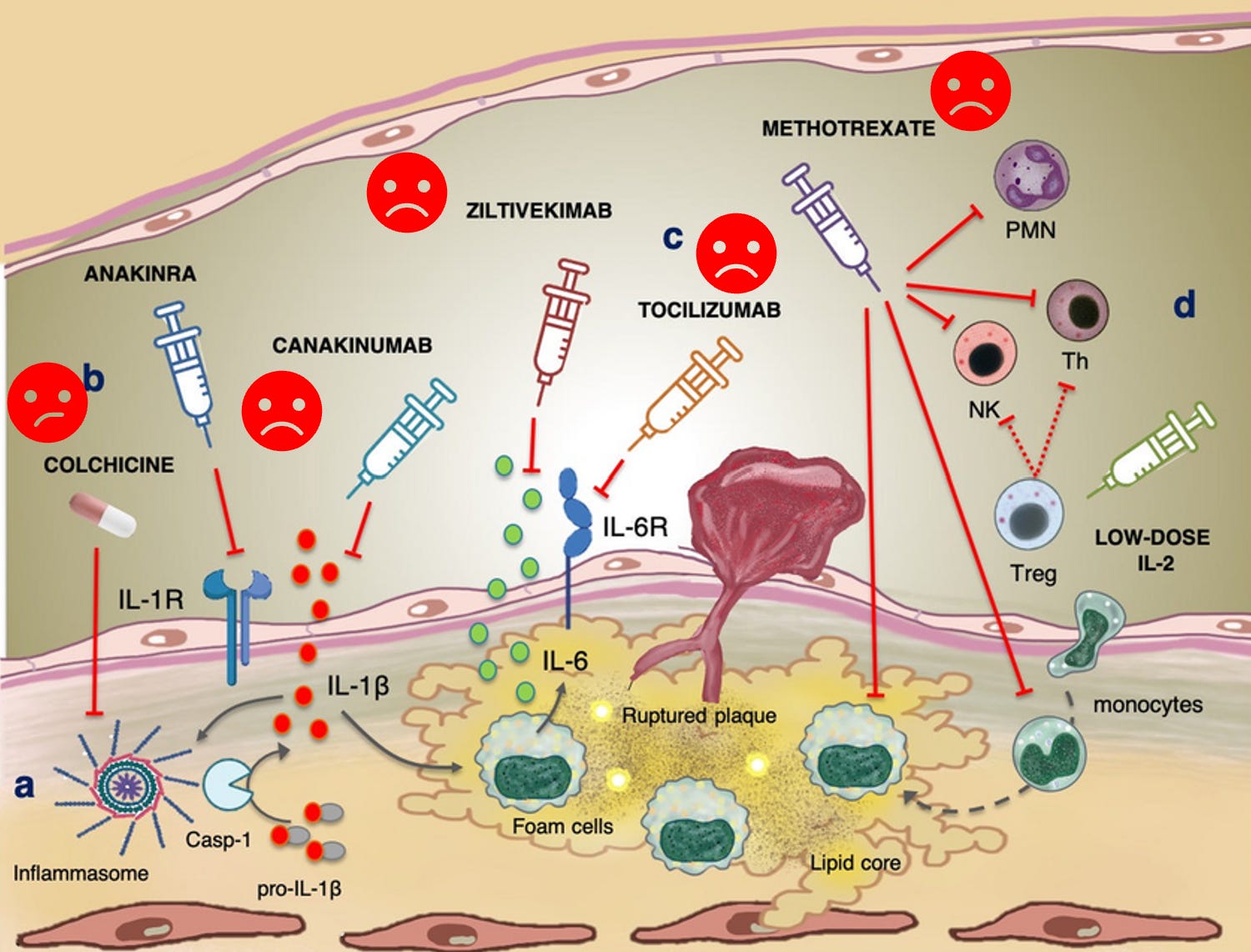
On July 31st of 2026, Novo Nordisk announced the failure of the ZEUS trial, which investigated ziltivekimab, a monoclonal antibody against the IL-6 ligand. The trial randomized 6,300 people with atherosclerotic disease, chronic kidney disease, and an hsCRP of at least 2 mg/L to receive ZIL or placebo. The drug did what it was designed to do; IL-6 dropped and hsCRP fell. As far as we know (the main study is not published yet) there were no novel safety signals, an uptick in serious infections notwithstanding. The drug also completely failed to improve cardiovascular death, non-fatal MI, or non-fatal stroke, with a hazard ratio for the primary outcome of 0.99.1
I want to talk about this today because I would have bet against this working. I would also bet against it working in the future with a different drug or a different mechanism or a different cardiovascular target. I am officially planting my flag on the “immune drugs will not fix cardiovascular-anything” hill, because I have seen this movie many times before. When you block a cytokine to prevent cardiovascular events, the effect is either marginal or nonexistent, and the benefits never outweigh the risks. So why does pharma keep spending gobs of cash on this? Hoping to unpack this today and - if you share this with enough people - perhaps we can encourage companies to divert these funds elsewhere.
The case for immunology in cardiology is pretty strong if you believe in pathophysiology and epidemiologic associations.
For as long as we’ve been looking at plaques under microscopes, we have known they are full of macrophages and T cells and inflammatry schmutz. Cholesterol crystals activate the NLRP3 inflammasome, which cleaves IL-1β, which drives IL-6, which drives hepatic production of the CRP. That gives you a tidy linear pathway from the lipid everyone agrees is causal to the biomarker everyone can measure. On top of that, hsCRP predicts cardiovascular events independent of LDL, statins lower hsCRP as well as LDL, and the patients whose hsCRP falls the most on a statin seem to do the best. The basic sciency side of this is not a hard sell.
The case for IL-6 is even a bit stronger. In addition to the aforementioned pathophysio-woo-woo, IL-6 inhibitors passed muster in a Mendelian randomization study. This one probably needs a brief explainer. The logic of Mendelian randomization is that you are assigned your genotype at conception, more or less at random with respect to everything else about your life. Theoretically, some variant that partially disables some drug target could function as a lifelong natural experiment. If people “randomized” at birth to some hobbled version of a receptor get less disease, then perhaps that’s not only observational evidence for some purported association, but also causal evidence for that association. It’s an elegant and testable hypothesis.
It turns out that the IL6 receptor has just such an experiment. The p.Asp358Ala variant blunts IL-6 receptor signaling, essentially producing the same biomarker fingerprint as tocilizumab. An interesting study that was published in big Lancet evaluated 25,458 coronary heart disease cases against 100,740 controls and found an odds ratio of 0.95 per allele. A companion paper in the same issue, pooling 82 studies, found a 3.4% reduction in coronary heart disease risk per copy of the variant. Separate Mendelian randomization work on CRP variants themselves has repeatedly failed to find a causal effect, which makes the IL-6 finding particularly alluring. I will also never fault someone for running a massive randomized controlled trial, so kudos to Novo Nordisk for taking that information and running with it.
It makes for an exciting story, but one that is incomplete without acknowledging the many prior failures in this space.
The hopes that immunosuppression will improve cardiology conditions are as old as TNFs themselves. The ink was barely dry on the 1999 rheumatoid arthritis approval of infliximab when the ATTACH study launched. ATTACH randomized 150 patients with an ejection fraction under 35% to infliximab at 5 mg/kg, infliximab at 10 mg/kg, or placebo, on the theory that TNF drives the progression of heart failure. Patients with CHF randomized to infliximab not only failed to improve, but the 10 mg/kg group actually did worse, with a hazard ratio of 2.84 for death or heart failure hospitalization. RECOVER and RENAISSANCE then randomized over 2,000 patients to etanercept or placebo, again expecting great things. Both studies were stopped early for futility.
I wrote about all of this at length last summer, and the conclusion I came to then holds up: I can say with a high degree of confidence that TNF inhibitors do not help heart failure. The case for harm is shakier and not the subject of this newsletter. What I’d rather focus on now is how thoroughly the pathophysiologic story convinced everyone in advance. TNF is elevated in heart failure, pilot studies observed substantial benefits, and everyone loves giving rheumatology drugs to cardiology patients. The investigators who powered ATTACH assumed infliximab would raise the proportion of patients with improved clinical status from 45% to 75%, a lofty thirty percentage point absolute gain.
ATTACH and co were discouraging enough to end TNF development in CHF, but investigators next shifted to coronary vascular disease. The most-positive study in this area was the CANTOS study, which recruited over 10,000 patients with prior MI and elevated hsCRP to receive placebo or the IL-1β inhibitor canakinumab at various doses. The multiplicity adjusted primary endpoint (nonfatal myocardial infarction, nonfatal stroke, or cardiovascular death) was met at the 150mg dose but not for the 300mg dose, though a quick glance sure looks like the 300mg dose has some juice. Success? Not so much.
The effect itself was pretty small - something like half a percent reduction over a 3-5 year period. You would have to treat at least a hundred and fifty people with canakinumab for many years to move the needle. Moreover, there was no difference in all cause mortality. I suspect this is because giving canakinumab was also associated with a small but significant increase in fatal infections or sepsis. In short, the benefits were marginal and the risks likely cancelled them out. All this at roughly $64,000 per patient per year, which modeling put at about $3.5 million per quality-adjusted life year, even after (perhaps erroneously) crediting an incidental lung cancer signal. To get canakinumab under a $100,000 per QALY threshold you would have to cut the price by more than 98%. The FDA rightly refused to approve it.
The concurrent CIRT trial investigated our favorite conventional synthetic DMARD, methotrexate, in a publicly funded study of nearly 5,000 patients with prior MI or multivessel disease. The CIRT study was stopped early for futility, failed to reduce inflammatory markers, and increased the risk of skin cancer. Again, the benefits were nonexistent, and in this case the risks make this a clearly-bad idea. In the discussion of CIRT the investigators said this:
Thus, although abundant data indicate that inflammation contributes critically to atherothrombosis, an important provisional hypothesis deriving from these two contemporary trials is that reducing the risk of cardiovascular events may depend on the pathway targeted
That may be true, but it is a cheeky statement to make in the wake of back-to-back failed randomized controlled trials. It also kept the dream alive. Reframing the failure of methotrexate as a failure to inhibit the right pathway and viewing CANTOS as a quasi-success meant that more studies needed to be done. That is not unreasonable, but I think it was the wrong take home lesson from CIRT and CANTOS.
ZEUS was not even the first IL-6 study of cardiovascular outcomes. The post-marketing study ENTRACTE, published in 2020, randomized 3,080 patients with seropositive RA and at least one cardiovascular risk factor to the IL-6 inhibitor tocilizumab or the TNF inhibitor etanercept. ENTRACTE followed patients for a mean of 3.2 years and had a primary outcome of MACE. To be fair, heart failure and MACE are not the same outcome. If IL-6 had a cardiovascular benefit, though, I would have expected it to emerge here. Instead, there were 83 MACE events in those randomized to IL-6 and 78 MACE events in those randomized to etanercept, with hazard ratio of 1.05. Tocilizumab failed to improve MACE against TNFs and raised LDL by 11%.
Comments
Nothing yet. Say the first thing.
Sign in to join the conversation.