
The EBR Journal Club Companion applies my adapted version of the JAMA approach to critical appraisal to an important RCT in rheumatology. Each review covers four domains: Does this apply to my patients? What is the risk of bias? How great are the benefits and harms? And what didn’t they show me? Feel free to use this in your own journal clubs! This edition: PHOENYCS GO (dapirolizumab pegol in SLE).
TRIAL: PHOENYCS GO (NCT04294667)
DRUG: Dapirolizumab pegol (a PEGylated, Fc-free anti-CD40 ligand fragment). Blocks the CD40-CD40L handshake that B cells use to get licensed, class-switch, and make the malhumors
DISEASE: Moderate-to-severe active SLE
DESIGN: Phase 3, randomized 2:1, double-blind, placebo-controlled, 177 sites, 25 countries, N=321 (208 DZP / 107 placebo), 48 weeks, adjunctive on standard of care
JOURNAL: Big Lancet, May 29, 2026
SPONSOR: UCB and Biogen
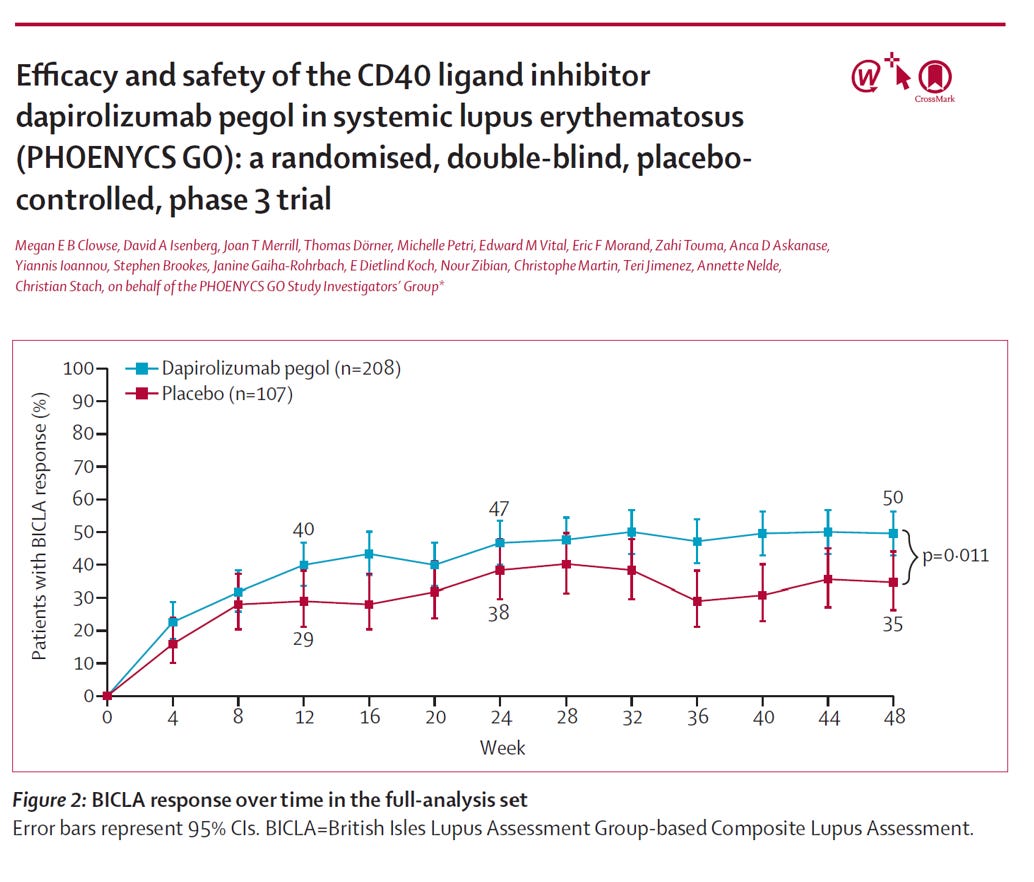
PRIMARY ENDPOINT: BICLA response at week 48. MET
THE TAKE: Dapirolizumab pegol just became the fourth biologic (after belimumab, anifrolumab, and obinutuzumab) to post a positive phase 3 primary in SLE. The key hierarchical secondary endpt at week 24 missed, so (as per usual for SLE) the analysis will be complicated. I suspect it gets approved but will struggle to gain traction in an increasingly crowded market.
Who they enrolled: Mean age ~42, 93-94% female (unsurprising, still worth saying every time). Mean SLEDAI-2K 10.7-11.2, nearly all with BILAG grade A in one organ or grade B in two or more (~97-99%). Baseline TJC ~11-12, SJC ~6-7, CLASI-A ~6-7. This is an arthritis-and-skin study
Diversity: Race/region breakdown shades to Latin Amewrica (28-34%), only 1 in 5 came from North America and Black or African American representation ranged from 5-8% . Globally representative and solid on Latin America, but less-so for our typical American SLE population
Who they excluded: Patients with an isolated acute flare and no other risk factor for relapsing disease were kept out unless they had at least one enrichment criterion (prior flare, low complement plus anti-dsDNA, African American race, age under 25). Sensible design, meant to avoid enrolling spontaneous remitters who’d make placebo look artificially good.
Background therapy: Everyone had to be on a stable dose of glucocorticoids, antimalarials, or immunosuppressants at baseline, and mandatory glucocorticoid tapering kicked in by week 8, targeting ≤7.5 mg/day by week 24
Bottom line: This is a joint-and-skin lupus population with mandated steroid tapering. Pretty standard for a non-SLE study
Randomization: 2:1, stratified by region, chronic-active vs acute-flaring, and baseline SLEDAI-2K (<10 vs ≥10). All reasonable enough
Blinding: Unblinded pharmacist prepped the infusion in an opaque bag; labs that could unblind (autoantibodies, Ig subtypes, complement, PK) were kept from investigators.
RED FLAG: Hypersensitivity reactions occurred exclusively in the dapirolizumab arm (6/213, all treated, none hospitalized) and infection rates ran meaningfully higher on drug. Smaller unblinding than some of our other drugs
Comparator: Placebo plus standard of care. At some point we need to mandate active comparators in this space. I suppose fine for regulatory purposes but not-so-much for me deciding the critical clinical question; how does this stack up against belimumab or anifrolumab?
Attrition: Completion was slightly better on dapirolizumab (85% vs 80%), which is a nice tell against a drug with a rough tolerability story. Non-responder imputation for the primary is the conservative choice (bueno)
Sponsorship: UCB and Biogen funded the trial, had a role in design, analysis, interpretation, and writing, and paid medical writers to assist. Typical modern drug development stuff
Bottom line: The mechanics are clean, but tapering got weird (placebo patients tapered slower). Remember - randomization is magical, but it only happens once. Post-baseline changes have a big impact on the week-24 miss
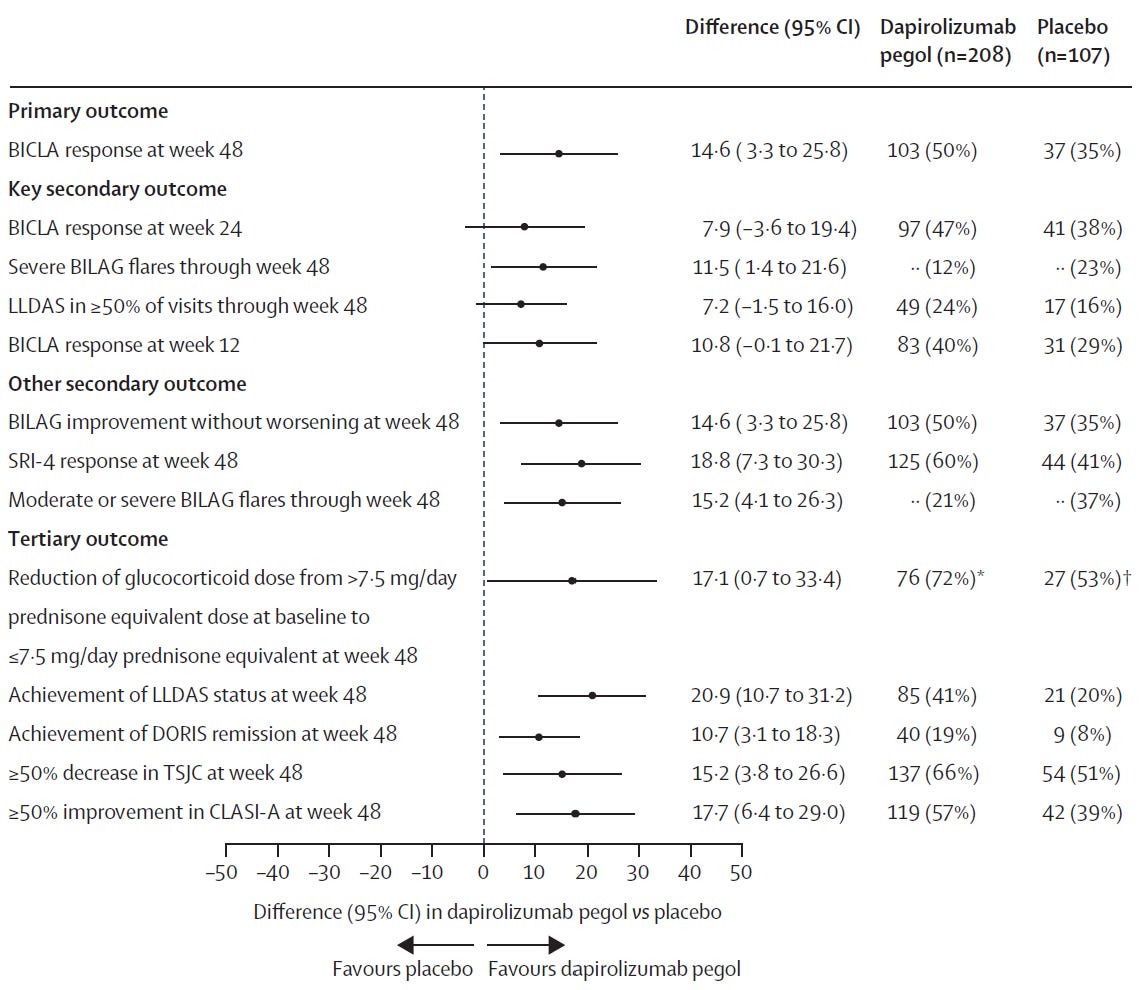
Primary endpoint (BICLA at week 48): 50% (103/208) vs 35% (37/107). Δ 14.6 (95% CI 3.3-25.8), p=0.011. NNT ~7. In the “not bad!” zone, but not revoluationary either.
Key secondary endpoint (BICLA at week 24, NOT MET): 47% vs 38%. Δ 7.9 (-3.6 to 19.4), p=0.18. This would be ignore-able, but it also closed the multiplicity gate. Every endpoint after this is nominal, not alpha-protected
Everything after the gate (all descriptive, not confirmatory): Severe BILAG flares through week 48, 12% vs 23% (~50% relative reduction, would have been a nice win run if not for the week 24 BICLA failure). LLDAS in ≥50% of visits, 24% vs 16%. DORIS remission at week 48, 19% vs 8% (more than double!). SRI-4 response, 60% vs 41%. Glucocorticoid taper to ≤7.5 mg/day among those starting above it, 72% vs 53%.
Benchmarks: That SRI-4 spread (60% vs 41%) sits in roughly the same neighborhood as anifrolumab’s TULIP-2 result and belimumab’s BLISS-52 result. Roughly. I’m not going to cross-trial-compare too hard (I did on the podcast lol, couldn’t help myself) because trials handle estimands and intercurrent events differently.
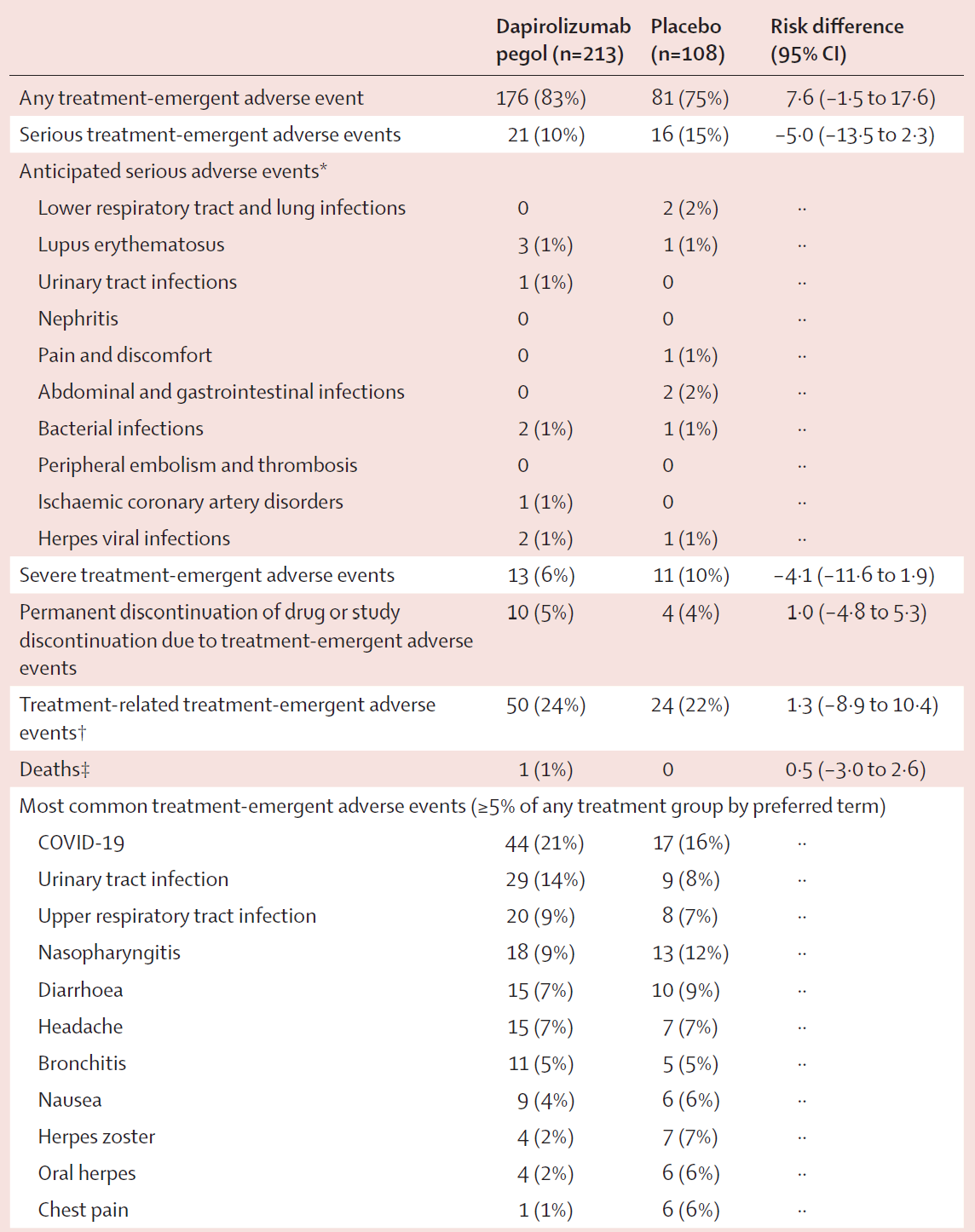
Safety: TEAEs 83% vs 75%, but serious TEAEs actually favored dapirolizumab numerically (10% vs 15%). Infections overall higher on drug (62% vs 52%), almost entirely driven by mild infections; severe infections were rarer on drug (1% vs 4%). Hypersensitivity in 3% (6/213), including 3 anaphylactic reactions meeting Sampson’s criteria; all resolved, none hospitalized, four discontinued. There was one adjudicated MI in a 53-year-old with triple-positive antiphospholipid antibodies and one death from gangrene-related sepsis, which was 57 days after the last dose of the study drug. Two cases of ophthalmic herpes zoster plus one herpes ophthalmic case, all in the drug arm
Bottom line: Mostly successful trial, but failing to run the board on hierarchical secondary endpoints is a bummer. This trial basically ran the table on “wierd 1 person safety signals that make me uneasy,” including MI, VTE, anaphylaxis, sepsis death, and funky viral things.
All the secondary endpoints! It’s not their fault, but we run hierarchical endpoints for a reason. They failed to run it and now we won’t know whether secondary endpoints were significant or not.
RED FLAG: No statisitcal analysis of BICLA-48, LLDAS, DORIS remission, SRI-4, or glucocorticoid tapering
Patient Reported Outcome Measures: I’m not sure why, but SLE trialists seem particularly averse to telling us whether or not their drug met patient reported outcome measures. I suspect there are multiple reasons for this. For one, these studies use an astonishing number of outcome measures. The typical alphabet soup includes SLEDAI-2K, BICLA, SRI-4, SRI6, BILAG, DORIS, LLDAS, and CLASI. For two, medical therapy just does not work very well in SLE. If they routinely hit MCIDs for SF36, you would hear about it. And finally, I think SLE investigators are just not that into PROs.
The trial I wish I had: So many. For starters, a head-to-head against belimumab or anifrolumab feels necessary at this point. A SLE-LN trial is also an obvious omission. I assumed we would see that coming soon, but there are currently no registered SLE-LN trials of the drug. We also probably need a relatively large phase 4 study to evaluate safety. The PHOENYCS FLY study (NCT06617325) is already enrolling and the long-term extension (PHOENYCS GLIDE NCT04976322) will carry the safety story forward.
Dapirolizumab pegol works! It hit on its primary endpoint, but the missed key secondary at week 24 means the downstream numbers (DORIS remission more than doubled! steroid tapering way better!) are descriptive.
First-generation anti-CD40L antibodies got shelved over thrombotic events tied to Fc-receptor cross-linking… and we did see one adjudicated MI in a high-risk patient. That isn’t terrible, but we need to see more data (FLY and GLIDE incoming!)
This is an arthritis-and-skin trial population, not a renal one, and I don’t see a renal one on clinicaltrials.gov. That + softer efficacy + OK-but-huh?-safety will put it behind BEL, ANI, and OBI in my prescribing tree.
EBR Journal Club accompanies the Evidence Based Rheumatology Podcast. Disclosure: I prescribe many of the medications I discuss in this newsletter. I also participate in clinical trials, unbranded educational activities, advisory boards, and consulting. Views my own, not those of my employer.
No posts
Comments
Nothing yet. Say the first thing.
Sign in to join the conversation.