
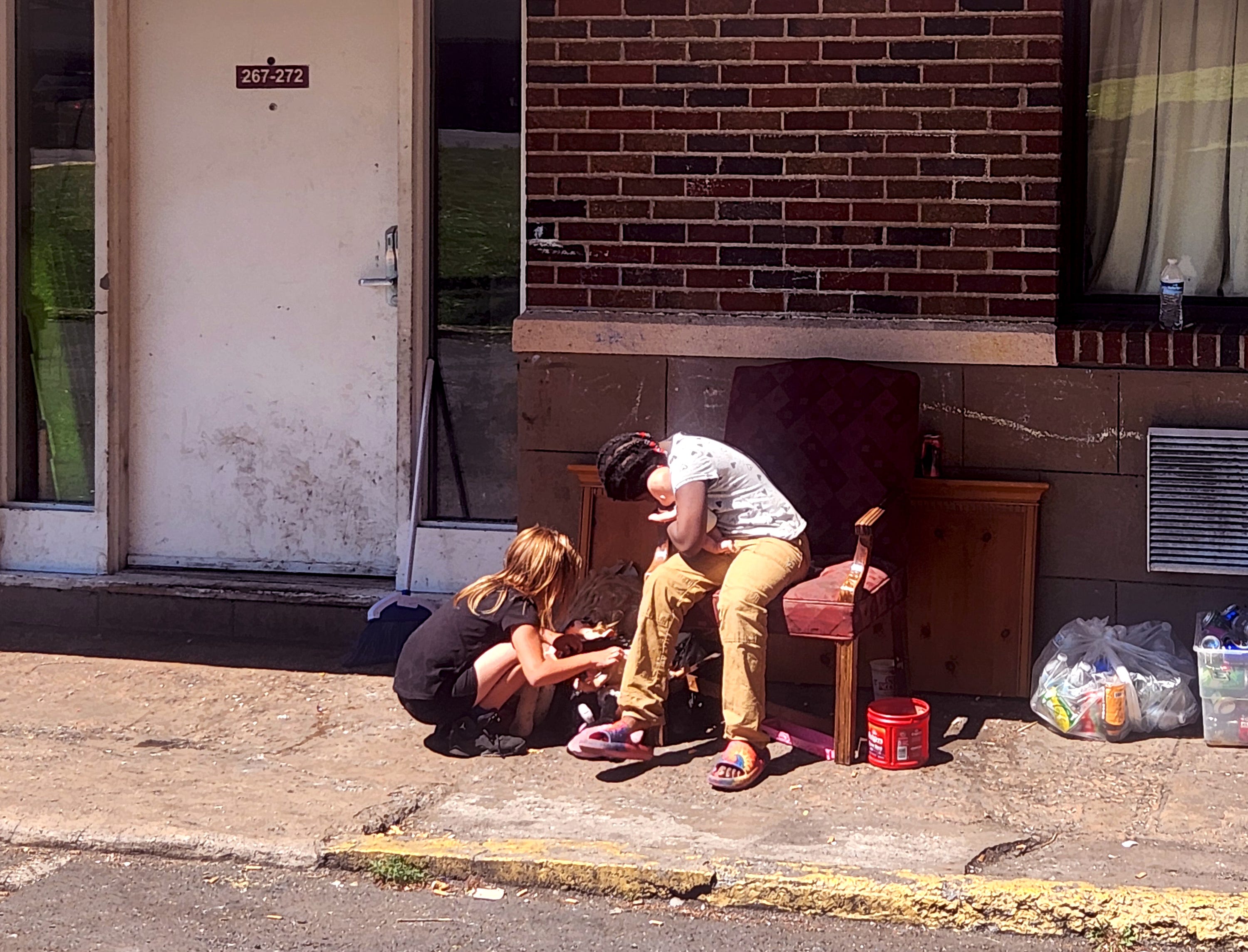
( Children play outside of motel, photo by Rokosz Most)
Valerie Russo’s day starts at 5 o’clock in the morning. Awakened by her alarm she rises to make sure her 16 and 13-year-old daughters are up and ready to catch the school bus. She walks her little rambunctious dog, eats breakfast and then she’s off to work the first of her two jobs.
At a strip mall in the Kingston Plaza, from 7:30 a.m. until 4 p.m., Russo works as an administrative assistant for the commercial driver training school. Then from 4 p.m. until 8 p.m., Russo manages the sales floor of the Cricket Wireless Cell Phone store a few doors down.
By 8:20 p.m. with the storefront closed and the lights turned off she locks the glass door behind her and heads over to the Hannaford Supermarket to get the night’s shopping over with. Then she drives the few miles back to the Kingston Motel and makes dinner for her family in the single room where they have all lived for the last two years.
With four people all in a single room- her 19-year-old son also lives with her- the sleeping arrangements are cramped.
“I share a bed with my 16-year-old, and my son shares a bed with my 13-year-old. It’s hard to sleep up there when you’re in a full-sized bed with two people in it.”
This is not the first motel in which they’ve lived. For the Russo’s, previously of Wallkill, life since the pandemic has been desperate.
“When I first became homeless, in 2020, it was due to the landlords selling the property,” Russo said, “leaving us with nowhere to go. In August they told us that we had 30 days to leave.”
With COVID raging all around, and winter fast approaching Russo and her children, landed at the Colonial Hotel in the town of Kerhonkson.
“The kids were going to school remotely,” Russo said. “We were in the boonies.”
The Department of Social Services eventually moved the Russo’s to the Motel 19 on the outskirts of Kingston and then a week later moved them again, just up the hill to the Kingston Motel, where 50 rooms had been reserved by the county for the emergency placement of unhoused families.
Just ten years ago multi-year stays in temporary emergency housing was uncommon. Now, explains Laura Nordstrom, county director of housing and homelessness since January, it’s the norm.
“The average length of stay for families with children living in hotels and motels was for 1,132 days last year,” said Nordstrom. “Longer than three years.”
In 2024, Ulster County residents spent a total of 129,170 nights in emergency housing. Unhoused families accounted for nearly 52,000 of those nights. (51,856)
The government of Ulster County maintains temporary emergency housing arrangements with 24 privately-owned hotels and two emergency shelters for the placement of families like Russo’s. With increased duration of stay comes increased cost. Paid for with a combination of Federal Block Grants and State and Local Funds, the cost of Family Assistance in 2024 rose to $4.038 million in 2024, up from $1.53 million in 2021.
Temporary Assistance for Needy Families, called TANF, is the name of the block grant administered by the state to provide assistance to families in need.
Annually performed Point in Time counts of unhoused persons in the state, most recently conducted in January of 2025, showed that when including surrounding Mid-Hudson Valley counties- Dutchess, Columbia, Greene, Putnam, Rockland and Sullivan - 542 children under the age of 18 were being raised in hotels, motels and other emergency shelters.
Data from 2025 for Orange County has not yet been released, but numbers from 2024 showed an additional 223 children living in emergency housing.
“My son graduated high school,” Russo said, “beginning to end, homeless.”
Comments
Nothing yet. Say the first thing.
Sign in to join the conversation.