
There has been no electoral landslide to arrest the darkness, no leader willing to surrender personal profit or power for the common good. This book presents a chilling reminder of the human consequences when autocracy, rather than democracy, prevails.
Today Trump met with the new leader of Syria, who last December ousted that country’s most recent dictator Bashar al-Assad. It is distinctly possible that Trump now represents a greater authoritarian threat to America than his counterpart Ahmed al-Shara does to Syria. And that terrifying irony reminded me of a novel that I reviewed five years ago about al-Assad’s reign of terror — a book that may well portend the near future of the United States of America.
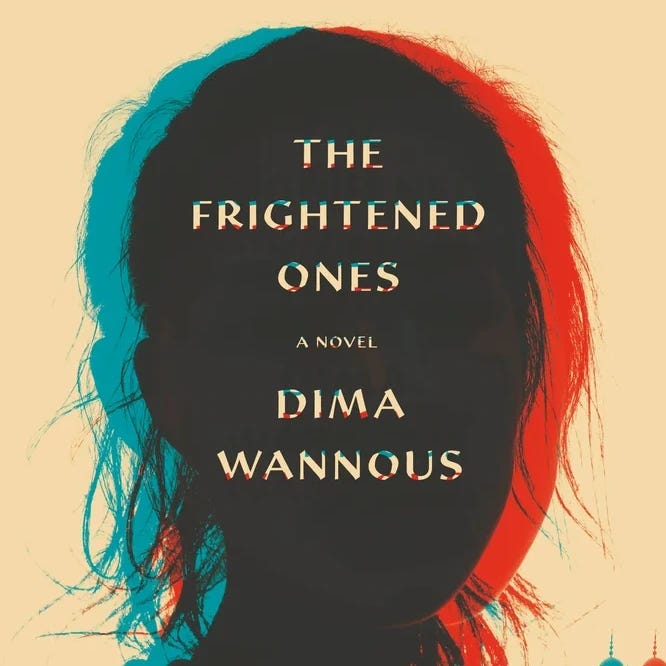
The Frightened Ones by Dima Wannous often reads like dystopian fiction, but it in fact is a crystalline portrait of life under an authoritarian regime. We ignore this portrait at our peril. That’s why I’m sharing my review with you today.
The fear of fear is an authoritarian weapon that is currently being wielded across Trump’s America. I invite you to read the following through that lens.
Thanks for reading Authors For Democracy ! This post is public so feel free to share it.
“I yelled and I heard my voice,” he told Suleima. “Everyone could hear each other. The age of silence is over!” Then he, too, disappeared, and Suleima asks in disbelief, “Did they think he was a terrorist?”
In his first inaugural address, U.S. President Franklin D. Roosevelt famously declared “that the only thing we have to fear is fear itself--nameless, unreasoning, unjustified terror which paralyzes needed efforts to convert retreat into advance.” The moment was January 1933. The Great Depression was entering its fourth year of global devastation. Americans faced what FDR called “the grim problem of existence” and “dark realities of the moment” brought on by rulers who believed that “public office and high political position are to be valued only by the standards of pride of place and personal profit.” Two months earlier, however, those same Americans had chosen a different kind of leader -- one who believed in “interdependence” and “sacrifice for the good of a common discipline.” They elected him by a margin of more than 17%. Democracy prevailed, and under FDR’s unifying leadership the U.S. eventually won both the war against the Great Depression and World War II.
Dima Wannous’s harrowing novel The Frightened Ones is not about FDR or the Great Depression or America in the 1930’s, but it is very much about “the fear of fear itself.” For in the contemporary Syrian context of The Frightened Ones, there has been no electoral landslide to arrest the darkness, no leader willing to surrender personal profit or power for the common good. This book presents a chilling reminder of the human consequences when autocracy, rather than democracy, prevails.
The ruler of Wannous’s Syria is Bashar al-Assad, a president so proudly ruthless that the mother of a child who lets his portrait touch the ground is made to disappear. Common discipline is so anathema among the members of Assad’s shabiha, or militia, that they freely threaten to kill their own family members if crossed. This is the grim existence of life under authoritarian rule, an existence built on a legacy of massacres and physical, emotional, and spiritual trauma. A dark reality perpetuated, as Wannous stresses, by the fear of fear.
Lest any reader doubt the reason for this fear, Wannous lays it bare within the first paragraphs. The narrator, who will remain unnamed for 35 pages, tells us that she was in the waiting room of her therapist Kamil’s office “exactly fifteen years ago.” The word exactly is a significant clue to both the nature of this book and the story’s historical context. Despite its distinctly surreal aura, The Frightened Ones is a work of acute realism, dystopian without being remotely speculative. Specific dates appear as sparingly as lethal secrets, but eventually it will be revealed that the revolution of 2011 took place “four and a half” years ago for the narrator, which means that her story begins in 2000, the year that Bashar al-Assad succeeded his father Hafez as President. Exactly.
By the second page Wannous sets this stage for us with a story about the brother of Kamil’s receptionist, Leila. This young man was a classmate of the narrator’s at the College of Fine Arts. One day his girlfriend caught the eye of an intelligence officer’s son, and when the girl rebuffed this unwanted suitor, Leila’s brother disappeared. “They hung him from his feet for days, left him upside down, until his mind poured out, to the last drop.” After he was released, he refused to leave his room. He sat by the window gesticulating and shouting into the street, “Have you seen Hafez al-Assad? If you see him, tell him I won’t leave my room until he comes to visit in person.”
That’s the last explicit scene of the regime that we will read for many pages. It is enough, as the narrator warns us with a glance around the crowded waiting room at “people not dissimilar” to Leila’s brother “one way or another. They had stories just as strange as his.” To dwell on the particulars would be to repeat the obvious. It is not the physical horror that’s central here, but the fear of fear itself.
The presentation of this story by an unnamed narrator about an unnamed brother in the waiting room of a therapist who is named but never visually described is as unsettling as the highly specific naming of Leila, an “unusually sweet” character who is peripheral yet carefully studied by the narrator. In a world where humans are summarily disappeared, the attachment of identities to names can be as treacherous as the attachment of souls to bodies. The central figures in this novel will be revealed slowly and sparingly, for the most part through indirection and stolen glimpses. We only learn that the narrator’s name is Suleima when her mother says “in her exasperatingly soft voice, ‘Suleima, I’m going to take a shower.” This is the same mother who sits for hours, day after day, reading the same sentence on the same page 24 in the same book, over and over again, the same mother who fears she’s losing her memory, the same mother who, according to her daughter, aged overnight. This is also the same mother who berated her late husband, Suleima’s beloved father, for bringing his family to Damascus and practicing medicine under a portrait of the President, choosing “to hide instead of disappearing” after the 1982 massacre in their hometown of Hama.
For readers like me, with little knowledge of Syria beyond the headlines in American news media, this novel will present both barriers and clues that require patience to decode. For those familiar with Syrian life before, during, and after the 2011 revolution, I suspect it will trigger emotional aftershocks similar to those that besiege Wannous’s characters. Either way, the gruesome scenery of war, from battlefield casualties to execution techniques, is neither necessary nor displayed in these pages. The horror mounts instead through the dissociation of the characters’ psyches and the barrenness of prose as stark as Camus’s in The Stranger.
Wannous writes with the clinical precision of a scalpel. She offers no luxurious descriptions of landscape, no sensuous details of local food or voluptuous lovemaking. Instead, her phrasing reverberates like an ongoing state of shock. Each sentence lands stripped, hard and colorless as the bones that Suleima claims to love "more than anything else.”
This love of bones is what attracts her to the man who ignites the psychological mystery at the heart of the novel. Naseem was another of Kamil’s patients when Suleima met him “fifteen years ago.” She studied this “stranger with prominent bones” in the waiting room, taking note of his solid forearms and wrists, and especially his broad chest. “I envied him his ribcage, that it could expand to hold so much air…I was desperately afraid of suffocating, terrified by the thought of the air around me running out.”
Naseem, whose own panic attacks are triggered by fear of drowning, seems unwilling to expend even the air it takes to converse with Suleima, yet he invites her for a cup of coffee. They sit in silence. Suleima pops a Xanax. The next time they go out, he takes her hand. Eventually she learns he’s a writer, though he publishes under a pseudonym because he’s “afraid of fear.”
“Afraid of fear,” she emphasizes. “This phrase was the deep current beneath my life: fear doesn’t have just one form; fear of fear never leaves you.”
Naseem is more pragmatic. “Fear ruins the imagination,” he tells her.
The fear that panics them both, she understands, is internal. “Not the fear of being detained, prosecuted, interrogated, or prevented from leaving the country, but a fear that came before all those other fears. Since Naseem was afraid of living in fear, he preempted it by writing under a pseudonym. Under his real name, Naseem wasn’t an author, he was a doctor.” Just like Suleima’s father.
Such parallels are common in this story, Wannous implies, because they reflect the impact of life under tyranny, the shared reality of twenty-three million “frightened” Syrians. “We may as well be copies of each other,” Suleima imagines Naseem telling her. “Here we are, at school, at home, in the streets, in Damascus’s few cinemas, at the theatre, in government offices… all of us living one story, one aching version of humankind.”
The common ache has the effect of disappearing individuality much as the shabiha disappears dissidents. As a result, each person feels erased, identities interchangeable. Memory dissolves along with the distinctive scenes and sensations that would mark a normal life. Dreams acquire the weight of reality. Time accordians.
Suleima’s confusion has intensified since that critical moment “four and a half years ago” when Naseem took his elderly father and emigrated to Germany, leaving her the key to his flat. She finds evidence that their relationship was not what she believed, that the love she believes she felt for him was not reciprocal, that he, perhaps, was nothing like she remembers him. Suleima is hardly a reliable narrator, however. She insists, “I don’t like things that are round, finished or whole. I like things lacking: absence makes me feel complete.” But her continuing preoccupation verging on obsession with Naseem “all these years” after his departure (“all these years” a percussive, insistent, and repeating theme) belies her claimed preference for absence.
Naseem orchestrates this obsession by sending Suleima an unfinished novel from exile. The story appears to be about Suleima herself. Like her, the unnamed narrator is “a woman shaped by fear,” a patient of Kamil. Her beloved father, too, was a doctor who died, as Suleima’s did, of natural causes when she was a girl. And Naseem uses the same flat delivery as Suleima’s internal voice. She feels that he has gotten inside her mind and stolen her life.
Or has he? This is the question that animates Suleima as she alternates chapters from Naseem’s manuscript with her own memories, dreams, and deductive commentary.
One major difference distinguishes Naseem’s narrator from Suleima: this other woman has left Damascus for Beirut. For the uninitiated, her story makes it clear that Lebanon is only one long taxi ride but a world away from Damascus. “War toyed with geography, redrawing roads and borders. My home retreated further every day, until it may as well have been as far as Paris, or London, or Germany.” Naseem’s narrator no longer belongs in Syria. She no longer belongs anywhere.
Suleima, however, has not left Damascus. She still lives with her mother, who’s stuck on page 24. She still calls herself a painter, though she hasn’t painted for four and a half years. She’s not under arrest, but her life is arrested in the state that her brother Fouad called the “Age of Silence.” For Fouad, the silence was exemplified by Channel Syria’s practice of broadcasting scenes without sound. “The prime minister cut a red ribbon and the attendees applauded, all smiling broadly. But there were no sounds of clapping or laughing.” The silence terrified him.
Fouad broke that silence by joining the protests during the revolution of 2011. “I yelled and I heard my voice,” he told Suleima. “Everyone could hear each other. The age of silence is over!” Then he, too, disappeared, and Suleima asks in disbelief, “Did they think he was a terrorist?”
She never raises her own voice. She’s like her late father in her need to survive. And now that both her father and brother are gone, she bears the brunt of her mother’s impotent resistance. Suleima’s mother encouraged her only son to join the protests. “She wanted him to make up for what her ‘traitor’ husband had done.” It had shamed her to live with a man who “fled in fear,” but she can be “proud that her lost son has given her life meaning.”
Fouad’s been gone for more than two years. Suleima prays that he’s dead. Her mother, she thinks, must believe he’s dead. “How could she be so calm if she knew he was alive?”
Questions of agency and attachment pulse through these pages. Suleima’s mother is paralyzed but yearns for her loved ones to fight, even if it means death. Naseem and his nameless proxy for Suleima surrender all sense of belonging as they resort to flight. Meanwhile Suleima remains psychologically spinning in place, her weeks revolving around her therapy sessions with the elusive Kamil, her nights weighed down by dreams of a gently attentive Naseem who perhaps never existed. As she works her way through the mysterious manuscript, she can’t decide if it’s evidence that Naseem has gone mad, or that she has, or that the entire world, including Kamil, has lost its mind and come apart.
This is the effect of the fear of fear itself, or as Roosevelt called it, that “terror which paralyzes needed efforts.” With authoritarian governments once again emerging and ascending throughout the world and an American president threatening to “Get rid of the ballots” in the upcoming U.S. election, the need for citizens “to convert retreat into advance” appears every bit as urgent now as it was in 1933. In the face of this new “dark reality,” The Frightened Ones reads like an essential and galvanizing portent.
Comments
Nothing yet. Say the first thing.
Sign in to join the conversation.