
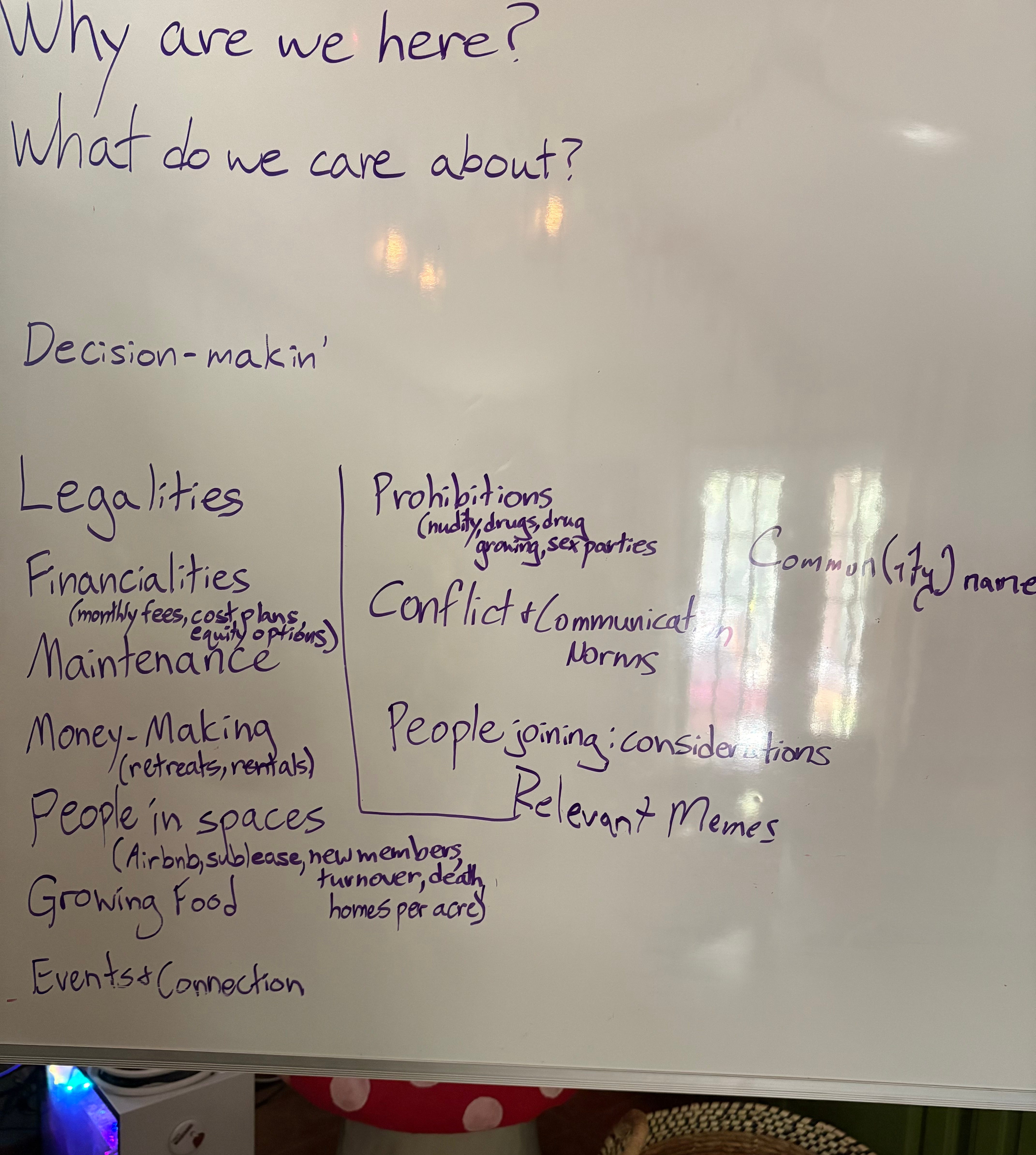
This past weekend, our Asheville land project held a planning retreat. 11 of us - with 8 or so present at any given time (due to work and “I’m just here for the grandbabies, decide whatever y’all want”) - had less than two days to decide what most intentional communities do in two years of meetings.
And y’all. We did it.
We shared and aligned visions; reviewed finances and discussed investment; chose decision-making protocols; defined subleasing norms, rental agreements, and businesses on property; set common house policies; clarified non-negotiables and preferences for hot-button topics like sex, drugs, nudity, and guns; and even got in some connection time.
I’ve been thinking about what made this work.
Why were we able to move with ease through an agenda that I thought was impossible?
How did we put together a complete community charter with 10 people, in less than 12 hours, with minimal planning or facilitation?
I don’t know! So let’s end this Substack here…
…jk, like I’d ever miss an opportunity to analyze group process.
I’ve identified five factors that I think made the retreat, and our co-living formation group, such a success. I’ll break them down - and at the end, I’ll share our fully-formed community charter.
Have you ever been in a group where someone has a need, but the way they’re speaking about it sounds like this:
“I’m not okay with having a farm on property. I don’t think it’s appropriate for a living community to grow crops. I think we should only do a food forest.”
Or,
“It seems like we’re not hearing everybody’s viewpoints here. I don’t think it’s fair for all members’ finances that we have a CSA. I’d like us to be more equitable.”
Or,
“I feel like I’m not being heard. I want you all to get where I’m coming from.” [10 minute monologue on the same thing they just said]
To me, there is a common feel to all of these statements. When I imagine saying them, I feel my body drawing backwards. My chest feels tight, tense, armored. My brows go down. My arms cross. Everyone looks, and feels, like an enemy. I am playing defense.
Hot take here: I think defensive behavior is even more detrimental to community than playing offense (hot anger, shouting, aggression). Offense is easier to confront. It’s easier to name the behavior, or take a pause.
Defense occurs, at least to the person doing it, as reasonable. This community member thinks they’re speaking up for their own needs. But the way they do it moves the group backwards.
A huge reason our group was able to get things done so quickly was that nobody stayed on defense.
We definitely had different preferences at times. But the way people spoke up for them sounded more like:
“I would rather have a food forest than a farm. We’d get more yield out of it.”
Or,
“Is there a way we can give people produce even if they can’t afford to buy in?”
And nobody said “I don’t feel heard” - they just spoke their view again, clearly and simply, with more context behind it.
Defense is a version of “I don’t trust you” or “I want to win”. It can look like trying to protect others (who haven’t asked for it), blocking others’ decisions without offering alternatives, or stonewalling. It slows everything down. It sows doubt into others’ minds.
Our weekend worked well because everyone asked others about their needs, spoke up for their own needs - and then stopped talking after a decision was made.
Comments
Nothing yet. Say the first thing.
Sign in to join the conversation.