
There is a question people ask when they notice the gap.
Where were all the women?
It sounds like curiosity. It functions like an alibi. Because embedded in the question is an assumption, that if women had been doing serious scientific work, we would know about it. That the absence of names in the record reflects an absence of contribution. That history is a complete document rather than a selective one.
It isn’t.
What the historical record reflects is not who did the work. It reflects who was permitted to sign it.
For centuries across Western science, the mechanisms that kept women’s names off their own work were not accidental, not cultural in some vague hand-waving sense, and not simply a matter of individual men making individual bad choices. They were structural. They were legal. They were written into bylaws, statutes, publishing contracts, and federal guidelines. They had names and dates and official seals.
The gate had a lock.
This essay is about the lock.
Not about one woman who was overlooked. Not about one discovery that got misattributed. About the system that made women’s authorship fragile, conditional, dependent on male permission, or impossible altogether — and about the specific legal and institutional mechanisms that built it, maintained it, and in some cases, are still being dismantled today.
Because the answer to “where were all the women?” is not complicated.
They were there. Calculating, translating, observing, illustrating, assisting, discovering, theorizing, and publishing — under their husbands’ names, their brothers’ names, their supervisors’ names, or no name at all.
The gate had a lock.
We are going to name the locksmith.
The women whose names we still know — Caroline Herschel, Marie Curie, Lise Meitner — survived the erasure partially. They are not the story. They are the visible edge of it.
For every woman whose name made it through the machine in some recoverable form, there are hundreds whose contributions dissolved entirely. Into a husband’s published paper. Into a brother’s lecture to the Royal Society. Into an institution’s proceedings under a male supervisor’s name. Into a footnote that said “with assistance from” and then gave no name at all.
We will never know how many. That is not an accident. It is the point.
The structure was not designed to make women’s contributions difficult to trace. It was designed to make them untraceable. And it worked. The historical record we are left with, the one that makes people ask “where were all the women?” is not incomplete by accident. It is incomplete by design.
Here is how the design worked.
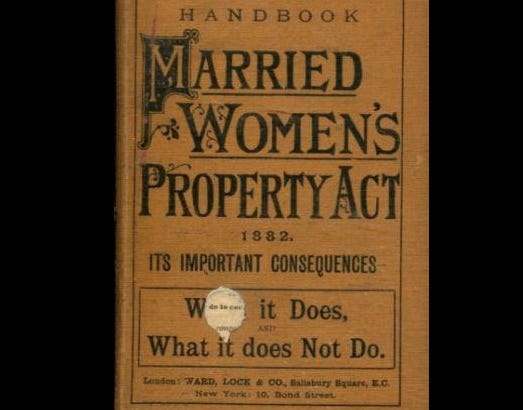
The first lock was not informal. It was not cultural bias or social pressure or the accumulated weight of tradition. It was written law, with named statutes, official seals, and courts to enforce it.
In England and Wales, it was called coverture. The doctrine had Norman origins — carried into English common law when William the Conqueror invaded in 1066, formalized through the legal reforms of medieval kings, written into legal treatises by the 13th century. William Blackstone codified it in his Commentaries on the Laws of England in 1765: “By marriage, the husband and wife are one person in law: that is, the very being or legal existence of the woman is suspended during the marriage.”
Suspended.
Under coverture, a married woman could not own property, keep her own earnings, sue or be sued independently, or sign a contract. Publishing required a legal contract. A married woman could not enter one without her husband’s explicit co-signature. Her intellectual work belonged to him by law. If he refused consent, she did not publish.
England began dismantling coverture with the Married Women’s Property Act of 1870. The 1882 Act went further, granting married women separate legal capacity to contract and hold property — though other vestiges of coverture, including the inability of spouses to sue each other and the marital rape exemption, persisted in English law for decades after. In the United States, reform came state by state, Mississippi first in 1839, but certain aspects of coverture survived in some American states into the 1960s.
Across the Channel, France was operating under different law with the same practical effect. Napoleon’s Civil Code of 1804 explicitly placed married women in Article 1124 alongside minors and people declared mentally disordered, all listed together as persons lacking legal capacity. Article 213 stated it directly: “The husband owes protection to his wife, the wife obedience to her husband.” A married woman could not sign contracts, enter employment, open a bank account, or publish without his written authorization. Her intellectual work, like everything else, was legally his.
Legal historian Ute Gerhard, writing for the Encyclopédie d’Histoire Numérique de l’Europe, identified the precise mechanism: family law created what legal scholar Dieter Grimm called “an enclave of unequal law” that presided over women until the mid-twentieth century.
That phrase, enclave of unequal law, is precise. It was not the whole of law. It was a specific carved-out space where the normal principles of legal personhood did not apply to women. And it spread across the continent.
The Napoleonic Code became the template for civil law across Western Europe. Belgium, Luxembourg, parts of Germany, Spain, Italy, and Poland all adopted versions of its framework. Germany’s own civil code, the Bürgerliches Gesetzbuch of 1900, gave husbands the final decision in all conjugal matters and the right to cancel a wife’s work contract if he felt her employment interfered with her domestic duties. Austria’s 1811 civil code contained a “tacit agreement” presumption — married women were assumed to have transferred administration of their property to their husbands by default, whether or not they had ever agreed to any such thing.
The Scandinavian countries moved earliest. Denmark repealed guardianship over unmarried women in 1857. Norway and Sweden followed in 1863. Married women’s property rights came between 1845 and 1888 across the Nordic countries. Full marriage law equality arrived: Sweden 1920, Denmark 1925, Norway 1927, Finland 1929.
The rest of Western Europe moved much more slowly.
France’s legal incapacity of married women was not abolished in principle until 1938. Its effects on matrimonial property continued until 1942. Until 1965, a married French woman had to present written marital authorization to open a bank account or sign an employment contract. Complete legal equality between husbands and wives in France was not established until 1985.
Germany reformed conjugal rights in 1957. Deeper reform came in 1977.
England achieved legal equality in family law in the 1960s.
These are not medieval dates. These are dates within living memory. The women affected by these laws are not historical figures. Some of them are still alive. And the women who worked inside these structures — who discovered, calculated, observed, theorized, and produced scientific knowledge while legally classified alongside minors and the mentally incapacitated — did so knowing that the law itself defined their work as belonging to someone else.
But law was only one lock.
Even when women found ways around marriage law — remaining unmarried, working as widows, navigating the narrow exceptions — science had another gate waiting.
The academies had built their own.
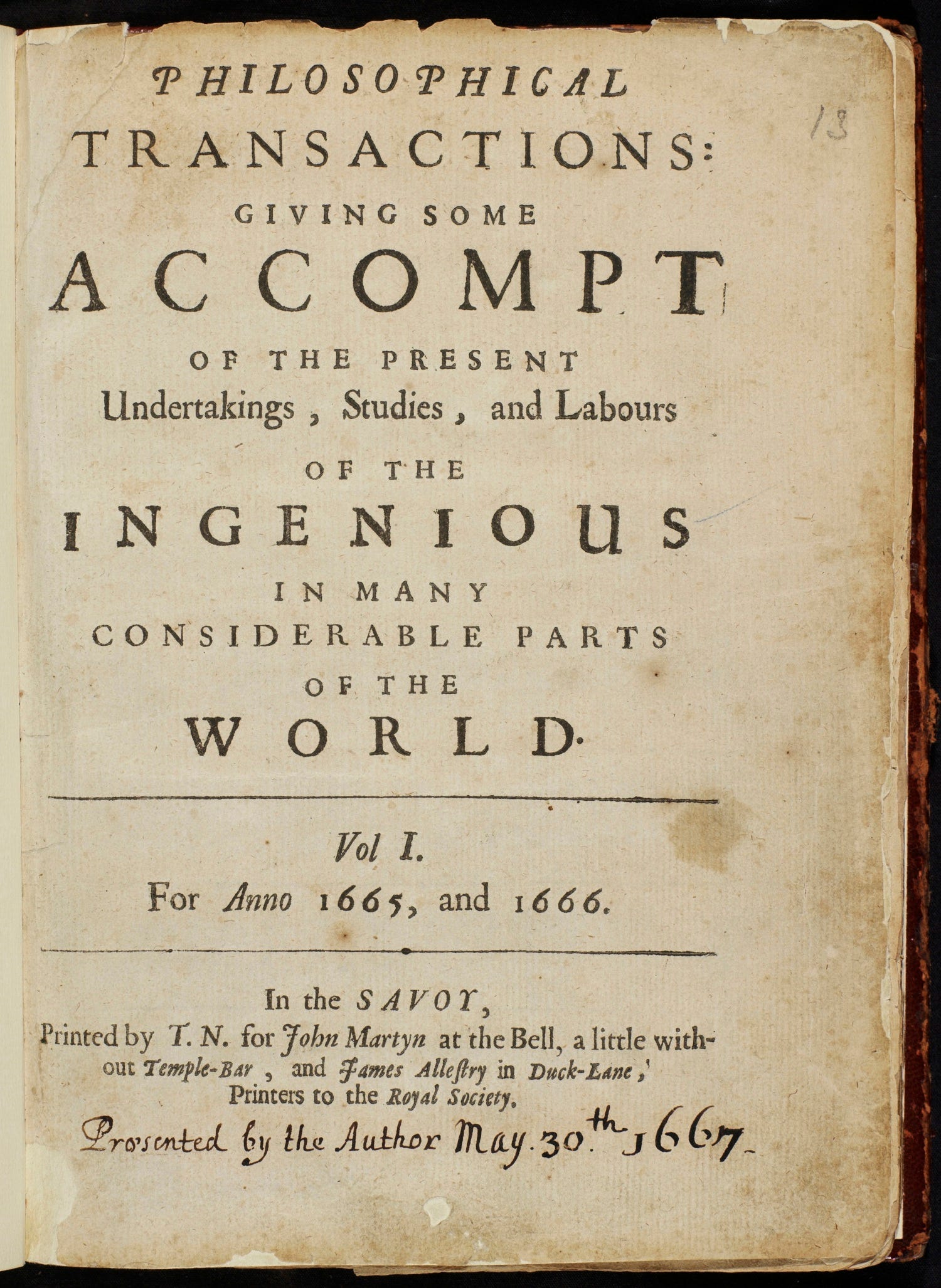
In 1660, King Charles II granted a royal charter to a group of natural philosophers meeting in London. They called themselves the Royal Society. Their journal, Philosophical Transactions, published from 1665 onward, became the most prestigious scientific publication in the English-speaking world.
Membership was restricted to elected Fellows. The journal published work communicated by Fellows.
Women were not Fellows. The bylaw was explicit.
Which meant that for a woman to publish in the most important scientific journal in the world, a male Fellow had to agree to sponsor and submit her work on her behalf. She could not submit directly. The gate did not merely exclude her. It made her invisible to the submission system entirely. Her work did not exist, officially, until a man decided it did.
The Académie des Sciences in Paris was founded six years later, in 1666. Same structure. Same restriction. Same result.
These were not informal clubs with loose membership criteria. They were state-chartered institutions with royal backing, legal standing, and control over the most prestigious publishing channels in Western science. When they excluded women they did not merely send a social signal. They enforced a structural reality: a woman’s scientific work could not reach the most credible audiences in the world without male permission and male sponsorship. The knowledge might enter the record. Her name would not.
This is the mechanism that produced the footnote. The “with assistance from.” The “calculations performed by.” The paper published under a husband’s name or a brother’s name or a supervisor’s name. Not because women lacked the confidence to claim their work. Because the system had no intake mechanism for work claimed by women.
In 1856, Eunice Newton Foote conducted experiments demonstrating that carbon dioxide trapped heat more effectively than other gases, the foundational observation of what we now call the greenhouse effect. She submitted her findings to the American Association for the Advancement of Science. Women were not permitted to present their own work. A male scientist, Professor Joseph Henry, read her paper aloud on her behalf. Three years later, British physicist John Tyndall published research on the same phenomenon. He received credit for discovering the greenhouse effect. Foote’s name disappeared from the scientific record for 155 years, rediscovered only in 2011 by a researcher browsing historical archives.
Her science was not wrong. It was right. She disappeared because the system had no mechanism for keeping her name attached to it.
In 1911, Marie Curie applied for membership in the Académie des Sciences. She was rejected by two votes. That was the year she won her second Nobel Prize, making her the only person in history to win Nobel Prizes in two different scientific disciplines. The institution that claimed to represent the pinnacle of French scientific achievement rejected the most decorated scientist in the world because admitting her would mean acknowledging that the gate could no longer hold.
They chose the gate.
The Royal Society admitted its first female Fellows in 1945, two hundred and eighty-five years after its founding. The Académie des Sciences did not admit a woman until 1962, two hundred and ninety-six years after its founding.
These dates are not incidental. They are the legal and institutional architecture made visible. Coverture formally ended in England in 1882. The Royal Society kept women out for another sixty-three years. The Napoleonic Code’s restrictions on French women formally began to fall in 1938. The Académie kept women out for another twenty-four years after that.
The laws changed. The institutions did not follow. Because the institutions did not have to. Their bylaws were their own. Their gatekeeping was self-governing. And the culture that had grown up around a century of legal exclusion did not evaporate when the statutes changed. It calcified into assumption. Into habit. Into the unexamined conviction that this was simply how science worked.
And the women whose names we can still attach to these moments — Foote, Curie, Meitner — are the ones whose contributions were too substantial to disappear entirely. They are the visible edge of something much larger.
The computers at the Harvard Observatory who catalogued hundreds of thousands of stars under male supervisors’ names. The calculators who checked the mathematics for papers that carried other people’s bylines. The assistants whose observations formed the data sets that launched other people’s careers. The women who handed their findings to the man who would submit them because there was no other way for those findings to travel.
Those women are not in the record.
The gate ensured it.
The laws did not only exclude women from credit. They created something more useful to the institutions that enforced them: a reliable supply of intellectual labor that required no professional acknowledgment in return.
A woman who could not publish independently could not threaten a man’s reputation. She could not submit competing findings. She could not claim priority. She could not go to a journal directly and say: this discovery is mine. The system had closed every avenue by which that claim could travel. Which meant that a woman’s contributions — her calculations, her observations, her data, her analysis — could flow directly into a man’s published work with no legal or institutional mechanism to stop it and no legal or institutional mechanism for her to object.
This was not incidental to the system. It was the system’s most practical feature.
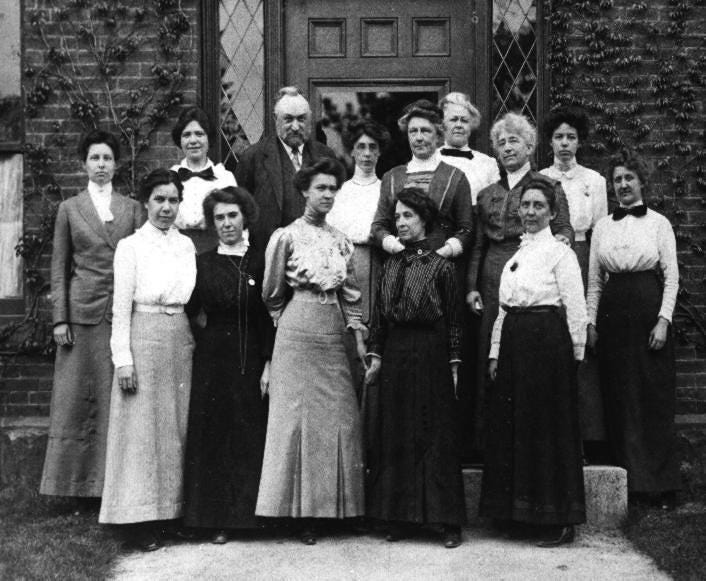
The Harvard Observatory hired women as astronomical computers beginning in the 1880s — cataloguing stars, classifying spectra, performing the calculations that formed the foundation of modern astronomy. They were paid approximately twenty-five cents an hour. Male astronomers were paid more and received publication credit. The women received acknowledgment, when they received it at all, in footnotes. The knowledge they produced entered the permanent scientific record. Their names, in most cases, did not.
This pattern — women producing the foundational intellectual labor, men receiving the credit and the career — was not confined to astronomy. It structured scientific collaboration across disciplines and across decades. Historians of science Anna Reser and Leila McNeill, examining the documentary record, found it operating consistently: the women organized the data, checked the mathematics, made the observations concrete and usable. The men drew the conclusions that got published.
The dynamic was self-reinforcing. A man who worked with a female collaborator under these conditions lost nothing and gained everything — the labor, the precision, the intellectual contribution — while assuming none of the professional risk of sharing credit with someone the institutions would not have taken seriously anyway. The law had already ensured she had no standing to object. The bylaws had already ensured she had no submission pathway. The culture had already ensured that her word against his, if it ever came to that, would not be treated as equal.
Albert Einstein understood this explicitly — and said so plainly, years later, when the stakes had turned financial. Mileva Marić, his first wife and a physicist in her own right who worked alongside him during the years he produced his most foundational papers, had by 1925 spent a decade watching his career built partly on ground they had once shared. When she threatened, in the middle of a dispute over his Nobel Prize money, to say something about what she remembered, he wrote back to remind her: that no one would have paid any attention to what she said if the man she was speaking of hadn’t accomplished something important.
He was not confessing guilt in a moment of tenderness. He was stating, coldly, a fact about the system — after the marriage had ended, when she tried to use her knowledge as leverage. Her word was only as credible as his reputation. His reputation depended on no one examining too closely what she had contributed to it. The system had arranged all of this in advance, before either of them was born. He simply understood it and used it, and she, eventually, was forced to reckon with it too.
Mileva Marić’s full story is next week’s essay. But her situation was not exceptional. It was the system operating as designed — on a woman who was educated, formally trained, and scientifically serious, and who still had no mechanism to protect her own intellectual contributions once the marriage ended and the collaboration with it.
The laws created the conditions. The institutions maintained them. The culture normalized them. And the labor market they produced together — invisible, unacknowledged, uncompensated intellectual work flowing from women to men across two centuries of Western science — is the answer to the question we started with.
Where were all the women?
They were doing the work.
There is a temptation, when tracing this history, to treat it as history. To locate the injustice safely in the past — in medieval common law, in Napoleon’s civil code, in the bewigged Fellows of the Royal Society making decisions by candlelight. To conclude that once the laws changed, the structure changed with them.
It did not.
When coverture fell, the institutional gatekeeping of the academies continued. When the academies finally opened their doors — 1945, 1962, decades after the formal legal barriers had begun to dissolve — the habits of mind that the laws had trained did not dissolve with them. The assumption that women’s work required male validation had been enforced by statute for so long that it had become invisible. It no longer needed a law to sustain it. It ran on its own momentum.
But the laws did not stop being written either.
In 1977, the United States Food and Drug Administration issued a guideline titled “General Considerations for the Clinical Evaluation of Drugs.” The guideline recommended excluding women of childbearing potential from Phase I and early Phase II drug trials. The policy was broad. It applied not only to pregnant women but to single women, women using contraception, and women whose husbands had undergone vasectomies. Any woman who could theoretically become pregnant was excluded from the earliest and most critical phases of drug testing.
The stated justification was the prevention of birth defects — a legitimate concern, shaped by the thalidomide tragedy of the 1950s and 1960s, in which a sedative widely prescribed to pregnant women in Europe caused severe birth defects in thousands of children. The caution was understandable. The implementation was sweeping. And the consequence was this: for sixteen years, the drugs being developed, tested, and approved for use by the entire American population were tested almost exclusively on male bodies.
Dosages calibrated to male physiology. Side effects documented in male subjects. Drug interactions studied in men. The entire pharmacological knowledge base built during those sixteen years reflected one half of the population and was then applied to the other half without systematic study of whether it should be.
The NIH Revitalization Act of 1993 reversed the policy. The Department of Health and Human Services, in its own language, described the 1977 guideline as having been “rigid and paternalistic.” Those are the government’s own words about its own policy. Rigid. Paternalistic.
The exclusion had lasted sixteen years. It ended in 1993, the same year that the World Wide Web became publicly available. This is not ancient history. This is the era of dial-up internet.
And the effects did not end in 1993 either. A Harvard Medical School study published in 2022 found that as of 2019, women were still substantially underrepresented in clinical trials for leading diseases. The policy changed. The practice continued.
This is the pattern the entire history has been describing.
The law changes. The institution resists. The institution eventually complies — partially, slowly, incompletely. The culture that grew up around the law continues operating without the law, because it has become normalized. Because the people inside the institution were trained by the old structure and carry it forward in their assumptions, their hiring decisions, their peer review, their citation practices, their sense of who sounds authoritative and who requires more evidence before being believed.
The enclave of unequal law that legal historian Ute Gerhard identified — the carved-out space where normal principles of legal personhood did not apply to women — did not need statutes to survive once it had run long enough to become culture. The statutes were scaffolding. The building they constructed is still standing.
The women whose names we will never recover are not a product of medieval barbarity. They are a product of a system that operated, in its most recent legal form, within the last fifty years. The unnamed calculators, the uncredited observers, the researchers who handed their findings to the man who would submit them — they were not all in the 18th century. Some of them were in the 1970s. Some of them were in the 1980s. Some of them are still working now, inside institutions whose cultures were shaped by laws that encoded, for centuries, the idea that women’s intellectual work was contingent, conditional, and always subject to male permission.
That is not the past.
That is the inheritance.
We began with a question.
Where were all the women?
We have spent this essay answering it. Not with a list of names. With a list of laws.
Coverture: the legal suspension of a married woman’s existence, Norman in origin, codified in the 13th century, enforced in English courts until 1882, surviving in American states into the 1960s.
The Napoleonic Code: Article 1124, married women listed alongside minors and the mentally incapacitated as persons lacking legal capacity, in force in France from 1804, not abolished in principle until 1938, full equality not until 1985.
The German civil code: husbands empowered to cancel their wives’ work contracts until 1957. The Austrian code, tacit presumption that married women had surrendered administration of their property by default. The Fellows-only bylaws of the Royal Society, 1660 to 1945. The Académie des Sciences, 1666 to 1962. The FDA guideline, 1977 to 1993.
These are not allegations. They are statutes. They have dates and official titles and the force of law behind them. They were not secret. They were published, enforced, defended, and in many cases defended vigorously, by institutions that understood exactly what they were protecting.
What they were protecting was a system that ensured women’s intellectual labor could be extracted, used, and credited to someone else. Not occasionally. Systematically. For centuries. Across every major Western nation simultaneously. With the full backing of civil law, institutional bylaw, and eventually federal health policy.
The named women — Foote, Curie, Meitner, Herschel — survived the erasure partially. Their contributions were too large, too documented, too Nobel-adjacent to disappear entirely. They are in the record because the record could not quite contain the scale of what they did.
The unnamed women are not in the record because the record was not designed to hold them.
We do not know how many there were. We cannot know. That is not a gap in our knowledge. That is the system’s most complete achievement, making the scale of the erasure itself unmeasurable. You cannot count what was designed never to be counted.
What we can say is this: for every Eunice Newton Foote whose paper was read aloud by someone else and whose name still survived 155 years later because a single researcher went looking, there were hundreds whose papers were never read aloud at all. Whose findings dissolved into a husband’s publication. Whose calculations appeared in a footnote reading “with assistance from.” Whose observations formed the foundation of someone else’s career without a single acknowledgment that they had been there.
They were there.
They were always there.
The question was never where the women were. The question was what the system was designed to do with them when they showed up.
We have answered that question now. With names. With dates. With statutes.
Next week we are going to look at one woman whose story sits at the center of this system — brilliant, formally trained, scientifically serious, and positioned by marriage and institutional exclusion at exactly the intersection of every mechanism this essay has described. Her name was Mileva Marić. She was Albert Einstein’s first wife. And her story is not the story you have probably heard.
The gate had a lock. Next week we are going to stand inside it with her.
Primary Legal Sources
Blackstone, William. Commentaries on the Laws of England. Oxford: Clarendon Press, 1765. Book I, Chapter 15: “By marriage, the husband and wife are one person in law.”
Napoleon Bonaparte. Code Civil des Français (Napoleonic Code). Paris, March 21, 1804. Article 213 — marital obedience. Article 1124 — legal incapacity of married women.
Married Women’s Property Act 1870. 33 & 34 Vict. c. 93. Parliament of the United Kingdom.
Married Women’s Property Act 1882. 45 & 46 Vict. c. 75. Parliament of the United Kingdom.
Bürgerliches Gesetzbuch (German Civil Code). 1900. Conjugal rights provisions reformed 1957, further reformed 1977.
NIH Revitalization Act of 1993. Public Law 103-43. United States Congress, June 1993.
FDA. “General Considerations for the Clinical Evaluation of Drugs.” 1977 guideline. Reversed by FDA “Guideline for the Study and Evaluation of Gender Differences in the Clinical Evaluation of Drugs,” July 22, 1993.
Peer-Reviewed and Academic Sources
Gerhard, Ute. “Civil Law: A Tool of Masculine Domination.” Encyclopédie d’Histoire Numérique de l’Europe (EHNE). Published June 22, 2020. https://ehne.fr/en/encyclopedia/themes/gender-and-europe/civil-law-a-tool-masculine-domination/civil-law-a-tool-masculine-domination
Halpérin, Jean-Louis. “Husbands, Wives, and Judges in Nineteenth-Century France.” German Historical Institute London. perspectivia.net
Applied Clinical Trials Online. “Women and Trials: When Is Gender a Consideration?” appliedclinicaltrialsonline.com
NIH Office of Research on Women’s Health. “History of Women’s Participation in Clinical Research.” orwh.od.nih.gov/toolkit/recruitment/history
NCBI Bookshelf. “Legal Considerations — Women and Health Research.” ncbi.nlm.nih.gov/books/NBK236532
Harvard Medical School study (2022). Women underrepresented in clinical trials as of 2019. Cited in AAMC. “Why We Know So Little About Women’s Health.” aamc.org
Institutional History
Royal Society. Founded 1660 by royal charter of King Charles II. Philosophical Transactions published from 1665. First female Fellows admitted 1945.
Académie des Sciences. Founded 1666. First female member Marguerite Perey, 1962.
Harvard College Observatory. Women hired as astronomical computers from the 1880s. Harvard-Smithsonian Center for Astrophysics online exhibit. hmsc.harvard.edu/online-exhibits/women-museum/working-conditions
Legal History — Comparative
Britannica. “Married Women’s Property Acts.” britannica.com/event/Married-Womens-Property-Acts-United-States-1839
ThoughtCo. “Coverture in English and American Law.” thoughtco.com/coverture-in-english-american-law-3529483
University of North Carolina. “Married Women’s Property Act, 1870 and 1882.” hist259.web.unc.edu
University of North Carolina. “German Civil Code — Bürgerliches Gesetzbuch BGB 1900.” hist259.web.unc.edu/german-civil-code-burgerliches-gesetzbuch-bgb-1900
BNP Paribas Histoire. “July 13, 1965: The Law That Changed French Women’s Lives.” histoire.bnpparibas/en
Library of Congress. “Feminism in the Long 19th Century — French Women and Feminists in History.” guides.loc.gov
On the Labor Market Dynamic
Reser, Anna, and Leila McNeill. “Wives, Sisters, and Helpers of Science.” Lady Science Podcast, Episode 17. ladyscience.com/podcast/episode17-wives-sisters-helpers-of-science
The Conversation. “Women Have Been Written Out of Science History — Time to Put Them Back.” theconversation.com/women-have-been-written-out-of-science-history-time-to-put-them-back-107752
Science and Industry Museum Blog. “Hidden Women of Science.” blog.scienceandindustrymuseum.org.uk/hidden-women-of-science
On Eunice Newton Foote
BBC News. “The Woman Who Discovered the Cause of Global Warming Was Hidden by History.” bbc.com/news/science-environment-33157396
On the Einstein/Marić Dynamic
Einstein, Albert. Letter to Mileva Marić. Quoted in biographical sources including Lady Science Podcast Episode 17, citing 2015 biography. Full attribution confirmed via ladyscience.com
Comments
Nothing yet. Say the first thing.
Sign in to join the conversation.