
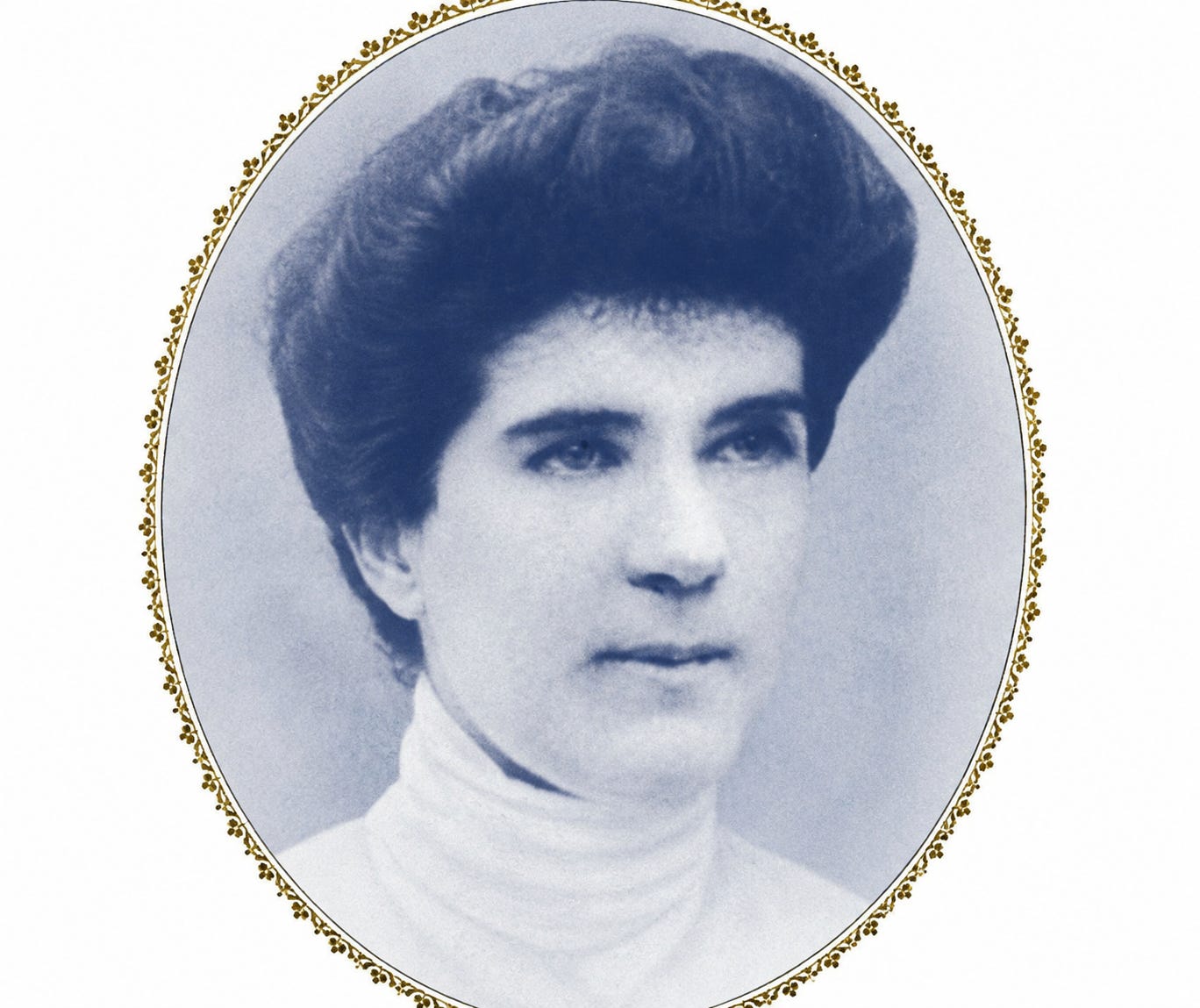
On August 8, 1918, Florence Deeks walked into the Toronto offices of the Macmillan Company of Canada carrying a purple manuscript.
She had spent more than three years writing it.
Florence had started with women.
She had gone looking for them in history and found that, somewhere along the way, they kept disappearing. Their work was there. Their lives were there. Their influence was there. But the histories she read did not seem terribly interested in them.
So Florence decided to write them back in.
At first, that was the project: women and their work throughout history.
Then it grew.
To understand where women belonged, Florence found herself going further and further back. She read library books, took notes, rewrote them, followed civilizations backward through time, and eventually produced a history that began before humanity itself.
She called it The Web of the World’s Romance.
By 1918, Florence wanted somebody in publishing to tell her whether the thing was any good.
She also had a practical question. She had quoted from John Richard Green’s Short History of the English People, whose copyright was controlled by Macmillan in London, and she wanted to know whether the company would object.
So she handed The Web to a Macmillan editor named John Saul.
The manuscript was clean.
Four days later, Saul wrote to her. He had read enough to know that he had not yet given it the attention it deserved. He was leaving Toronto on a hurried trip and asked whether he might keep it until he returned.
Florence agreed immediately.
She wrote that she was “only too pleased” to leave it entirely at his convenience and was grateful he was willing to give it a careful reading.
And then Florence waited.
Saul read The Web.
Twice.
The second time, he later remembered, he took it home.
Then Saul went west.
Florence knew none of that.
She simply knew that her manuscript was still with Macmillan.
Weeks became months.
And while she waited, Florence began doubting the book itself.
In January 1919, she wrote to Saul apologetically. She had been rereading The Web, she said, and it seemed to require so much revision that perhaps she had been unwarranted in asking him to read it in its present condition.
Maybe she should rebuild the whole thing around a different idea: democracy as the world’s civilizing force, militarism as its degenerating one.
Then she suggested something more drastic.
Perhaps she should:
“leave woman out of it altogether as my research along that line seems to be unreliable.”
The book Florence had begun because women were missing from history might be better, she was beginning to think, if she took the women back out.
Saul answered on January 31.
He thought the manuscript should be materially condensed.
Then he added:
“I am very glad indeed that you are undertaking to cut out the womens idea.”
The following day would be Saul’s last with Macmillan.
He told Florence he was cleaning up his work before leaving, that he was sorry he did not have time to go more fully into the manuscript, and that he was leaving it at the office for her.
Florence finally collected The Web sometime in early April.
Eight months had passed since she handed it over.
And it did not look the way it had when she left it.
Corners had been turned down.
The ends of the pages curled upward.
Florence had deliberately chosen heavy paper because it could withstand handling.
It looked as though it had been handled.
She was discouraged.
She took The Web home.
And put it away.
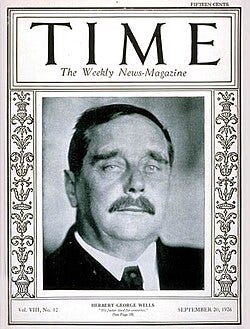
More than a year passed.
In the summer of 1920, Florence began working on her manuscript again.
Then, that December, a copy of the Toronto magazine Saturday Night arrived carrying a long review of a new book.
H.G. Wells’s The Outline of History.
Florence later said it was the first time she had heard of it.
She began reading.
And then she began comparing.
The problem was not simply that Wells had also written a history of the world. Two people could write histories covering many of the same events.
Florence began noticing smaller things.
The order in which subjects appeared.
The amount of space given to them.
Unusual omissions.
Errors.
Phrases.
Places where both books seemed to choose an older or less obvious version of events when other authorities were available.
She kept finding things.
Not one dramatic sentence she could point to and say, There. That is mine. Something slower and worse than that, the sensation of reading a book that already existed inside her, wearing someone else’s name.
A turn here. An omission there. A strange choice of source. An error that felt like remembering.
Florence needed to know whether she was seeing something real.
So she took the two works to people who knew more than she did.
William Andrew Irwin, a scholar of the ancient Near East, was not immediately persuaded.
In fact, he later said that when he began examining Florence’s material, he expected to hand it back with a negative report.
Then he reached the history he knew best.
Something stopped him.
Both Florence and Wells used Hatasu for the Egyptian queen now generally called Hatshepsut.
Irwin found that odd. After twenty years in the field, he said, he had almost never encountered that spelling.
But there was another explanation.
Florence had used the older historian Victor Duruy.
Duruy used Hatasu too.
One strange resemblance could disappear when another source appeared behind it.
Florence learned quickly that this would not be a case won by pointing at one word.
She kept comparing.
So did her experts.
Lawrence Burpee was more cautious than Irwin. He did not believe any single resemblance necessarily proved much.
What concerned him was the accumulation.
Similar ideas appeared in similar sequences, sometimes in substantially similar language.
Eventually Burpee reached his own conclusion.
Someone involved in preparing The Outline of History, he believed, must at some stage have had access to The Web.
And that left Florence with a question she could no longer put away.
If somebody had seen her manuscript, how?
She had handed it to Macmillan.
So Florence began trying to find out what Macmillan had done with it.
That was when the purple manuscript became a mystery.
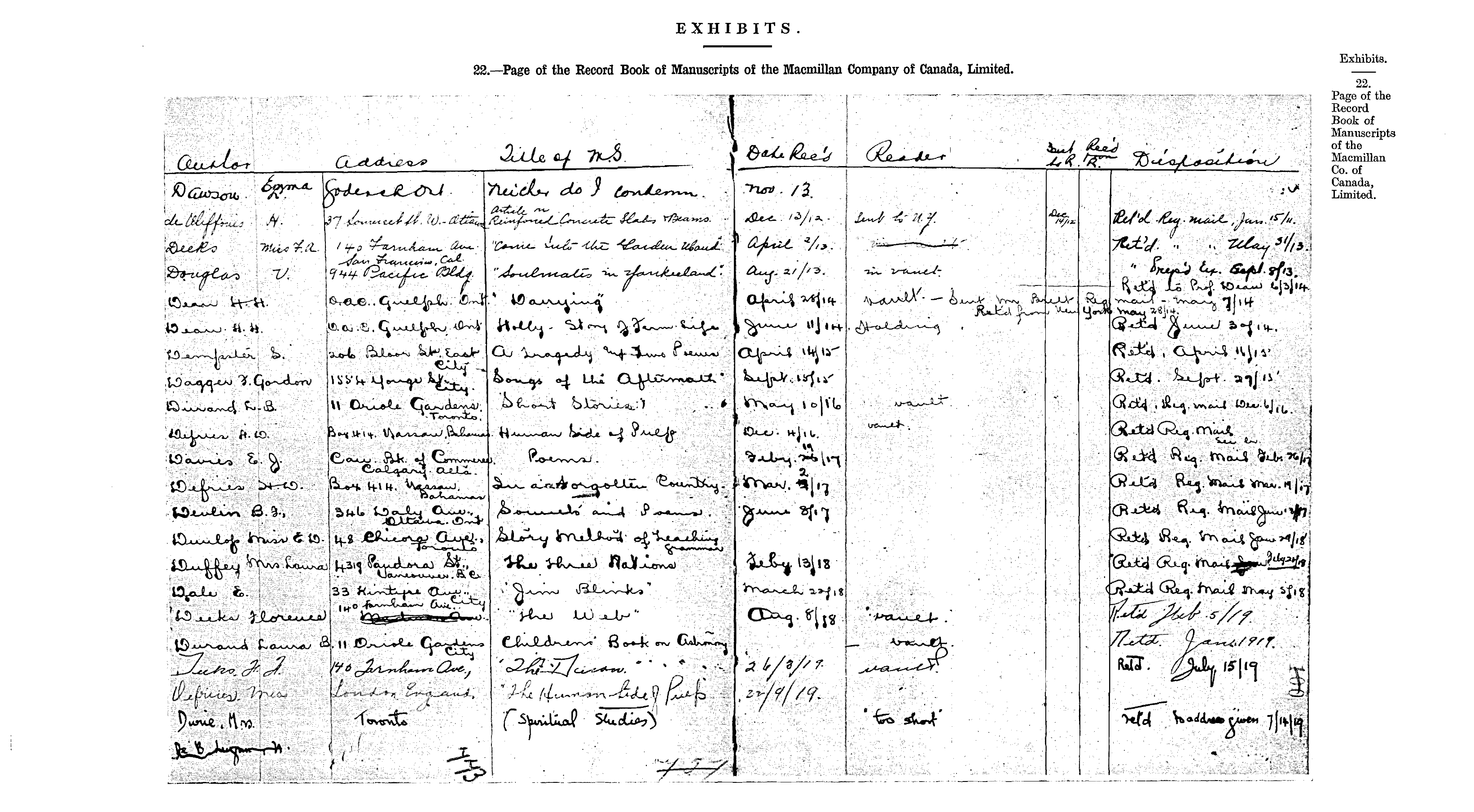
Macmillan had kept a ledger.
Florence’s name was there.
Her address.
The title of her manuscript.
The date it arrived: August 8, 1918.
And under a column marked Reader, one word:
Vault.
At first glance, vault sounded reassuring.
Then Florence began learning what it actually meant.
John Saul had taken The Web home.
No entry recorded that.
Years later, under oath, he was asked whether he had carried Florence’s manuscript with him when he traveled west to Winnipeg.
He could not swear to it.
But he thought he had.
One purpose of the trip, he said, had been to explore whether Florence’s book might work as a Manitoba school text.
Had he shown it to Dr. McIntyre, principal of the Normal School?
Again, Saul could not say for certain.
“I think I did.”
None of those movements would necessarily have appeared in the ledger.
Saul explained that when he traveled for weeks at a time, he might carry six or eight manuscripts with him.
The company did not record every time a manuscript went into or came out of the vault.
Other employees had access.
The company president could enter the vault and take a manuscript without consulting Saul.
And Saul eventually admitted that after his second reading of The Web, he had no definite recollection he could swear to of seeing Florence’s manuscript again.
Then there was the return date.
According to Macmillan’s ledger, The Web had been returned to Florence on February 5, 1919.
It had not.
Florence did not collect it until April.
The woman who had originally entered Florence’s name, address, title, receipt date and the word Vault later testified that she had not written the February return notation.
And farther down the same page was another entry under Florence Deeks’s name.
A manuscript called The Dawn.
Received March 26, 1919.
Vault.
Returned July 15.
Florence said she had never submitted a manuscript called The Dawn.
“The Dawn” was the title of the first chapter of The Web.
Nobody ever produced a satisfying explanation for that entry.
Florence had wanted a paper trail.
What she found was a system that could not tell her where her manuscript had been.
She let herself think about the timing, because the timing was the only thing she had.
There was evidence she could not simply wish away. H.G. Wells had been thinking about a history of mankind before Florence carried The Web into Macmillan. There was correspondence to prove it. Her case could not rest on the idea that she had given Wells the idea for his book.
Her question was what happened afterward.
While Macmillan still had her manuscript, Wells’s history began moving quickly. Around October 1918, Wells wrote to George Brett at Macmillan in New York about an idea he had in hand: children around the world should learn the history of mankind rather than separate national histories. He imagined a book of about 200,000 words.
Eleven days later, Sir Richard Gregory sent Wells astronomical figures, comparisons between the earth and the sun, and a copy of Huxley’s Physiography that he thought might be useful “in connection with the book you have in hand.” Gregory wrote from Macmillan’s London offices, where he edited Nature.
Florence would never find evidence that Gregory had seen The Web.
What she found was proximity. Her manuscript was somewhere inside Macmillan’s world while Wells was gathering material for his own world history from people inside that same world.
By November, Wells was writing directly to Sir Frederick Macmillan. By February, he told Brett he was nearly halfway through.
Florence still did not have The Web back.
The scholars whose names would eventually lend The Outline of History its authority arrived later. Gilbert Murray received what he called “the great bale” of Wells’s manuscript at the end of July 1919. Ernest Barker began receiving sections around the same time and eventually sent Wells pages of criticism, correction and suggestion. But when Barker was asked whether he had supplied any raw historical material, his answer was simple.
“None whatever.”
For Florence, the question narrowed again. If those men had helped refine a book already underway, where had the earlier material come from?
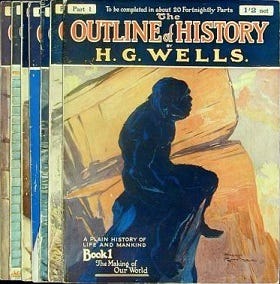
In August 1924, Florence had an opportunity to speak to one of them.
Ernest Barker was in Toronto for a meeting of the British Association.
Florence wrote and asked whether he would see her.
He agreed.
She told him about The Web.
She told him about Macmillan.
She explained what she believed she had found in Wells’s book.
Afterward, Barker wrote to Wells and tried, he later said, to explain Florence’s position as simply and accurately as he could.
Wells answered.
A short handwritten letter.
Barker destroyed it.
Five years later, under oath, he would not guess at words he could no longer remember.
He remembered only the impression:
“I think he did not take it seriously.”
Whatever Wells wrote when Florence Deeks’s accusation first reached him disappeared with that letter.
The following year, Florence took legal action.
Now Wells had to respond formally.
In a memorandum for his solicitor, he proposed two possibilities.
Perhaps Florence genuinely believed something that was not true. In that case, the similarities could probably be explained by a common idea and common sources.
Or perhaps the claim was fraudulent — a blackmailing claim built around a manuscript that had been altered or rewritten after leaving Macmillan.
There was something Florence would later discover about that second possibility.
Wells had never read The Web.
Asked about it from the witness box, he said:
“Never read it at all; I hope I never may.”
He had entertained the possibility that Florence’s manuscript had been altered, rewritten or faked.
He had never opened it.
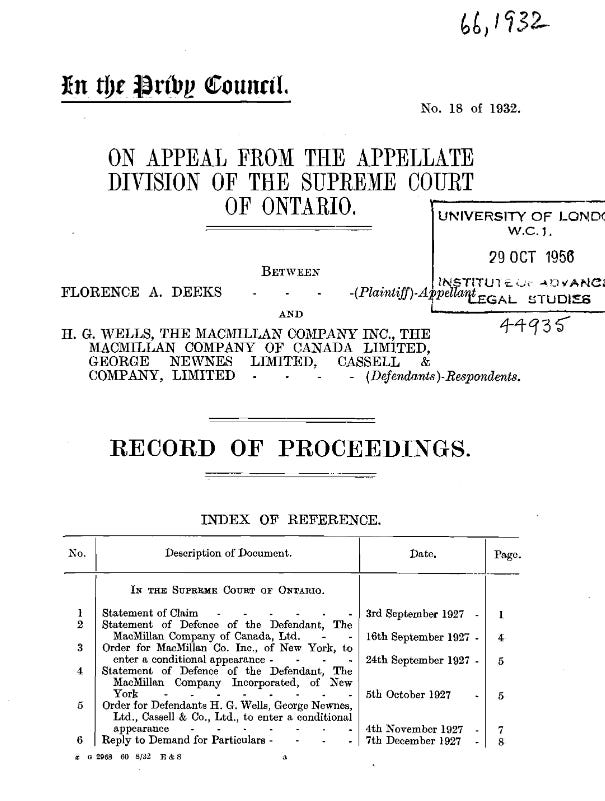
By 1925, Florence was in court.
Wells denied ever seeing her manuscript.
Macmillan searched its London and New York records.
No trace of The Web appeared.
George Brett of Macmillan New York described the company’s record system as practically perfect.
A manuscript like Florence’s, he said, could not have arrived without leaving a permanent record.
That sounded devastating.
Then came the testimony from London.
Harold Geikie kept Macmillan’s manuscript ledger there.
Everything submitted for publication was entered, he explained.
Then Florence’s side asked him something narrower.
Suppose a manuscript came to London not because somebody wanted it published, but because they wanted Macmillan to determine whether material in it infringed a copyright the company controlled.
Would that manuscript be entered?
“No, certainly not.”
That was exactly why Florence had first left The Web with Macmillan.
If her manuscript had gone to London for the very reason she submitted it, the ledger would not necessarily have recorded it.
Then Sir Frederick Macmillan was questioned about what happened to manuscripts inside the London office.
Could a director put one in his bag and take it home overnight?
Yes.
Could he send it to somebody else to read?
Yes.
An outside reader?
“Yes, certainly.”
Florence had wanted records that could tell her where The Web had been.
Instead, witness after witness described a system in which manuscripts could move without appearing in those records at all.
Then John Saul was asked a different kind of question.
Had he thought a book like Florence’s might be more profitable if its author were already well known?
As a general book, he said, yes.
And if Florence’s book were going to reach a large general readership, counsel asked, would somebody else have to be the author?
“Yes,” Saul answered. “That is fair.”
Florence had spent years trying to learn what Macmillan thought had happened to her manuscript.
Under oath, its former editor had now said something plainly about what he thought of Florence Deeks as an author.
The problem was not necessarily the book.
The problem was that nobody knew her name.
Florence lost.
Justice Raney did more than reject her case.
He called Irwin’s theories fantastic.
He accepted Wells’s denial and Macmillan’s evidence of good faith.
Then he turned to Florence herself.
Her belief that something improper had happened, he wrote, had become an obsession.
She was no longer in a condition of mind to judge fairly the accusations she was making against a “reputable publishing house” and an “eminent and respectable author.”
He ordered her to pay costs.
Florence appealed.
Eventually, she lost her lawyers too.
Her counsel declined to argue the appeal.
So Florence did it herself.
She had written out what she intended to say. She began reading from it, but after several pages had to abandon the prepared argument and continue extemporaneously.
Much of what she had intended to say was left unsaid.
She lost again.
And still she kept going.
In 1932, fourteen years after she had carried a clean purple manuscript into Macmillan, Florence Deeks crossed the Atlantic.
Her case had reached the Judicial Committee of the Privy Council in London — then Canada’s highest court of appeal.
She stood before Lord Atkin and the other judges alone.
Ordinarily, the Board would not even have heard an appeal where two lower courts had already agreed on the facts.
But Florence appeared in person.
They let her argue.
At length.
And as the judges worked through her case, they acknowledged some of the very things Florence had spent years trying to establish. The February return date was wrong. The Dawn entry had not been satisfactorily explained. The surviving business records did not provide satisfactory information, and there were difficulties that had never been entirely cleared up.
The judges also accepted that Florence did not necessarily need a witness who had physically seen The Web in Wells’s hands.
In principle, similarities between two works could themselves be powerful enough to establish copying.
But Florence’s comparisons did not persuade them.
They accepted Wells’s denial.
They accepted Macmillan’s witnesses.
They believed the similarities could be explained by common sources, coincidence and the nature of writing two histories covering the same enormous subject.
Florence lost for the final time.
And then the judgment went further.
After acknowledging the wrong return date...
the unexplained Dawn entry...
the unsatisfactory records...
and difficulties that had never been entirely cleared up...
the judges concluded that it had nevertheless been definitely established that The Web had never left Canada.
That Wells had never had access to it.
That he had not used it in preparing The Outline of History.
Near the end of the judgment was one more sentence.
Florence had petitioned for permission to introduce further evidence, or to add something more to the record.
The petition was not opened.
No order was made upon it.
She had brought more.
Nobody looked.
Florence Deeks never found the piece of evidence that could have ended the argument.
There is no surviving letter saying: Send Miss Deeks’s manuscript to Wells.
No shipping receipt.
No witness who remembered seeing H.G. Wells holding The Web.
And Wells was already thinking about a history of mankind before Florence ever walked into Macmillan. She had to contend with that too.
But she had begun with a simpler question.
What happened to my manuscript?
She spent fourteen years trying to fill the space between the day she handed it over and the day she got it back.
She never could.
Neither could Macmillan.
The court decided that only one of those failures mattered.
Judicial Committee of the Privy Council. Florence A. Deeks v. H. G. Wells and Others, Appeal No. 18 of 1932, [1932] UKPC 66. Judgment delivered 3 November 1932.
Judicial Committee of the Privy Council. Florence A. Deeks v. H. G. Wells et al., Record of Proceedings, Appeal No. 18 of 1932. A 510-page compilation containing the trial testimony, commission testimony, correspondence, exhibits, Ontario judgments, and appellate material.
Deeks, Florence A. Case of the Appellant, Privy Council Appeal No. 18 of 1932.
McKillop, A. B. The Spinster and the Prophet: H. G. Wells, Florence Deeks, and the Case of the Plagiarized Text. New York: Four Walls Eight Windows, 2002.
Scheick, William J. “H. G. Wells & Plagiarism.” English Literature in Transition, 1880–1920 46, no. 3 (2003): 296–299.
Magnusson, Denis N. “Hell Hath No Fury: Copyright Lawyers’ Lessons from Deeks v. Wells.” Queen’s Law Journal 29 (Spring 2004).
Fox, Harold G. “Evidence of Plagiarism in the Law of Copyright.” University of Toronto Law Journal 6, no. 2 (1946): 414–460.
Whittle, Steven. “Telling Legal Backstories—Making Historic Case Papers from the Judicial Committee of the Privy Council Available to All Online.” Legal Information Management 16, no. 1 (2016).
Comments
Nothing yet. Say the first thing.
Sign in to join the conversation.