
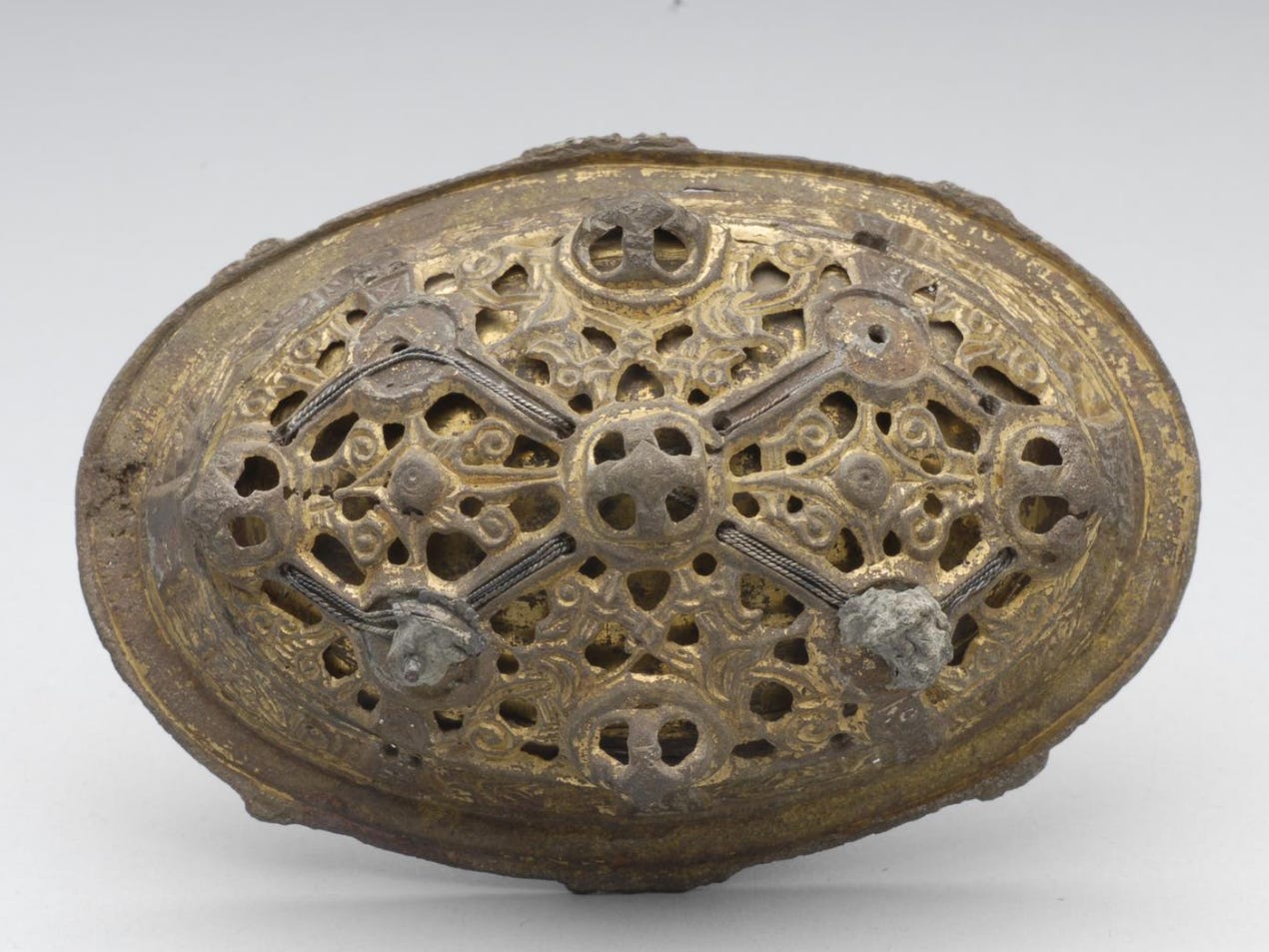
In 1801, William Cunnington opened a burial mound near the village of Upton Lovell in Wiltshire, less than ten miles from Stonehenge.
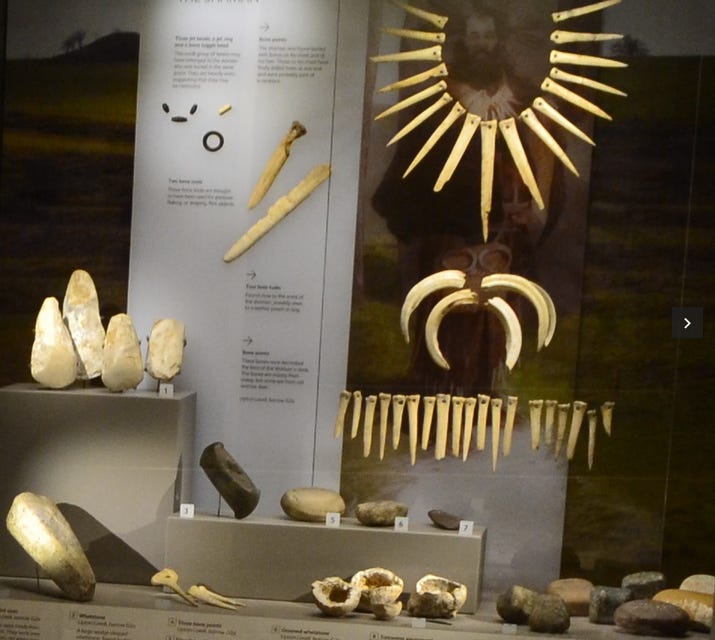
At the bottom of a chalk-cut grave lay a body on its back. Above it was another burial, placed later in a crouched or seated position. Around the primary body was an extraordinary collection. Stone axes. Flint tools. A copper-alloy awl. Boar tusks. More than forty perforated bone points, probably once attached to an elaborate garment. Small stone implements whose purpose would take another two centuries to understand. Cunnington looked at the remains and decided that, from the size of the bones, the person appeared to be a “stout man.”
And the stout man stayed a man.
For more than two hundred years, archaeological literature referred to the primary burial as male. Later scholars debated what kind of man he had been. Was it a shaman, metalworker, goldsmith, or possibly all three?
There was one small problem.
As a 2023 study in Antiquity quietly noted, although the primary burial was routinely described as male, no published osteological assessment establishing that identification existed. Throughout subsequent years, the man had become remarkably well established for someone whose maleness had never actually been proven.
By the twenty-first century, researchers were asking better questions of the objects buried beside him.
In 2023, Rachel Crellin and her colleagues subjected the stone tools from Upton Lovell to microwear analysis and scanning electron microscopy. They found traces consistent with Early Bronze Age gold on five of them, four detected for the first time, and reconstructed an entire sequence of highly skilled goldworking.
What was discovered is that the tools were not for smelting gold.
They were used to hammer it into sheets, smooth it, polish it, decorate it and fit those sheets over objects made from other materials. Some of the stone implements had once been battle axes before being deliberately repurposed as metalworking tools. The researchers concluded that the assemblage formed a specialized goldworking toolkit and whoever had been buried at Upton Lovell had a deep understanding of materials.
An intimate knowing of which stone made the right hammer. Which surface made the right anvil. How much pressure gold could take. How to turn something soft enough to deform beneath a tool into an object delicate enough to survive four thousand years.
Even though the gold itself was gone, the knowledge was still sitting on the stones.
And the person buried with them was still a man. Until July 2026.
Researchers at the Francis Crick Institute extracted ancient DNA from the remains. The first result was unexpected, so they checked other material, including a tooth and a toe bone. The results agreed, the goldsmith had XX chromosomes. It was female.
The person who had occupied museum displays and archaeological literature for generations as the Upton Lovell male shaman and metalworker was a woman. The full genetic study has not yet been published, an important limitation; the result was announced through the Crick Institute exhibition and Wiltshire Museum in July.
Suddenly, a two-hundred-year-old sentence had to be rewritten.
But this is where her story stops being a simple archaeological correction.
Because she is not the only one.
Before ancient DNA and molecular analysis, archaeologists were not simply pulling sex assignments out of a hat.
Human skeletons can show sexual dimorphism - where males and females of a species have different sizes, colors, or body shapes - particularly in adults. The pelvis is especially useful because females typically have a wider, broader, and shallower pelvis than males. The skull and other bones can contribute additional evidence. When enough of the right anatomy survives and the traits are strongly expressed, osteological sex estimation can be very good. Modern comparisons between methods have found high agreement between confident osteological assessments and molecular results.
The trouble is that archaeological skeletons do not arrive neatly packaged for assessment and analysis. Often they are broken, incomplete, burned, and/or missing the pelvis. At times, they belonged to children who died before puberty.
Many skeletal differences used in sex estimation develop under the influence of hormones during adolescence. Children therefore do not yet display the adult traits researchers rely upon, and adolescents can remain ambiguous. Preservation removes more information still.
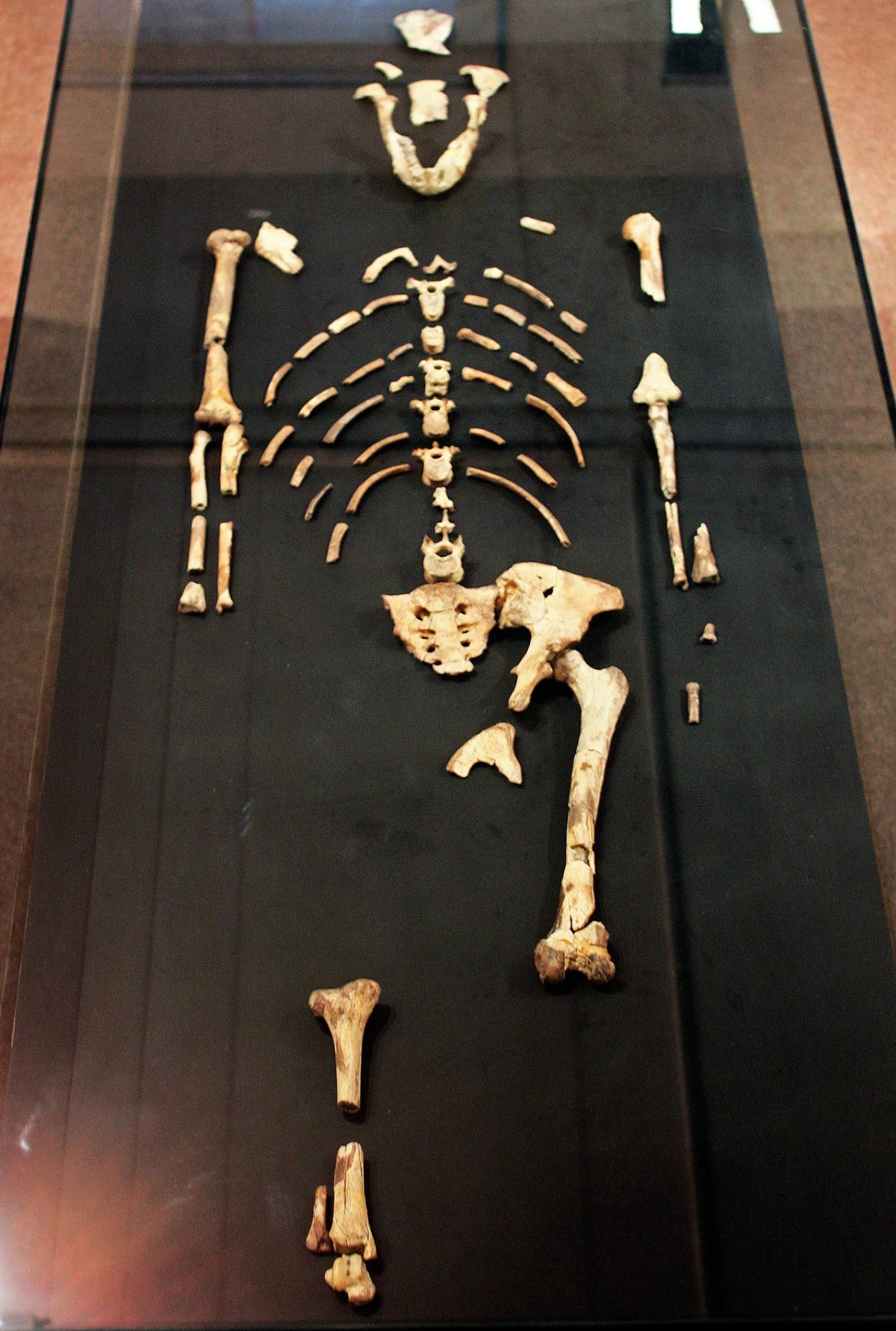
Rebecca Gowland, a bioarchaeologist at Durham University, once illustrated the problem using perhaps the most famous skeleton in human evolution.
Lucy, the 3.2-million-year-old Australopithecus afarensis, was sexed using, among other evidence, part of a pelvis. Gowland’s question is wonderfully destabilizing:
“What if Lucy was Larry?”
She wasn’t announcing that Lucy is male. She was pointing at the size of the confidence gap. We are reconstructing entire worlds from bodies that often arrive in pieces and then something else happens.
Once a classification enters the literature, it acquires a life of its own. A hypothesis quickly evolves into a certainty and “Probably male” becomes “male.” The interpretation now becomes a label. The label becomes a citation. The citation becomes a fact everybody downstream assumes somebody upstream established properly.
Upton Lovell managed that trick for two centuries.
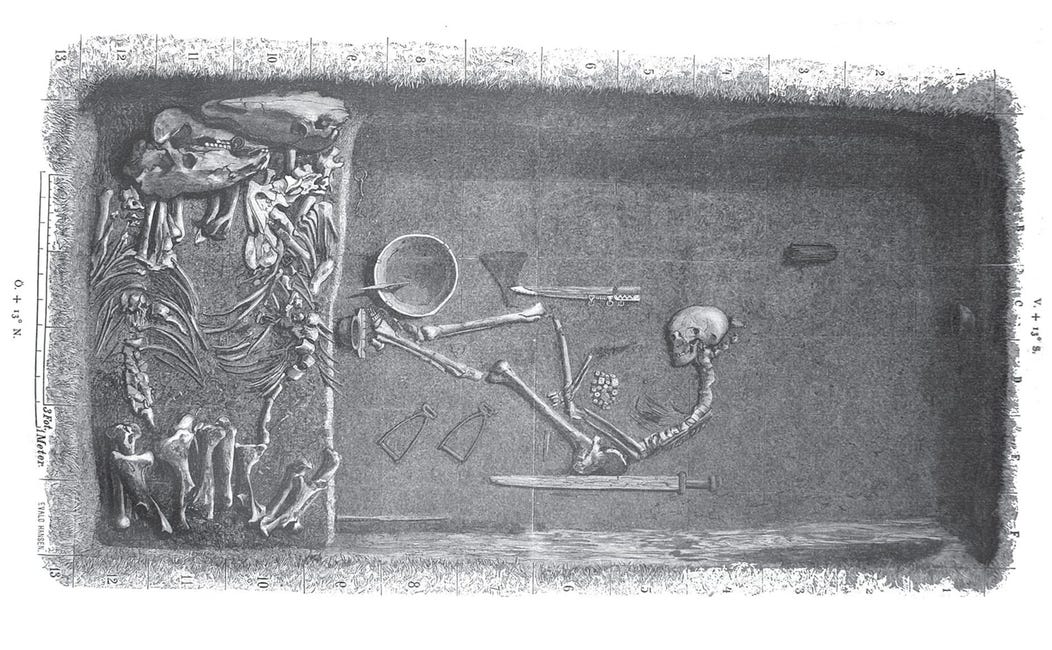
In 1878, archaeologist Hjalmar Stolpe excavated grave Bj 581 at the Viking trading center of Birka in Sweden.
It was spectacular specimen. A sword, axe, spears, shields, a fighting knife, and two horses. Gaming pieces that researchers have interpreted in connection with tactical or command knowledge. It became an archetypal high-status Viking warrior grave and the warrior was assumed to be male.
Then an osteological reassessment suggested the skeleton was female which generated an overwhelming amount of controversy.
Researchers tested the DNA and by 2017, genome-wide analysis confirmed that the individual had no Y chromosome. The skeletal material tested belonged to one biologically female person.
This produced one of the more revealing moments in modern archaeology. Before the sex changed, the grave goods were enough to establish a warrior. But, after the sex changed, people began asking whether the grave goods did not establish a warrior after all.
The sword had not moved.
Neither had the spears.
Neither had the horses.
The skeleton had not crawled into another grave.
Only one piece of information had changed. The occupant was female.
Charlotte Hedenstierna-Jonson, one of the researchers, later pointed out the asymmetry: the warrior interpretation had caused little trouble when everyone thought the person was a man. Once the skeleton was established as female, the interpretation itself suddenly required another trial.
That does not mean every woman buried with a weapon fought.
Leszek Gardeła, who has studied women and weapons in the Viking world extensively, notes that roughly 90 percent of weapon graves contain biologically male individuals. An axe can have ritual as well as martial meanings. A weapon beside a body is not a battlefield résumé. He accepts that the Viking worldview had room for female warriors while cautioning that they were probably not the norm.
Good.
That’s exactly what better evidence is supposed to do. It is supposed to make the record harder to lie about. Yet, Birka tells us something more precise. When evidence traditionally associated with male activity was attached to a presumed man, the association looked obvious. When the presumed man became a woman, suddenly we could see how much interpretation had been hiding inside the word obvious.
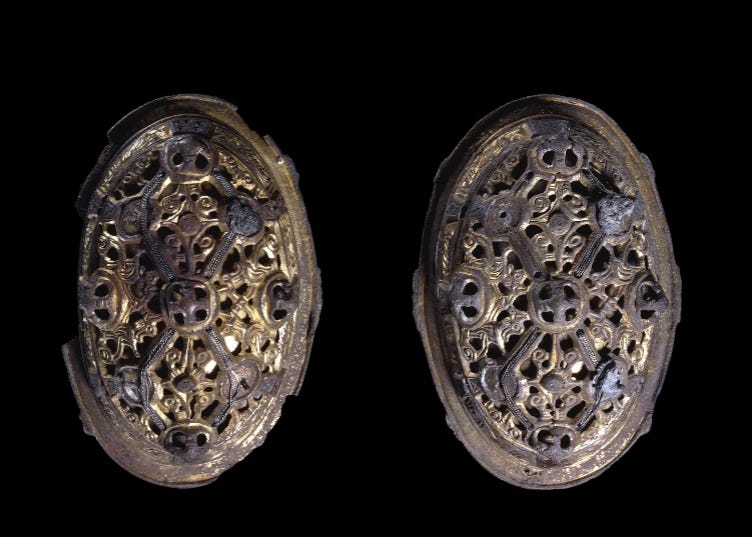
Then there is Santon Downham.
In 1867, a Viking-period grave was discovered in Norfolk. The burial contained objects that nineteenth- and twentieth-century archaeology knew how to sort. Weapons over here and jewelry over there. One for a male and one for a female. Easy.
Except the objects were in the same grave.
The literature eventually described Santon Downham as a double burial and it solved the problem nicely. A man could have the weapons and a woman could have the jewelry. Except, according to British Museum curator Gareth Williams, only one skeleton was reported when the grave was excavated.
That skeleton has since been lost.
There is no surviving biological evidence with which to test it. And Williams has pointed out that there is no actual evidence establishing the two-person interpretation that became conventional in the literature.
We cannot now determine who was buried at Santon Downham. Perhaps it was a woman with a sword or a man wearing objects archaeologists later categorized as feminine? Maybe important information disappeared before anyone recorded it? Maybe there really were two bodies and the original report somehow failed to mention one of them.
At this point, no one knows. Because at some stage, an archaeological contradiction was not preserved as a contradiction, it was resolved. It should make us uncomfortable to know that only on paper, a second person appeared.
Not because it proves that archaeologists intentionally fabricated a woman or a man to protect Victorian gender expectations. Motive is impossible to recover. But because once a tidy interpretation exists, it can become remarkably difficult to see how untidy the evidence underneath it actually was.
The same problem can run in the opposite direction.
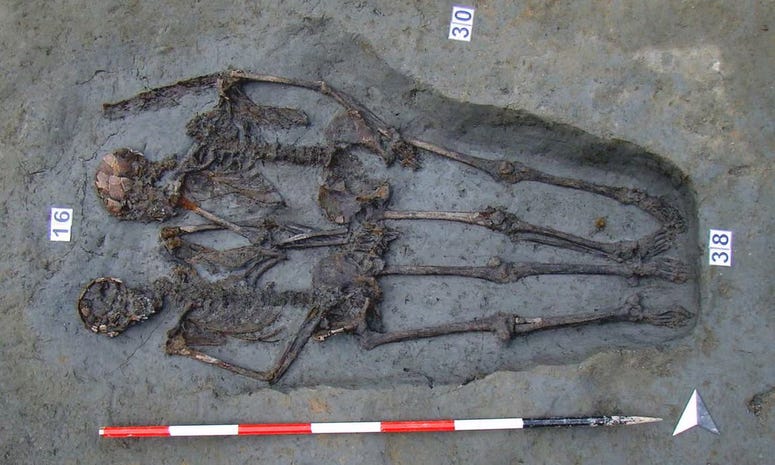
In 2009, workers in Modena, Italy, uncovered a Late Antique cemetery and one grave immediately captured attention. Two skeletons had been buried side by side, their hands joined.
They became the Lovers of Modena.
News coverage quickly supplied the rest of the story: a man and a woman, united in death. Yet, there was just one complication, the bones were too poorly preserved for researchers to determine the pair’s sex reliably through conventional osteology. Initial DNA attempts were also unsuccessful.
The heterosexual lovers existed before their biological sex had actually been established. Then researchers tried something newer.
Tooth enamel contains proteins called amelogenins. Versions of these proteins are encoded on the X and Y chromosomes, and sex-linked peptides preserved in enamel can be detected through mass spectrometry. Enamel is extraordinarily durable, sometimes preserving molecular information when usable ancient DNA has degraded.
In 2019, researchers tested the teeth of the Lovers. Both were male and science corrected the story.
People started writing another story.
Perhaps they were brothers.
Perhaps they were comrades.
Perhaps they were soldiers buried together.
The researchers themselves discussed several possibilities, including kinship and military companionship, while acknowledging that their actual relationship remained unknown.
And that is where this gets much more interesting than a series of archaeological gotchas. The molecular test answered a question it was capable of answering.
What was their chromosomal sex?
Male.
Male.
It never answered who were they to each other. It did not tell us whether they were brothers, friends, comrades, lovers, or something for which our language has no surviving category.
The instrument removed one assumption. It did not remove our appetite for replacing it.
If I stopped here, this would be a very satisfying story about modern technology repeatedly exposing old-fashioned assumptions. It would also be dishonest. Because sometimes the new science checks the old record and says: Actually, you mostly got that right.
In Early Bronze Age cemeteries at Franzhausen I and Gemeinlebarn F in Austria, burial practices followed strikingly gendered patterns. Bodies were positioned and oriented differently, and grave treatment often corresponded with male or female categories.
There were, however, individuals whose osteological sex estimates appeared to conflict with the way they had been buried. Were there potential gender minorities and exceptions? People who did not fit the burial system?
Researchers tested the disputed cases using sex-specific peptides from dental enamel.
A 2025 study found that many of the apparent contradictions were actually errors in earlier sex estimation or transcription. Across the larger dataset, osteological sex estimates and gendered burial treatment corresponded in about 98 percent of adult cases.
The new method didn’t reveal a hidden population overturning the binary burial system, it made the binary pattern stronger. This belongs in this story every bit as much as Upton Lovell. Because the argument cannot simply be: Old archaeology said men. New archaeology finds women. That’s advocacy looking for receipts.
The actual scientific argument is: Test it. Sometimes the woman appears. Sometimes the warrior remains a woman. Sometimes the lovers become two men. Sometimes the supposed exception disappears because somebody sexed the bones incorrectly eighty years ago.
That is what an audit looks like. You don’t get to decide what you want it to find first.
Ancient DNA gets most of the attention, but DNA is only one part of this shift. Its survival depends heavily on preservation. In poor conditions, there may simply not be enough usable genetic material left. Tooth enamel has opened another door.
In 2017, researchers demonstrated a method for identifying biological sex from sex-linked amelogenin peptides preserved in human tooth enamel. Subsequent work has shown that proteomic sex estimation can succeed in archaeological remains where osteology or even DNA cannot provide a confident answer.
One 2020 comparison applied osteological, genomic and proteomic methods to the same archaeological sample. Proteomics produced a sex estimate for every individual tested. Genomics did so for most. Osteology could provide estimates for only about half, largely because the necessary skeletal features simply were not preserved or expressed.
But when osteological assessments were definitive, agreement with the molecular methods was extremely high and that nuance matters. The pelvis did not suddenly become useless because we invented a mass spectrometer.
Archaeologists were not fools before DNA. They were working with the evidence and technology available to them. The problem begins when the confidence of the statement exceeds the confidence of the evidence.
Possibly male is useful information but male is different information. And two hundred years later, the difference can disappear from the label.
Which brings us back to the woman in Wiltshire because her case is almost too perfect.
William Cunnington looked at her bones in 1801 and saw size. A body with large bones and a robust body equaled man. The next generations inherited his conclusion.
They debated whether the man had been a shaman.
Then whether the man had been a metalworker.
Then whether the man had worked gold.
In 2023, microscopic analysis found the physical residue of that work on the tools themselves. Gold. As the craft became firmer, the man stayed. Then DNA results arrived: Female.
Nothing in her grave had changed. The tools did not become more delicate. The battle axes did not shrink. The gold did not suddenly appear. The new examination also reportedly found arthritis in her right wrist, a pattern researchers say is consistent with repetitive manual work.
She had been there the whole time and the only thing that changed was us.
It would be easy to turn her into another triumphant story about a forgotten woman finally being restored to history, but we still know remarkably little about her.
“Shaman” remains an interpretation.
Her tools demonstrate goldworking; they cannot tell us exactly what her status was, how she learned her craft, whether she worked alone, whether she taught apprentices, whether her community thought metalworking belonged particularly to women or whether she herself was unusual.
DNA can tell us about her chromosomes. It cannot interview her. That is the strange bargain modern archaeology has made. Our instruments have become astonishingly good at answering certain questions about people who cannot speak. And that makes it even more important not to make them answer questions they cannot.
The dead do not bury themselves nor do they label themselves. We do that. We excavate a grave and decide what matters. Describe a skeleton, assign a sex while sorting the objects and then we write the catalog. Someone cites us and someone else cites them while centuries pass. Eventually, the interpretation can become so firmly attached to the dead person that we forget there was ever a moment when somebody made a judgment call.
In museum collections around the world are thousands upon thousands of people excavated before ancient genomics, before enamel proteomics, before the methods available to researchers now. It does not mean thousands of skeletons labeled male are secretly women. Franzhausen should cure us of that temptation immediately. It means something better, they can be asked again.
Some answers will hold and some will become more complicated while others collapse. And somewhere, almost certainly, another woman is waiting inside a record that became more certain than the evidence ever was.
Her bones haven’t changed.
The label might.
Crellin, Rachel J., Christina Tsoraki, Christopher D. Standish, Richard B. Pearce, Huw Barton, Sarah Morriss, and Oliver J. T. Harris. “Materials in Movement: Gold and Stone in Process in the Upton Lovell G2a Burial.” Antiquity 97, no. 391 (2023): 86–103.
Primary source for the Upton Lovell burial history, goldworking toolkit, microwear/SEM analysis, and the statement that the burial was generally described as male despite no published osteological assessment establishing that identification.Wiltshire Museum. “Startling New DNA Evidence Shows Goldworker from the Time of Stonehenge Was Female.” July 15, 2026.
Official museum announcement of the new ancient-DNA finding identifying the Upton Lovell individual as female.“Ancient DNA Analysis Reveals Wiltshire’s Upton Lovell ‘Shaman’ Was a Woman.” The Guardian, July 14, 2026.
Reporting on the new DNA results, including the repeated testing of the remains and the reported arthritis in the right wrist.Hedenstierna-Jonson, Charlotte, et al. “A Female Viking Warrior Confirmed by Genomics.” American Journal of Physical Anthropology 164, no. 4 (2017): 853–860.
Genomic confirmation that the individual buried in Birka grave Bj 581 was biologically female.Price, Neil, Charlotte Hedenstierna-Jonson, Torun Zachrisson, Anna Kjellström, Jan Storå, Maja Krzewińska, et al. “Viking Warrior Women? Reassessing Birka Chamber Grave Bj.581.” Antiquity 93, no. 367 (2019): 181–198.
Detailed reassessment of Bj 581, its excavation history, warrior interpretation, grave goods, and the assumptions surrounding the original male attribution.Lugli, Federico, et al. “Enamel Peptides Reveal the Sex of the Late Antique ‘Lovers of Modena.’” Scientific Reports 9 (2019).
Proteomic analysis showing that both individuals in the so-called Lovers of Modena burial were biologically male.Stewart, Nicolas A., Raquel F. Gerlach, Rebecca L. Gowland, Kurt J. Gron, and Janet Montgomery. “Sex Determination of Human Remains from Peptides in Tooth Enamel.” Proceedings of the National Academy of Sciences 114, no. 52 (2017): 13649–13654.
Foundational study demonstrating minimally destructive biological-sex estimation using sex-linked amelogenin peptides preserved in tooth enamel.Buonasera, Tammy, et al. “A Comparison of Proteomic, Genomic, and Osteological Methods of Archaeological Sex Estimation.” Scientific Reports 10 (2020).
Direct comparison of the three methods in 55 archaeological individuals: sex estimation was possible in 100 percent using proteomics, 91 percent using genomics, and 51 percent using osteology, with important qualifications concerning DNA quality.Rebay-Salisbury, Katharina, Margit Berner, Karin Wiltschke-Schrotta, Ana Mercedes Herrero Corral, Michael Wolf, and Fabian Kanz. “More Error than Minority: Gendered Burial Practices Align with Peptide-Based Sex Identification in Early Bronze Age Burials in Central Europe.” Cambridge Archaeological Journal 35, no. 3 (2025): 456–471.
Reassessment of Franzhausen I and Gemeinlebarn F showing approximately 98 percent correspondence between biological sex and gendered burial treatment among adults after peptide-based testing.“Archaeology’s Sexual Revolution.” The Guardian, January 16, 2022.
Useful secondary overview containing interviews and discussion of Birka, Santon Downham, the Lovers of Modena, skeletal sex estimation, Rebecca Gowland’s discussion of Lucy, and Leszek Gardeła’s cautions concerning weapon burials.
Pape, Eleonore, and Nicola Ialongo. “Error or Minority? The Identification of Non-Binary Gender in Prehistoric Burials in Central Europe.” Cambridge Archaeological Journal (2024).
Useful for the methodological problem of circular reasoning when archaeological gender assignments and osteological sex classifications influence one another.Hodgkins, Jamie, et al. “An Infant Burial from Arma Veirana in Northwestern Italy Provides Insights into Funerary Practices and Female Personhood in Early Mesolithic Europe.” Scientific Reports 11 (2021).
Proteomics and ancient DNA identified a richly furnished 40–50-day-old infant as female, illustrating how molecular methods can answer biological-sex questions that skeletal morphology simply cannot in very young children.
Comments
Nothing yet. Say the first thing.
Sign in to join the conversation.