
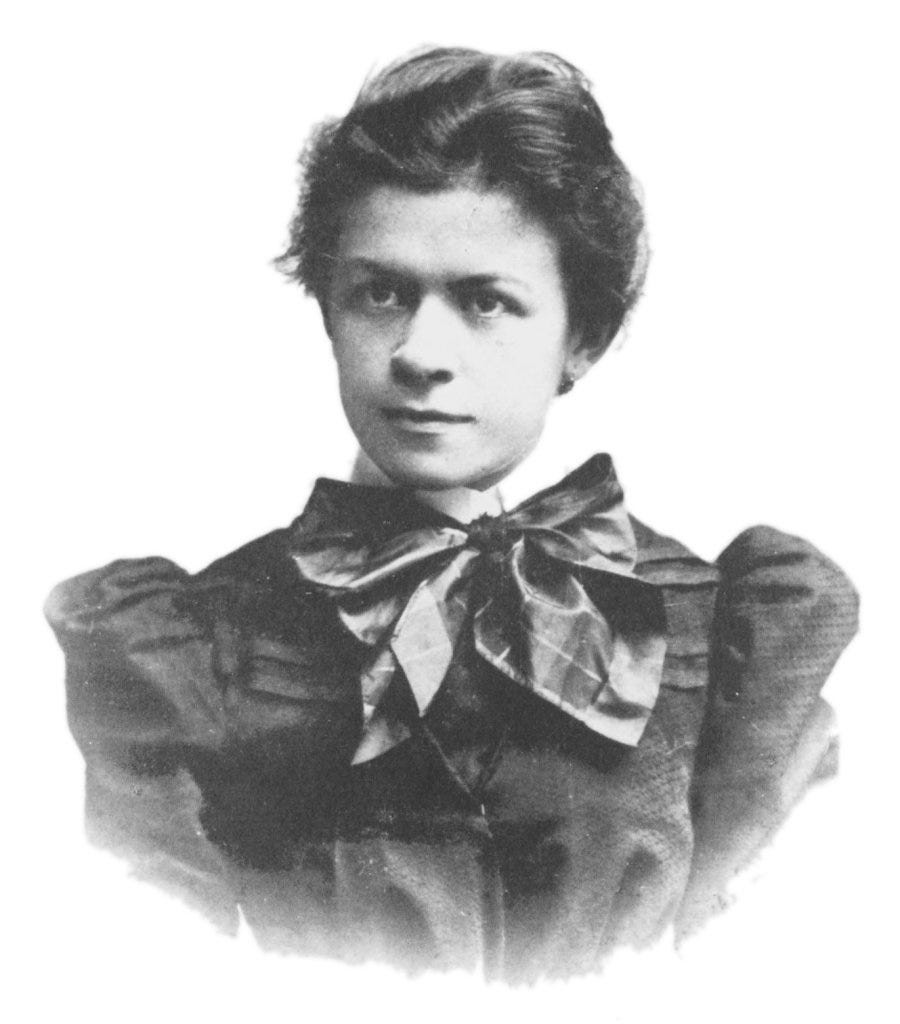
There is a version of this story where Mileva Marić helped build one of the greatest scientific revolutions in history. There is another where she was simply Albert Einstein’s gifted first wife. Between those two versions lies more than a century of argument. Historians have defended both in peer-reviewed journals, biographies, and documentaries.
We are not going to pretend that fight is settled. It isn’t, and an essay that tells you it is would be lying to you.
But there is a document neither camp disputes. Neither the historians who believe she co-created relativity nor the historians who believe she never touched the physics deny that this document exists, that Einstein wrote it, or what it says. It is the reason this essay exists at all, and it is the reason “One Stone,” the mystery in this essay’s own title, is the least mysterious thing in Mileva Marić’s life once you know how she used it.
Here is what we know for certain, and here is where the certainty runs out.
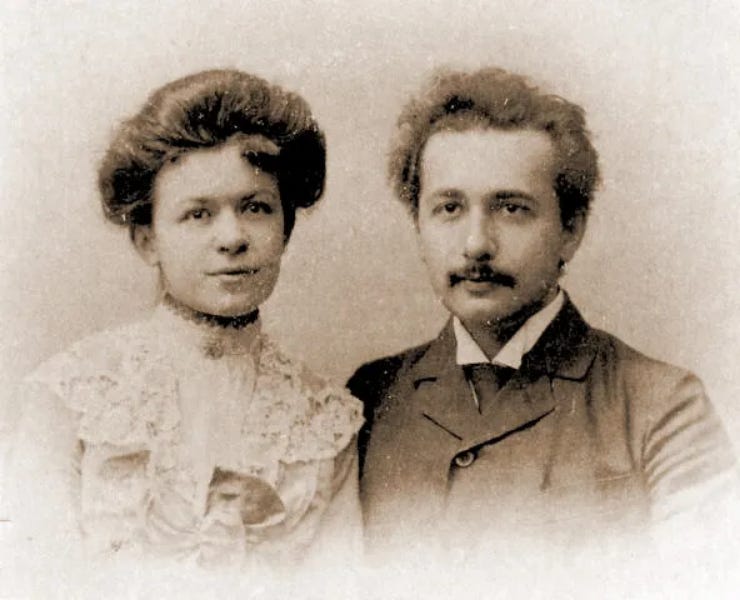
Mileva Marić was born in Titel, in what was then Austria-Hungary, on December 19, 1875. From an early age, she showed unusual talent in mathematics and physics. Recognizing her ability, her father petitioned the Ministry of Education for special permission to allow her to attend physics lectures reserved for boys. He got it. Most girls of her generation were never even offered the opportunity to ask.
In 1896, she enrolled at the Zurich Polytechnic, one of five students admitted to the physics-mathematics teaching section that year and the only woman among them. One of the four young men was a seventeen-year-old named Albert Einstein.
She passed her intermediate examinations and kept pace in one of Europe’s most demanding programs. By then, she had already done what almost no woman of her generation was permitted to do: enter an elite scientific institution, remain there, and earn her place in the room.
They fell in love.
In 1900, Einstein wrote to her that he was lucky to have found her: a woman who was his equal, as strong and independent as he was, someone with whom he could truly be himself. The letter survives. Its words are uncontested.
The following year, writing about the physics they were exploring together, he told her how proud he would be when the two of them had brought their work on relative motion to a triumphant conclusion. Not my work. Their work. Mileva used the same language in letters to friends, describing a paper they had sent to a physicist for review and hoping “he” would write back to “us.”
The timing matters. These letters were written before the Nobel Prize, before relativity, before fame, and before the marriage began to fracture. Whatever historians ultimately conclude about the science, Albert Einstein himself described their intellectual life in the language of “we.” This essay is not an attempt to prove what that “we” meant mathematically. It asks a different question:
What happened to it?
In July 1900, both sat their final diploma examinations. Einstein passed with an average of 4.91 on a six-point scale, the lowest passing mark among the men in his cohort. Mileva did not. Her average was 4.00, pulled down by a 2.5 in theory of functions, the mathematics component of the examination.
Some retellings of this story turn that examination into a clean morality play: a jealous professor, a rigged oral exam, a 5 handed to her while the men around her received 11s. That version comes primarily from a single biography written decades later. The most rigorous analyses of the surviving records do not support it.
What the records reveal is messier and, honestly, sadder: a woman who had once been offered an assistantship by her physics professor, who successfully navigated years of one of Europe’s most demanding scientific programs, and who encountered a wall in one subject at precisely the moment her life outside the classroom was beginning to unravel.
She retook the exam a year later. She failed again, with the same 4.00 average. She was three months pregnant.
We don’t get to know what she might have scored under different circumstances: not pregnant, not financially precarious, not watching the man who had called her his equal postpone the future they had imagined together because he still could not secure a job. The record doesn’t hand us a controlled experiment. It hands us a young woman struggling in mathematics at the precise moment the rest of her life was becoming immeasurably more complicated. It asks us to draw conclusions from that anyway. We won’t.
What we will say plainly: Einstein got his degree. Mileva did not. That fact is not contested by anyone.
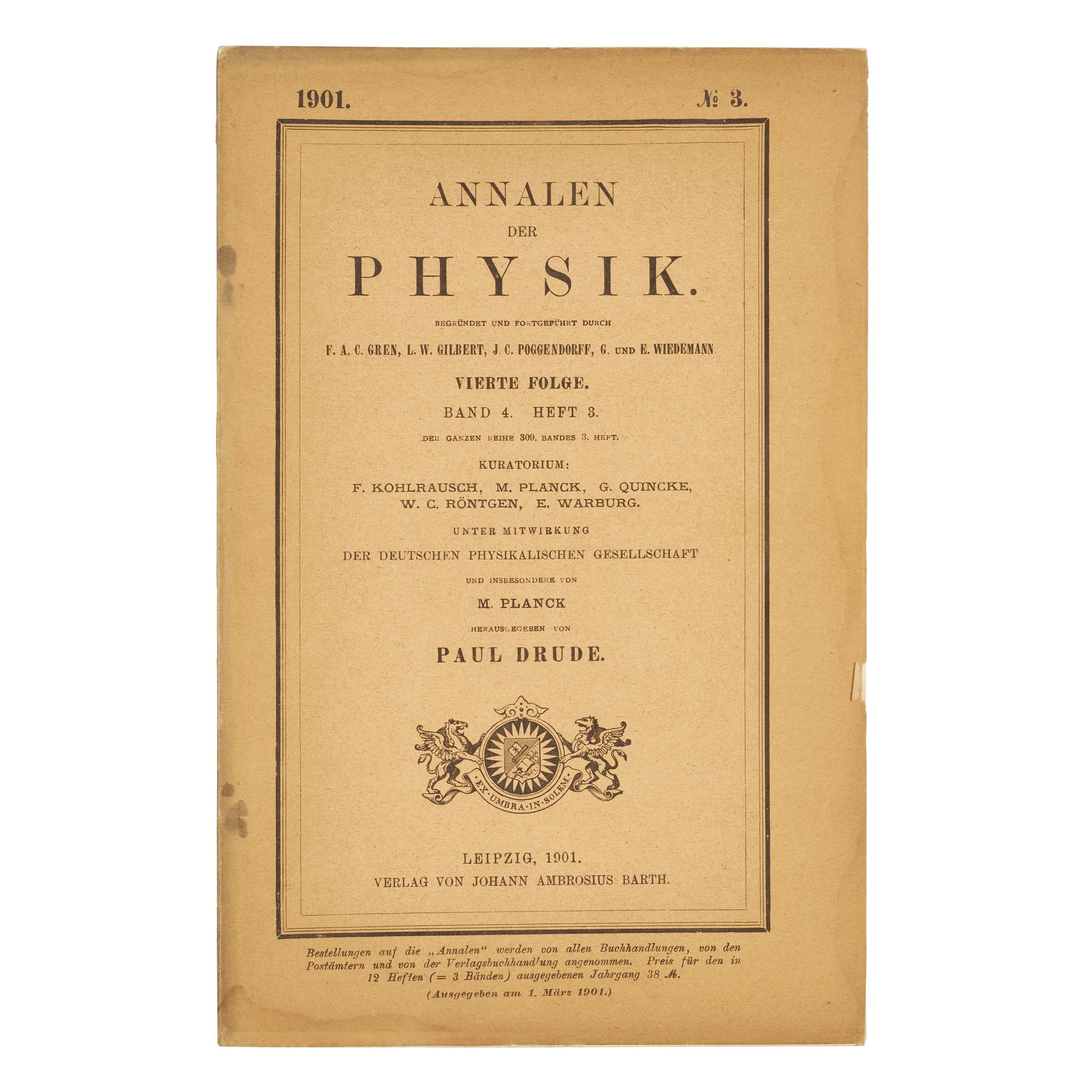
That December, the two of them submitted a paper on capillarity to Annalen der Physik. It appeared under one name: Albert Einstein.
In their private letters, both of them called it our paper.
This is the first documented glimpse of a pattern that would become painfully familiar. Not a grand theft of a grand theory, which is a much harder claim to prove, but a small, mundane, repeatable fact: work discussed as shared in private correspondence, submitted for publication under one name only. The institution had no category for ours. Scientific institutions did not award credit to ours. They awarded it to the signature beneath the paper.
It happened once, demonstrably, in December 1900, with a paper about surface tension in liquids. Whether it happened again, five years later, with a paper that would change physics forever, is where historians divide.
In 1905, Einstein published four papers that reshaped modern physics, including the paper introducing special relativity. All four appeared under his name alone.
From there, the historical record becomes contested.
One group of historians argues that Mileva’s contribution extended beyond discussion and into substantive scientific collaboration. They point to family recollections, later biographies, surviving correspondence, and the way the couple themselves spoke about “our work.” They argue that her role has been underestimated or forgotten.
Another school of historians, most rigorously represented by physicist Galina Weinstein and historian Allan Esterson, whose analysis has been published in peer-reviewed journals, argues there is no surviving manuscript evidence, no documented mathematical contribution, nothing beyond the affectionate “our work” language of two people deeply in love and deeply immersed in the same field of study. In this reading, Mileva was a sounding board, a devoted intellectual companion, possibly even a source of real encouragement and clarity, but not a co-author of relativity.
The surviving evidence does not allow us to resolve that debate with certainty. Neither side possesses the decisive document that would end it. And yet her hand is not entirely absent from the record. Eight pages of Albert’s first university lecture notes survive in Mileva’s handwriting, as does a drafted reply to a letter from Max Planck. Whether that handwriting belonged to a secretary or to a collaborator is precisely the question the surviving record cannot answer — which is, by now, the story of her life. The manuscripts that would settle it, if they ever existed, do not survive. What survives is a marriage, a set of letters, and a scientific culture that offered Albert possibilities it rarely offered women like Mileva.
That is worth sitting with, uncomfortably, rather than resolving. The uncertainty is part of the historical record itself. Had women been more readily recognized as independent scientific contributors, the historical record itself might look very different. Instead, we inherit uncertainty—and argue over its meaning.
Whatever happened to the physics, here is what happened to the marriage.
They married in January 1903. They had two sons, Hans Albert and Eduard. And they had a daughter first. In January 1902, a year before the wedding, Mileva gave birth to their child at her parents’ home in Serbia. The surviving letters call her Lieserl. Albert was not there; an illegitimate child could have cost him the government post he was waiting on, so the baby was kept hidden from his career, his family, and the record. Her fate is unknown. No document survives past infancy, no death record, nothing but a name in a handful of her parents’ letters and a silence that has never been filled.
Einstein’s fame grew. Mileva’s world shrank to fit around it. She confided to a friend that she hoped fame wouldn’t damage his character. It’s a small, quiet line. Whether it reflected intuition, worry, or simple hope, it now reads with heartbreaking hindsight.
By 1912, Einstein had begun a relationship with his cousin, Elsa Löwenthal. In letters to her, he described Mileva as unfriendly and humorless. He also admitted treating her more like an employee than a wife: separate bedrooms, emotional distance, and a household governed by rules rather than affection.
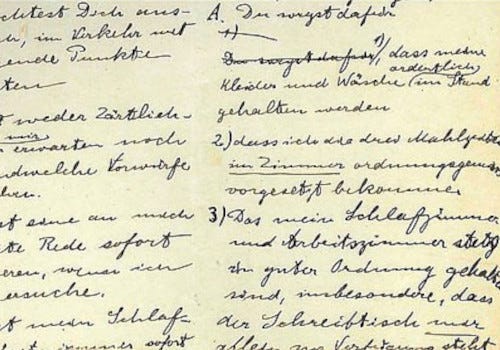
In July 1914, with the marriage collapsing and Elsa waiting in Berlin, Einstein wrote Mileva a memorandum. Not a letter. A memorandum: a list of conditions under which he was prepared to continue living with her and their sons.
The document survives. It is catalogued in the Collected Papers of Albert Einstein, Volume 8, as Document 22. Princeton’s own editors, scholars with no stake whatsoever in flattering Mileva Marić or condemning Albert Einstein, whose entire job is simply to annotate the historical record accurately, describe its contents as a list of brutal conditions.
Among them: she was to keep his clothes and laundry in good order. She was to serve him three meals a day in his room. She was to renounce all personal relations with him except when it served social appearances. She was not to expect intimacy or affection from him, and was to stop talking to him if he asked her to. His bedroom and study were to be kept in order, and, the memorandum specifies, especially the desk, which was to remain at his disposal alone.
The third condition deserves particular attention. The entire century-long argument about Mileva Marić is an argument about whether two people once shared the work. In 1914, the man who had written “our work on relative motion” put the answer to the future in writing: the desk was his alone. Whatever happened at that desk before 1914, the memorandum made certain it would never happen again.
The editors record something else, something that belongs at the center of this essay rather than buried in a footnote: his dismay when she accepted it. Read that again. If the editors are right that Einstein was surprised by her acceptance, it raises an uncomfortable possibility: perhaps the memorandum was never meant to preserve the marriage at all. The memorandum reads less like a marriage contract than an eviction notice dressed up as one, engineered to be unacceptable.
She accepted it anyway. The documents cannot tell us exactly why. They do tell us the world in which the decision was made. In 1914, women in Germany could not vote. Mileva had no university degree, no independent scientific career, and little prospect of supporting two children through the profession she had once hoped to enter. Had she passed her diploma examinations years earlier, her most realistic future would likely have been teaching in a secondary school. Albert’s path, by contrast, led toward university appointments, publications, and eventually international fame. Their choices were never made on equal ground.
And one more thing must be said before her acceptance is read as a verdict on her character. By July 1914, she had spent fourteen years inside the arc his own letters document: adored as an equal, then managed as an employee, then handled as a burden. Anyone who has watched relationships like this in any century knows what that treatment, sustained over years, does to a person’s sense of what she deserves and what she could survive leaving. Consider the two endpoints the record gives us. The woman of 1896 forced open a government ministry, an elite institution, and a laboratory. The woman of 1914 signed a list of conditions for her own domestic service. Those are not two different women, and the difference between them is not a flaw she carried into the marriage. It is what the years in between produced. Whatever unraveled in Mileva Marić’s life cannot be separated from the treatment that unraveled it. Reading her compliance as her weakness, rather than as the manufactured result of his conduct and her constraints, is simply the erasure running one level deeper.
The memorandum did not save the marriage. Weeks later, she and the boys left Berlin for Zurich anyway, war breaking out around them as they went.
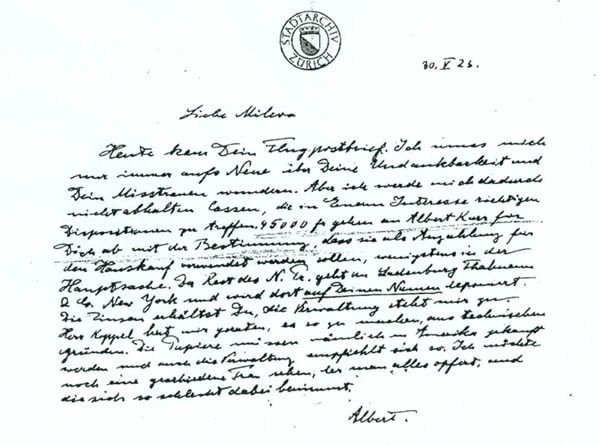
By 1918, with the marriage in legal limbo and money arriving late or short, their older son Hans Albert, fourteen years old, was reduced to arguing with his father by letter for child support and for his younger brother’s medical care.
They divorced in 1919. As part of the settlement, Einstein agreed that if he ever won the Nobel Prize, the money would go to her: deposited in a Swiss bank, the interest hers to live on, the capital untouchable without his consent.
He won the Nobel Prize in 1921 for the photoelectric effect, not relativity. When the prize money arrived, he ignored the settlement’s provision that it be deposited in Switzerland, placing it instead in New York under arrangements that remained largely under his control. Mileva eventually used part of the principal, with his consent, to purchase three apartment buildings in Zurich, living in one and renting the others for income.
Notice the through-line, because it runs the length of the record. Support payments arriving late or short. A fourteen-year-old negotiating his own child support. A settlement rerouted an ocean away from where the agreement placed it. Capital she could not touch without his consent. And, years later, the roof over her head transferred into his name. At every point where money met her independence, his hand stayed on the tap. None of it required breaking a single law. The law was built so it wouldn’t have to.
In 1925, when Einstein moved to formalize that money as his sons’ inheritance rather than leave it under her control, Mileva pushed back, and reportedly considered, for the first time, saying something publicly about what she remembered of their years of collaboration.
He wrote back to remind her of exactly how little that would matter. You made me laugh, he told her, when you started threatening me with your recollections. Have you ever considered, he asked, even for a second, that nobody would pay attention to anything you said if the man you were talking about hadn’t accomplished something important? When someone is completely insignificant, he wrote, there is nothing to do but remain modest and silent. And then he closed with a sentence that should be quoted rather than paraphrased, because no paraphrase would be believed: “Not only children need a bit of thrashing but also grownups and especially women.”
By 1925, the tenderness of “my equal” was eleven years and a world war in the past. What remained was a man who no longer needed to persuade Mileva that no one would believe her. He only needed to remind her.
Set his letters side by side and the arc is unmistakable. His equal, in 1900. An employee he could not fire, by 1912. A nonentity, by 1925. Every one of those descriptions is his own, in his own hand. The only thing that changed across those twenty-five years was how much he still needed her.
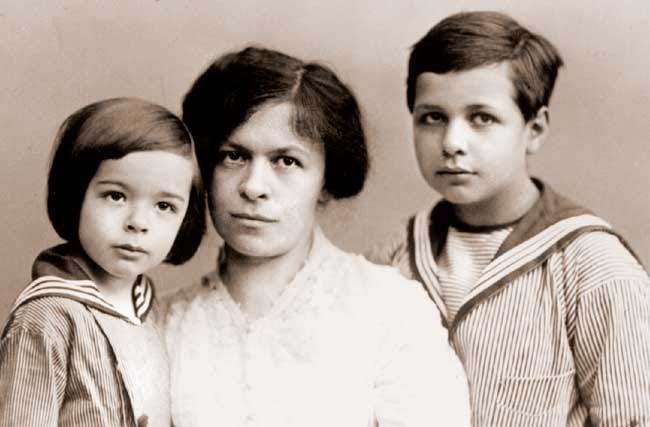
In 1930, their younger son, Eduard, had a breakdown and was diagnosed with schizophrenia. He would spend much of the rest of his life in and out of the Burghölzli psychiatric clinic in Zurich. The cost of his care gradually consumed the financial security she had built from the Nobel settlement. She sold buildings to keep paying for it.
The Depression did not strike the two of them equally. It struck them according to position. He held worldwide fame, an American appointment, and a name no market could crash. She held fixed assets in Zurich, tenants who were themselves going under, capital she could not freely touch, and a son’s care as a rising cost that could not be deferred. He absorbed the 1930s with income. She paid for them with everything she owned. And who held which position had been decided decades earlier, by whose name went on the papers.
In 1939, to prevent the loss of the last building, the house she still lived in, she transferred its ownership to Einstein, keeping only the right to remain there.
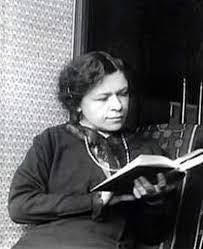
She died of a stroke in Zurich on August 4, 1948, at seventy-two. She had spent nearly three decades raising two sons largely alone, one of them chronically ill, on the far side of the world from the man whose name had become synonymous with genius.
Her apartment was cleared out after her death. Years later, going through a box of her papers, her son Hans Albert discovered he had a sister. No one had ever told him.
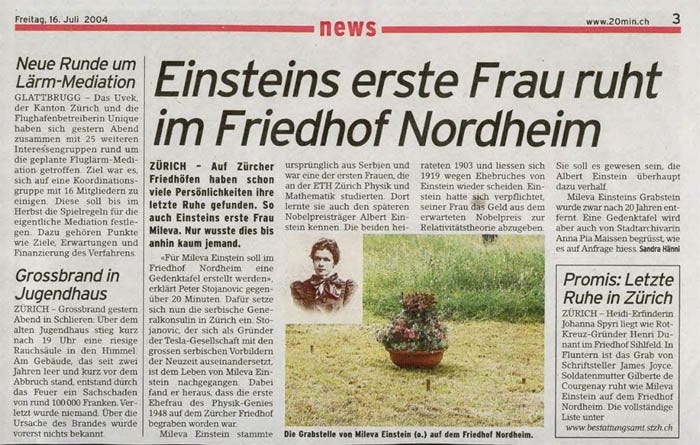
She was buried in Zurich’s Nordheim cemetery in an unmarked grave. The site was not identified until 2004: plot number 9,357. For half a century, the record held her the way it always had. Present, and unnamed.
Ein Stein. One stone. It’s the kind of small linguistic accident that becomes irresistible once you notice it: his own name, in German, meaning the one solid, singular, undividable thing. And for over a century, the historical record has largely agreed to treat it that way. One name. One mind. One stone at the center of modern physics.
But the pun was hers first, and once, she used it out loud. When Einstein and their friend Habicht patented a small invention the three of them had worked on together, it was Habicht, not Mileva, who asked why only two names appeared on it. Her answer, as her biographer records it: it didn’t matter, because she and Albert were ein Stein. One stone. Acting as a unit.
A three-person invention. The two men were named. The woman waved it off with a pun on her married name. She did not necessarily believe she was disappearing. She may have believed that his name represented them both. Either way, the record documents how she lived: inside a “we” she believed was real, under a name the world would only ever read as his.
She honored the obligations of that marriage as she understood them. He did not.
We don’t know, and may never know, how much of the physics was hers. We do know the record was never built to find out. A woman who fails one exam under duress becomes, in the popular telling, either erased or exaggerated: mythologized as secretly the true genius, or dismissed as a footnote who couldn’t hack the math. Both versions do the same thing. They replace an actual, complicated, only partially knowable person with a story simple enough to argue about at a dinner party. And the popular telling has never applied its standards evenly: his cruelties are excused as the manners of his era, while her deference is read as her personal failing. If the era explains him, the era must be allowed to explain her.
What we can say without dispute is this: a woman who was told she was equal gave, at minimum, encouragement, partnership, and a home life organized entirely around someone else’s work, and received, in return, a memorandum listing the conditions under which her presence in that home would be tolerated. Whatever she contributed to the physics, we know exactly what she was permitted to contribute to the record: nothing under her own name. Not once. Not for the capillarity paper in 1900, not for the patent, not for anything that followed.
That is not speculation. That is the byline.
The lock was never just one man. It was a legal system, an academic culture, and a scientific world that rarely imagined women as independent authors of knowledge. Mileva Marić’s life shows us what that lock looked like from the inside, because the system she lived inside was never built to let anyone measure it. Not even the people who loved her. Especially not them.
History did not preserve enough evidence to settle the question of her scientific contribution. It preserved enough to show how easily a partnership could become one name.
We will never know how much of Albert Einstein’s genius was, in some measure, also hers.
Primary Archival Documents & Correspondence
The Collected Papers of Albert Einstein, Vol. 1: The Early Years, 1879–1902. Doc. 28 (“Polytechnic Academic Record”), Doc. 67 (“Diploma, Exam Records”), and Doc. 94 (Einstein to Marić, March 27, 1901). Princeton: Princeton University Press, 1987. [1]
The Collected Papers of Albert Einstein, Vol. 2: The Swiss Years: Writings, 1900–1909. Doc. 1, “Folgerungen aus den Capillaritätserscheinungen” (Capillarity Paper), Annalen der Physik 4 (1901): 513–523. Princeton: Princeton University Press, 1989. [1]
The Collected Papers of Albert Einstein, Vol. 8: The Berlin Years: Writings and Correspondence, 1914–1918. Doc. 22, “Memorandum to Mileva Einstein-Marić,” ca. July 18, 1914. Princeton: Princeton University Press, 1998. [1]
The Collected Papers of Albert Einstein, Vol. 9: The Berlin Years: Correspondence, January 1919–April 1920. Doc. 6, “Zurich District Court Divorce Decree,” February 14, 1919. Princeton: Princeton University Press, 2004. [1, 2]
The Collected Papers of Albert Einstein, Vol. 15: The Berlin Years: Writings and Correspondence, June 1925–May 1927. Doc. 95, Einstein to Marić (“Nonentity Memorandum”), October 24, 1925. Princeton: Princeton University Press, 2018. [1]
Albert Einstein / Mileva Marić: The Love Letters. Edited by Jürgen Renn and Robert Schulmann. Translated by Shawn Smith. Princeton: Princeton University Press, 1992. [1]
Biographical & Historical Analyses
Esterson, Allen, and David C. Cassidy, with Ruth Lewin Sime. Einstein’s Wife: The Real Story of Mileva Einstein-Marić. Cambridge, MA: MIT Press, 2019.
Krstić, Djordje. Mileva & Albert Einstein: Their Love and Scientific Collaboration. Radovljica: Didakta, 2004. (Source for the timeline of the Planck draft and lecture notes in her handwriting.)
Milentijević, Radmila. Mileva Marić Einstein: Life with Albert Einstein. New York: United World Press, 2015. (Esp. pp. 112, 175–176, 199–200, 218–219, 287, 343, 374, 377.)
The Independent. “Does Albert Einstein’s first wife Mileva Maric deserve credit for some of his work?” Long read feature covering the 2004 identification of her unmarked Zurich grave.
Troemel-Ploetz, Senta. “Mileva Einstein-Marić: The Woman Who Did Einstein’s Mathematics.” Women’s Studies International Forum, Vol. 13, No. 5 (1990): 415–432. [1, 2, 3, 4, 5]
For Verification Purposes
All primary source documents cited above are open-access, fully digitized, and searchable in both their original language and English translation at The Digital Einstein Papers.
To verify the specific receipts referenced in the text, navigate directly to:
The “Our Work” Letter: Volume 1, Document 94.
The Coercive Household Conditions: Volume 8, Document 22.
The Zurich Divorce Decree: Volume 9, Document 6.
The “Nonentity” Memorandum: Volume 15, Document 95
Comments
Nothing yet. Say the first thing.
Sign in to join the conversation.