
The Grill'd strike on October 19, 2024 represents a crucial moment in Australian labour history - not just as the first fast food strike in the country, but as a living example of how workers develop consciousness of their collective power through struggle. This process of transformation, from individual workers facing exploitation to a unified force capable of challenging capital, deserves deep analysis.
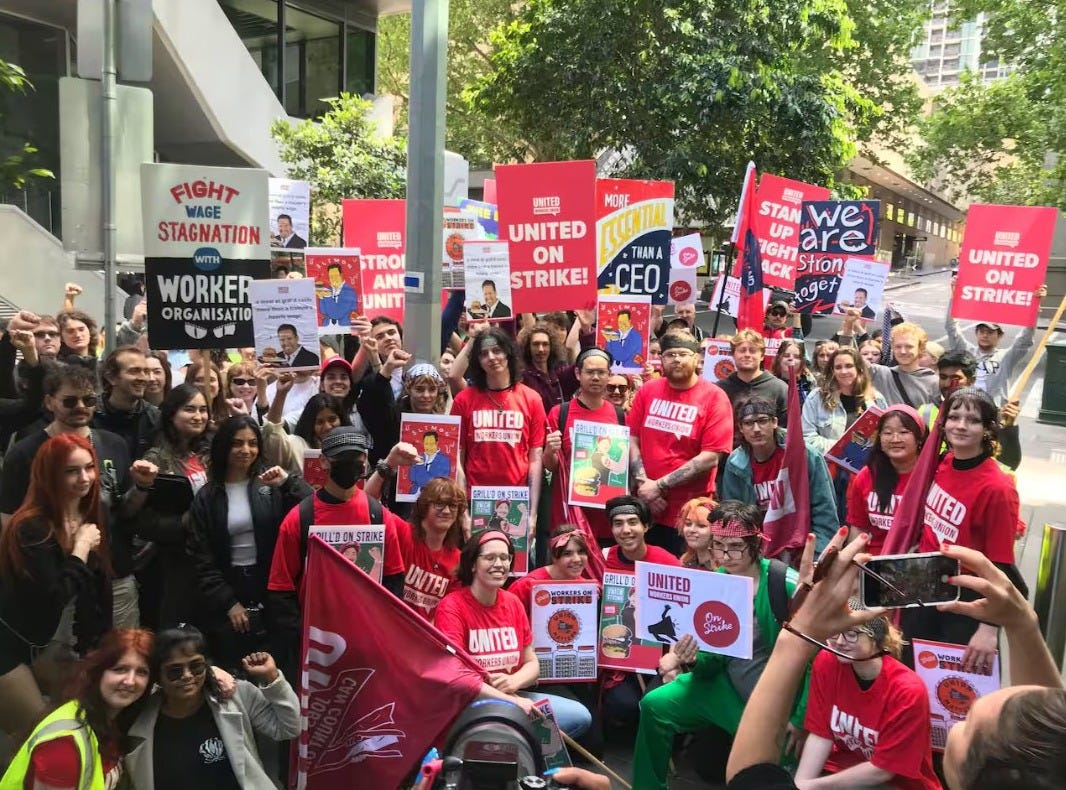
At its core, this strike emerged from the daily reality of fast food work - the controlled movements, monitored breaks, enforced smiles, and persistent low wages despite ever-increasing productivity demands. Grill'd in particular is known for its exploitative practices. Through its use of ‘traineeships’, the company pays workers as little as $14.90 per hour - significantly below minimum wage - while often never delivering the actual training promised. Many employees report working for months or even years without completing their ‘qualifications’, exposing the scheme as merely a pretext to undercut wages. These already difficult conditions have been exacerbated by the ongoing cost of living crisis with union members revealing that workmates regularly go without meals some weeks just to keep up with rent.
These conditions encapsulate what Marx identified as alienation - where workers' very existence becomes something external to them, dominated by forces they seemingly cannot control. But it's precisely these conditions that also create the potential for resistance. This dynamic reflects Marx's insight that capitalism contains within itself the seeds of its own destruction. The more capitalism squeezes workers and intensifies these oppressive conditions, the more it simultaneously creates collective relationships and shared grievances among workers that spark rebellion. The very alienation that workers experience from their labour becomes the foundation for recognising their common interests and understanding the necessity of fighting back together.

At the rally following the Grill’d walk-off, the workers radiated with pride and conviction. When Peter, a long-time employee, addressed the crowd, he wasn't just speaking about Grill'd - he was speaking about a system that treats workers as disposable. "We are the foundation of this company... this company wouldn't be here without the blood, sweat, and tears of these workers... but if there's anyone else out there, any other workers, you can stand up and say enough is enough!"
His words resonated because they spoke to a deeper truth - that there is power in being a worker, whether in fast food or any other industry. Through the organising work led by Victorian Socialists member Mitch, these workers had come to see their value not just as individuals, but as part of a broader working class struggling against systematic exploitation. The act of withdrawing their labour alongside their coworkers had awakened the recognition that change is possible.

Lenin argued that while workers' resistance to exploitation emerges spontaneously from their conditions, revolutionary consciousness requires the fusion of socialist theory with workers' practical experience of struggle. As he explains in "What Is To Be Done?", this transformation requires patient political work from socialists embedded in the workers' movement. The process of rank-and-file organisation at Grill’d by a socialist embodies this transformative process.
For years, Mitch methodically built relationships with his coworkers, demonstrating Lenin's understanding that socialists must be "tribunes of the people" who can explain the connections between individual grievances and their systemic exploitation. Each shared grievance over low pay and unfair treatment revealed the common thread of exploitation binding them all. As Marx noted, "The combination of capital has created for this mass a common situation, common interests. This mass is thus already a class as against capital, but not yet for itself." While the material conditions of capitalism created common interests, it took the conscious political intervention of a socialist to transform these shared experiences into organised resistance and class consciousness.
It cannot be too strongly maintained that this is still not Social-Democracy, that the Social-Democrat’s ideal should not be the trade union secretary, but the tribune of the people, who is able to react to every manifestation of tyranny and oppression, no matter where it appears, no matter what stratum or class of the people it affects; who is able to generalise all these manifestations and produce a single picture of police violence and capitalist exploitation; who is able to take advantage of every event, however small, in order to set forth before all his socialist convictions and his democratic demands, in order to clarify for all and everyone the world-historic significance of the struggle for the emancipation of the proletariat.
The process of becoming a "class for itself" unfolded through escalating stages of struggle. What began as quiet conversations between coworkers evolved into open confrontation with management. Mitch's declaration captured this growing militancy: "My crew and I reckon that no worker in this country should live in poverty, and we'll do everything we can to prevent it." Each step built workers' confidence and clarity about their shared situation.
The electric energy on the picket line showed this transformation in real-time. Workers' speeches demonstrated that the strike transcended mere economic demands – it became a fundamental struggle for dignity and respect. These workers were reclaiming their humanity from a system that had reduced them to interchangeable parts in a profit-making machine. Through collective action, they weren't just discussing their power – they were actively exercising it.
This process dismantles the persistent myth that young hospitality workers are unorganisable. Instead, we see how theory and practice interact in the formation of class consciousness. The workers' experiences of exploitation provided the material basis, while their organised resistance, led by a socialist, created the conditions for a deeper understanding of their collective position. Their confidence grew from the concrete experience of wielding their power together on the picket line. This demonstrates Marx's insight that consciousness emerges from the dialectical relationship between material conditions and collective action – where workers become revolutionary subjects through their own struggle.
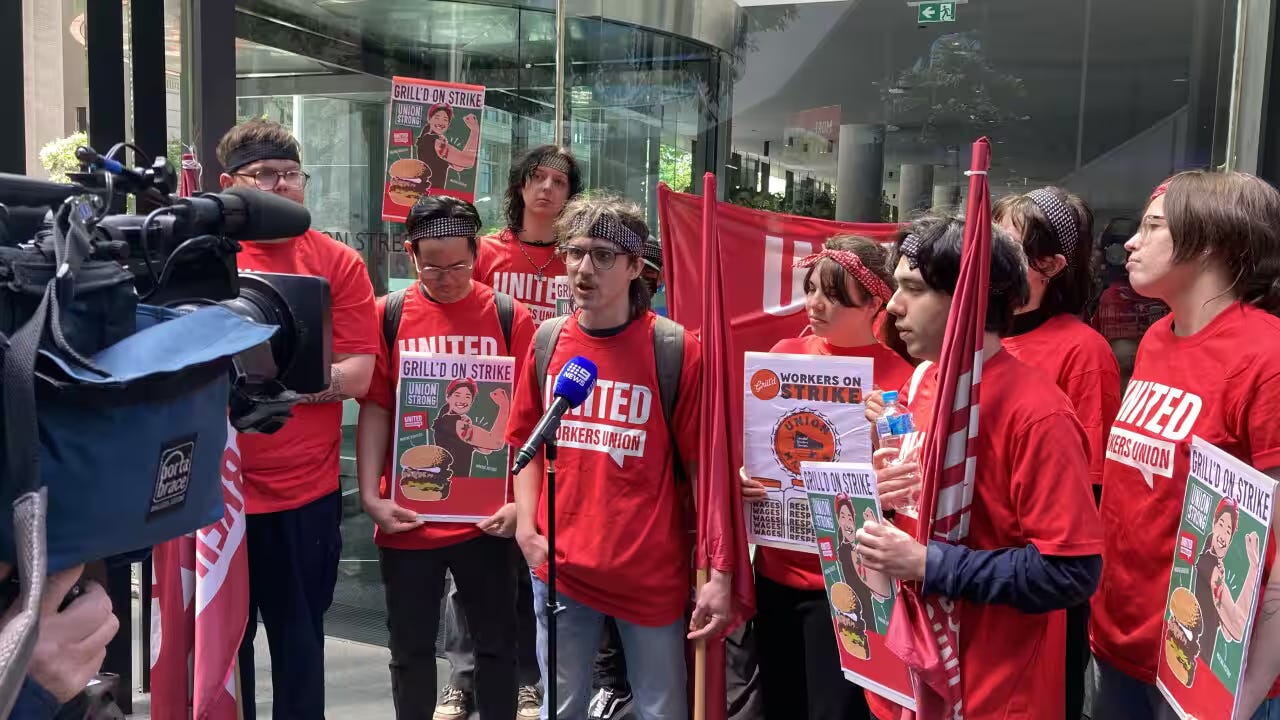
This transformation extends beyond Grill'd. When workers at other fast food outlets see their colleagues standing up, it changes what they believe is possible. Following the strike - workers spent the rest of the day picketing other Grill'd locations across the Melbourne CBD. They handed out over 1,500 flyers to other workers and members of the public. Even 8 hours later - they were still bursting with energy.
This was a common theme at the Woolies warehouse strike at the end of last year. In conversations with workers on the picket line in Laverton, they often referenced other strikes in the area as sources of inspiration and confidence in their own demands. This illustrates how strikes serve as a practical education in power, concretely demonstrating how the wheels of profit stop turning when workers withdraw their labour. This understanding shows how strike action can have a ripple effect beyond the individual workplace, contributing to the development of working-class consciousness as a whole.
The strike's impact resonates with workers across industries because it demonstrates fundamental truths about workplace organising. First, that class consciousness develops through the fusion of socialist politics with workers' practical experience of struggle - as shown by the way that Mitch's political work helped transform individual grievances into collective resistance. Second, that collective struggle transforms the participants themselves, building confidence and political understanding through practical experience.
Most importantly, this struggle shows how workers move from being objects of exploitation to subjects of their own liberation. The process of organising, of building unity, of facing down management, develops the skills and consciousness needed to challenge the entire system of exploitation. This is why Engels describes strikes as "schools of war" - they are living examples of how struggle puts theory to the test and gives rise to new lessons that could not emerge from study alone.
With this in mind, the task for socialists is crucial. While workers naturally develop resistance to exploitation, building this into sustained class consciousness requires political leadership. Socialists must be present and embedded in these struggles, helping workers connect their immediate battles to the broader fight against capitalism.
The goal isn't just to win better conditions at one workplace, but to build a movement capable of transforming society. Each strike, each workplace battle, becomes a stepping stone in developing the confidence, organisation, and political understanding of the working class. When we understand strikes this way - as moments of transformation rather than just economic disputes - we can better appreciate their revolutionary potential. As Engels wrote, "In every strike there lurks the hydra of revolution."
Time and time again, workers have shown what's possible. The challenge is to build on this example, to spread these lessons throughout the working class, and to develop the kind of mass movement capable of challenging capital itself. As Trotsky observed, "Without a guiding organisation, the energy of the masses would dissipate like steam not enclosed in a piston box. But nevertheless what moves things is not the piston or the box, but the steam." This is the true mission of socialists - not just to interpret workers' struggles, but to help lead them toward their revolutionary conclusion.
No posts
Comments
Nothing yet. Say the first thing.
Sign in to join the conversation.