
Sorry for the delay on this one! Big weekend and I totally forgot to hit send.
This week the total Australian box office was $50.25 million across 203 films. That’s more than double last week, and almost all of it belongs to one title: SPIDER-MAN: BRAND NEW DAY opened to $38,440,282 on 1,026 screens, which is 76.5% of everything taken in the country on 26% of the screens.
Eleven of the 203 were Australian fiction features released this year. Their combined weekly total was $69,698 across 79 screens. Two were Australian documentaries released this year, taking $12,153 across 6 screens. Together that’s $81,851, or 0.163% of the national box office.
There were 73 rereleases charting this week, taking $142,958 between them. Eight of those were Australian. Ten screens, $14,808 for the week, a per-screen average of $1,481.
Read those last two paragraphs next to each other, because I had to read them twice. Eight Australian films that are between eleven and forty-seven years old, on ten screens, out-earned per screen every one of the eleven new Australian fiction releases sitting on 79 screens, which averaged $882.
The one new Australian film this week was THE BIRTHDAY TRIP. It took $13,428.37 from 14 screens. KHALI BALAK MIN NAFSAK, an Arabic-language release from Ceema Films now in its second week, took $13,499.18 from four.
* means back in cinemas after a period away
Badlands | Week 1 | 14 screens | $13,428 week total | $34,470 cumulative inc previews | $959 per-screen average
Maslow Entertainment | Week 7 | 19 screens | $37,629 week total | $1,980 per screen | $1,438,818 cumulative
Up 44% on last week’s $26,131 while losing three screens. Top Australian film of the week again, and the per-screen average nearly doubled.
Umbrella Ent. | Week 2 | 20 screens | $7,744 week total | $387 per screen | $38,715 cumulative
Lost nine screens and 64% of its takings. The per-screen average halved, from $739 to $387.
Maslow Entertainment | Week 12 | 1 screen | $3,520 week total | $3,520 per screen | $53,493 cumulative
One screen, and the third-highest per-screen average of any Australian film this week. More than triple last week’s $1,021 from the same single screen. Is Maslow Entertainment Australia’s hardest working distributor right now?
Jaggi Entertainment | Week 7 | 12 screens | $2,377 week total | $198 per screen | $2,976 cumulative
Think there’s some data issues here. The takings went up five times over and the per-screen average went from $478 to $198.
Bonsai Films | Week 4 | 4 screens | $2,327 week total | $582 per screen | $74,395 cumulative
Lost five screens and half its takings, but held the per-screen average almost exactly.
Umbrella Ent. | Week 8 | 3 screens | $915 week total | $305 per screen | $43,553 cumulative
Athabasca Film | Week 13* | 1 screen | $763 week total | $763 per screen | $19,962 cumulative
Dark Matter / Bonsai Films | Week 14 | 1 screen | $690 week total | $690 per screen | $161,691 cumulative
Halved its screens again and lost about 60% of its take.
Maslow Entertainment | Week 4 | 2 screens | $156 week total | $78 per screen | $37,604 cumulative
Madman | Week 11 | 2 screens | $148 week total | $74 per screen | $112,402 cumulative
Garage / Madman | Week 6 | 5 screens | $12,003 week total | $2,401 per screen | $51,982 cumulative
From one screen to five, and from $415 to $12,003. Highest per-screen average of any Australian film this week. Is this the biggest week-on-week jump from an Australian documentary this year? If I was making doco’s right now I’d be looking at what they did last week for this change.
Universal | Week 24 | 1 screen | $150 week total | $150 per screen | $4,245,761 cumulative
Umbrella Ent. | 3 screens | $3,588 week total | $1,196 per screen
Roadshow | 1 screen | $2,888 week total | $2,888 per screen
Roadshow | 1 screen | $2,627 week total | $2,627 per screen
Madman | 1 screen | $1,991 week total | $1,991 per screen
Hoyts | 1 screen | $1,460 week total | $1,460 per screen
Warner Bros. | 1 screen | $1,425 week total | $1,425 per screen
Roadshow | 1 screen | $613 week total | $613 per screen
Universal | 1 screen | $216 week total | $216 per screen
I haven’t seen this film. There is one cinema in Western Australia showing it and neither session works around my family, so everything below is drawn from the marketing, the press and the numbers rather than from the film itself. If you have seen it, please tell me where I have this wrong.
Fourteen screens.
There were 3,899 screens reporting box office in Australia this week, so the film was showing on roughly one screen in every 280. SPIDER-MAN: BRAND NEW DAY opened the same week on 1,026 of them.
I don’t want to lean too hard on that comparison, because a Sony tentpole and a self-distributed first feature were never competing for the same bookings. The more useful comparison is a film that was.
THE PLAGUE opened here in March on 14 screens, the same number, and took $684 per screen in its first week. THE BIRTHDAY TRIP took $959. Opening days were $540 and $2,434. THE PLAGUE arrived with a Cannes Un Certain Regard premiere, Joel Edgerton in front of and behind the camera, 97% on Rotten Tomatoes and an established distributor. THE BIRTHDAY TRIP arrived having been passed over by festivals and distributors, released by a company its own director co-founded.
Either THE PLAGUE was badly under-screened for what it was carrying, or THE BIRTHDAY TRIP did remarkably well to get where it got. I suspect both are true, and that what we are actually looking at is a ceiling. Cannes selection and a recognisable name bought Charlie Polinger no more Australian screens than James Robert Woods bought himself by picking up the phone.
Of those 14 screens, one is in Western Australia. One cinema, for the whole state, showing the film at 1:15pm and 6pm.
WA is about 11% of the country’s population and got about 7% of the film’s screens, which on its own is not worth complaining about. The session times are the part I keep turning over. A 1:15pm screening is available to people who are not at work or at school. A 6pm screening is available to people who are not putting children to bed. Between them they exclude most of the audience this film is aimed at, which is working adults in their thirties.
I have written this paragraph before. In Week 11, about THE PLAGUE, I wrote that I had searched for it on the weekend, it was not playing at a cinema near me, I wanted to see it and I could not. Five months later I am typing the same thing about a different film on the same number of screens.
I have gone back and forth on this and landed on no, which I want to explain properly, because it is not necesarily a comment on the film’s quality.
THE BIRTHDAY TRIP is being sold as satire. That is how the pull quotes read, and the Ruben Östlund comparison turns up across most of the coverage. A friend of mine (noteably someone in the screen industry rather than outside of it) who has seen it and loved it described it to me the same way before I had read any of the press, so the comparison is landing with actual viewers rather than just with publicists.
The trouble I have is with “people who like satire” as a description of an audience. When I look back at what has worked across these newsletters, the films that beat their screen counts are the ones with a community attached. Diaspora films have community associations, group chats and a reason to turn out in the first weekend. A martial arts film has gyms. A queer film has organisations with calendars and mailing lists. Even PENNY LANE IS DEAD last week had horror infrastructure, and I said at the time that being reachable is rarer than being identifiable. People who enjoy sharp social observation are everywhere and nowhere at once, and there is nobody you can ring to organise them.
My sense is that when audiences do turn up for satire at a cinema, they are turning up for a filmmaker they already trust. Östlund can open a film on his name, and I think that is doing most of the work.
Which is why I think the Östlund comparison is being used back to front.
The films people reach for are TRIANGLE OF SADNESS, THE SQUARE and FORCE MAJEURE, all made by a director carrying two Palmes d’Or and two decades of accumulated audience. I would rather look at THE GUITAR MONGOLOID (2004), which was his first feature. Shot cheaply over several years on DV and blown up to 35mm, released in Sweden by Triangelfilm in October 2004. It won the FIPRESCI Prize at Moscow the following year, and Variety described it as ideal festival fare, which I read as a polite way of saying nobody could identify a paying audience for it. Twenty-two years on it sits at 5.9 on IMDb from around 1,600 ratings.
So nobody had a clear audience for Östlund at the start either. He built one across five features and thirteen years before the Palme d’Or turned up.
THE BIRTHDAY TRIP is James Robert Woods’ first feature, I assume festivals passed on it, and distributors passed on it (or did they? Did they activley choose to self distribute from the get go?). He is at roughly the position Östlund occupied in 2004, releasing into a market that only really knows how to sell a filmmaker who is already at the 2022 position.
Badlands seem to have decided the answer was to build the audience room by room instead of assuming one was already sitting there.
The film played the Vision Splendid Outback Film Festival in Winton and Sydney’s Inner West Film Fest, then sold out sessions at Thornbury Picture House in Melbourne and at the Art Gallery of NSW’s Cinémathèque. It screened at Golden Age Cinema in Surry Hills on 17 July, and the theatrical premiere was at Dendy Newtown on 30 July, the day the national release began.
That venue list tells you who they think the audience is, and I suspect they have read it correctly. Inner-city, cinema-literate, the sort of person who will book a session on a weeknight. A satire about affluent inner-urban millennials being played to affluent inner-urban millennials, in the cinemas those people already use.
The part I find most interesting is that when cinemas wanted audience data before they would take the film, Badlands went and produced the data themselves. Woods wrote, directed, shot and co-produced it, and he and Stephanie Jane Day set up a distribution arm to release it. There is no waterfall sitting between the people who made this film and the people booking the screens, and nobody in the middle deciding whether a marketing spend can be justified. It’s a great concept and maybe as producers we should be doing more of this - except there’s theat old chestnut about the producer offset. Now does doing this release Badlands a recognised distributor by the ATO that means next time they can know they can make the film with the producer offset in the budget.
THE BIRTHDAY TRIP went into its release week having already taken $21,042. The release week itself, across 14 screens, brought in $13,428. So 61% of the film’s cumulative total was earned before it opened.
I have been doing these for thirty-one weeks and I have not seen that shape on an Australian film before. Normally the preview figure is small enough to ignore, because previews are a marketing device bolted onto a release. PENNY LANE IS DEAD went into previews the week before it opened on 5 screens and took $873. Here it looks more like the previews were the release, and the 14 screens came along afterwards.
The release week is also very front-loaded. Opening day was $2,434, and the weekend brought in $12,005, which is 89% of the week’s total. Monday to Wednesday added $1,423 across those 14 screens, working out at $34 per screen per day.
I can read that two ways and I honestly do not know which is closer to the truth. Either the curated audience had largely been used up in the previews and there was not much sitting behind them, or the previews were the real release and the national week was a formality.
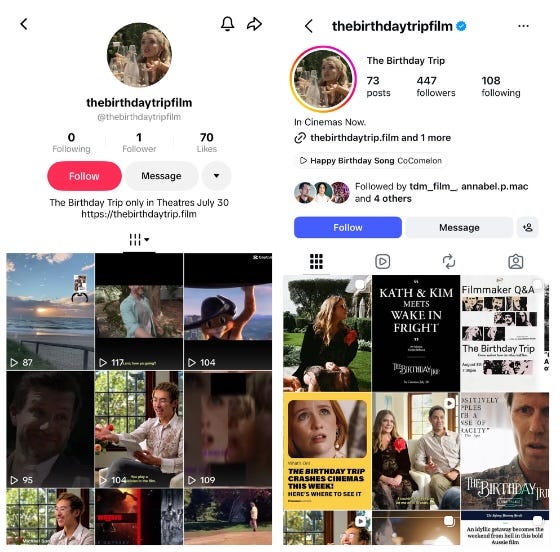
The Instagram account has 73 posts and 447 followers. It is verified, which surprised me on an account that size. The bio reads “In Cinemas Now.” Scroll the grid and the content is genuinely good: pull quotes from reviews, a filmmaker Q&A, a post headed “The Birthday Trip crashes cinemas this week, here’s where to see it.” One of the quote cards reads “Kath & Kim meets Wake In Fright,” which is a great piece of positioning on this film.
The TikTok account has one follower.
Not one thousand. One. Zero following, 70 likes across the entire account. The six videos you can see on the grid have between 87 and 117 views each, so somewhere around 600 views in total. The bio says “The Birthday Trip only in Theatres July 30,” which is accurate and local and exactly what an Australian needs to know.
Spread across 14 screens, the Instagram following works out at 32 people per screen.
What is different here, and I think it matters, is that the messaging is right. There is no confusion about where or when to see this film. No offshore streaming date competing for the same week. The “here’s where to see it” post is precisely the information a person needs. It is being received by 447 people nationally.
Badlands raised $21,042 in previews. The Instagram account with 447 followers and a TikTok account with one. At Australian ticket prices that is somewhere north of a thousand admissions. Those admissions did not come from social.
THE BIRTHDAY TRIP went into its release week having already taken $21,042. The release week itself, across 14 screens, brought in $13,428. So 61% of the film’s cumulative total was earned before it opened.
I have been doing these for thirty-one weeks and normally the preview figure is small enough to ignore, because previews are a marketing device bolted onto a release. PENNY LANE IS DEAD went into previews the week before it opened on 5 screens and took $873. Here it looks more like the previews were the release, and the 14 screens came along afterwards.
The release week is also very front-loaded. Opening day was $2,434, and the weekend brought in $12,005, which is 89% of the week’s total. Monday to Wednesday added $1,423 across those 14 screens, working out at $34 per screen per day.
I can read that two ways and I honestly do not know which is closer to the truth. Either the curated audience had largely been used up in the previews and there was not much sitting behind them, or the previews were the real release and the national week was a formality.
$13,428 in week one on 14 screens, at $959 per screen.
The comparison that stays with me is KHALI BALAK MIN NAFSAK, an Arabic-language release from Ceema Films, which took $13,499 this week from four screens in its second week. Two films, seventy-one dollars apart, and one of them needed ten fewer screens to get there. That is $3,375 per screen against $959. It is the same lesson I keep writing down: a community that already exists will out-earn a film that has to assemble one.
Against the two other films that opened nationally this week, THE BIRTHDAY TRIP did better per screen than THE WIZARD OF THE KREMLIN in its second week ($350 across 114 screens) and considerably worse than THE BLUE TRAIL, which took $2,260 per screen across 25.
Last week I finished by writing about a script I decided not to option, because I could not answer my own two questions about it. This week I want to write about what that decision opened up, because THE BIRTHDAY TRIP is a model that could have worked for the film I was talking about last week.
Look at what it produced. $21,042 from the rooms. $13,428 from the fourteen screens. The thing they did because they had no other option earned 61% more than the thing everybody in this industry treats as the actual release.
I have been thinking all week about what it would look like to plan that deliberately rather than fall into it. Not previews in the marketing sense, where you put a film on five screens the Tuesday before to seed word of mouth. Something closer to a touring release. Fifteen or twenty booked events across a year, each one with a filmmaker in the room, in venues that already program that way and already have an audience who trusts their programming. You would sell fewer tickets than a wide release and you would keep a great deal more of what you sold, because you are recouping the P&A spend and there’s no split with a distributor in the waterfall.
Here is the part I do not have an answer to, and I would like one.
The Producer Offset pays 40% for a film with a qualifying theatrical release and 30% without (amongst the other qualifying factors). I do not know whether a release built the way I have just described qualifies. But if a touring curated release does not qualify, then we have a system paying films an extra 10% of their budget to do the version that earns less money, and pushing every producer of a small film towards fourteen screens they cannot fill instead of twenty rooms they could. .
The WA angle is the one that lands hardest for me. I could not see an Australian film in my own state because the two available sessions did not fit around my children. What I can get here is rooms. Perth has venues that program exactly this way and an audience that turns out for them.
So my hot tip this week is a question to sit alongside the other two. Does this have a clear audience, do I know how to reach them, and if the answer to the first question is no, could I build one room by room instead? For some films that is not a fallback. It is the release.
Till I see you at the cinema next,
Kate
No posts
Comments
Nothing yet. Say the first thing.
Sign in to join the conversation.