
The Australian box office took $22,668,338 this week across 218 films.
Australian films took $75,219 of that, across 23 titles.
10 Australian fiction releases in cinemas, taking $58,883
5 Australian documentaries in cinemas, taking $4,988
8 Australian films in rerelease, taking $11,348
The market fell about 28% on last week, from $31,489,670 to $22,668,338, while the number of films playing went up from 163 to 218. Fewer people bought tickets, and there were 55 more films for them to choose from. Most of that increase came from rereleases, which jumped from 55 titles to 75. Eight of those were Australian, double last week’s four.
* means back in cinemas after a period away
Umbrella Ent. | Week 1 | Position 32 | 29 screens | $21,434 week total | $30,971 cumulative inc previews | $739 per-screen average
Maslow Entertainment | Week 6 | 22 screens | $26,131 week total | $1,188 per screen | $1,401,189 cumulative
Down from 27 screens and $44,965 last week, and still the top Australian film of the week. Now past $1.4 million.
Bonsai Films | Week 3 | 9 screens | $5,060 week total | $562 per screen | $72,068 cumulative
Gained a screen and lost about 20% of its takings.
Dark Matter / Bonsai Films | Week 13 | 2 screens | $1,847 week total | $924 per screen | $161,001 cumulative
Halved its screens and tripled its take.
Screen Inc. | Week 26 | 1 screen | $1,134 week total | $1,134 per screen | $45,944 cumulative*
Maslow Entertainment | Week 11 | 1 screen | $1,021 week total | $1,021 per screen | $49,973 cumulative*
Maslow Entertainment | Week 3 | 4 screens | $859 week total | $215 per screen | $37,448 cumulative
From 16 screens to 4 in a week.
Umbrella Ent. | Week 7 | 3 screens | $663 week total | $221 per screen | $42,638 cumulative
Jaggi Entertainment | Week 6 | 1 screen | $478 week total | $478 per screen | $599 cumulative*
Madman | Week 10 | 3 screens | $257 week total | $86 per screen | $112,254 cumulative
ABCG Film | Week 14 | 1 screen | $2,034 week total | $2,034 per screen | $40,273 cumulative*
Kismet | Week 12 | 1 screen | $1,987 week total | $1,987 per screen | $67,923 cumulative*
Back on a screen after time off, and second-highest per-screen average of any Australian film this week.
Universal | Week 23 | 2 screens | $530 week total | $265 per screen | $4,245,611 cumulative
Garage / Madman | Week 5 | 1 screen | $415 week total | $415 per screen | $39,979 cumulative
Bonsai Films | Week 21 | 1 screen | $22 week total | $22 per screen | $106,081 cumulative
Umbrella Ent. | 2 screens | $2,726 week total | $1,363 per screen
Hoyts | 1 screen | $1,935 week total | $1,935 per screen
Roadshow | 5 screens | $1,545 week total | $309 per screen
Roadshow | 1 screen | $1,430 week total | $1,430 per screen
Roadshow | 1 screen | $1,369 week total | $1,369 per screen
Roadshow | 1 screen | $1,105 week total | $1,105 per screen
Roadshow | 1 screen | $695 week total | $695 per screen
Palace | 1 screen | $543 week total | $543 per screen
I haven’t had the chance to see this film yet so I’m working off guessing from the marketing for some elements - please chime in the comments if you have another take on this.
29 screens. Umbrella put the film into previews the week before on 5 screens, which took $872.91, so the cumulative figure includes that.
I feel like this film could have done better at the cinemas so maybe it was about the locations it screened at.
The core is the genre audience. The film is being positioned in the Ozploitation tradition as a blood-soaked, 80s-set horror thriller laced with dark comedy and feminine rage. That is a specific, self-identifying group of people who follow horror as a category rather than following individual films.
That description does something most Australian films can’t do. It tells a stranger, in one sentence, whether this film is for them. I wouldn’t think this film has a huge theatrical audience - it feels like one that could build as a cultlike one over time but interestingly I think young women could be a potential audeince - Three teenage girls at the centre, revenge structure, feminine rage in the framing. That audience shows up for horror in numbers that get consistently underestimated and they are the segment most likely to go in a group rather than alone.
The 1986 texture crowd. The period is the aesthetic, not the hook, and nostalgia for 1986 belongs to people who are now in their fourties and fifties. Although some could claim that the early adults/late teens are reaching into 1980’s nostalgia.
Young women. This is where I’ve changed my mind. Three teenage girls at the centre, a revenge structure, rage in the marketing language: on paper that reads as a young female audience, and that audience shows up for horror.
But look at the trailer. It’s very violent, and the marketing is not hiding it. Spooky Astronauts, who is one of my favourite horror reviewers, described the film as quite disturbingly violent, and she watches a lot of horror. That’s not a criticism of the film. Plenty of people want exactly that, and the reviews have been good.
It does change who’s likely to buy a ticket, though. There’s a difference between a film a group of nineteen-year-olds decides to go and see on a Friday night and a film that lands in the “too disturbing, save it for a sleepover with the lights on” category. The second one still gets watched. It gets watched at home, later, with people you trust, and with a pause button. Young women are a hard audience to reach at the best of times, and a violence-forward campaign may have moved this film out of the cinema column and into the home column before it opened.
The 1986 crowd. I’ve talked myself out of this one too. The period is the texture rather than the hook, and genuine nostalgia for 1986 belongs to people now in their fifties. Some of them loved horror at seventeen and have quietly aged out of wanting to sit through a slasher in a cinema. They are not going out on a Saturday night for this.
So the audience is real and identifiable, and it’s narrower than the film’s ingredients suggest. It’s the committed horror crowd.
Here’s the good news, and it doesn’t come up often: the horror audience is easy to reach.
Every other week I write about films with no obvious route to their audience. Horror has infrastructure. There are blogs and sites that cover the genre exhaustively, there are reviewers with real followings, and there are influencers whose recommendations move people. A horror fan has somewhere they go to find out what’s coming. Almost no other Australian film gets that.
PENNY LANE IS DEAD used it. This had a very good week for press. That is not something I get to write often about an Australian film opening on 29 screens.
It premiered at Adelaide Film Festival last October and screened at Fantastic Film Festival Australia. It had its North American premiere at Fantasia on 20 July. Bloody Disgusting, Dread Central, Rue Morgue and most of the genre sites that matter all covered it. One of them called it possibly the steal of Fantasia. The trailer went out through Bloody Disgusting as an exclusive back in May.
So this is not the usual week where I have to explain that nobody wrote about the film. Plenty of people wrote about the film.
The problem is what they wrote, and who they were writing for.
On 20 July, Shudder announced it had acquired PENNY LANE IS DEAD, with a streaming date of 28 August. The film opened in Australian cinemas on 23 July.
Three days apart.
The acquisition covers the United States, Canada, the Caribbean Basin Islands, the United Kingdom and Ireland. It does not cover Australia. Umbrella produced the film through Sanctuary Pictures, its own production arm, and distributes it here, so the Australian rights never left the building. I don’t know where they go next or when, and I couldn’t find it published anywhere.
Here is what that means in practice.
The largest wave of coverage this film has received, or is likely to receive, broke in the same week it opened in Australian cinemas. Almost all of it was written for an American or British reader. Almost all of it ends with some version of the same line: streaming on Shudder from 28 August.
For a reader in Cleveland or Manchester, that line is a service. For a reader in Adelaide, where the film was shot, it is wrong. Not deliberately, and not inaccurately either, because the sentence “Penny Lane Is Dead streams on Shudder from August 28” is entirely true. It just isn’t true for them, and nothing in the article tells them so.
Australian horror audiences read international horror press. That is not a criticism of them or of the local press. It is a structural fact about a genre where the centre of gravity sits offshore, and where the trusted sources are Bloody Disgusting and Dread Central and Rue Morgue rather than anything published here. Those are the outlets that a horror fan in Perth has bookmarked. Those are also the outlets that spent the week of this film’s Australian release telling readers to wait five weeks, maybe with the misunderstanding that it will be on Shudder in Australia too on August 28 (which it may - I can’t tell).
I want to be careful about how far I push this, because I can’t measure it. I have no way of knowing how many Australians read a Fantasia write-up in July and quietly filed the film under “wait for streaming.” That number could be small. But the mechanism is real, and I’ve never seen it laid out this cleanly before, because the timing here is almost perfectly unfortunate.
Usually the Awareness problem I write about is absence. Nobody knows the film exists, the search results are thin, the AI Overview has nothing to say, the category query returns a listicle from 2019. This is the opposite problem. There was a great deal to find. It was addressed to somebody else.
I also want to be fair to Umbrella here, because I don’t think this is a mistake anyone made. A Fantasia premiere is good. A Shudder deal is good - a great home for the audience, and for a first feature it is very good. Neither of those was fully theirs to schedule. Fantasia programs when Fantasia programs. Shudder announces when Shudder announces. An Australian distributor with a July release date does not get to tell an international streamer to hold its announcement for a month so that the domestic run has clean air.
The clearest example I’ve got is Spooky Astronauts. She’s a horror reviewer with well over 200,000 subscribers, and she covered the film. She’s also Australian, born and raised here, which is the part I keep turning over. An Australian creator, covering an Australian film, in the week it opened in Australian cinemas, and the release she pointed her audience toward was Shudder on 28 August.
That isn’t a criticism of her. Her audience is overwhelmingly international, and Shudder in August is the accurate answer for most of the people watching. It’s just a very clean illustration of the problem. The Australian theatrical release is invisible even in coverage produced by an Australian, because the audience being addressed isn’t here.
So here’s the friction. The things that make an Australian genre film internationally viable, festival slots and offshore acquisitions and coverage in the outlets that horror fans actually read, are the same things that can crowd out its domestic release when they land in the wrong week. The film’s international success and its Australian availability were competing for the same seven days of attention.
There is a version of this where the two support each other. Fantasia buzz on the Monday, Australian cinemas on the Thursday, and a line in every press release to outlets saying “in Australian cinemas now via Umbrella.”
Which leaves one place where an Australian could have heard the right information from the film itself.
The owned channels are the one part of this that Umbrella controls completely. No editor, no territory restrictions, no international audience to write around. Whatever is on these accounts is aimed squarely at Australians, and it can say whatever the distributor wants it to say.
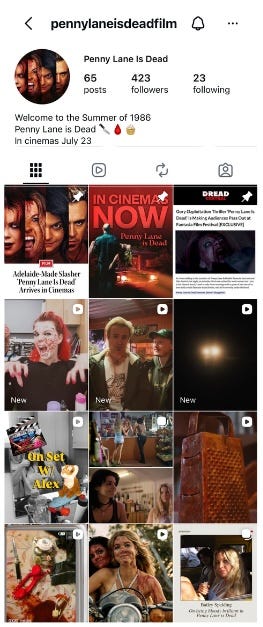
The Instagram account has 65 posts and 423 followers. The bio reads “Welcome to the Summer of 1986. Penny Lane is Dead. In cinemas July 23.” The three pinned posts are an IN CINEMAS NOW card, an article about the Adelaide-made slasher arriving in cinemas, and the DREAD Central exclusive about the film’s Fantasia screening.
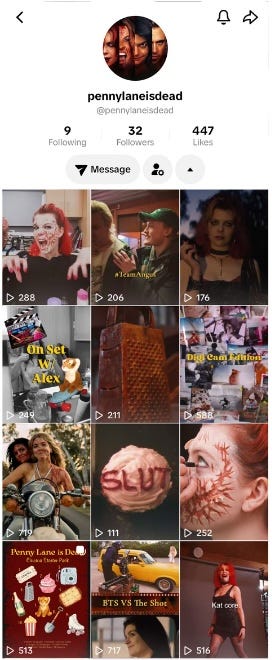
The TikTok account has 32 followers and 447 likes across the whole account. The twelve videos visible on the grid have between 111 and 717 views each, totalling about 4,500 views. The average video has been seen 378 times.
Thirty-two followers.
The content is not the problem. Scroll the grid and it’s practical effects breakdowns, a prosthetic being built, scar work, a digicam-styled cast piece, a BTS versus the finished shot comparison, an on-set video with one of the cast. This is exactly the material I would have made. Mia’Kate Russell spent years in the Australian special effects and make-up scene before directing this, and it shows in what the account is posting. A director with a practical effects background has content that a marketing department cannot invent, and this account has it.
It has 32 people watching.
For context: 423 Instagram followers, spread across 29 screens, is about fifteen followers per screen. The film’s entire Instagram following would not fill one large suburban cinema. The film’s entire TikTok following would not fill a row.
So the message here is correct. The bio says “in cinemas July 23.” It is accurate, it is local, it is exactly the information a person needs, and it is the only version of this film’s release that was written for an Australian. And almost nobody is receiving it.
Set that against the numbers from the section above. The coverage pointing at a 28 August streaming date reached tens of thousands of horror fans. The account telling Australians the film is in cinemas now reached 423 people on Instagram and 32 on TikTok.
It gets worse when you look at what those pinned posts are. Two of the three are press coverage rather than the film’s own material, and one of those is the Fantasia piece. Even the account’s own front page is amplifying the offshore conversation, because that is where the volume is.
An organic-looking account with good practical effects content does not build itself an audience in six weeks from a standing start. It needs seeding, and seeding costs money, and a film releasing on 29 screens does not have that money. Which means the one channel that speaks accurately to Australians is also the one channel with no budget behind it.
$21,434 in week one on 29 screens, at $739 per screen.
Set against the two films that opened the same week, PENNY LANE IS DEAD did more per screen than THE WIZARD OF THE KREMLIN, which took $99,286 across 148 screens for $671 per screen. COLOURS OF TIME took $140,871 across 39 screens for $3,612 per screen, which is nearly five times the PENNY LANE figure on ten more screens.
The comparison that keeps coming up: JANA NAYAGAN, in its first week, took $736,946 on 108 screens. That is $6,824 per screen, Nine times the per-screen average of the Australian film that opened the same week.
Against HOW TO TALK AUSTRALIANS, which is the fairest comparison available, PENNY LANE IS DEAD is running slightly behind: $21,434 on 29 screens versus $21,776 on 27.
Here’s what I keep circling back to. The reviews are good. The press was good. The audience is identifiable and, for once, reachable. And it still opened at $739 per screen.
My suspicion is that the violence is doing more work here than anyone wants to admit. A film that reviews well and disturbs people is a harder proposition for an exhibitor than a film that reviews well and doesn’t. It narrows who will come out on a Tuesday, it makes the session times that would suit it the least commercially attractive ones, and it makes word of mouth run in a strange direction, where people recommend it and warn you about it in the same sentence.
My own work helped me make a hard decision this week. I’ve been looking at optioning a script. It’s a drama but it has some dark comedy elements in it.
I realised if I asked my own two questions I couldn’t answer them - Does this film have a clear audience? and How do I find them in Australia?
The script - althought really good doesn’t have a super clear audience. It’s a drama - maybe at a stretch a thriller depending on the executed tone. There was nothing in the other elements of the film that could be clearly linked to an group of people (like dentists or people dealing with family death) or thematically had anything that resonated with what’s going on in the world.
I could see a w0orld where it could become a black comedy like IN BRUGES, MURIELS WEDDING or FARGO but the writer wasn’t interested in writing that version.
It didn’t mean I wasn’t not interested in the script anymore but making this film in WA meant either - What am I presenting when I take this film to distributors, A good script (especially in the drama space) is nothing without a great director and probably a shit hot cast. And having a shit hot cast in WA means lots of travel and accommodation, which adds to the budget that can’t be seen on screen. And if it didn’t have the great director and cast, I could make it here in WA but it would be super low budget and probably not a theatrical film - which the current producer offset makes it difficult to finance.
So it’s a not right now for that project and that clears the space for the other projects I’m working on that do have the clear audiences.
So there’s my hot tip - ask yourself the questions Does this have a clear audience, and do I know how to reaach them for all your projects.
Till I see you at the cinema next,
Kate
No posts
Comments
Nothing yet. Say the first thing.
Sign in to join the conversation.