
Music is a trade of tools. Almost just as much as what you do defines the tools you use, the tools you use define what you do. I think it’s a bit more complex than the literal “turn of phrase” suggests.
Sometimes, seemingly inane differences reverberate into larger stylistic choices. I recently restrung all my acoustic guitars. Normally, I use .012-.053 gauge strings—that’s .012 of an inch—but on one guitar I decided to experiment a bit. A tiny 0.001 of an inch to 0.11-0.52 gauge strings. Pedantic, perhaps, but the outcome totally amazed me. That 0.001 of an inch produced a dramatic difference in playing. The .011 strings were much more supple and delicate than the .012.
I realized that, as I’ve been playing .012-.053 strings as long as I can remember, the strings have probably done as much to shape the contours of my playing as much as anything else. Would I have been a different kind of guitar player with different strings?
DAWs are a great example of a tool I have been tinkering with for more than a decade now. I started out on Garage Band, then gravitated to Ableton, then Logic in high school, then returned to Ableton in college, then Pro-Tools, etc. etc. In the last five years or so, since finishing Slacker Poetry, I’ve turned my indecision between DAWs into a mindful decision to work with multiple. I like having all the tools at my disposal. “Mamma Mia” and Puzzle Solver are Ableton through and through and could never have been made in Logic or ProTools. Late to the Party is pure ProTools. Derecho and The Stone Smile probably could have been made in Logic or ProTools, but the greater fluidity of Logic let me be much more freely impulsive with my creative choices where the more linear ProTools might have cut ideas off.
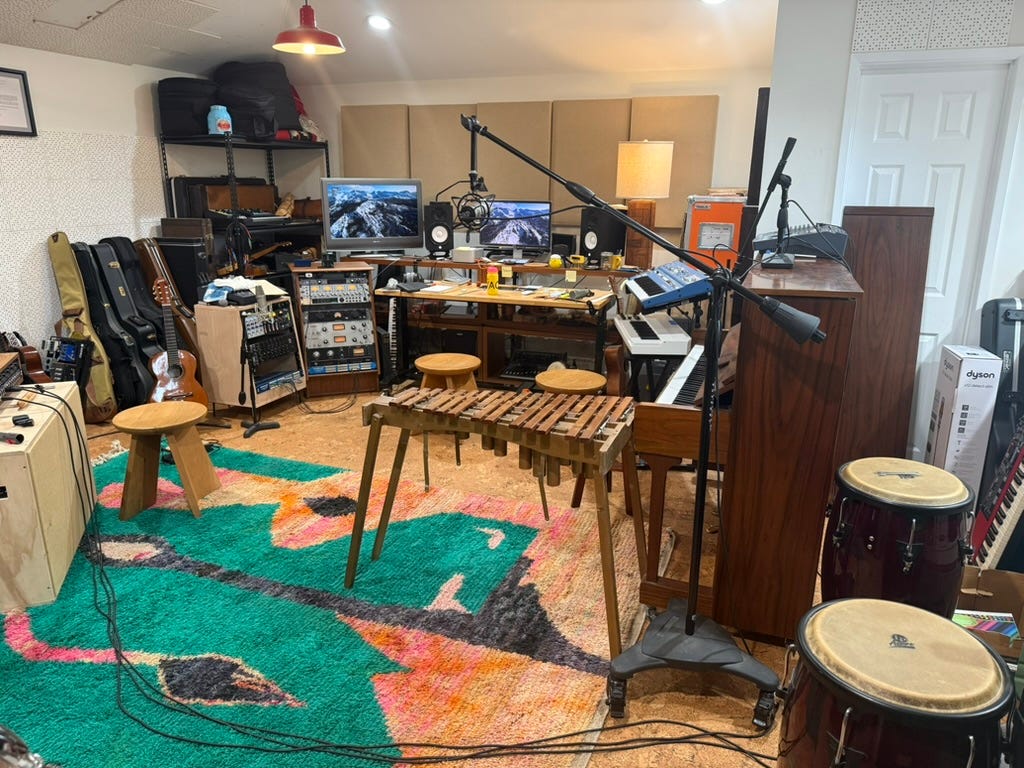
The single biggest tool I tinker with is the room itself.
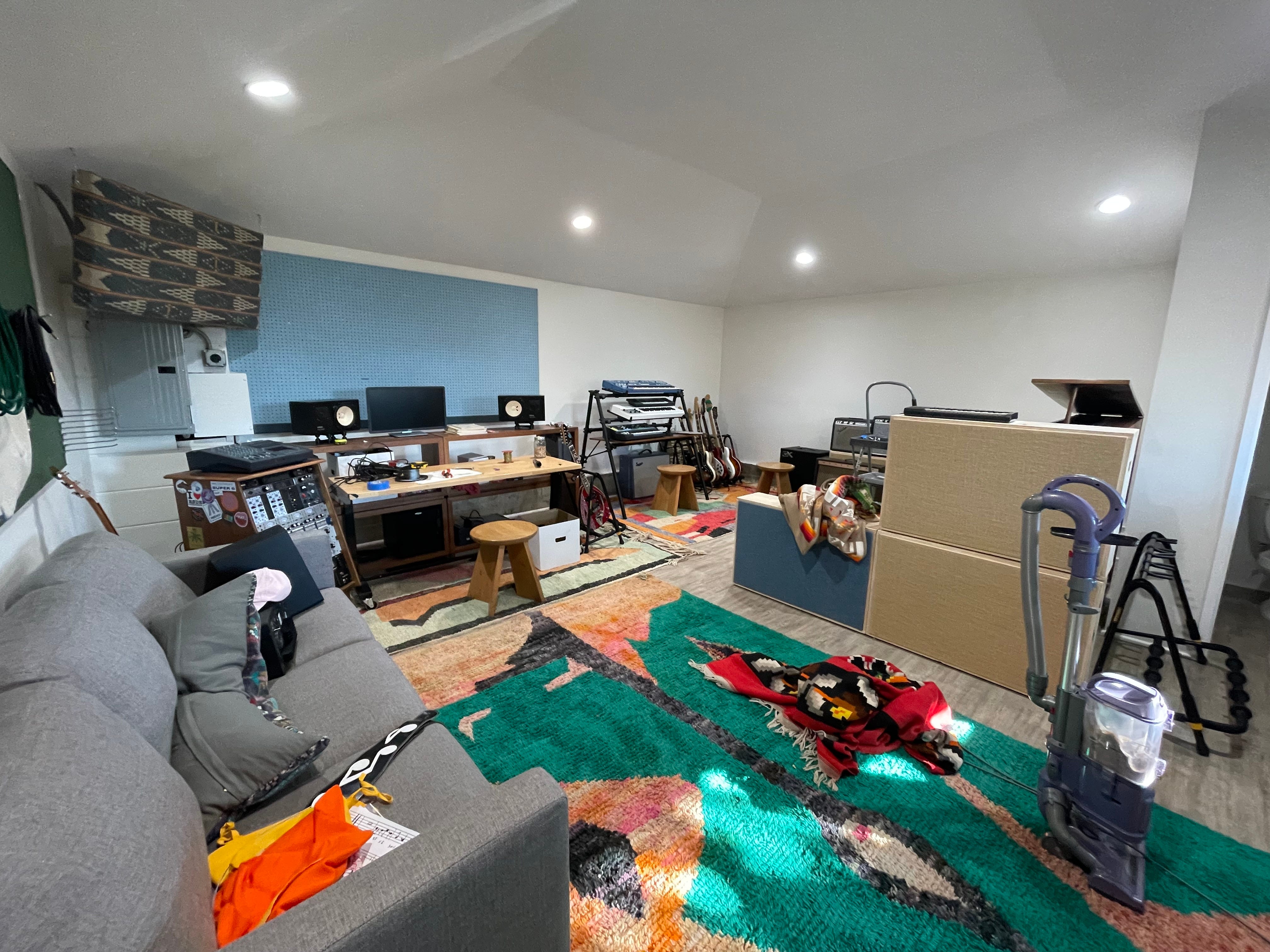
Here’s what that same studio from above looked like four years before. Different things are close at hand, different things are harder to reach, different choices are easy to make or hard to make. It’s like keeping the cookies behind the mustard in the back of the fridge.
It’s rare that I move an instrument to an easy-to-reach spot because I think “Man, I should use that more,” but often when I start using something more, it becomes naturally established nearby leading to me using it more when I’m not sure what to do. It’s a bit circular and leads to a natural-feeling ebb and flow of studio organization. Take the marimba in the 2026 studio photo. I had bought it the year prior from a fellow Northeast transplant Mt. Washington musician, King Tuff, on a lark. I’d always wanted a marimba on the very “tools” basis of this article. A year later, I started scoring a new feature, Echo Lake (hopefully coming to festivals in 2027), and landed on the marimba as one of the key sounds for that movie. Having that marimba out, led to many other marimba incursions when they otherwise would not have happened, and, suddenly, the marimba was everywhere in the music I was making.
Also, for this same reason, I like to “reset” my studio at regular intervals, usually after the end of a big project. It feels like I’m also resetting my sound and my brain. I am resetting the regular patterns that accumulate over the course of a project, the instruments that are easy to reach, the ideas that are easy to integrate. When we moved to New York in the spring, my studio went through its biggest ever reset. I’m excited and intrigued to figure out how my music changes as a result.
The Stone Smile is a reader-supported publication. To receive new posts and support my work, consider becoming a free or paid subscriber.
See you next week,
Austin
Comments
Nothing yet. Say the first thing.
Sign in to join the conversation.