
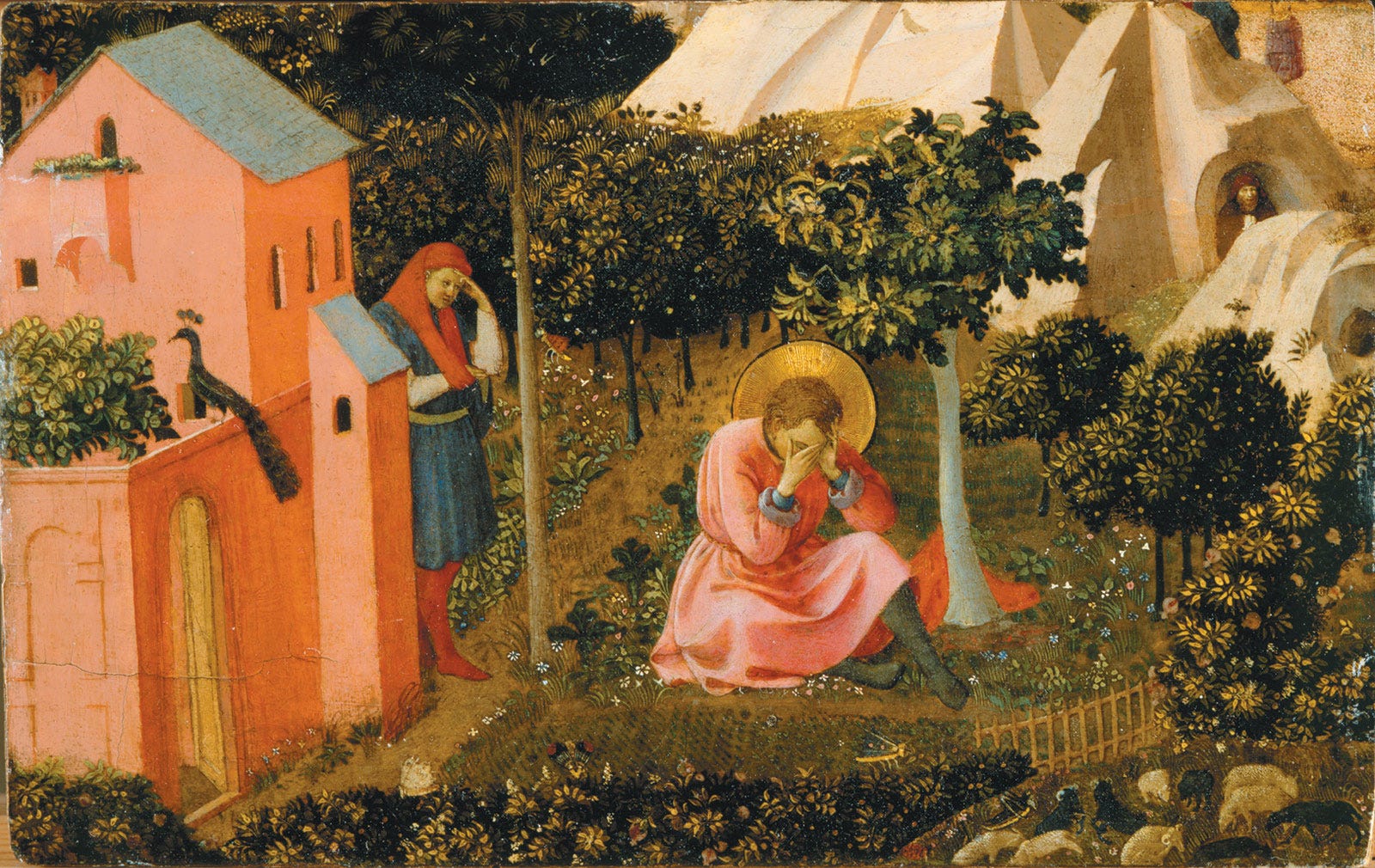
Perhaps no scene from Augustine’s life is as famous as his dramatic conversion in the late summer of 386. After wrestling with the claims of Christianity for years, Augustine’s search reaches a boiling point. In a moment of immense, tormenting inner conflict, he hears a voice saying, “tolle, lege,” and upon opening the Scriptures, decides to give his life to Christ. Finally, the decisive domino has fallen. As Augustine writes, “the light of confidence flooded into my heart and all the darkness of doubt was dispelled.”1 We love to see it.
We often forget, however, what comes next in the story of Augustine’s life. We want to move straight from conversion to baptism and onto that sublime contemplative experience he has with his mother at Ostia. After that, we soon get Augustine the priest and bishop who spends his life writing, preaching, and rallying all his intellectual might against the Donatists. That sounds like more than enough for a biography. However, between that garden conversion and his reception into the church at Easter, an important period of Augustine’s life passes.
During the traditional autumn vacation (around November), Augustine takes a small group of family and friends to a villa in the Lombardy hills outside Milan for a philosophical retreat. There, they fill the days reading Virgil, writing poetry, debating philosophy, and doing some occasional work with their hands. Their conversations range from in-depth debates about Platonic philosophy to whether or not it’s permitted to sing hymns while going to the bathroom.2
Side note: I now really want to arrange a pilgrimage to Lombardy where we just have a philosophical retreat. Who’s in?
Out of this philosophical retreat came four dialogues, the first works Augustine wrote as a Christian: Against the Academics, On the Happy Life, On Order, and Soliloquies.

Whether it’s due to their inherent quality or my personal affinity for the dialogue format, I can’t say, but I find these works to be incredibly enjoyable either way.
The first of the dialogues, Against the Academics3 will be the focus of this essay. With a title like that, it might be helpful to know who these “Academics” are. I won’t bore you with lots of background information. For the sake of brevity, all you need to know is that Augustine is broadly addressing those philosophers who claim the wise man gives assent to nothing.
I often hear people lament that, living in the modern world, we have access to so many competing points of views that it makes certainty feel impossible. If so many people who are smarter than us disagree, how can we ever really know anything at all?
As Solomon quips, there’s nothing new under the sun, and it didn’t take 24/7 access to YouTube for people to come to a similar point of despairing of certainty. Greek and Roman philosophers before Augustine—figures like Carneades and Cicero—noticed that, once we begin pulling on the threads of epistemology, everything starts unraveling.
However, they didn’t despair. They still believed strongly in the pursuit of wisdom, even if we might never attain it. While we might not know the truth, we can recognize that things are “truth-like.” And this probabilistic approach to knowledge, they argued, was enough to ward off the paralysis that can come from doubt.
So, it’s this set of ideas that Augustine encourages two of his students, Licentius and Trygetius, to explore in the first of the Cassiciacum dialogues. Licentius takes up the position that wisdom is about the pursuit, not the attainment of knowledge (the Academic position), while Trygetius argues for the opposite.
Like most students trying to wade into the deep waters of philosophy, they make a hash of it. So, somewhat against their will, Augustine and his friend Alypius (who, you might remember, was in the garden with Augustine during his conversion and experienced a conversion of his own) get roped into the debate, now squaring off as sparring partners instead of their previous roles as teacher and judge.
Alypius takes up the defense of the Academic position, succeeding Licentius in this role, and Augustine plays the prosecutor, putting skepticism to the test. Alypius’s defense of the Academics is quite interesting at the level of biography. Alypius himself was a lawyer, so we might suspect that, in defending the Academics, he’s simply performing the role thrust onto him by the stumped students. If that was the case, we’d see this as a simple exercise in dialectic. However, what’s fascinating is that Alypius actually seems to hold the Academic/Skeptical position himself. Bearing in mind that Alypius is himself a new convert to Christianity, hear his passionate defense of skepticism:
“If you ask me my own position, I think that the truth has not yet been discovered. I also add, which is what you were demanding of the Academics, that I don’t think that it can be discovered either—not only by virtue of my own deep-seated opinion, which you have almost always noticed, but also on the authority of the great and outstanding philosophers before whom either our weakness or their strength somehow or other compels us to bend the neck, and it should be believed that nothing can now be discovered that surpasses their authority.”4
Clearly for Alypius, being an Academic/Skeptic and being a Christian are not at odds.
For a book with the title, Against the Academics, you might expect that Augustine views things radically different from Alypius. Certainly Augustine, the man who has had light dispel all doubt, doesn’t share this assessment that we can’t know the truth, right?
On the one hand, yes. Augustine argues forcefully against the Academics, mustering his dialectical skill to tie their position into knots and win the argument. However, I must say that the argument is rather different than I expected. When the contours of the debate begin taking shape in Book 1 while the students are still stumbling through it, you expect that Augustine the confident convert will argue decisively for our ability to know things, but by the end, you realize that Augustine and Alypius are not too far apart.
Recall that the debate is centered around this question of whether the wise man assents to anything. The framing here is key. In fact, as far as Augustine’s argument goes, the fatal flaw in the Academics’ position is their foolishness in using the term “wise man.” This opens the position up to the charge of internal inconsistency. That is, they claim there are, in fact, wise men, but they are forced to simultaneously say that these wise men do not possess knowledge. Augustine goes on the offensive, poking holes in this by asking whether it’s more probable that the wise man possesses wisdom, and, having established that it is more probable, he argues it would be foolish for the wise man, likely possessing wisdom, to not assent to wisdom. And if he assents to wisdom, then it can’t be said he assents to nothing. However, one gets the impression that, if the Academics would have just said there are no wise men, Augustine’s argument would either collapse or have to take a much different tact.
Aside from the internal critique about the foolish wise men, the only certain truths Augustine puts forth are relatively axiomatic ones. For instance, he argues that we can’t know whether there is one world or many, but we can know that there is either one or many. This is true, of course, but it is not incredibly inspiring. Michael P. Foley argues in his commentary on this dialogue that Augustine concedes that 99% “of what people think of in the course of their lives is not genuine knowledge or scientia, for it cannot be truly perceived or comprehended.”5 Again, probably not the kind of statistic that makes the epistemically anxious feel warm and fuzzy inside.
There’s another important point to notice in Augustine’s reserved affirmation of certainty. That is, Augustine doesn’t consider himself a wise man. He admits, “There is nothing I find, however, that isn’t doubtful; but the wise man as we have been saying, finds wisdom itself.”6 Indeed, while dogmatic about the possibility of wise men, he doesn’t seem to think there are many of them.
The real problem for Augustine is that, by asserting the impossibility of certainty, the Academics dissuade people from even searching for it. He writes, “Don’t you know, then, that I as yet have nothing which I perceive as certain, but that I’m prevented from seeking it by the arguments and disputations of the Academics?”7 The irony is that the Academics were trying to promote inquiry by their method, as they saw dogmatism as the stifling force and skepticism as the liberator. But by the time of Augustine, skepticism had become the dogma and now, in order for philosophy to thrive, skepticism must be overthrown so people don’t despair of the truth.
This has really interesting implications for our theological debates today. On the one hand, if we are overly confident in having arrived at the right answers, we will dissuade people from properly engaging the task of theology. It becomes nothing other than a process of memorizing the conclusions. Why study when you have the answer key, right?
In response, people often push back against such dogmatic certainty, emphasizing the apophatic nature of theology (we can say what God is not but not what God is) or the analogical nature of theology (we can say what God is like but not what God is). However, pushed to extremes, these can lead people to despair of knowing anything about God.
In Against the Academics, Augustine tries to chart a middle course. We must affirm the possibility of true knowledge without hastily asserting that we’ve already attained it. In method, then, Augustine works similarly to the Academics. He argues from probability and he’s wary of easy conclusions. The core difference, though, is he doesn’t turn method into dogma.
All of this offers us a fascinating counterpoint to the clear-eyed convert we meet in Confessions. If that work tempts you to think conversion brings with it immediate certainty, Against the Academics forces you to reconsider the scope of that certainty. It’s true, Augustine appears to have given his full assent to Christ back in that garden. But it is not an assent based upon empirical certainty. It is an assent that holds within it space for much exploration in pursuit of greater clarity. And, at least at this point in his life, Augustine saw philosophy as a genuine path to that clarity. Toward the end of the dialogue he writes:
“Therefore, I am determined not to depart ever, in any way, from the authority of Christ, for I find no authority more powerful. But what should be pursued by a most subtle reason — for I am now of such a mind that I impatiently long to apprehend what is true not only through believing, but also through understanding — I am confident in the meantime that I shall find among the Platonists, and that it won’t be incompatible with our sacred [teachings].”8
Though written more than a millennia after this dialogue, Augustine’s fellow Doctor of the Church, John Henry Newman’s thoughts might be of service here. In An Essay in Aid of a Grammar of Assent, Newman distinguishes between inference and assent. Inference is always probabilistic. Agreeing with the skeptics, Newman concedes that the data itself never leads to certainty. However, assent is something different. While inferential arguments might prepare the way for assent, they are not, ultimately, the foundation of it. There comes a time in life when your confidence in an idea is not strictly proportionate to, or even dependent upon, the arguments that got you there. The assent becomes unconditional.
Perhaps that is the best way to read Augustine here. He is the convert who has given his unconditional assent to Christ. He’s not doubting Christ. There’s no turning back for him. And yet, he is still the philosopher who knows that his reasons are never certain. Whether this imposition of Newman’s categories is anachronistic or not, Against the Academics offers us a brilliant picture of passionate conversion not putting a stop to rigorous philosophical inquiry.
In case you weren’t aware, my novel, The Long Road to Holy Island, is now available for pre-order. It’s a story about a grieving young man who embarks on the pilgrimage his mother always dreamed of—St. Cuthbert’s Way—despite not sharing her faith. Along the way, he meets a monk who becomes his traveling companion, and through their conversations and other people he meets, the protagonist is forced to wrestle with questions of faith in a world that so rarely makes sense. Pre-ordering is a huge help, especially for debut authors like me. So, if you’re so inclined, it would mean a lot to me if you grabbed a copy early.
If you’re looking for ways to start studying church history, I recently put together a Church History in a Year reading guide which takes you through 2,000 years of primary sources in just 52 weeks. It’s available for $15 individually or freely to all my Patrons.
Finally, paid subscribers receive access to my book club, in which we’re currently reading Irenaeus, Against Heresies. We meet on Mondays at 8pm EST on Zoom. Recordings are provided for those that can’t make it. If studying the church fathers with people from diverse church backgrounds is something that sounds fun to you, I think you’ll love our book club.
Augustine, Confessions, VIII, 12.
Yes, that was a real debate in On Order.
Augustine alternatively refers to it as On the Academics and Against the Academics in his later works. Perhaps that should foreshadow its complicated nature.
Augustine, Against the Academics, 2, 13, 30.
Michael P. Foley, Against the Academics: Translation, Annotation, and Commentary, 200.
Augustine, Against the Academics, 3, 14, 32.
Augustine, Against the Academics, 2. 9, 23.
Augustine, Against the Academics, 3, 20, 43.
No posts
Comments
Nothing yet. Say the first thing.
Sign in to join the conversation.