
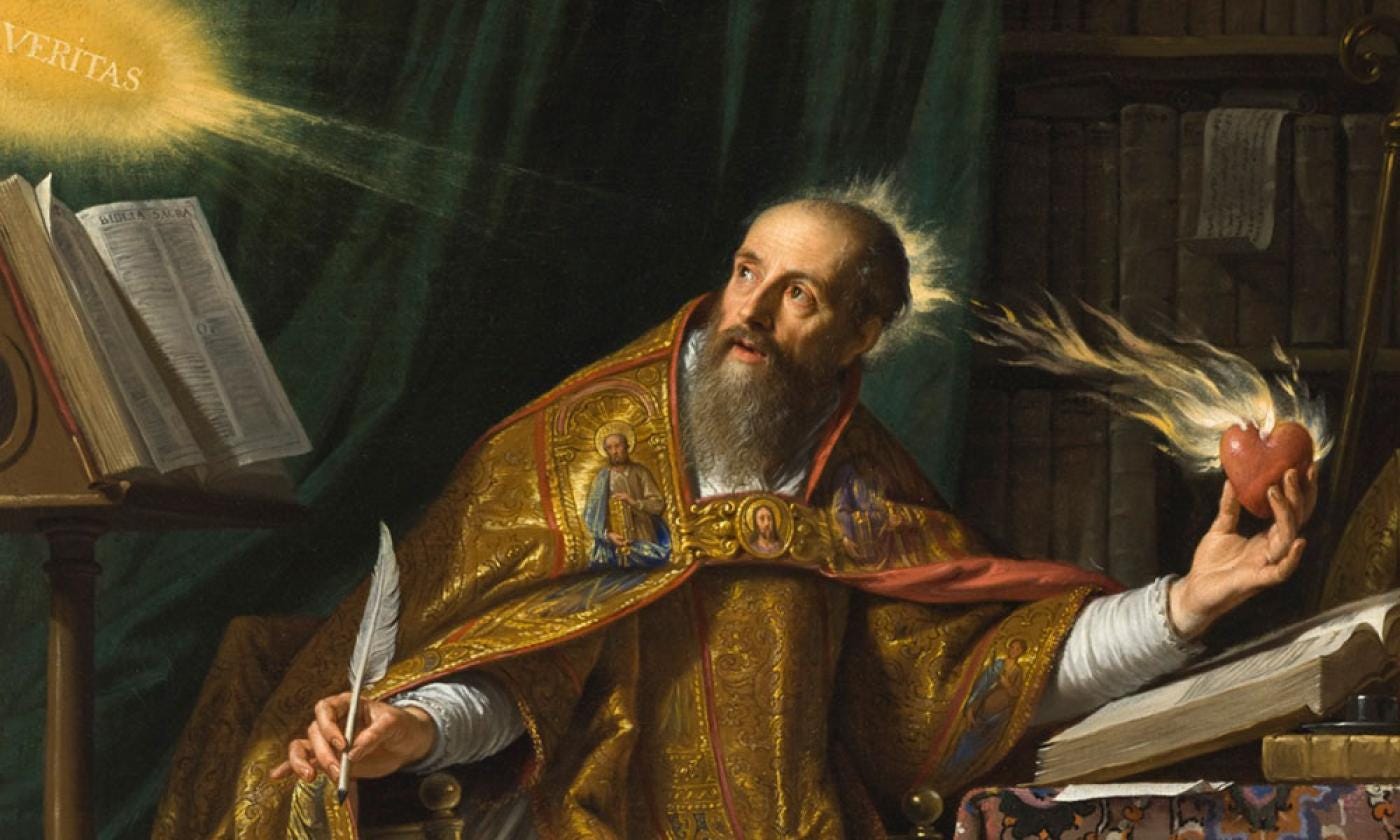
When St. Augustine was 72 years old, he took upon himself the task of reviewing his books, letters, and sermons “with a kind of judicial severity … indicating what dissatisfies me.”1 If you have even a passing familiarity with Augustine’s literary corpus, you’ll recognize this as a gargantuan task. His was a life spent writing, and his complete works in English span 49 volumes. Just re-reading all those works, much less examining them with “judicial severity” and articulating what went right and wrong, is quite the undertaking, to put it lightly.
We can still find this review of his works in a wonderfully unique book, Retractiones. Though it didn’t quite achieve the comprehensive survey he intended, he did succeed in reviewing 93 books that he had written up to that point in his life.
More than the individual critiques, what stands out to me about Retractiones is what it reveals about the task of theology. Augustine is revered by many as the theologian par excellence in the Western Tradition. It has often been said, with only a touch of exaggeration, that Medieval Theology was largely footnotes on Augustine and the Reformation was a debate about Augustine. And yet, this man of near unparalleled brilliance in the Christian tradition, thought he got a bunch of stuff wrong.
And if that’s the case for Augustine, how much more so will it be the case for us?
The Wonderful and Precarious Task of Theology
I was 18 when I first stumbled across the work of British New Testament scholar N. T. Wright. Immediately, I was hooked. Previously, my love of literary analysis and passion for faith were completely separate. Faith was something devotional and personal. My academic love of books was something different. Wright’s work was my gateway into the world of theology where faith met academic rigor, and in time I’d fall in love with philosophy and historical theology.
Somehow, talking about these things has become my job, thanks in no small part to the people who support me on Patreon and over here on Substack.
Early in my theological journey, I took a course called, “The Theologian’s Craft.” Before taking systematic theology courses, all theology majors were required to spend a semester thinking about the craft of theology. It was a class about method, not conclusions, and it instilled in us a sense of the sacredness of the work of theology. Pedagogically, this was wonderful. Many of us rush into doing theology without first thinking about the nature of the task we’ve undertaken and end up doing it all the more poorly on account of this.
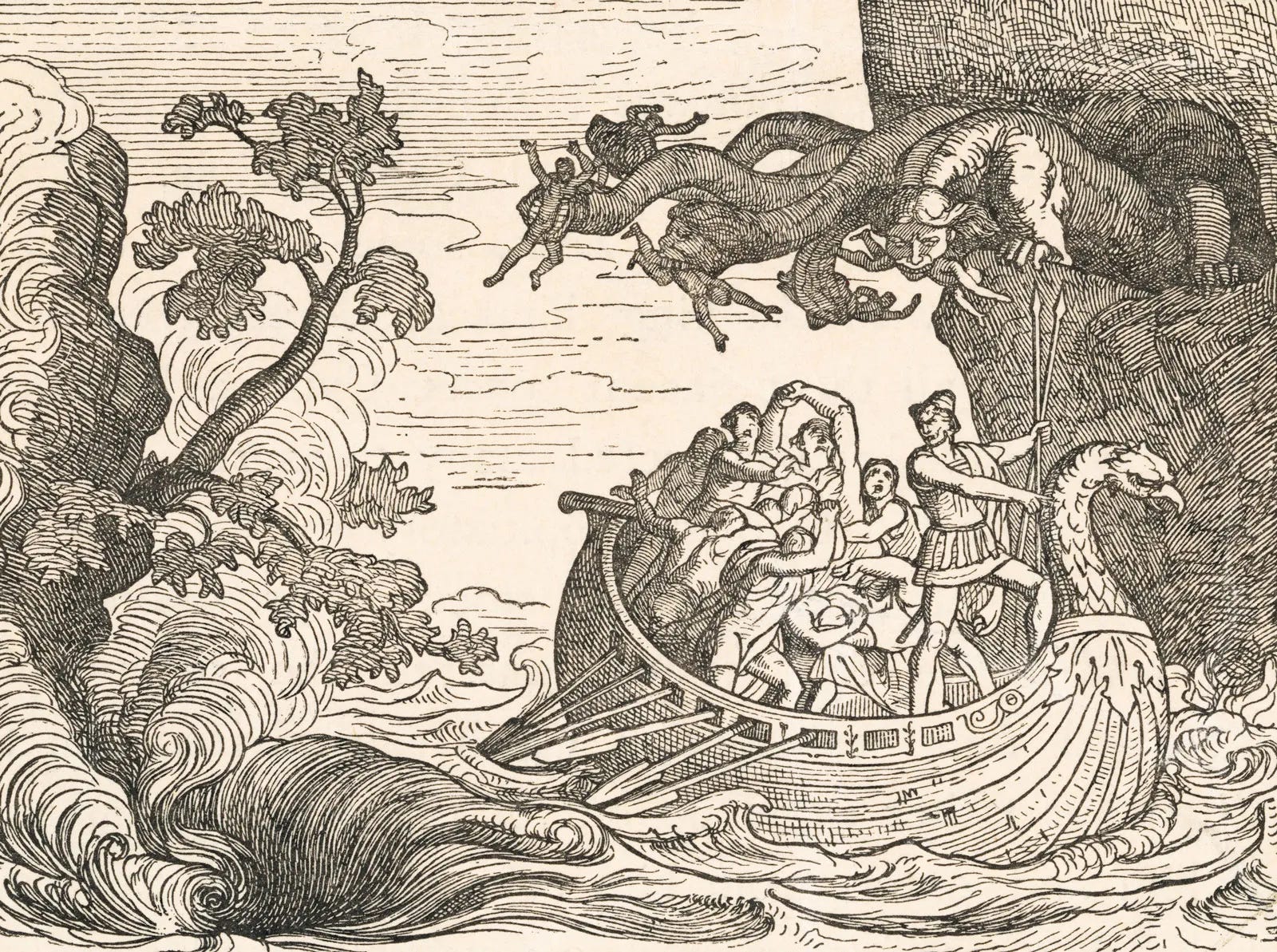
It seems to me there are two vices opposing vices in the work of theology. On the one hand, there is the Charybdis of flippancy, not recognizing the gravity and care that becomes speaking of the Creator of Heaven and Earth. On the other hand, there is the Scylla of scrupulosity, an immobilizing fear of saying the wrong thing that makes us settle for merely restating what has already been said before and never joining in the conversation ourselves.
In my own work, I’ve felt the pull of both of these. I’ve spent the last seven years creating theological videos online (673 at the time of publication). In a world where rebuttal videos are a genre all to themselves and comments are flooded with critiques, it’s easy to become overly cautious, trying avoid the six-headed Scylla of every possible response. When we do this, though, our theology can become a bit dull. Sure, if we merely repeat what St. Thomas Aquinas said, we won’t anger too many people. We’ll be on safe ground, but we’ll hardly be enaging the task of theology. Each generation must join into the great conversation of our Tradition, lest it become less than a living Tradition.
But Charybdis is equally deadly, that swirling whirlpool that sucks us in when we’re careless. If we make theology into an exercise of just rattling off reactionary hot takes or half-baked thoughts, we’re primed to see our ships go under.
At this point, it’s tempting to despair. The way seems remarkably narrow, and the stakes are high. In many ways, this is an accurate description. But it’s also incomplete. And I think Augustine shows us a better way than white-knuckling it through these precarious waters.
The Augustinian Way
Conventional wisdom would say you should walk before you run, learn the scales before you solo, and sit at the feet of the masters before hazarding your own thoughts.
Augustine did almost all of this backward.
Much has been made of the fact that Augustine was a poor student of Greek and thus was isolated from much of the best theological thinking of his time. In the hands of some Orthodox apologists, this is pinpointed as the fatal misstep of the West. If only Augustine would’ve read the Cappadocians, all would be well. Maybe.
But, as it was, Augustine’s linguistic isolation meant that he was often doing theology in a speculative, creative mode. And he was doing it without first waiting to spend years studying from the masters.
Even before Augustine was baptized, he was rattling off works of theology at a remarkable pace. Now, he wasn’t an unlettered man speculating with no training whatsoever. He was a master of rhetoric, a keen student of philosophy, and a self-learner when it came to Scripture.2 Still, he showed little fear to roll up his sleeves and start theologizing right from the start.
For readers of this Substack who are already wary of the phenomenon of over-zealous converts propping themselves up as experts, this might be cause for concern. Surely, we don’t want to encourage such behavior?
I’m sympathetic to this. However, I think Augustine’s early works, many of which are dialogues, reveal something about theology that we often forget: it’s a process of discovery.
Here, I would like to make a distinction between theology in its authoritative mode and its discursive mode. Some theology is a pronouncement from on high, a binding decree. We often call this dogmatic theology. Properly speaking, this is not the domain of laypeople on the internet, and certainly not of recent converts. Other theology, however, is simply the task of reasoning together about God. And, done in a spirit of openness, mutual discovery, and—critically—humility, this form of theology encourages all people to participate.
Augustine’s early dialogues are not all super polished pieces. But I think that’s by design. He invites young students and uneducated family members into the task of theology. He treats it less like a white-knuckled voyage and more like a joyful exercise of shared learning.
In other words, he’s not sailing between Scylla and Charybdis because he doesn’t see theology as the type of thing where you’ve only got one shot to get it right. Instead, it’s the task of a lifetime in which it’s ok to go out on a limb sometimes as long as you commit to always learning and being willing to admit your mistakes when you get it wrong.
The danger I see today is less in people sharing too many thoughts out of season, but rather in taking themselves a bit too seriously in the process. That’s not to say we should be flippant, not caring whether we’re right or wrong and spouting off ideas that could shipwreck not only ourselves but others too. James rightly says, not all should be teachers. But I think flippancy is setting oneself up as a teacher and not recognizing the weight of that office nor caring to correct oneself or be corrected when necessary. It is a different thing altogether, though, to take the posture of a learner and invite others along for the journey while committing to constantly refining one’s thoughts.
It is this type of attitude that forged the thought of Augustine. Notably, while he critiqued his earlier works, he didn’t delete them. He doesn’t pull his punches where he thought he spoke incorrectly, and this is more common in those youthful works of his, and yet he allowed those works to stay in circulation. He didn’t rewrite the record.
I’m not going to say Augustine always got this right. Committed though he was to inquiry and the liberal arts, he did also allow the Donatists to be suppressed by imperial force, setting up a dangerous precedent for church-state cooperation against heretics. At times in his later years, it’s harder to find the same joie de vivre that marked the time when his son was still alive, when he was living in a philosophical retirement and hadn’t yet the scars of decades of ecclesial ministry in a divided North Africa.
And yet, it’s a deeply Augustinian insight to recognize that none of this should surprise us. The same man who critiques his own theology examines his flawed soul in Confessions.
As some of you will know, I’ve set out to spend this year studying St. Augustine. Soon, I will be writing a series of essays on those delightful Cassiciacum Dialogues. But I thought it might be helpful, before starting at the beginning of his works, to join him in his late reflections, realizing that, brilliant though he was, he got a lot of stuff wrong. And that’s ok. In fact, it might just be a mark of being a good theologian: being willing to dare a few thoughts that you later realize were incorrect. If we’re lucky, in time we’ll realize that some of what we said was better than we thought, much was worse, and the conversation of the Great Tradition will carry on full-steam ahead, hopefully taking the good and leaving the bad. If we have enough humility to be corrected when need be, and enough faith in the church of today and tomorrow to recognize truth from error, we can explore the fields of theology freely, learning together and always keeping our eyes fixed on the One who is greater than any of our words could ever express.
Odds and Ends
In case you weren’t aware, my novel, The Long Road to Holy Island, is now available for pre-order. It’s a story about a grieving young man who embarks on the pilgrimage his mother always dreamed of—St. Cuthbert’s Way—despite not sharing her faith. Along the way, he meets a monk who becomes his traveling companion, and through their conversations and other people he meets, the protagonist is forced to wrestle with questions of faith in a world that so rarely makes sense. Pre-ordering is a huge help, especially for debut authors like me. So, if you’re so inclined, it would mean a lot to me if you grabbed a copy early.
If you’re looking for ways to start studying church history, I recently put together a Church History in a Year reading guide which takes you through 2,000 years of primary sources in just 52 weeks. It’s available for $15 individually or freely to all my Patrons.
Finally, paid subscribers receive access to my book club, in which we’re currently reading Irenaeus, Against Heresies. On Monday (8pm EST), we’ll be tackling the most famous sections of the book, in which Irenaeus talks about the “pre-eminent” authority of the bishop of Rome, apostolic succession, and more. If studying the church fathers with people from diverse church backgrounds is something that sounds fun to you, I think you’ll love our book club.
Augustine, Retractiones, trans. Sister M. Iner Bogan R.S.M., Fathers of the Catholic Church, vol. 60 (Washington, DC: Catholic University of America Press, 1968), 3.
That’s not to say that the early Augustine had no access to theological works or training. At the very least, he had learned some things from St. Ambrose who himself was a translator of the Greek theological tradition. Augustine appears to have been a voracious reader and eager student all his life. What I mean to note here is simply that much of this was “learning on the job.” For instance, he tried to resist his ordination on the account that he felt underprepared, especially in terms of his knowledge of Scripture, but the response was essentially, “learn as you go.”
Comments
Nothing yet. Say the first thing.
Sign in to join the conversation.