
Hey, y’all!
This week from Austin Scholar...
First think, then ChatGPT
Scholar’s Sources: What I’ve been thinking about…
I got back from South Africa two days ago and I truly had the most remarkable time. Here is one of my favorite photos from the trip: a female leopard hunting for her cubs.

How beautiful is that?! And on the note of Africa, we have the final Alpha World School info session this Wednesday before the students arrive in New York for the pre-departure program. So if you’d love your kid to not only experience the beauty in Africa as I did, but also transform its educational system, come to the info session.

First think, then ChatGPT
Last week, I argued that filling your brain with knowledge is good (unfortunately an increasingly controversial opinion). But getting knowledge into your brain is only half the battle.
Just as a chatbot is able to recall facts, it’s even more famously able to write essays and complete analysis for students.
Students having access to chatbots has led to a crazy situation in schools: students don’t know how to study and learn. Schools no longer know how to teach kids to study and learn. Even at the Ivy League.
This is, naturally, also a massive issue that schools are floundering while trying to solve. School districts across the country have started to completely ban student cellphone use during the school day and specific AI tools (such as ChatGPT, Claude, Gemini, Perplexity, etc.), yet allow students to use AI tools for “research, exploration, and creative projects” and “brainstorming, summarizing information… and as a study partner” as students are “already encountering AI beyond school walls.”
As a student myself, I am also confused about how and when AI should be used in academia. Every teacher has different policies and everyone has a different meaning of “research.” And so, because there are so few clarified guidelines and no true incentive not to, students across the country use AI to write papers, complete problem sets, and solve exam questions.
It goes all the way to higher education, too.
A post went viral on X exposing the discrepancy between Brown University students’ take-home midterm scores versus their in-person final exam scores:
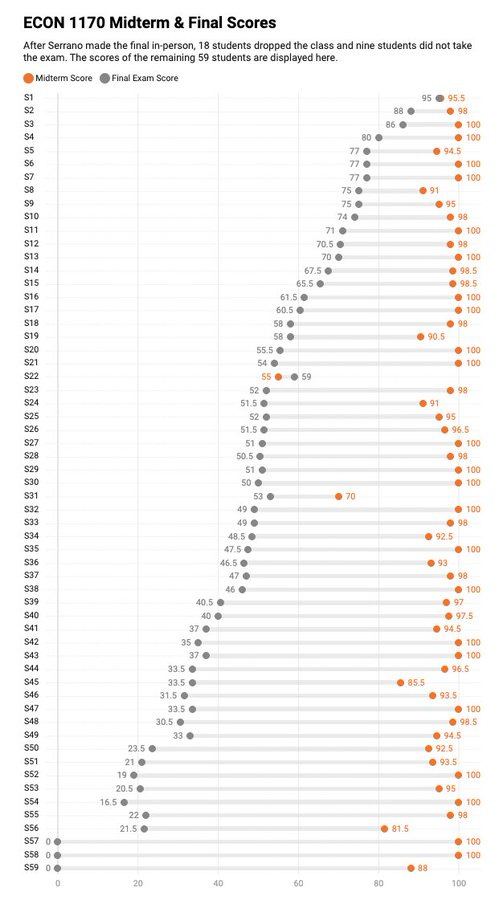
Clearly, almost every single student used AI to cheat on their midterm, which is, of course, a problem. Part of it due to how easy it is to use to get a good grade, part of it due to a lack of incentive not to (Brown administrators and professors themselves remain arguing about what constitutes AI use, how to and if they should punish suspected that AI use).
All of that is concerning and troublesome and all of those things.
But what I find really concerning is that the students couldn’t figure out how to study for the final exam! These are smart kids; they’re all students (typically juniors and seniors) who have taken challenging classes, likely had some sort of job or internship, and were interesting enough to get into the Ivy League. But in between the time their professor announced the final would be in-person and the end of the semester, they were unable to actually study for this exam to do any semblance of passing.
Why?
AI has created such an ease for mental offloading that even at the slightest cognitive challenge students feel like they’re learning. This is where the re-reading epidemic has come in. Re-reading as a study technique has been prominent for essentially ever, but recently I’ve noticed that today’s students are overestimating its value. It might feel as though you are learning when passively watching a video or re-reading something, but it is only when you actively recall the answer without the material in front of you that true learning happens.
But re-reading a ChatGPT-generated summary of a chapter, class notes, or the practice exam answer sheets is classified as the best form of studying and learning across educational institutions, even ones such as Stanford.
I totally understand why, though. Rereading notes feels productive because everything looks familiar, but recognition is not recall. A student can recognize every term on a study guide and then go blank when asked for a definition.
Think of it like this: you can watch TikTok videos or Instagram reels of someone lifting weights for hours. You can study their form, count every repetition, and receive a beautifully formatted summary of the workout. But their muscles get stronger, not yours.
Your brain is like a muscle, so learning works the same way.
Every time a chatbot, an existing answer key, or the professor’s notes remembers the fact, constructs the argument, or makes the connection before you try, it may give you a better answer, but it also steals the rep. And the rep is where learning process happens:
“That answer looks right.” -> “I can produce the answer.” -> “I can explain why it is right.” -> “I can use it somewhere new.”
Successfully moving through the learning process can look like:
Explaining the causes of World War I without notes.
Solving a math problem before viewing the worked example.
Reconstructing a scientific process from memory.
Defending an interpretation of a novel using specific scenes.
Predicting what happens next before running an experiment.
The reading allows recognition, but you need to practice to produce, understand, and transfer if you want to be able to actually do anything (like pass an exam) with the information.
Knowledge becomes useful when students retrieve it without the answer in front of them. The struggle (the thing that students are so unused to these days) is not evidence that learning has failed; often, it is the activity that produces learning.
My last newsletter talked about how a chatbot can hand the student a dot but cannot weave the tapestry. When AI recalls, organizes, explains, and connects everything for you, it may complete the assignment but will eliminate the mental rep the assignment was designed to create. So if you want to learn something, you can’t just let AI write up your answer and read it. You need to practice solving the problem yourself, complete the writing assignment on your own, and embrace the struggle instead of shying away from it.
All of this is not to say that you can’t – or shouldn’t – use AI in education. This is the Austin Scholar newsletter, after all! I went to Alpha for 8 years; I know it’s not true. However, AI should enter after the first act of thinking, not before it.
Here’s how I used AI at Stanford:
Comments
Nothing yet. Say the first thing.
Sign in to join the conversation.