
This week from Austin Scholar...
Filling your brain with knowledge is good
Scholar’s Sources: For the kids who love science…
I’m spending the week in South Africa with my mom and sister. No words could do this trip justice, so here’s the view from the top of Table Mountain.

Speaking of, if you have a high schooler who wants to change the world by completely transforming educational access across Africa, come to our Alpha World School info session on July 16th (or learn more here).

Two things I read this week inspired me to write this newsletter.
First, the Atlantic article about the so-called “end of reading.” There were a lot of trends to discuss throughout the piece, but the one that I want to talk about was highlighted (literally) in this post.
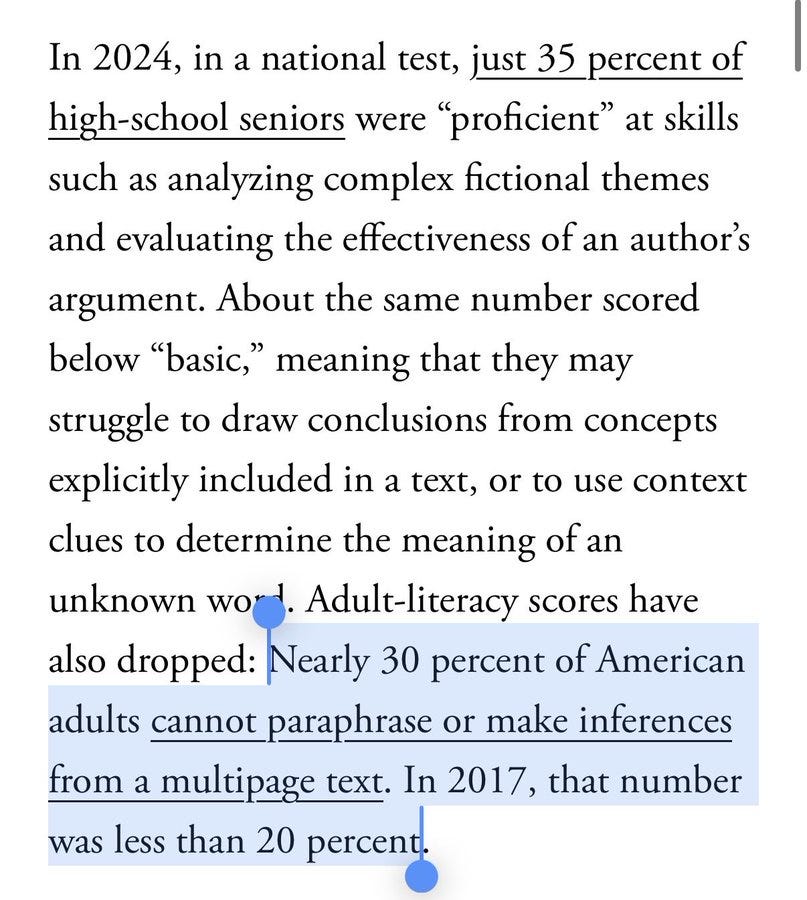
What does that mean? Well, the skill that so many schools and administrations claim they teach, the ever elusive skill of “critical thinking,” has not, in fact, been effectively taught to the American population.
In a world that is rife with hallucinated facts and AI-generated images you can’t differentiate from real life, critical thinking does appear to be quite, well, critical.
This brings me to the second thing I read this week that inspired this piece: Carl Hendrick’s Children of the Magenta Line newsletter article. Every single paragraph of this newsletter is rich with incredible insights that I could ramble on about for days, but for this newsletter I’m going to focus on the section with my favorite title, “You can’t connect the dots if you don’t have any”. Here’s how the section starts off:
One of the dominant concepts of learning since the 1970s has been the idea that facts and internalised knowledge is the lowest rung on the ladder of learning, the part we can safely externalise, because you can always look it up (see Bloom’s taxonomy). Teach the transferable skills, ie the critical thinking, the questioning, the analysing, and let the facts take care of themselves; after all, they are only a search away, and half of them will be out of date within five years in any case.
In essence, Hendrick is describing the reasoning that encourages kids to not waste time learning their multiplication tables because calculators exist. Or the idea that they don’t have to actually remember any of the history facts they crammed for their exam because they’ll be able to look it up if they ever actually need to use it.
However, if you don’t know these things, how can you reason an answer if your server splits a check unevenly and hands you a total? How do you know whether to question it if you can’t ballpark the math instantly? Or if a politician explains that “this economic policy has never been tried before”, how do you know whether that’s true, or even what to Google, without knowing that similar policies existed? What about if you’re reading an article that calls something “unprecedented” and don’t know if it’s true? Well, you can only evaluate that claim if you have precedents stored in memory to compare it against.
As Hendrick explains:
You cannot analyse a text on a subject you know nothing about; you cannot evaluate a claim in a field whose hinterland of knowledge is unavailable to you. Comprehension itself, the plain act of understanding a sentence, depends on a vast store of background knowledge.
For example, my best friend’s dad is an absolute expert in baseball. He’s watched so much baseball, talked so much baseball, and read so much baseball that if he has an opinion about the sport, I know that it’s based in fact and personal experience. However, every four years, he and my dad get in arguments about the correct soccer strategy during the World Cup. Neither of them actually know anything about soccer, so I know not to put stock in anything either of them says because they don’t have the knowledge base to analyze the game or create strategy.
(And to even begin analyzing baseball strategy, you’ve gotta start by knowing your math facts.)
So if you want your kid to be able to “think critically,” you can’t ignore the mastery of facts. But the good news is that learning these facts will get easier as they continue to learn new facts.
A bit ago, I wrote about Ausubel’s article on meaningful learning. In the essay, Ausubel explains that your existing knowledge can be thought of as schemas in your long-term memory.
A “schema” is a package of logic or knowledge that helps you understand how part of the world works. Each schema has “branches” or “hooks” that related knowledge can hang on.
The idea is that when you’re learning new material, it’s easier to learn if you can hang it on an existing schema. And lucky for us, so many people have already charted out everything that a child will learn in K-12 education and exactly how they all relate together.
Here is the coolest display of everything a child learns in elementary school:
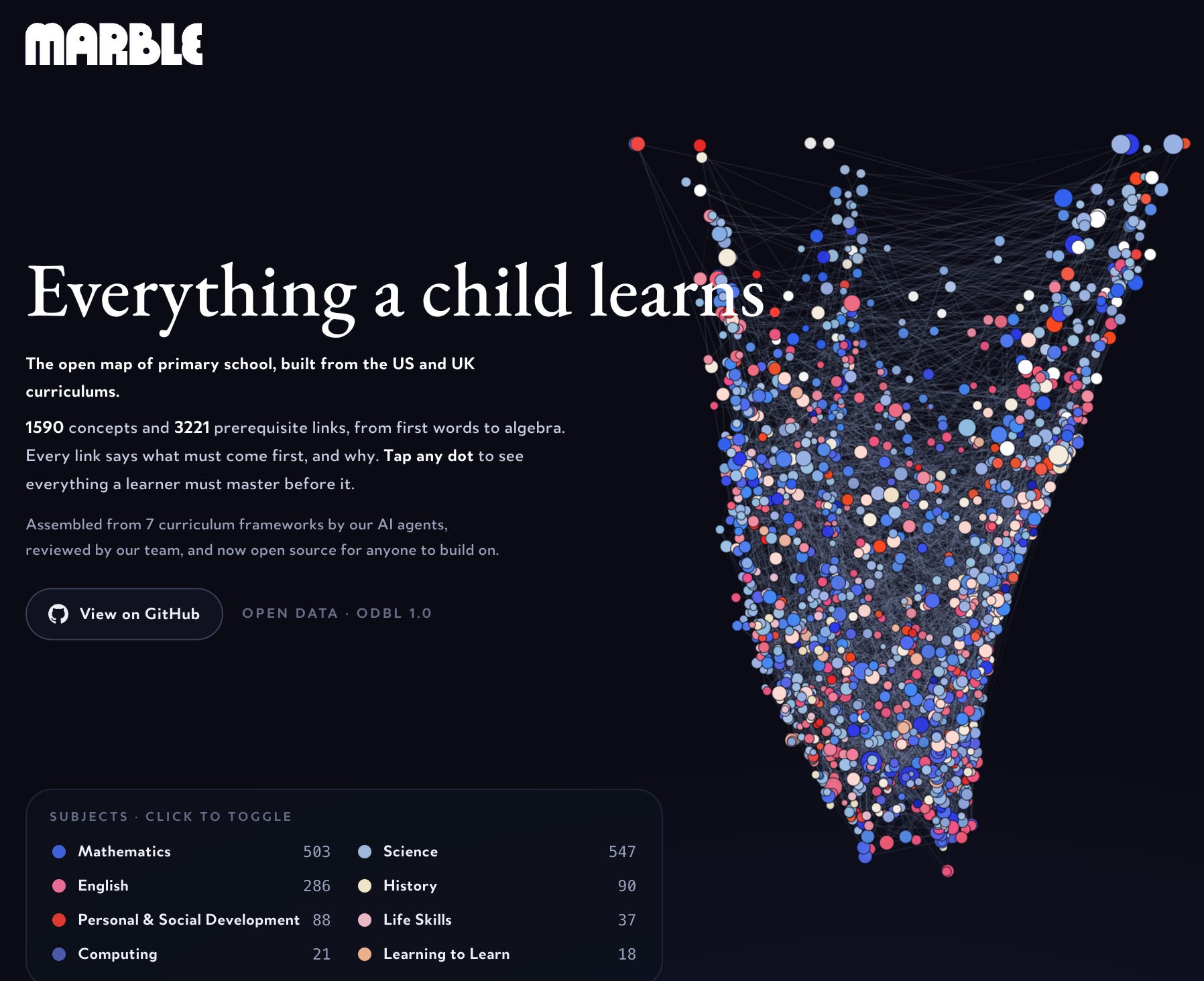
Every single dot allows for new connections, a deeper understanding of the world, and thus an increased ability to reason, make decisions, and think critically about the world.
Hendrick captures this idea well:
This is what schema theorists have in mind when they talk about assimilation of knowledge and say we grasp a new thing only by fastening it to things we already hold: the richer the existing weave, the more points at which a new thread can catch. This is why knowledge doesn’t just add to what you know but also compounds what you are able to learn next, and why the child with the fuller store of knowledge pulls further ahead with every passing year.
So as it becomes easier and easier to access information and basic facts and it becomes more and more important to know what to do with those facts, you can’t simply stop trying to master that which is accessible. In order to rise above chatbots and even people using chatbots, you need to be able to think better and critically about the world. And you can do that with developed schemas and a wide knowledge base. Once you have that, you’ll be able to spot patterns, notice interesting connections, and have intuition if something seems out of place.
So even though it’s the most unsexy answer, if you want to set your kid up for success and ensure they’re not part of the growing number of adults who cannot do basic reading comprehension, you need to make sure that they’re actually learning. And yes, that means no chatbot. Because:
A chatbot can hand a novice a ‘dot’, fluent, finished and correct but what it cannot do is weave the tapestry, because the weave is not a product to be delivered but a labour that only the mind doing the connecting can perform, and a mind that is handed the finished picture never learns to connect anything at all.
This seems obvious for math (i.e. you can’t learn a math concept if you let ChatGPT generate all of the answers), but how about for the “fuzzy” topics such as literature?
Without reading the book, I could hand in a paper about Steinbeck’s East of Eden that would easily get at least a B+ (A-territory with Fable) and thus know that the book has a theme of free will, but still be unable to explain how the concept of choice in America changed after WWI and what the effects of that might be today. I could generate a paper on the similarities between Nick Carroway from The Great Gatsby and Richard Papen from The Secret History but be completely unable to explain how an unreliable narrator impacts a story (though I wouldn’t have even made the connection in the first place if I hadn’t read the book).
These books changed my worldview only because of the work I’d already done: struggling through dense prose, learning AP US History, and reading Genesis and The Great Gatsby again and again. I had these insights because I thought about the “facts” (in this case, the novels), added them to my existing schemas, and drew new connections.
And those insights will allow me to “think critically” about the next news article I read.
So, to recap this article:
If you want to think critically, you need to know facts.
If you want to know facts, you can’t let a chatbot generate them.
One of my 4th-grade students at Alpha NYC loves science. In fact, she loves it so much that she created her own podcast on quantum physics (yes, I’m serious) called Quantumplations. Because of her absolute love of the subject, she’s been able to articulate what she wants out of AI-powered learning for it: namely, visual models and virtual experiments. So when I saw this post, I knew I had to share it for her and any of the other science-obsessed kids out there. The account (the very same one that created the graphic of everything a kid learns in elementary school) has a ton of online modeling/experiments that kids can play with, so even those who don’t have podcasts called Quatumplations would enjoy these science games.
Thanks for reading. Go crush the week! See y’all on Sunday.
No posts
Comments
Nothing yet. Say the first thing.
Sign in to join the conversation.