
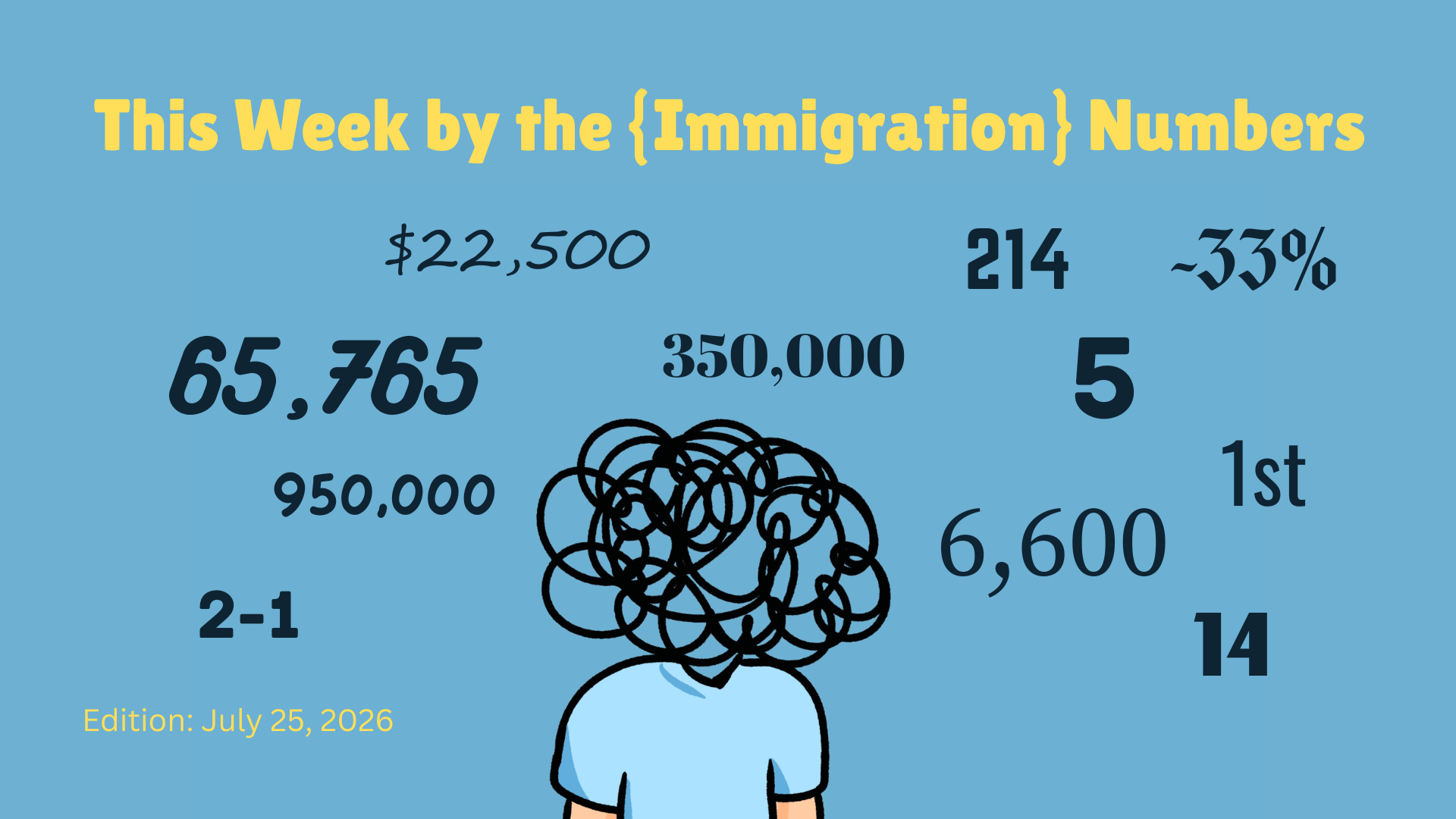
Welcome to the weekly segment called This Week by the {Immigration} Numbers! I’ll highlight some of the main takeaways from the week’s news that you might have missed, but do it in a unique way. Rather than try to summarize everything, I’ll pick a handful of figures each week that best capture where things are moving, explain why they matter, and provide a source where you can learn more. If you have a number to add to the mix or have a question about any of the numbers here, let me know in the comments.
The number of people held in ICE detention nationwide as of July 11, from the first enforcement data ICE has released since April.
ICE released enforcement data for the first time since April, and my analysis of it shows the agency arresting more people than at any point in this administration, an average of 1,474 arrests a day over the first 11 days of July. Detention remains near record levels, at 65,765 people in ICE custody as of July 11, and the largest group is immigrants with no criminal history at all, a share that has kept growing since April even as the proportion with charges or convictions falls. The data also shows more than 10,600 people released from detention by court order since January, most of them likely cases where a judge found ICE was holding someone unlawfully, which is about a quarter of all releases that did not end in deportation. After a three-month blackout, the numbers describe a system arresting at record speed and detaining people who, by the government’s own data, are mostly not the criminals it says it is pursuing.
Kocher, A. (2026, July 21). ICE Quietly Arresting More People Than Ever According to Latest Data. Austin Kocher.
The number of children swept up in ICE enforcement operations that a new ACLU report examined, 32 of them U.S. citizens.
The ACLU’s report Agents of Chaos and Cruelty reviewed more than 1,200 enforcement actions across eight states and found 214 children caught up in ICE operations, 32 of them U.S. citizens. The same review counts hundreds of protesters, journalists, and clergy targeted and roughly 400 incidents involving misconduct, the pattern that ties isolated raids into a policy. I spoke with two of the report’s authors, the ACLU’s Naureen Shah and Denise Bell, about what they found and why they describe it as reckless by design. Counting the citizen children matters because it shows an enforcement model operating with so little precision that it sweeps up the very people it has no authority to remove.
American Civil Liberties Union. (2026, July). Agents of Chaos and Cruelty: How the Trump Administration’s National Deportation Policing Force Has Attacked American Communities. American Civil Liberties Union.
The first case ever filed in the Alien Terrorist Removal Court, a national security deportation tribunal that went unused for the 30 years since Congress created it.
The Justice Department’s National Security Division filed an application on July 15 to the Alien Terrorist Removal Court, the first use of a tribunal that Congress created in 1996 and no administration had ever invoked. The court is built to deport noncitizens the government labels terrorists while withholding the classified evidence against them, and its chief judge, Joan Ericksen, held a closed hearing the next day before ordering prosecutors to explain the legal basis for their request. The respondent’s name is sealed, so the public knows a secret deportation court is now operating without knowing who it is being used against. Activating a dormant tool built to run on evidence a person cannot see establishes a precedent that will outlast whatever this first case decides.
Pagliery, J. (2026, July 23). A Decades-Old Terrorist Deportation Court Is Being Used for the First Time. NOTUS.
The number of locations where ICE is seeking builders for new or expanded detention facilities, from the Virgin Islands to Guantánamo Bay, under a plan capped at $10 billion.
A federal request for construction proposals shows ICE looking to build or expand detention at as many as 14 sites, from the U.S. Virgin Islands to Guantánamo Bay, moving toward purpose-built facilities after its earlier attempt to convert commercial warehouses stalled in lawsuits. Each proposed building follows the same design, a single story of 26 cells sharing three showers, at an estimated $24 million to $40 million apiece, with total expansion spending capped at $10 billion and contracts expected by the end of September. Several of the sites, including Guantánamo Bay and St. Thomas in the Virgin Islands, have held few or no immigration detainees before. Building rather than renting signals a system meant to be permanent and harder to unwind than the county jails and converted warehouses ICE has leaned on until now.
Wang, P. (2026, July 20). ICE Seeks New Or Bigger Detention Facilities at 14 Sites, Documents Show. TIME.
The amount ICE will pay a partner agency for each unaccompanied child it locates and checks on under a new incentive program for local law enforcement.
Under a new incentive program for its 287(g) partners, ICE offers local agencies up to $22,500 for each unaccompanied child they track down and subject to a “safety verification,” combining a $2,500 case payment with up to $20,000 more per completed check. The program, documented through a service agreement with an Idaho sheriff’s office, treats finding and visiting children who were released from federal custody as a billable enforcement task with a price attached to each one. Framed as protecting children, the payments give local police a cash reason to locate kids whose households often include people the same agencies can then move to deport. A bounty structure attached to children turns their safety into the government’s entry point into their families.
Thrasher, A. (2026, July 17). A $22,500 Per-Child Bounty System. Maxwell Commons.
The number of Haitians whose deportation protections and work permits the Supreme Court cleared the administration to end, with their work authorization lapsing this month.
About 350,000 Haitians hold Temporary Protected Status, and a 6–3 Supreme Court decision cleared the administration to terminate it, with the work permits that a last-minute reprieve had extended reaching their new expiration on July 24. Losing that status strips both protection from deportation and the legal ability to work from people who have built years of life in the United States, roughly a third of them in Florida. The same ruling found that TPS terminations are largely shielded from judicial review, which is why the same logic has since reached Yemenis and other nationalities. Ending a legal status for hundreds of thousands of people at once, and placing that decision beyond the reach of the courts, removes the check that once slowed revocations on this scale.
Bustos, S. R. (2026, July 10). About 350,000 Haitian TPS Holders Get Last-Minute Reprieve: Work Permits Extended to July 24. WLRN.
The number of people DHS itself estimates could drop or forgo public benefits like Medicaid and food assistance under its new public charge rule.
DHS estimates that roughly 950,000 people could disenroll from or avoid programs such as Medicaid, SNAP, and housing assistance under a new rule letting officers weigh the use of those benefits in green card decisions. Most of the projected drop is a chilling effect. The rule itself denies few people benefits directly, and instead families forgo aid they already qualify for out of fear it will later be used against them or a relative. The people who go without are disproportionately children and mixed-status households, many of them citizens who lose coverage because someone else in the home is not. I talked with experts about how that same fear keeps immigrants out of emergency rooms, and the public charge rule is the mechanism that carries the fear across the rest of the safety net.
Sganga, N. (2026, July 16). DHS Could Weigh Immigrants’ Use of Medicaid, Food and Housing Help in Green Card Decisions. CBS News.
The number of noncitizens New Jersey found on its voter rolls after a motor vehicle software error, fewer than 400 of whom ever cast a ballot.
New Jersey removed about 6,600 noncitizens from its voter rolls after a Motor Vehicle Commission software error registered them in 2023 and 2024, and Governor Mikie Sherrill said fewer than 400 of them had ever voted. The error is a real administrative failure, and it is also the opposite of the coordinated fraud that the phrase “noncitizens on the voter rolls” is usually used to imply. A glitch that produced fewer than 400 votes across two years, caught and corrected by the state itself, is evidence that the safeguards work rather than that elections are being stolen. The same 6,600 gets held up as proof of a stolen election precisely because the correction it triggered, and the fewer than 400 votes actually involved, go unmentioned.
Mulvihill, G. (2026, July 21). 6,600 Noncitizens Registered to Vote by New Jersey Motor Vehicle System Error, Gov. Sherrill Says. PBS NewsHour.
The number of states the Trump administration has sued, along with the city of Philadelphia, over laws requiring ICE officers to show their faces and identify themselves.
The Trump administration has filed suit against five states, New York, Virginia, Connecticut, New Jersey, and California, and against Philadelphia, arguing that laws barring ICE officers from wearing masks and requiring visible identifiers would put agents in danger. To make their case, federal lawyers point to an online tool that runs officers’ photos through facial recognition, but the artist who built it says it draws on a decade-old list of about 700 self-identified ICE employees and cannot identify the deportation officers now in the field, most of whom joined after ICE roughly doubled its force from 10,000 to 22,000. The suits would strike down accountability measures on the strength of a threat the government has not shown is real. Whether officers carrying out home raids can hide their identities is being decided in the government’s favor before the factual claim behind it has been tested.
Varner, M. (2026, July 22). States Want ICE Agents to Show Their Faces. The Trump Administration Is Blocking Them. WIRED.
The share of the roughly 2 million immigration court hearings held remotely by video in fiscal year 2025, according to the GAO.
The Government Accountability Office finds that almost a third of the roughly 2 million immigration hearings in fiscal year 2025 were conducted by video rather than in person. Stakeholders the GAO interviewed raise concerns that remote hearings can weaken a person’s ability to consult counsel, present evidence, and be understood through an interpreter, all of which bear directly on whether a hearing is fair. Video lets a strained court system move a historic caseload faster, but speed and access pull against each other when someone’s deportation turns on being heard. As the docket grows, how these hearings are held becomes as consequential as how many there are.
U.S. Government Accountability Office. (2026, July 15). Immigration Courts: Stakeholder Perspectives on the Use of Remote Hearings (GAO-26–108110). U.S. Government Accountability Office.
The vote by which a federal appeals court affirmed the release of a Georgetown scholar whom ICE had detained over his speech.
A three-judge Fourth Circuit panel voted 2–1 on July 23 to uphold the release of Badar Khan Suri, a Georgetown postdoctoral scholar from India whom ICE arrested outside his Virginia home in March 2025 and held for six weeks in Texas. The majority rejected the administration’s argument that federal courts cannot review the constitutionality of an immigration detention until the immigration case itself ends, holding that habeas protections apply while a person is still being held. That reasoning reaches beyond Suri, because the government has used the same jurisdictional argument to move speech-based detention cases out of the reach of the courts that would hear them. A 2–1 margin also shows how contested even this check has become on the federal bench.
Center for Constitutional Rights. (2026, July 23). In Big Win, Appeals Court Affirms Release of Georgetown Peace Scholar Detained by ICE for His Speech. Common Dreams.
I’m honored that this Substack continues to drive media reporting, research, and public debate, but it does take effort and expense. If you can pitch in a few bucks a month or year, it would help enormously. Find an option that fits your budget at austinkocher.substack.com/subscribe.
Wherever you already spend your time, you can keep up with the data between weekly posts. Find me on Bluesky, X, Instagram, Threads, LinkedIn, Mastodon, and Facebook. Bluesky continues to be a really great place. If you’re not there yet, consider joining and following along there.
I just hit 5,000 followers on Instagram this week, which is an exciting milestone on a platform that just a year ago I really didn’t understand very well or care about that much. Now it’s the source of a lot of productive collaborations and conversations.
Comments
Nothing yet. Say the first thing.
Sign in to join the conversation.