
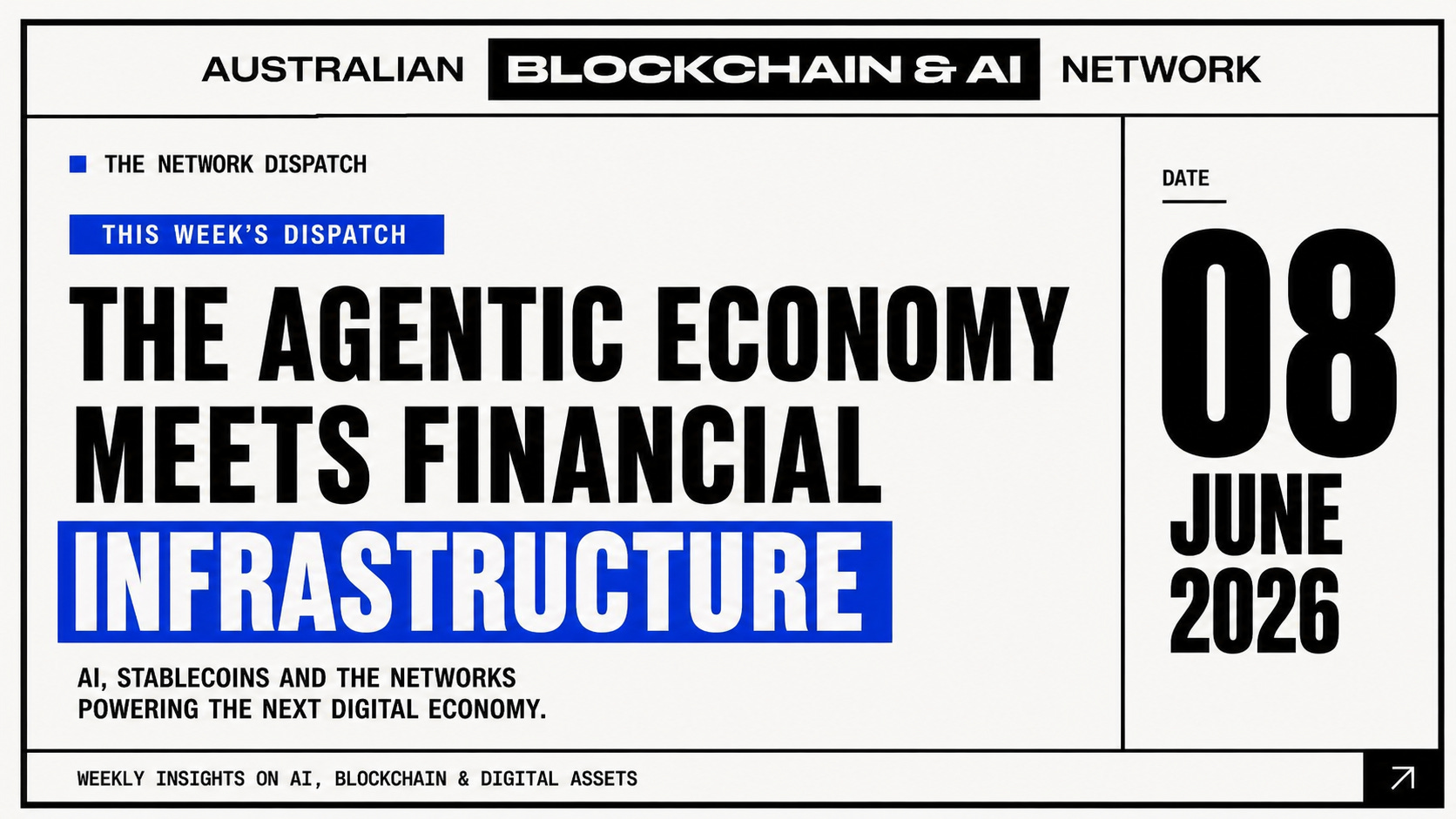
This week’s update comes at a busy time for our community as we prepare for a series of events across Melbourne and Sydney focused on the convergence of AI, blockchain and the digital economy.
Tomorrow we will be hosting the Aus Blockchain & AI Network Meetup in Melbourne, followed by our Sydney event during DECA Conference week. These gatherings continue to bring together founders, builders, investors, policymakers and enterprise leaders who are actively shaping the future of digital infrastructure. If you are interested in where AI, digital assets, stablecoins and tokenisation are heading, these events are some of the best opportunities to engage directly with the people building that future.
At DECA Conference, I will also be hosting a roundtable with Visa on the Agentic Economy and Stablecoins and participating in a debate on the question: Can you trust AI with your money? It is a timely discussion as AI systems become increasingly capable of making decisions, executing transactions and interacting with financial infrastructure.
Alongside these events, I have continued publishing essays on AI, law and policy, exploring what it is actually like to build AI products in regulated environments. Much of the public conversation around AI focuses on model capabilities, benchmarks and product launches. In practice, however, building AI often involves navigating legal uncertainty, intellectual property questions, privacy obligations, governance frameworks, liability risks and regulatory expectations.
The reality is that deploying AI into legal, financial, government and enterprise settings requires far more than technical excellence. Teams must think carefully about trust, accountability, explainability and compliance from the outset. As AI moves from experimentation into critical infrastructure, the challenge is no longer simply building systems that can perform tasks. It is building systems that organisations, regulators and users can confidently rely upon.
Against that backdrop, this week’s news highlights the accelerating race for AI infrastructure, the growing importance of governance and safety, and the continued evolution of stablecoins, tokenisation and digital asset infrastructure.
OpenAI’s frontier models and Codex are now generally available through AWS, giving enterprise teams another major cloud pathway to access and deploy OpenAI systems. This matters because AI adoption is increasingly moving through existing enterprise infrastructure rather than standalone tools.
Link: https://openai.com/index/openai-frontier-models-and-codex-are-now-available-on-aws/
OpenAI also announced new Codex capabilities aimed at different roles, tools and workflows. The interesting signal is that coding agents are no longer just for software engineers. Analysts, operators, designers, researchers, investors and bankers are becoming part of the target market.
Link: https://openai.com/index/codex-for-every-role-tool-workflow/
Anthropic confidentially submitted a draft S-1 registration statement to the SEC for a proposed IPO. The filing does not guarantee a listing, but it shows how quickly frontier AI companies are moving from research labs into major public-market candidates.
Link: https://www.anthropic.com/news/confidential-draft-s1-sec
Anthropic is expanding Project Glasswing to around 150 organisations across more than 15 countries. The initiative focuses on security and critical infrastructure, including sectors such as power, water, healthcare, communications and hardware. This is a reminder that AI safety is no longer just a model alignment issue. It is becoming an infrastructure issue.
Link: https://www.anthropic.com/news/expanding-project-glasswing
Anthropic also sparked debate by suggesting that frontier AI development may need to slow down if governance, safety research and social systems cannot keep up. Whether you agree with the position or not, the debate captures the core tension in AI right now: capability is accelerating faster than institutional readiness.
Link: https://www.channelnewsasia.com/world/anthropic-pause-global-ai-development-6163531
Reuters reported that SpaceX has landed a major AI compute deal with Google, following earlier AI infrastructure arrangements involving Anthropic. The broader takeaway is that compute access is becoming one of the defining competitive advantages in the AI race.
Link: https://www.reuters.com/business/media-telecom/spacex-signs-cloud-deal-with-google-2026-06-05/
UK lawmakers urged the Bank of England to take a more flexible approach to planned stablecoin regulation, particularly around holding limits and reserve requirements. This is important because the UK is trying to balance financial stability with the need to develop a competitive sterling-backed stablecoin market.
Link: https://www.reuters.com/business/finance/bank-england-faces-calls-uk-lawmakers-ease-stablecoin-plans-2026-06-02/
Zodia Custody’s CEO said that every bank will soon need to know how to hold digital assets, with Standard Chartered’s acquisition of the firm progressing towards signing by the end of June. The signal is simple: custody is becoming a foundational layer for institutional adoption of tokenisation, stablecoins and digital assets.
Link: https://www.coindesk.com/business/2026/06/03/standard-chartered-buyout-of-zodia-custody-is-great-news-for-crypto-tech-adoption-ceo-says
CoinDesk reported that several general-purpose Ethereum layer 2 networks have seen declining bridge deposits, raising questions about whether too many chains are competing for too little sustained activity. The useful takeaway is not that layer 2s are “dead”, but that infrastructure without liquidity, users or differentiated demand is hard to defend.
Link: https://www.coindesk.com/tech/2026/06/04/not-all-ethereum-layer-2s-are-dying-but-many-general-purpose-chains-no-longer-have-a-reason-to-exist
CoinDesk’s adviser-focused coverage argued that stablecoins and tokenised short-term assets should not be treated as generic cash products. Product structure, issuer controls, settlement mechanics and client use case all matter. This is a healthy sign that the industry is moving past slogans and into proper infrastructure analysis.
Link: https://www.coindesk.com/coindesk-indices/2026/06/03/crypto-for-advisors-the-crypto-due-diligence-questions-you-forgot-to-ask
Tomorrow, we will be in Melbourne for the Aus Blockchain & AI Network Meetup at Mantel Group. The event will bring together builders, infrastructure providers and community members working across blockchain, AI and the broader digital economy.
Link: https://luma.com/2ie8qq06
Next week, we are back in Sydney for the Aus Blockchain & AI Network event as part of DECA Conference week. This event will focus on builders working at the intersection of blockchain and AI, and forms part of the wider Digital Economy Conference program.
Link: https://luma.com/x5ygy1v2
The Digital Economy Conference runs from 15–17 June in Sydney, bringing together leaders across digital assets, tokenisation, AI, payments, infrastructure, policy and regulation. I will be hosting a roundtable with Visa on the Agentic Economy and Stablecoins, and also debating on the “For” side of the question: Can you trust AI with your money?
That is exactly the right question for this moment.
As AI systems become more agentic, they will need payment rails, identity, permissions, audit trails and dispute mechanisms. As stablecoins move closer to mainstream financial infrastructure, they will need governance, compliance and institutional-grade trust.
The future is not AI acting alone with your money.
The future is programmable financial infrastructure where AI can assist, automate and optimise within trusted boundaries.
Link:
https://www.deconference.com.au/
The Australian Blockchain & AI Network (ABAI Network) is a non-profit community organisation dedicated to increasing education and awareness of blockchain technology, specifically blockchain and AI-based projects. Their goal is to empower the Australian community with the knowledge and tools to participate in the digital economy, and to promote the adoption and growth of emerging technology in Australia and beyond.
This newsletter is brought to you by the following sponsors:
No posts
Comments
Nothing yet. Say the first thing.
Sign in to join the conversation.