
As a subscriber to Gil Duran’s podcast The Nerd Reich, I have been looking forward to the publication of this book: The Nerd Reich: Silicon Valley Fascism and the War on Democracy. I preordered the Kindle edition, which arrived a few days back. At first I wanted to post individual summaries of the book’s seven chapters, but then I did not want this to serve as a TLDR substitute for Gil’s book, so I decided on posting a recent interview of Gil by Jean Guerrero, the author of Hatemonger: Stephen Miller, Donald Trump, and the White Nationalist Agenda, plus a few other relevant media links.
These from Democracy Now: Part I and Part 2 or on YouTube.
On MSNOW with Stephanie Ruhle.
And the interview by Jean Guerrero in what may be the final episode of The Nerd Reich podcast.
What follows is an AI summary of this interview, followed by an edited and slightly shortened version of the transcript. Enjoy (if you can).
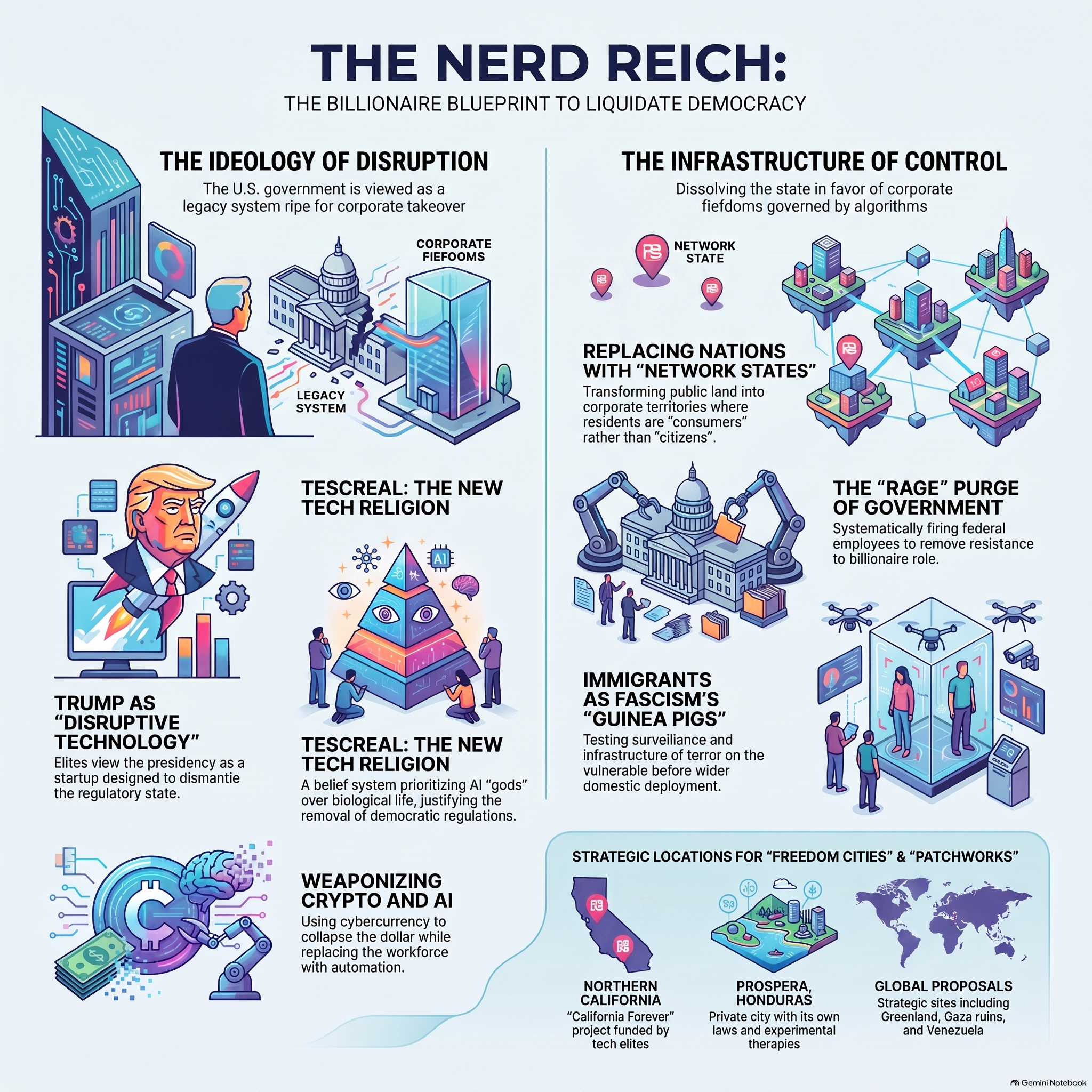
The Nerd Reich: 6 Chilling Takeaways from the Billionaire Plot to Liquidate Democracy
Introduction: The Ghost in the Political Machine
While the media remains hyper-fixated on Donald Trump’s latest rhetorical firebomb, the true architects of our instability are operating in the shadows of Sand Hill Road. We are told we are witnessing a populist uprising; in reality, we are watching a hostile takeover. As investigative journalist Gil Duran reveals in The Nerd Reich: Silicon Valley Fascism and the War on Democracy, Trump is not a leader to these elites. He is a tool—a blunt-force instrument wielded by a cadre of “tech fascists” who view the American government not as a sacred institution, but as a legacy system ripe for “disruption.”
The thesis is as dark as it is undeniable: a group of Silicon Valley billionaires is actively conspiring to replace our democratic experiment with corporate fiefdoms. To them, the current political chaos is a calculated venture capital investment intended to dissolve the state and usher in a world governed by raw wealth and cold algorithms rather than the will of the people.
Takeaway 1: Trump is Not a Leader, He is a “Disruptive Technology”
In the cold logic of venture capital, success is defined by “disruption”—the breaking of old markets to make room for the new. The “Nerd Reich” has applied this methodology to the United States government. While some tech leaders feigned opposition to Trump in 2016, the 2024 landscape reveals a total alignment. They have stopped viewing Trump as a liability and started viewing him as an asset for the systematic dismantling of the regulatory state.
By leveraging social media algorithms to bypass traditional media gatekeepers, Trump effectively became the “first AI president.” These billionaires are now doubling down on their investment, treating the presidency as a startup designed to liquidate democratic institutions.
“Donald Trump is a technology for destroying democracy. And what do venture capitalists do? They invest in disruptive technologies.”
Takeaway 2: The 18-Second Silence and the “Sovereign Individual”
At the heart of this movement is Peter Thiel, the Palantir co-founder whose worldview is defined by a chilling nihilism. When asked in an interview if the human race should even survive, Thiel hesitated for a full 18 seconds—a silence that speaks volumes about the “emotional inferiority” of the men currently steering our future. This mindset is grounded in the 1997 book The Sovereign Individual, which Thiel treats as a work of prophecy.
The book outlines two technological levers intended to collapse the welfare state:
Crypto: A “cybercurrency” designed as a weapon of mass corruption to hide wealth from government detection and collapse the power of the dollar.
Advanced Automation and AI: Tools meant to replace the human workforce, triggering economic collapse and social chaos.
In this vision, wealthy “sovereign individuals” roam a burning earth with multiple passports, catering to no nation. This is not a theory; it is a recruitment drive. Thiel’s most successful “creation,” Vice President JD Vance, was hand-picked and funded to the tune of millions to ensure this apocalyptic vision has a direct line to the Oval Office.
Takeaway 3: TESCREAL—The New Tech Religion
The “Nerd Reich” is driven by a radical, post-human belief system. Scholars Dr. Émile Torres and Dr. Timnit Gebru coined the acronym TESCREAL (Transhumanism, Extropianism, Singularitarianism, Cosmism, Rationalism, Effective Altruism, and Longtermism) to describe what has become a tech-centric religion.
In this cult, AI is the “thermodynamic god” and the ultimate savior. These elites harbor a profound disdain for biological life, frequently referring to human bodies as mere “sacks of meat.” Their goal is a “post-human paradise” where they can upload their consciousness into computers and escape mortality. This religious framing serves a tactical purpose: it justifies the removal of all democratic regulations as a necessary sacrifice to “unleash” the technological acceleration required for eternal life. As Thiel has noted, religion is a technology for controlling human behavior—and they are using it to justify a world where they are the only ones who matter.
Takeaway 4: “Freedom Cities” as a Rebranding of the Network State
One of the most dangerous concepts emerging from this circle is the “Network State” (or “Patchworks,” as tech philosopher Curtis Yarvin calls them). These are corporate territories intended to replace nations. In these zones, there are no “citizens,” only “consumers” living under the dictatorial whims of corporate CEOs.
This is the hidden blueprint behind Trump’s “Freedom Cities” proposal. These are not urban developments; they are corporate authoritarian territories. This model is currently being tested or proposed in strategic locations around the globe:
Prospera, Honduras: A private city with its own laws and experimental therapies.
Northern California: The “California Forever” project, funded by Marc Andreessen.
Global Expansion: Active proposals exist for these corporate states in Greenland, the ruins of Gaza, Guantanamo Bay, and Venezuela.
Takeaway 5: Immigrants as the “Guinea Pigs” of fascism
The brutal anti-immigrant rhetoric of the modern right is a “Trojan Horse” for a broader fascist agenda. Using a “Guernica” analogy—referencing the Spanish village where fascists tested their weaponry before WWII—it becomes clear that the violence directed at immigrants is a trial run.
The deployment of surveillance, armed masked goons, and “electrocution gloves” are not just policy choices; they are the testing of a new infrastructure of terror. If these tactics can be used on the most vulnerable, they can be used on anyone.
“The lists tend to get longer and longer under fascism of who can be targeted... They’re using immigrants as guinea pigs for the fascist future they have in mind for the rest of us.”
Takeaway 6: The “DOGE” Blueprint and the Purge of the State
The “Department of Government Efficiency” (DOGE), headed by Elon Musk, is the realization of Curtis Yarvin’s “RAGE” philosophy: Retire All Government Employees. Yarvin—a favorite of Thiel and Andreessen—has long advocated for a “massive purge” to install a regime where the civil service answers only to a dictator-style CEO.
This plan follows a tactical roadmap involving the “Gray Tribe” (the tech power) partnering with the “Red Tribe” (the MAGA movement) to systematically purge the “Blue Tribe” (the democratic establishment). The impacts are already being felt:
The Destruction of Diplomacy: Systematically undermining the United States’ international standing.
The Humanitarian Toll: Slashing international aid programs like USAID, which experts predict will result in the deaths of millions, including children.
The Workforce Purge: Firing hundreds of thousands of federal employees to remove any internal resistance to billionaire rule.
Conclusion: The Final Choice
We have reached a breaking point where we must name the central problem: billionaire power. These “federal welfare kings” have built their fortunes on public infrastructure only to use those fortunes to burn that infrastructure down. They are “part-time trillionaires” who have regressed into a revenge mentality, seeking to punish a world that they feel never sufficiently celebrated their genius.
The path forward requires a “civil war” within our political institutions—specifically within the Democratic party—to decide if we will continue to chase billionaire money or finally name it as a threat to our existence. Crypto has already become a “weapon of mass corruption,” making our system more vulnerable than ever. We must be prepared to envision a world without billionaires, because the billionaires have already finished envisioning a world without us. The question remains: are you ready to fight for a future that belongs to people, or are you content to be a consumer in a corporate kingdom?
RR (R.R. Robbins, editor and producer of this episode): On this episode of the Nerd Reich podcast, our guest is Gil Duran. He’ll talk about his brand new top 100 Amazon book, The Nerd Reich: Silicon Valley Fascism and the War on Democracy. Interviewing Gil is our very special guest host, Jean Guerrero. She’s a contributing opinion writer at the New York Times and an associate professor of journalism at USC’s Annenberg School. She’s also the author of the amazing investigative biography of Steven Miller, Hatemonger from William Marorrow Harper Collins. Here’s that conversation. And once again, thank you to our audience for supporting this work at the Nerd Reich.
JG (Jean Guerrero): Thank you for sitting in the guest chair with me today and letting me talk about the book with you. As you know, as soon as I heard this book was coming, I reached out to ask for an early copy. I’ve been following the tech fascists for a while, but I’ve never seen anyone so succinctly capture what they’re trying to do. And I read it in one sitting and instantly recognized it as one of the most important books of our time. You trace how the tech elites are openly plotting to destroy democracy here and across the world. So much of the political discourse on the left is focused on the evils of Trump, but people have to realize that Trump is not the main villain. As you observe, he’s a tool of the attack fascists. So, for people who are new to all of this, can you talk a little bit about what he is a tool for?
GD (Gil Duran): Donald Trump is a tool for disrupting democracy and he’s been that way for over 10 years now. He sort of came off of Twitter using the algorithms of social media to become more powerful than any other political figure in the country and to some degree in the world. And if you think about what happened before Twitter, Trump had run for president before and he had flirted with the idea and he gained no traction because the media and the beltway media still had sway over who would be taken seriously and who wouldn’t. And social media disrupted that. And Trump was an early adopter of social media. Some people might say because of those algorithms, he’s the first AI president. And so when Trump returns to power in 2024, there were people in tech who opposed Trump. There was something called tech against Trump. And a lot of these companies made visible efforts to oppose his agenda of deportations and brutality and racism and terror.
This time around it’s very different. And what’s different about it is that a lot of these billionaires have aligned behind Trump. They have decided that instead of opposing this disruptive democracy destroying technology, they’re going to invest in it because what do venture capitalists do? They invest in disruptive technologies. And Donald Trump is a technology for destroying democracy.
JG: Exactly. And there is a further alignment between him and the tech fascists in that they’re all influenced by eugenics, by this idea of a genetic hierarchy. Many of them believe that there are certain people who are superior, specifically the rich and the powerful, often the white, and that they are the ones who should inherit the world. Can you talk about this relationship which you explore in the book between tech fascism and eugenics? This desire to breed a kind of master race.
GD: White supremacy is Donald Trump’s superpower. That’s what he really tapped into to get his core base revved up. This idea that white people are under threat from the rising demographic tide of people of color who will become a majority of the country in this century. And he’s been able to create this cult of grievance that sees itself as the ultimate victim of society. And he promises them a return to greatness if only they can purge their hated enemies and return to their former status of glory, which obviously is a myth and never really existed. What Trump shares with the tech right wing is this idea that they are superior. I’ve done a lot of work over the years with George Lakoff, the cognitive scientist who I feel did the best job of categorizing how politics really works. And if you look at what right-wing thought revolves around, it’s a hierarchy, a very systematic hierarchy that is considered the moral order of the world. And the hierarchy is God over man, men over women, whites over non-whites, Western cultures over non-western cultures, Christianity over other religions, rich over the poor, the strong over the weak, straight over the LGBTQ, and on and on and on. They see that there has to be this hierarchy enforced in the world or the moral order is out of balance. Make America Great Again is a classic fascist movement because it seeks to restore that hierarchy by demonizing and purging its opponents.
And the tech right very much shares this idea. If you look at Silicon Valley venture capitalists and billionaires, it’s all white men. White men who have been treated as geniuses for much of their lives, mostly because of their ability to make money, occasionally because they have some kind of technical knowledge that has unlocked some sort of product that’s useful. But they’re taking that to the extreme degree of now thinking that they should be the rulers of the earth, not just of the boardroom or of their companies. And it didn’t take very long for this kind of thinking to merge with basic off-the-shelf white supremacist thinking. And that’s how you get Elon Musk who formerly seemed like this sort of humble self-effacing, quasi liberal guy who wanted to save the world from climate change with electric vehicles into the white supremacist-in-chief using the social media platform he bought to foment racial strife and polarization and hatred all over the world. And they view themselves as cognitive elites. And what we’re seeing here is an effort by this handful of very wealthy people to seize power and control the future.
JG: Trump has long posed as a nationalist, as a guy who wants to “make America great again.” But as you show in your book, the tech elites who are behind him are publicly conspiring to accelerate the decline of nation states, including the United States. They do not believe in borders or nations and in fact are in the process of violating the sovereignty of nations across the world. So, how does an alleged nationalist like Trump, who used to claim to hate globalist elites, come to be so helpful to these transnational elites? You talk about this marriage between Silicon Valley and the Trump family. Tell us a little bit about that.
GD: Trump’s beliefs and morals are extremely flexible based on who’s paying him. So he played to this sort of nationalist, overwrought Trump as muscular Uncle Sam image, when that was to his benefit with the MAGA base early on. We’re seeing a very different Trump in this term. First of all, everything about MAGA and Trump now is an assault on American values and American ideals. The entire basis of our system of government is under attack from these people. In addition, one of the key planks of American power in the world for the past century or so has been our foreign policy of being involved in other countries as being a world superpower. And Donald Trump has really worked hard to erode that, to withdraw the United States from its role on the global stage and to pretty much make us a laughingstock. And right now, I’d say we’re a bit of a joke, but a joke with nuclear weapons. And what we are in essence right now is a crypto banana republic.
Donald Trump, who once called crypto a scam, became a crypto billionaire on the day he returned to office. And now he’s the crypto bro-in-chief. And unsurprisingly, his stance on American power in the world has also changed, so that he is trying to withdraw American power and allow basically Russia and China to fill the gap. Trump is actively weakening the United States. And if you look at that through the crypto lens, crypto is essentially a tool for undermining government authority. The entire prophecy of crypto is that it will replace the dollar. And not only will it replace the monetary power the United States has, but it will also replace and undermine the political power of the United States. And so, since shifting over to crypto-billionaire, Trump is a lot more aligned with this idea that the United States has had its day and must now decline into just one little sliver of the world that it bullies and controls while letting our geopolitical adversaries fill in the gap and take over. This is a thing called multi-polarity. And it’s very much favored by Russia and Saudi Arabia and North Korea and China. And now it’s also favored by the president of the United States.
JG: In the book, you dive into the central role that Peter Thiel plays in all of this spread of tech fascism. And Thiel, for those who don’t know, is one of the most powerful men in the world who co-founded the surveillance company Palantir, PayPal as well. He’s someone who, when asked in an interview if the human species should survive, hesitated for a long time and had a hard time answering the question. So, can you tell us about the role of Peter Thiel in the spread of tech fascism and the world that he is trying to build?
GD: Well, he hesitated for 18 seconds. And I know that because I counted it twice just to make sure. He stammered and finally said yes, but it wasn’t a convincing yes that the human race should survive. Peter Thiel is a tech billionaire who was born in Germany and spent part of his childhood in Namibia and South Africa before spending the rest of his teenage years in California just south of San Francisco. And he went to Stanford and he got a degree in philosophy and a degree in law. But he was a mediocre lawyer. Then he went to hedge funds and he was a mediocre hedge fund guy. But he found more luck in Silicon Valley. He was in the right place at the right time. Everything was just about to explode in Silicon Valley and Thiel, by hanging around Stanford after he had graduated, already was able to come into contact with some people who would go on to become very successful in tech. And he as an investor reaped the benefits of that.
People don’t realize that Thiel’s not a technology guy. He’s not a coder. He’s not a computer guy. He’s a lawyer, a wannabe philosopher, and an investor. In 1997, Peter Thiel read a book called The Sovereign Individual: How to Survive and Thrive During the Collapse of the Welfare State. And this was an apocalyptic strange book that predicted that in the 21st century, technology would undermine and collapse democratic nations like the United States and the UK. And the two technologies in particular that would do this would be something called cybercurrency, which we would call crypto—this new form of digital money that would undermine government authority and allow wealthy people to exfiltrate their money from the system without detection. And the other was advanced automation, which we would today call AI, which was going to replace most workers and lead to an eventual economic collapse that would result in chaos and violence. And the proper role for these so-called sovereign individuals, the heroes of this kooky-crazy apocalyptic book, would be to gather up multiple passports and travel to different countries that would now desperately cater to the needs of these wealthy individuals. And that would be the new world order, these sovereign individuals roaming the earth as everything else collapsed.
JG: And he was excited about this.
GD: Oh, he saw it as a work of prophecy. And he has said that it helped inspire his decision to co-found PayPal as an effort to get ahead of this digital currency that was supposedly prophesied. But when this book was reissued in 2020, Peter Thiel, now a billionaire, wrote the forward. And if you look back at the last few decades, he has spent a lot of time trying to make this a self-fulfilling prophecy and pursuing the dystopian dream of The Sovereign Individual.
JG: Tell us about Thiel’s relationship with JD Vance, because I think that really illustrates how deeply Silicon Valley has infiltrated our politics.
GD: Yeah, probably the most disturbing part of all this is JD Vance. And it’s not a secret that he and Thiel have a relationship. Vance recently wrote a memoir, his second one called Communion about his religious conversion. And the book largely erased Peter Thiel’s role in his life. This is a book that covers him going from being a lawyer in law school to becoming vice president of the United States. And strangely, he doesn’t mention the fact that it was Peter Thiel who convinced him not to be a lawyer. Instead, to go to Silicon Valley, become a venture capitalist. That he became a venture capitalist at Mithril Capital, which was co-founded by Peter Thiel. And when he went back to Ohio to do his own thing and start a venture fund, it was with millions of dollars from Peter Thiel and Mark Andreessen. When he decided to run for Senate, it was with $15 million from Thiel, which set a record as the largest amount of money any individual had ever spent in a Senate race. And then when he decided to become vice president, it was Thiel who made the peace between Vance and Trump, played a role in bridging this gap because Vance had previously been a Never-Trump guy and had called Trump America’s Hitler and cultural heroine. They make the peace and Vance becomes the vice president of the United States.
I mentioned Vance’s memoir because he does say in the book that Peter Thiel played a key role in his conversion to Catholicism. It was the ideas of Thiel that inspired Vance, an atheist, to convert to Catholicism, even though, by the way, Peter Thiel is not a Catholic. And he couldn’t hide that because in his previous essays he’d written about his conversion, he gave credit to Thiel. So here’s a guy who became a venture capitalist, a Catholic, and a politician with the backing of one man, Peter Thiel. That’s why I say that JD Vance is essentially a creation of Thiel. And now he’s one heartbeat away from the presidency. And that’s distressing because he shares a lot of these very dangerous extremist ideas.
JG: Can you talk about how the Nerd Reich, as you describe it, has taken advantage of Trump’s war on immigrants as a kind of Trojan horse for their agenda?
GD: Earlier when I was talking about The Sovereign Individual, I mentioned that the other word for the sovereign individuals was cognitive elites. And that term cognitive elite came from a 1994 book called The Bell Curve, which was a very controversial book that argued essentially that whites were more intelligent than everyone else. The very idea of this new tech sovereignty rising out of Silicon Valley, it has deep semantic roots even with this idea of eugenics and white supremacy. The tech fascists see the immigration issue as something they can exploit for power and to create fear. They certainly know that the people making the DoorDash deliveries and driving the Ubers and lifts are immigrants. They certainly understand that our entire economy is dependent on immigrant labor, but this is one of the tools they can use to create fear. And remember, they’re in this strange alliance with the MAGA movement. And Donald Trump has made hatred of immigrants, specifically Haitians and Latinos, one of the key parts of his entire fascist program.
Every president does deportations. What’s different about this is that it’s an overt terror campaign as well. They’re doing it in the most violent and distressing and scary way possible to send the message that this is the way things work now. These armed masked goons doing these crimes in the open, killing people, immigrants and non-immigrants alike. And while immigrants are bearing the brunt of that, it’s a message to all of us that this is now possible, that this is what can happen. And the lists tend to get longer and longer under fascism of who can be targeted. But we are seeing immigration as a testing ground, the use of surveillance, the use of brutal tactics. Now they’re unleashing these electrocution gloves. It’s sort of the Guernika, the village where the fascists tested out their weapons during the Spanish Civil War. They’re using immigrants as guinea pigs for the fascist future they have in mind, for the rest of us. And you do not see any Silicon Valley billionaires, even the ones who are supposed to be the good ones, speaking out against this. And I think that’s the biggest sign. Where are all the billionaires speaking out against these horrors, as they were by the way during the first Trump administration. Something changed. Maybe people are a little more afraid now but maybe people are a little more fascist now and open to being a part of this as long as it wins. So Latinos and immigrants are the canaries in the coal mine. We’re living in fascism and fascism is coming for everyone else as well.
JG: One thing that struck me while I was reading is that there were so many interesting parallels between the origin stories of some of the characters in The Nerd Reich and the origin story of Steven Miller who I wrote my book Hatemonger about, who was Trump’s immigration policy architect. He just like Curtis Yarvin, Balaji Srinivasan and other individuals who you delve into. They’re all these antisocial aggrieved people early in their lives. Why do you think tech fascism appeals to people with those kinds of backgrounds? And also why do you think Peter Thiel seems to see people like that as allies? He seems to gravitate to those aggrieved antisocial nerds.
GD: Well, birds of a feather flock together and you know that’s kind of how the world works. It’s their affinity group. My theory is that to some degree these are guys who just didn’t mature like normal people, right? Though they consider themselves genetically superior, they are emotionally inferior, psychologically inferior. A lot of us don’t fit in at some point in our lives. A lot of us deal with things like bullying. I certainly did. But at a certain point in life, you overcome that and you don’t make it your bitter mission for the rest of your life to get revenge on everybody and to keep that chip on your shoulder. What’s amazing about a lot of these guys though is that not only have they overcome whatever challenges or awkwardness they had growing up, but they have become some of the most successful and powerful people in society, if not in the world. And so rather than realize, hey, I can let that go and try to be a better person, they regress into this sort of revenge mentality of seeking revenge on the entire world because they were not celebrated or accepted when they were at a younger phase of their lives.
And I think that’s one of the things that is most shocking about what’s happening. We’re being betrayed by the most successful people in our society. The people who have benefited the most, not only from capitalism, but from the public investment we made. Elon Musk and Peter Thiel are federal welfare kings. They would be nowhere without the money that the government invested in the public infrastructure that was the basis for their fortunes. And I think it’s important to realize that this idea that they are the victims and deserve their vengeance is an important part of fascism. Remember, fascism is always a cult of grievance where you claim to be the victim of others in order to justify your victimization of others. And I would also point out that while we’re going after immigrants and demonizing immigrants, the men playing the key role in this destruction of our country are immigrants as well. And they’re the immigrants we should be deporting. Not the people doing the work to make this country better, right? But those who hate our values despite benefiting more than anyone from everything that our forefathers and foremothers built in this country.
JG: Yeah. And Elon Musk is a really interesting case study in this because as you pointed out, he owes his wealth to government contracts and at the same time he’s spewing hatred against the government and he seems to despise everything that made him who he is including his body. You know he’s talked about how humans need to ditch our bodies which he describes as sacks of meat to become robots. But some of the most cutting-edge science on consciousness shows that consciousness is deeply rooted in biological bodies. That it arises from this meat that Elon Musk so despises. But they are so convinced that they can upload their minds, their souls, their identities into computers. And I bring this up because I’m concerned that as crazy as those ideas sound, I think to most people, there are a lot of people who find them seductive. And in particular, I’m worried about their ideas resonating with marginalized communities, with who have a history of corporate exploitation and oppression and this desire to transcend that condition. I know as a younger woman myself, I fantasized about eternal life as an algorithm. I found these kinds of ideas, these transhumanist ideas seductive. So, how do you reckon with this fact that while on the one hand their ideas sound crazy, there are people who find them seductive?
GD: Religion is always seductive. That’s why it’s still around after thousands of years. Technology is extremely seductive as well. And what they’re creating really is a religion of technology. And if you think about it, it maps on to all the same elements as Christianity, some kind of savior or God in the form of AI or some other kind of technological miracle that’s going to allow us to transcend our humanity and become eternal beings who don’t have to die and go off into heaven, the planets, traveling and becoming multi-planetary and eternal, thereby enjoying this mystical superabundance that will be provided for us. It’s a kind of posthuman paradise where we will all be surrounded by riches and extreme wealth and never want for anything.
Dr. Émile Torres and Dr. Timnit Gebru call this TESCREAL: transhumanism, extropianism, singularitarianism, cosmism, rationalism, effective altruism, and longtermism—a lot of words that basically add up to tech’s new AI based religious ideas. And I think that religious element is important because it’s key to understand that the reason these guys want to get rid of democracy and law and regulation is not just to get richer. Many of them believe that this is necessary to unleash this tech acceleration that will deliver the creation of a thermodynamic god that will bring with it eternal life and multi-planetary travel and cyborg oneness, the singularity, etc. And so at the heart of this cult is a very religious idea animating it. Much like al-Qaeda was animated by a vision of the creation of a new world that would arise after the destruction of the United States and an apocalyptic war that they would set off with the attacks on 9/11.
The other part of it, as you definitely know, Peter Thiel has been traveling the world preaching about the Antichrist for the past couple of years putting a Christian mask on these tech religious ideas. And the key here is that he sees religion as an important technology for controlling and inspiring the behavior of human beings. It’s not enough to believe in a product or a material ambition. You have to have a totalizing belief that makes you commit to a movement.
JG: But in their vision, not everybody who subscribes to these ideas is going to be able to become this transhuman, this superhuman. I wanted to ask you about network states which you explore in the book.
GD: The network state is this cult idea founded by Balaji Srinivasan who’s a protetége of Peter Thiel. The idea of the network state is that democracies are going to collapse in the 21st century. Sounds familiar by now, right? And that they will be replaced by these corporate territories or kingdoms or fiefdoms called network states where basically corporations will found their own nations and instead of being a citizen of the country, you’ll be a consumer who can pick among different countries if you have the income and the ability to belong to one of these things. Otherwise, you’ll be out there in the chaotic violent wasteland, the no-person’s-land where you’ll belong if you can’t afford a network state. The important thing to understand about Balaji’s network state idea is that he got it from Curtis Yarvin who’s another tech fascist philosopher, another Peter Thiel friend who Peter Thiel funded, sort of Peter Thiel’s political alter ego or guru, and Yarvin called the idea “patchworks.” Yarvin advocates replacing democracy with dictatorship and he had written that the United States should be replaced with a patchwork of territories, basically corporate authoritarian territories that could even kill their citizens for no reason and where everybody would be under constant surveillance. And what Srinivasan did was try to update this into a more startup-friendly idea that you could wear a suit and talk about in public, more digestible, more cleaned up.
What’s important about the network state is that there is a venture capital fund Pronomos Capital that exists to fund these things around the world. And all around the world right now you’re seeing this idea of billionaire-funded new cities pop up. There’s Prospera in Honduras which has its own regulatory statutes and where they allow all these experimental therapies that are not allowed in other countries. There’s an idea to build longevity therapy. So it kind of reconnects back to this desire to live forever. There’s a proposal to build one in Greenland if Trump is able to steal Greenland from Denmark. There’s a proposal to build a new billionaire tech utopia/dystopia city in the ruins of Gaza. And other billionaires have proposed building them in Guantanamo Bay, Cuba, and in Venezuela. There’s one supposedly underway right now in Northern California, “California Forever.” They deny they’re a network state project but Balaji himself said that one of their funders is Mark Andreessen who’s a central figure along with Thiel in all of these ideas.
The most interesting thing though is that in his 2024 campaign Trump proposed an idea to build 10 new freedom cities on federal land and said it would be a competition, sort of a reality TV competition for corporations to pitch their new cities and then he would choose 10 and they would get federal land on which to build. The interesting thing about the freedom cities is that though it was reported on in a very superficial way, to this day, no one has said, “What is a freedom city? Why do we need new freedom cities instead of investing in existing cities?” And where does the idea come from? Well, that idea comes from the network state. And there’s a whole lobbying effort in Washington to get these things built.
JG: You mentioned Curtis Yarvin. I want to return to him because he has this whole idea of the Dark Enlightenment which you delve into in the book and he talks about how certain races are more suitable for slavery. All kinds of horrible ideas that Srinivasan made a bit more palatable. But we saw Curtis Yarvin having an impact already in Trump’s second term in terms of DOGE. Can you talk about how that was connected to some of his proposals?
GD: That’s a great question because I think it points exactly to why I wrote my book and why I consider this stuff so important. While I was working on this over the past few years, I could feel sometimes a bit of judgment from my peers in journalism who wondered why I was going so far down this rabbit hole. And DOGE is one of the examples I think I can point to of why this mattered. Curtis Yarvin for many years seemed like this obscure eccentric racist troll online and some people didn’t understand why is this guy important? Why should anybody listen to what he says? But the importance of Curtis Yarvin is that he’s very very important to powerful billionaires like Peter Thiel and Mark Andreessen or others. We may consider him stupid, idiotic, etc., but they consider him a genius. In the late 2000s, he wrote that a future president acting more like a dictator than a president should conduct a massive purge of the federal government in order to eliminate basically the believers in liberal democracy and install a regime where every member of the civil service would answer to the president and follow whatever dictates this president handed down. And as part of that idea, Yarvin suggested also destroying the United States’ diplomatic status around the world and eliminating international aid programs. In 2012, he did a new version of this idea, which he called RAGE, Retire All Government Employees, suggesting that the federal bureaucracy should be purged by this future dictatorial president. And in 2022, he updated it again to say that if Trump returned to power in 2024, he should install a CEO to act as a dictator and purge the federal government, etc.
And that’s exactly what happened when Trump got reelected. He immediately announced the creation of DOGE and put Elon Musk, CEO of several companies, in charge of it. And the first thing they did was set about purging the federal government, firing hundreds of thousands of workers, and slashing aid programs like USAD, which according to studies will result in the death of millions of people, many of them children. So, these crazy-kooky ideas written by a racist troll who spent much of his youth abusing psychedelic drugs and then writing a fantasy version of 21st century fascism while living off of his wife and his mother—this is someone we should have never heard of again. No one should even know his name. But when a billionaire decides you’re important, they have the power to make your crazy ideas into reality. And that’s one of the things we’ve seen happen. And actually, the Washington Post did a story about DOGE’s connection to Yarvin, that DOGE was inspired by Yarvin in April of 2025. And that was one of those moments, I think, when people saw that this crazy stuff Gil’s been talking about for a few years was kind of important after all.
JG: Yeah. And for a crazy conspiracy theorist, Gil, it seems like you’ve ruffled some of the feathers of these people in Silicon Valley because you have been repeatedly banned from social media platforms, most recently YouTube. To me it’s like evidence that these tech fascists are afraid of your book and the truth that you are exposing. What has that been like?
GD: Well, it’s not a theory if it’s on the record and a lot of my book is told in their words and I think that’s what they’re afraid of. I’ve often wondered why they say so much of this stuff out loud. They write it down. They want people to know. And I think part of the rationale there is that they’re trying to evangelize. They’re trying to create a movement and pull in other people. And on some level, they understand that the things they say are so extreme that the Washington establishment media is going to ignore that stuff, is not going to take it seriously. And so in a way the radical nature of the ideas is a cloak that protects them from scrutiny until now. And it’s funny because in April of 2024 I wrote a piece on Balaji and I uncovered some of the craziest things he said in these 6-hour long podcast interviews he does. He gave one where he called his idea tech-Zionism and spelled out this whole idea for the red-tribe Republicans to make war against the blue tribe, the Democrats, by partnering with the gray tribe, this new tech power that was going to rise up. And then they would purge the Democrats and they would wear gray uniforms with corporate logos, all this crazy stuff. He said they’d have a gray pride parade with drones flying overhead. And you know, he unleashed this really bizarre fantasy. And I wrote it all down. It was verbatim, word for word. I had the hyperlinks to the videos, timestamped sections.
And Srinivasan went insane for like two days denying that this was true, saying I was making it all up, saying it was fabulism. And literally there was never a correction on my story. It was unimpeachable that I had the facts there. But I think he was embarrassed to find out how he sounded to a sane person because these guys are so wealthy that wherever they go on these silly fascist podcasts in rooms with young people who are hoping to get an investment or be a big deal in Silicon Valley someday, I think people just nod along and no one tells you that you’re stupid or you sound crazy. And so to actually come up against somebody who could very succinctly and incisively show everybody how crazy you are, he couldn’t really handle that. And I got all kinds of weird threats and for two days I was just under assault on social media. Then it all went away and quieted down. And he has since then had a policy of never responding to anything that I do. The only response I’ve had in the past few years has been Elon Musk banning me from Twitter, first when he first bought the platform for 8 months. Then last year, Meta wouldn’t allow links to my newsletter to be put on Facebook. And when I reached out to customer service about it, it was the weirdest thing cuz the guy straight up told me that it was because I write about the network state and I criticize tech figures. And so this was being flagged as controversial.
And I’m so thankful, Ray, that you were honest about that because it blew my mind. I thought surely people kept telling me they couldn’t post links. And I thought maybe I’ve got something wrong with my website. I have to configure something differently cuz I kind of set it up myself and had a few problems. And no, here comes Ray from Meta Customer Support to tell me that it’s because of what I write about. Once that got some media attention, Meta backed off. In April, on 4/20, I was permanently banned from Twitter for posting about Palantir’s manifesto, which I refer to as fascist. And it was surprising even to me. People assured me, “Oh, it was probably just a mass reporting thing that triggered the algorithm. If you appeal it, they’re going to lift it.” I appealed it twice. No luck. I’m permanently banned. And I think it’s really clear why. By the way, I wasn’t even a big deal on X. I had 30,000 followers. I’d occasionally have a viral tweet. But increasingly lately my audience was getting bigger as my book came nearer and suddenly, boom, I’m not there. And if you look at X there’s very little discussion of my book which is being talked about on other platforms. They kind of did a good job of making sure I’m not a player on X which is fine with me by the way.
And now YouTube. This may very well be our last episode of the Nerd Reich podcast because YouTube has announced they’re going to disable our channel on Saturday because someone is running a campaign of false copyright strikes against our channel and there’s this new thing where you can pay some people and they’ll just keep filing copyright strikes until you get taken down. And YouTube has zero way for anybody to reach out to a human and explain what’s happening. So, every day we wake up to more copyright strikes. We’ve been fighting the best we can. But all of that is to say I think the best review of my book is coming from the Silicon Valley billionaire platforms that are trying to ban me. But it’s too late. My book is now on the shelves. I’m here in New York today. I just went to Barnes & Noble. It’s already out on the shelf. But I take it as a compliment that somebody really, really, really wants me deplatformed from everywhere.
JG: Well, so Gil, what can people do? I mean, you talk a little bit about this in your book. What is the way forward? How do we fight back against these people with these crazy ideas that they’ve somehow turned into self-fulfilling prophecies? How do we create a different world? When some of the most powerful people on this planet are intent on creating this world that you describe, that’s so horrifying.
GD: We need to remember the old saying that money is the root of all evil. And we have to realize that billionaires are the root of all of our problems today. We can have billionaires or we can have democracy. We cannot have both. We’re in a terrible situation where the economic inequality has meant that there’s this tiny class of billionaires, some of them part-time trillionaires, deciding that it is their destiny to rule over us. They have enough money to buy power in a political system that is very vulnerable to corruption, especially through crypto, which has become a weapon of mass corruption in the second Trump era. And fighting billionaire power, we find the key to all of our problems because even before the tech fascists, somehow everything has been stacked in favor of a tiny few so that they can get richer. But the money only makes them crazier and it doesn’t make them happier. So, we have to find a way to envision a world without billionaires because the billionaires are envisioning a world without us.
JG: Yeah. I heard you say on a different interview that the politics of the future is a war against billionaires. And by the way, it’s a war that they started. And I think that’s so key because as we’re seeing the rise of Democratic Socialists across the country presenting a different kind of politics, there’s still this stubbornness within Democratic party leaders to not want to call it out for what it is, which is the billionaires are the ones who are making everybody’s lives miserable. And particularly this, this movement that is determined to create a world without us or at least with extreme inequality.
GD: Unfortunately, the only people as addicted to billionaire money as Republicans are Democrats. And it’s funny to see the establishment Democrats getting so angry at the Democratic Socialists and the left for winning elections. The Democratic Socialists and the people on the left are the ones who are fighting. And the Democratic Party’s own polls show that people want fighters. They do. The establishment doesn’t want to give the people what they want because they want to maintain relations with the billionaires. And so, I do think we’re going to need a bit of a civil war in the Democratic party. And we need to fight on the side of people who are willing to name the problem as billionaire power and who are willing to fight against that without any fear of the ramifications. And I hate to use the war metaphor. It’s a destructive one. There’s no other way to put what’s happening right now. The billionaires have declared war on us and we need to realize that that’s going on. And anybody who thinks we can somehow just make nice and go back to the status quo, there is no status quo under tech fascism.
No posts
Comments
Nothing yet. Say the first thing.
Sign in to join the conversation.