
The other day I listened to a recording of this TEDx talk:
This prompted me to enter the following prompt into Gemini/Deep Research: “In this TEDx talk, Joe Trippi mentions warnings by Teilhard de Chardin against possible future misuses of the Noosphere, a concept introduced by Teilhard. Teilhard has been blamed for the misuse of this concept by people (Dave Troy comes to mind) that fail to acknowledge his warnings. Dive into the claims and counterclaims regarding Teilhard and assess whether his warnings absolve him of such accusations.”
The most obvious failing of the report produced is that of the 22 “Works cited” only 8 are actually cited (1-3, 5, 7-10). My one serious criticism concerns the final section, where the famous maxim “An error is the more dangerous the more truth it contains” has been effectively converted into “a truth is the more dangerous the more errors it empowers.” I have omitted a summary in tabular form of the report’s comparative analysis of Teilhard, Trippi, and Troy. The underlined superscript numbers refer to notes added by me.
The concept of the Noosphere—a theoretical “thinking layer” or collective sphere of human consciousness enveloping the planet—occupies a contentious position at the intersection of political strategy, media theory, and the philosophy of technology1. Formulated in the 1920s by the French Jesuit paleontologist Pierre Teilhard de Chardin, alongside the Russian biogeochemist Vladimir Vernadsky and mathematician Édouard Le Roy, the Noosphere was originally conceived as the next stage of planetary evolution1. Teilhard posited that just as the geosphere of inanimate matter gave rise to the biosphere of living organisms, the biosphere would inevitably culminate in the noosphere: a globally interconnected layer of mind, self-reflection, and spiritual convergence1.
In contemporary political discourse, this century-old concept has split into two starkly contrasting interpretations. Political strategist Joe Trippi views Teilhard as an insightful prophet who anticipated global digital infrastructure while explicitly warning against its perversion into systems of psychological modification and autocratic control1. Conversely, investigative journalists and political researchers such as Dave Troy criticize the Noosphere as an esoteric, teleological narrative that provides ideological cover for modern anti-democratic movements, Russian information warfare strategies, and Silicon Valley transhumanism3.
This report examines the underlying metaphysical structure of Teilhard’s Noosphere, analyzes his internal warnings regarding totalitarianism and forced social mechanization, evaluates the claims and counterclaims advanced by Trippi and Troy, and assesses whether Teilhard’s explicit warnings absolve him of intellectual responsibility for the contemporary misuse of his ideas.
To evaluate Teilhard de Chardin’s theoretical responsibility for modern applications of his philosophy, his core metaphysical framework must be analyzed alongside the historical context in which he wrote. Composing his primary philosophical works, including The Phenomenon of Man and The Future of Man, during the 1930s and 1940s, Teilhard developed his ideas against the backdrop of rising totalitarian regimes across Europe5. His writings directly confronted the threats posed by fascism, Nazism, and Stalinism, seeking to differentiate authentic evolutionary convergence from coercive state collectivism9.
Teilhard’s system rests on the concept of cosmogenesis, asserting that the universe is an evolving process moving continuously toward higher states of complexity and consciousness9. Within this framework, human socialization and the expansion of global communication networks are interpreted not as artificial constructs, but as organic, biological continuations of terrestrial evolution5. The ultimate destination of this cosmic convergence was termed the Omega Point—a supreme, autonomous center of consciousness that unifies humanity while preserving individual personhood10.
Far from being oblivious to the perils of forced political organization, Teilhard explicitly addressed the totalizing movements of his time10. In The Phenomenon of Man, he confronted modern totalitarianism directly, posing the rhetorical question of whether modern totalitarian systems were a monstrous distortion of something magnificent and thus dangerously close to the truth10. To explain this phenomenon, Teilhard invoked the classical Latin dictum Corruptio optimae, pessima (“The corruption of the best is the worst”), arguing that fascist and communist collectivism were perilous precisely because they counterfeited the true evolutionary drive toward global human unity10. He asserted that these political systems substituted mechanical, state-enforced coercion for genuine spiritual and intellectual convergence9.
To establish a safeguard against authoritarian absorption, Teilhard formulated the philosophical principle that “union differentiates” (L’union différencie)10. He drew a foundational distinction between two opposing modes of social aggregation:
● Totalitarian Collectivization (Forced Unanimity): A coercive process driven by external political power, state propaganda, or mechanical organization10. This mode forces individuals into an oppressive collective, eroding human personhood, critical thought, and individual originality like salt dissolving in water10.
● Personalist Unanimization (Authentic Convergence): A voluntary process driven by internal motivation, mutuality, and shared consciousness10. Under this model, as individuals unite into a higher collective intelligence, their distinct personal identities are heightened and perfected rather than erased10.
Teilhard explicitly warned against confusing “individuality”—which he defined as selfish isolation and egoism—with “personality,” which represents the realization of the self through meaningful relation to others10. He argued that any system relying on forced conformity or social mechanization represented a retrograde step in cosmic evolution, dragging humanity backward toward unreflective matter10.
In his TEDx address It’s Time to Reclaim the Noösphere, veteran political strategist Joe Trippi brings Teilhard’s framework into direct contact with modern digital platforms, algorithmic behavior modification, and democratic erosion1. Trippi presents a defense of Teilhard, portraying him as an insightful thinker whose theoretical model correctly anticipated global digital connectivity while providing the analytical tools needed to critique its modern corruption1.
Trippi contends that modern society has physically constructed the Noosphere that Teilhard envisioned a century ago, but through unexpected technological means1. Rather than emerging through enlightened parliaments or spiritual movements, the thinking layer materialized via digital platforms, software code, microprocessors, and global satellite constellations1. Consequently, a network originally conceived as a medium for global compassion and shared knowledge has been subverted into an apparatus designed to digitize, monetize, and weaponize human interaction1.
To describe this subversion, Trippi … compares contemporary social media architecture to a global “Skinner box” operating on billions of human minds simultaneously1. Variable dopamine rewards—such as likes, algorithmic notifications, outrage loops, and infinite scrolling—condition users to repeatedly engage with platforms, while artificial intelligence scales this behavioral experiment1. Trippi emphasizes that this psychological conditioning is not an accidental byproduct of digital connectivity, but its core business model1. This infrastructure has enabled a dangerous alignment between tech oligarchs and autocratic political actors, creating what Trippi calls “the hour of the predator”,1 in which citizens are reduced to manipulated subjects1.
Trippi explicitly defends Teilhard against accusations that his philosophy inspired or validated these predatory systems1. He points out that Teilhard explicitly foresaw the dark possibility of coercive collective control and warned against its manifestation1. In Trippi’s assessment, Teilhard’s only limitation was an inability to foresee the specific technical mechanics of 21st-century information operations, such as predictive machine-learning algorithms, deepfakes, micro-targeted psychological manipulation, and private satellite fleets1. For Trippi, Teilhard is absolved of blame because he warned humanity of the danger; the responsibility lies with modern platform architects who built a weaponized counterfeit of the Noosphere, and with a public that allowed itself to be conditioned1. Trippi concludes with a call to “climb out of the box” and reclaim the digital Noosphere as a domain for democratic governance and human dignity1.
In contrast to Trippi’s focus on platform mechanics, investigative technologist and researcher Dave Troy advances a structural critique of the Noosphere concept itself3. Troy shifts the analytical focus away from Teilhard’s subjective spiritual intentions toward the historical and geopolitical consequences of teleological “global brain” theories3.
Troy traces the ideological trajectory of the Noosphere through both Teilhard de Chardin and his contemporary, Vladimir Vernadsky3. In Troy’s mapping, the Noosphere concept was deeply absorbed into Russian intellectual tradition, fusing over decades with Russian Cosmism, Nicholas Roerich’s esoteric prophecies, and post-Soviet strategic theory3. Troy highlights that senior Kremlin strategists, including Vladimir Putin’s Chief of Staff Anton Vaino, have explicitly embraced the Noosphere framework—Vaino going so far as to publish papers on a theoretical monitoring device called a “nooscope” designed to track global collective consciousness3. Within this Eurasian geopolitical strategy, the Noosphere is deployed as a philosophical alternative to the Westphalian system of state sovereignty and liberal democracy established in 16488. In its place, autocratic theorists promote “noocracy”—rule by a self-appointed wise elite operating through information warfare, “reflexive control,” and the systematic disruption of democratic consensus3.
Concurrently, Troy examines how Noosphere teleology has infected Silicon Valley elite culture2. He links Teilhardian evolutionary spirituality to the “TESCREAL” ideological cluster—an acronym standing for Transhumanism, Extropianism, Singularitarianism, Cosmism, Rationalism, Effective Altruism, and Longtermism2. Troy argues that tech leaders use concepts of cosmic evolutionary destiny to frame artificial intelligence deployment and space colonization as imperative historical steps2. Within this secularized teleology, biological human beings are treated as mere transitional hardware required to birth a superintelligent machine mind or a digitized global consciousness7.
Troy’s central argument is that teleological grand narratives inherently erode democratic governance regardless of their creator’s good intentions3. When a philosophy asserts that history is driving toward an inevitable destination—whether the Omega Point, a global brain, or a technological singularity—it introduces anti-democratic incentives3:
● Erosion of Democratic Agency: If humanity’s ultimate purpose is to serve a cosmic evolutionary leap into a collective intelligence, individual voter sovereignty, constitutional rights, and legislative deliberation are viewed as inefficient, temporary obstacles3.
● “Ends Justify the Means” Authoritarianism: Believing oneself to be an agent of cosmic evolution fosters an elitist mindset7. Democratic disagreement is dismissed as evolutionary backwardness, justifying psychological manipulation, information warfare, and technocratic coercion to align society with the “inevitable” future3.
● Bypassing Liberal Institutions: Teleological frameworks encourage political and technological actors to replace transparent democratic institutions with centralized, holistic control systems, operating under the assumption that traditional nation-states are obsolete3.
Consequently, Troy contends that while critics like Trippi correctly identify platform abuses, they fail to recognize that the Noosphere theory itself acts as an ideological Trojan horse that undermines democratic values3.
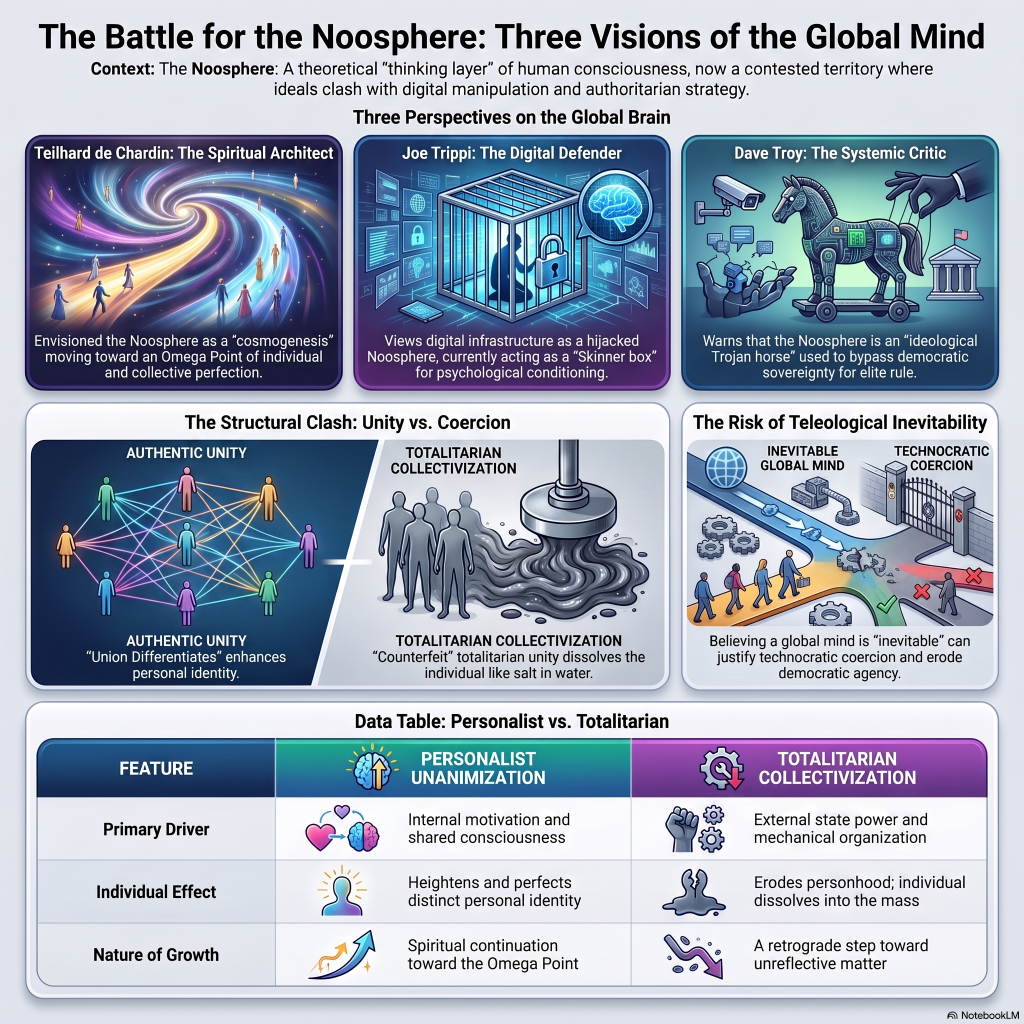
Determining whether Pierre Teilhard de Chardin is absolved from philosophical culpability regarding the modern misuse of the Noosphere requires distinguishing between subjective moral intent and objective structural vulnerability.
The Case for Absolution: Textual Warnings and Personalist Safeguards
From the standpoint of textual analysis and intellectual history, there is compelling evidence to exonerate Teilhard from direct moral culpability for modern techno-authoritarian abuses. Teilhard did not construct an uncritical, utopian vision of global integration10. He specifically identified state-enforced collectivism, totalitarianism, and social mechanization as monstrous distortions of evolution10. By invoking corruptio optimae, pessima, he explicitly warned that attempting to force human minds into a unified layer through external compulsion or mechanical control would produce catastrophic results10.
Furthermore, Teilhard established a central philosophical principle designed precisely to counter authoritarian absorption: “union differentiates”10. He insisted that true evolutionary convergence must hyper-personalize the individual, maintaining that genuine unity enhances unique human personality rather than submerging it into an anonymous, algorithmically conditioned collective10. Holding a mid-20th-century Jesuit paleontologist personally responsible for 21st-century micro-targeting algorithms, deepfakes, and Russian information operations requires an unhistorical projection of modern systems onto a religious text written in exile1. In this light, Joe Trippi’s assessment is persuasive: Teilhard identified the core danger of coercive unification, even if he lacked the modern technical vocabulary to describe its current algorithmic mechanisms1.
The Case Against Absolution: Structural Vulnerability and Teleological Risk
However, a rigorous critique reveals that Teilhard’s philosophy contains structural vulnerabilities that render it susceptible to autocratic co-optation, validating the core concerns raised by Dave Troy. The primary weakness of Teilhard’s framework lies in its dependence on a Christian metaphysical foundation9. Teilhard assumed that cosmic convergence would be guided by divine love, guaranteeing the preservation of human dignity10. When secular political strategists, Eurasian autocrats, or Silicon Valley transhumanists strip away this theological foundation while retaining the teleological narrative of an inevitable “global brain,” the framework becomes dangerous3. Without spiritual safeguards, the drive toward the Noosphere becomes a justification for technocratic coercion3.
Up to this point the analysis provided appears to me perfectly defensible. The remainder of the report, on the other hand, contains statements that cannot pass unchallenged. Such as the following: “Teleological grand narratives inherently minimize intermediate suffering.” Certainly not “inherently.” What can be stated truthfully is that inherently sound teleological narratives lend themselves to misappropriations that run the gamut from dispensing with efforts to relieve suffering to inflicting suffering in the service of authoritarian agendas. A categorical denier of spiritual truth will also deny the existence of inherently sound teleological narratives, but their nonexistence cannot simply be taken for granted as Troy does.
“An error is the more dangerous the more truth it contains,” Henri-Frédéric Amiel wrote. “The most dangerous untruths are truths slightly distorted,” Georg Christoph Lichtenberg held. “Evil tends to respect goodness enough to disguise itself in it,” C.S. Lewis maintained. Does it follow that a truth is the more dangerous the more errors it empowers? Should the truth of spiritual (and thus teleological) evolution be blamed for the false utopias that totalitarians invent to conceal their aims and justify their methods? Obviously not. Neither did Teilhardian teleology frame totalitarianism as necessary “birth pang” of cosmic evolution, nor did it romanticize historical oppression, as the report here asserts. Teilhard may have provided “a dangerous conceptual opening for authoritarian actors, who can argue that temporary coercion is justified to achieve the next evolutionary stage.” Yet even if one disregards his warnings against the counterfeiting of the evolutionary drive toward human unity by the fascists and communists of his day, he cannot be blamed for it. True that by crafting a grand teleological narrative which frames human integration as an inevitable cosmic process, Teilhard may have created a conceptual architecture that is easily secularized and weaponized. True, too, that stripped of its theological core, his concept of an evolving Noosphere may have provided metaphysical cover for autocratic regimes and technology oligarchs seeking to bypass democratic procedures in pursuit of holistic control. But so what? It was to be expected, as Teilhard did.
The report concludes that “Teilhard’s explicit warnings defend his personal integrity, but they do not eliminate the anti-democratic risks inherent in” what the report (echoing Troy) calls “teleological historical determinism.” The expression “teleological historical determinism” is a final disparagement of Teilhard’s spiritual teleology. How so? Because history is the disciplined, evidence-based inquiry into, reconstruction of, and interpretation of the past from the vantage point of the present, where “the past” is everything that is presently known to have occurred.2 History knows nothing of a teleological determinism, which nonetheless is a metaphysical animal of good standing.
[1] It’s Time to Reclaim the Noösphere | Joe Trippi | TEDxMidAtlantic - YouTube
[2] Could We Become Ultra-Human? UFOs, AI & Our Evolution | D.W. Pasulka | Insights at the Edge - YouTube
[3] Is Democracy Dying? - Dave Troy (Transcript) - The Singju Post
[5] The Future of Mankind by Pierre Teilhard de Chardin - MEDIA SABDA
[7] The Wide Angle: Understanding TESCREAL — the Weird Ideologies Behind Silicon Valley’s Rightward Turn - Washington Spectator
[8] The Wide Angle - Dave Troy - Washington Spectator
[9] Teilhard de Chardin: The Phenomenon of Man Book Highlights
[10] Teilhard: The Phenomenon of Man - Dialogue Institute
Trippi’s use of this expression is a reference to the title of a non-fiction book by Swiss-Italian author and political scientist Giuliano da Empoli: The Hour of the Predator: Encounters with the Autocrats and Tech Billionaires Taking Over the World, published in English in late 2025.
The standard consensus definition codified by the American Historical Association captures what the profession accepts today: “History is the study of the human past as it is constructed and interpreted with human artifacts, written evidence, and oral traditions. It requires empathy for historical actors, respect for interpretive debate, and the skillful use of an evolving set of practices and tools.”
No posts
Comments
Nothing yet. Say the first thing.
Sign in to join the conversation.