
The Principle of Sufficient Reason and the poverty of human language
The Principle of Sufficient Reason (PSR) states that everything must have a sufficient reason to exist, occur, or be true. In a recent post Marco Masi has thrown doubt on the truth of the PSR. His doubts may be justified, for I can see no sufficient reason for the PSR to be true — except for one: rational thought must perforce take its validity for granted, because finding the reason why a thing exists, happens, or is true is its job. You can’t look for a cause if you don’t assume that there is one to be found.
Long before I became a “card carrying” Aurobindonian, long before I embarked on this amazing adventure of consciousness, long even before I enrolled at the University of Göttingen to study physics, I was struck by the extraordinary poverty of the explanatory tools which language puts at our disposal.
Because we can form sentences composed of a subject and a predicate, we know the meanings of “substance” and “property.” As Aristotle has taught us, a self-existing thing is one that can’t be the property of another thing. If we add the general form of our external sensory experiences (extension in time and space) to the logic of human thought or the grammar of human language, we get events (things that happen in time and space) as well as causation: the idea that things or events can cause (or be the causes of) things or events.
But how do we know that thing or event A is the cause of thing or event B? This kind of knowledge requires regularity or, in other words, natural laws. The PSR implies that every event can be exhaustively described and accounted for in terms of (a) the properties of the things involved and (b) the natural laws through which they are causally related.
Quantum objects, the shapes of things, and the objective fuzziness of spatial relations
As mentioned in a previous post, every thing in visual experience is spatially extended and therefore conceptually divisible by cutting.1 The literal meaning of the Greek word ἄτομος is “uncuttable.” The reason it is usually translated as “indivisible” is that, until quantum mechanics came along, the ultimate parts of material objects were defined by boundaries, while the form of an ultimate part was conceived as the boundary separating a “stuff-filled” inside from an empty outside (imagine three-dimensional cookie cutters).
When the special theory of relativity came along, it became clear that there was no such thing as a rigid body. Spatially extended objects are perforce elastic, and the only feasible way to model their elasticity is in terms of spatially unextended interacting parts.
When quantum mechanics came along, we were forced to conceive of an entirely new kind of thing — a quantum object. When talking about quantum objects, it becomes imperative to distinguish between objects qua individuals and objects qua types. The formal apparatus of quantum mechanics is concerned exclusively with types. An individual quantum object only exists in an experimental context by which it is individuated. As Brigitte Falkenburg has argued convincingly, quantum objects “are only individuated by the experimental apparatus in which they are measured or the concrete quantum phenomenon to which they belong.” In what follows all references to quantum objects are references to quantum objects qua types.
The next thing to know about a quantum object is that its form — insofar as it has one — consists of spatial relations (or relative positions) between unextended parts. Moreover, these spatial relations lack definite (or “sharp”) values; they are “fuzzy.” The proper way of dealing with indefinite/fuzzy things is in terms of probability distributions. However, only in the simplest case of a bipartite object does the sample space — the space over which the probabilities are distributed — have three dimensions. The forms of quantum objects with more than two components “exist” in sample spaces of higher dimensions. But if the form of a quantum object consists of spatial relations between unextended parts, then a quantum object that lacks internal spatial relations also lacks a form. (Such objects are often described, in a grievously inapt phraseology, as “pointlike.”)
The important takeaway here is that the fuzziness associated with the internal spatial relations of a multipartite quantum object is objective. If we have to describe in statistical terms the relative position p(rel) between the electron and the nucleus of a hydrogen atom, it is not because we are ignorant of the exact value of p(rel). There is nothing to be ignorant about. The fuzziness of p(rel) is what fluffs out matter. A material object occupies as much space as it does because the atoms and molecules of which it is compose occupy as much space as they do. And they occupy as much space as they do because their internal spatial relations are fuzzy.
If you don’t find an efficient cause, look for a final cause
How does the essential indefiniteness of spatial relations evince itself in the lab? Quantum experiments typically establish correlations between two procedures, one appropriately named “preparation,” the other rather inappropriately called “measurement.” (The reason the latter term is inappropriate is that the procedure in question generally does more than simply reveal a preexisting property or value.)
Let’s assume (i) that a hydrogen atom is prepared in one of those stationary states — each of which is mathematically represented by a probability distribution p(distr) — and (ii) that what is subsequently “measured” is the exact position of the electron relative to the nucleus (which the electron did not possess prior to the measurement). Let’s further assume, for the sake of argument, that such a measurement can be made. Quantum mechanics then predicts that any given exact position will be obtained with the probability that p(distr) assigns to it.2
The PSR, Marco observes, “becomes controversial in contexts such as quantum mechanics, cosmology, and existential questions.” Nonetheless, even in these contexts he finds it “difficult to believe that something could occur without a cause.” While the claim that a physical event could be entirely causeless strikes him as “deeply implausible,” he concedes that the occurrence of genuinely probabilistic events without deeper deterministic causes is “to a considerable extent accepted among physicists and philosophers of science.”
Now why would that be? For the simple reason that if the outcome of the measurement just outlined were not irreducibly probabilistic, the fuzziness to which p(distr) gives testimony would not be objective, in which case we would have no explanation of why a hydrogen in its ground state is stable, or why atoms and molecules neither explode nor collapse as soon as they are formed, or why it is possible for a material object to enjoy a reasonably stable existence.
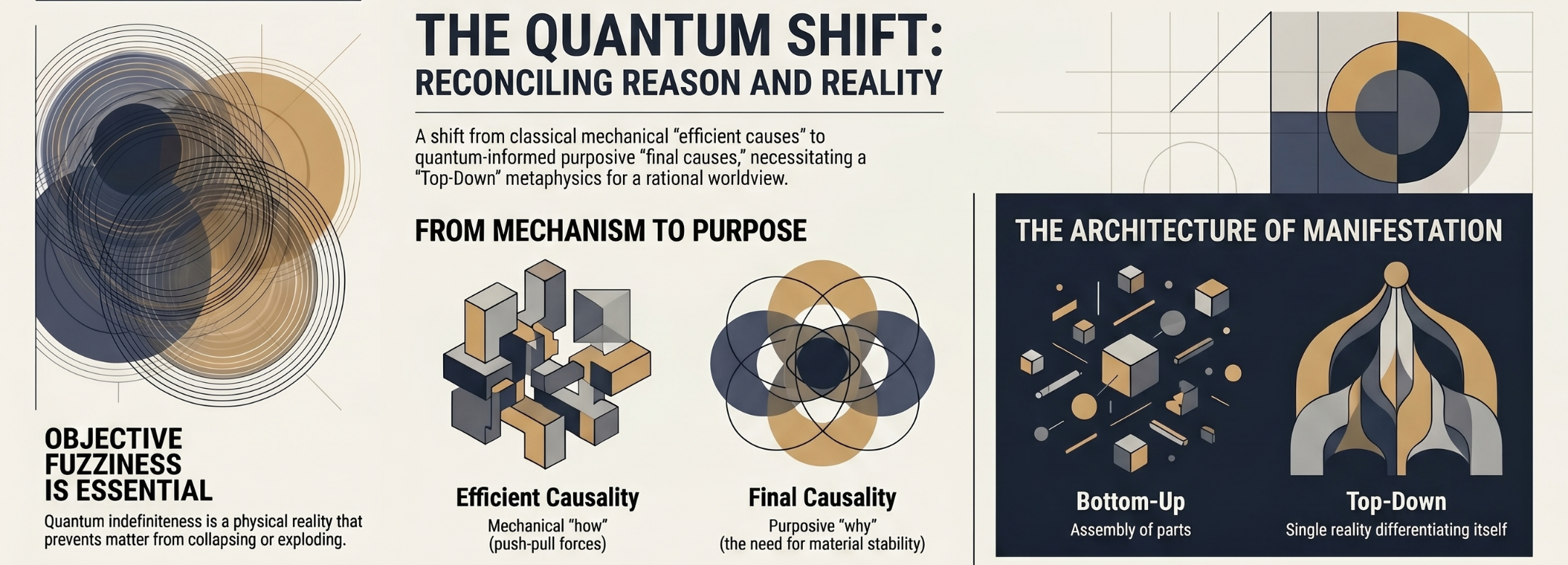
Let me lend Marco a hand. Aristotle’s philosophy famously outlines four distinct “causes” or rational explanations — material (the stuff a thing is made of), formal (the kind of thing it is), efficient (what brought it into existence or made it what it is), and final (the purpose it serves). Making it possible for stable material objects to exist appears to me to be a jolly good reason for the irreducibly statistical nature of quantum mechanics. If you don’t find an efficient cause for the existence or truth of something, look for a final cause instead.
Quantum mechanics and the elision of the thinking and perceiving subject
There are several ways in which quantum mechanics can be introduced. By one count there are nine formulations of quantum mechanics,3 each laying down a different set of ground rules, some more philosophically enlightening than others. To my mind, the least enlightening formulation (and the least enlightening set of rules to start with) posits the Schrödinger wave function Ψ with its two modes of evolution — continuous and deterministic between measurements, discontinuous and probabilistic at the time of a measurement.
What this approach gets wrong is the wave function’s dependence on time. Ψ is not something that exists and evolves in time, neither continuously nor discontinuously. The t in Ψ(t) is the time of the measurement to the possible outcomes of which Ψ serves to assign probabilities. Quantum mechanics encapsulates statistical correlations between preparations and measurements (i.e., outcome-indicating or value-indicating events). Farewell, then, to all the futile attempts at explaining the “collapse” of the wave function!
The approach I find most enlightening, which I adopted in my textbook4 and in my classes, also begins by positing two rules. Unlike the two rules of the least enlightening approach (continuous evolution between measurements, “collapse” at the time of a measurement), they lay bare the very heart of quantum mechanics. To Richard Feynman, it was the two-slit experiment with electrons that “has in it the heart of quantum mechanics.” But the reason this experiment has in it the heart of quantum mechanics is that it is the paradigmatic application for these rules. Another paradigmatic application for these rules is this two-particle experiment.
What, then, is the fundamental difference between experimental arrangements in which the first rule applies and experimental arrangements in which the second rule applies? Put as succinctly as possible: if something can happen in two ways, and if the experimental arrangement indicates the way in which it happened, the first rule applies; if on the other hand the experimental arrangement does not indicate the way in which it happened, the second rule applies.
In the two-slit experiment, there are two slits through which an electron can pass. If the first rule applies, the electron has passed through the indicated slit. If the second rule applies, it isn’t the case that it has passed through the left slit, nor is it the case that it has passed through the right slit. The distinction we make between the two possibilities cannot be objectified. If the first rule applies in the two-particle experiment, each initially observed particle is identical with one of the subsequently observed particles. If the second rule applies, there is no answer to the question, “Which initially observed particle is identical with which subsequently observed particle?”
To make sense of this, it is essential that we take the objective world for what it is — a mental construct. If distinctions we make in our minds can be objectified, they form part of the objective world. If they cannot be objectified, they do not.
This is also the point at which the cardinal difference between classical physics and quantum physics becomes patent. Human experience is the universal context of human knowledge. In classical physics every possible distinction — in particular the distinction between two disjoint regions (e.g., the two slit) or the distinction between two particles — can be objectified. This is why the world of classical physics can be de-contextualized. We can ignore our hand in constructing it and pretend that it exists all by itself. The same can’t be done for the world of quantum physics. Because the theory compels us to differentiate between distinctions that are objectifiable and distinctions that are not, the world of quantum physics cannot be de-contextualized from its human origin. Quantum theory does not countenance the elision of the thinking and perceiving subject.
A larger context: the manifestation of the world
This does not mean that we cannot speculate about the larger context. At a minimum we know that reality writ large allows us to objectify our mental constructs (to the extent it does). Quantum physics even offers clues as to its contours. Here are two of them:
If (in our minds) we keep partitioning physical space, we reach a point at which the distinctions we make between regions cease to be objectifiable. The same goes for the distinction we make between time intervals. The spatiotemporal differentiation of the objectifiable world is therefore incomplete; it does not go “all the way down.”
If (in our minds) we go on decomposing a physical object, we reach a point at which the distinctions we make between its components cease to be objectifiable. Eventually they become identical in the strong sense of numerical identity. This can be expressed by saying that the number of “ultimate constituents of the universe” is one.
These clues suggest to me that the world cannot be mentally constructed from the bottom up, whether on the basis of an infinitely differentiated spatiotemporal manifold, or by positing a multitude of distinct ultimate parts. The world is manifested from the top down, and this subjectively as well as objectively.
In his later writings, Erwin Schrödinger explains the fact that we all experience one and the same world by positing that “we are all really only various aspects of the One.” To him, the “arithmetical paradox” posed by a multitude of subjects experiencing a single world has only one solution, namely: “the unification of minds or consciousnesses. Their multiplicity is only apparent; in truth there is only one mind. This is the doctrine of the Upanishads. And not only of the Upanishads.”
The Upanishads testify to a descending series of supraphysical worlds, whose subjects grow increasingly distinct. Complementary to the process by which a single subject containing the world becomes a multitude of subjects contained in the world, there occurs a process by which the One qua Being manifests the world we share. We may envision this process as a progression from the undifferentiated unity of the One qua Being to a world which allows itself to be described in the language of everyday discourse. Subatomic particles, non-visualizable atoms, and partly visualizable molecules mark the stages of this progression. Instead of being constituent parts of the manifested world, they are instrumental in its manifestation.
While the objects that populate the manifested world are accessible to direct sensory experience, the quantum objects belonging to the intermediate stages are not. For this reason, concepts which derive their meanings from the spatiotemporal structure of human sensory experience cannot be applied to them. They are “unspeakable” in the language of everyday discourse: “quantum mechanics is neither compatible with the traditional concept of substance (that is, the principle of attributing properties to property carriers) nor with the principle of causality in its usual application to individual systems and processes”.5 What is instrumental in the manifestation of the world can only be spoken of in terms of statistical correlations between events that happen (or could happen) in the manifested world. On the positive side, this goes a long way towards explaining why quantum theory — the general theoretical framework of contemporary physics — is essentially a probability calculus.
Causation in and beyond the world
Marco writes that “the only light at the end of the tunnel I can see lies in Schopenhauer’s idea that the ‘Will’ underlying the world, and thus the will manifest in Nature or, ultimately, the Will of God, is something that does not itself require a cause.” That light I too can see. To this Will, Sri Aurobindo gave the name “Supermind.”
We have to regard ... this all-containing, all-originating, all-consummating Supermind as the nature of the Divine Being, not indeed in its absolute self-existence, but in its action as the Lord and Creator of its own worlds. This is the truth of that which we call God.... The Truth-Consciousness is everywhere present in the universe as an ordering self-knowledge by which the One manifests the harmonies of its infinite potential multiplicity.... [T]he knowledge that creates, because what it creates or releases are forms and powers of itself and not things other than itself, possesses in its own being the vision of the truth and law that governs each potentiality, and along with that an intrinsic awareness of its relation to other potentialities and the harmonies that are possible between them; it holds all this prefigured in the general determining harmony which the whole rhythmic Idea of a universe must contain in its very birth and self-conception and which must therefore inevitably work out by the interplay of its constituents....
This Supermind in its conscious vision not only contains all the forms of itself which its conscious force creates, but it pervades them as an indwelling Presence and a self-revealing Light. It is present, even though concealed, in every form and force of the universe; it is that which determines sovereignly and spontaneously form, force and functioning; it limits the variations it compels; it gathers, disperses, modifies the energy which it uses; and all this is done in accord with the first laws6 that its self-knowledge has fixed in the very birth of the form, at the very starting-point of the force. It is seated within everything as the Lord in the heart of all existences...; it is within them and embraces them as the divine Seer who variously disposed and ordained objects, each rightly according to the thing that it is, from years sempiternal.7 [LD 141–45]
Since Aristotle’s four causes stake out the four kinds of explanation mental consciousness can come up with, it is not hard to map them onto the Vedantic conception of Reality. The One, Brahman, is Sachchidananda — sat or the constituent, material cause of things, chit or the conscious force of Supermind, which is the efficient cause of things, ānanda or the delight of self-experience and self-expression, which is the final cause of things, and the “ordering self-knowledge by which the One manifests the harmonies of its infinite potential multiplicity,” which is the formal cause of things. To our minds these are separate causes, to a supramental consciousness they are mutually implicative aspects of the One.
Marco again:
There may well be facts and forms of causation that transcend the explanatory frameworks of the analytic mind.... However, I would still contend that such phenomena are not therefore simply “causeless.” Rather, they may obey forms of causality fundamentally different from those governing ordinary physical processes and comprehensible to the human mind. Even if these causes remain unfathomable to us mortals, they would still constitute deeper “reasons” or principles underlying the manifestation of events.
Indeed. But if Sachchidananda is the cause of the manifested world or the reason for its existence, then it is also the reason why the laws of physics have the particular form that they do. At bottom, all physical laws encapsulate correlations. Because the laws of classical physics are deterministic, it used to be possible to transmogrify them into physical processes by which causes produce their effects — until quantum physics came along.
As a case in point, consider the familiar story about the propagation of radio signals. When being jiggled, the electrons in antenna A locally act on an all-pervading physical entity known as “the electromagnetic field.” On being jiggled by the electrons, the field acts locally on itself. (Imagine a bucket brigade with infinitely many buckets separated by infinitesimal distances.) In this way the jiggles of the field propagate as an electromagnetic wave, and when they reach the electrons in antenna B, they cause them to jiggle as well. At this point it will be instructive to consider David Mermin’s disillusionment about the explanatory power of classical electromagnetism8:
When I was an undergraduate learning classical electromagnetism, I was enchanted by the revelation that electromagnetic fields were real. Far from being a clever calculational device for how some charged particles push around other charged particles, they were just as real as the particles themselves, most dramatically in the form of electromagnetic waves, which have energy and momentum of their own and can propagate long a er the source that gave rise to them has vanished.
That lovely vision of the reality of the classical electromagnetic field ended when I learned as a graduate student that what Maxwell’s equations actually describe are fields of operators on Hilbert space. Those operators are quantum fields, which most people agree are not real but merely spectacularly successful calculational devices. So real classical electromagnetic fields are nothing more (or less) than a simplification in a particular asymptotic regime (the classical limit) of a clever calculational device. In other words, classical electromagnetic fields are another clever calculational device.
Together with the Lorentz force law, Maxwell’s equations allow us to calculate the effects that charged particles have on charged particles. Even in the context of classical physics, nothing explains how — by what process — physical effects are produced. Nor is such an explanation needed if the force at work in the world is an infinite force. What needs explaining then, and can be explained, is why — to what end — this force works under the particular constraints that it does, or why the laws of physics have the particular form that they do.9 That end is to set the stage for the adventure of evolution. (It is worth emphasizing that the laws of physics do not direct the drama that is played on this stage.)
A final note on entanglement
Quantum entanglement refers to a correlation which exists between simultaneous random events in different locations, and which cannot be accounted for in either of the two explanations that are available to us: direct causation (event A directly increases or decreases the likelihood of event B, or vice versa) or the existence of a common cause (an earlier event C influences the respective likelihoods of both A and B). (You may want to review the introductory remarks to this post regarding a correlation between ice cream consumption and drowning incidents.) The most famous correlation of this type was first discussed by Albert Einstein, Boris Podolsky, and Nathan Rosen in 1935. An equally famous correlation was first discussed half a century later, by Daniel Greenberger, Michael Horne, and Anton Zeilinger.
The profound significant of such entangled random events is that no conceivable cause can explain why they occur. It’s not that we haven’t found their causes. It’s that we know that they don’t exist. According to Marco, “the term ‘random’ is useful as a statistical and epistemic concept, but from a deeper ontological perspective it explains nothing.” It explains nothing because there is nothing that needs to be explained. We know that (and why) these events are random.
Nobody doubts that stars, which to ordinary visual experience appear pointlike, are spatially extended as well.
Since no continuous variable can be measured with absolute precision, the same idea ought to be expressed in terms of an integral over an infinitesimal region of the space of relative positions. But here we don’t let ourselves be bothered by such trifles.
D.F. Styer et al., Nine formulations of quantum mechanics, American Journal of Physics 70, 288–97 (2002).
U. Mohrhoff, The World According to Quantum Mechanics: Why the Laws of Physics Make Perfect Sense After All (2nd Edition, World Scientific, 2018).
B. Falkenburg, Particle Metaphysics, p. 28 (Springer, 2007).
A Vedic expression. The gods act according to the first laws, original and therefore supreme, which are the law of the truth of things. [Original footnote]
Isha Upanishad, Verse 8. [Original footnote]
N.D. Mermin, What’s bad about this habit, Physics Today 62 (5), 8–9 (2009).
U. Mohrhoff, Why the laws of physics are just so, Foundations of Physics 32, 1313–24 (2002); Quantum mechanics explained, International Journal of Quantum Information 7, 435–58 (2009); The World According to Quantum Mechanics, Chapter 25.
No posts
Comments
Nothing yet. Say the first thing.
Sign in to join the conversation.