
Objectivity is a subject’s delusion that observing can be done without him. Involving objectivity is abrogating responsibility – hence its popularity. — Heinz von Foerster1
Some time ago, neuroscientist, philosopher, and fiction writer Erik Hoel published a Substack post titled “We Consciousness Researchers Have Failed You.” He begins by telling us that Michael Pollan’s latest book, A World Appears: A Journey into Consciousness, has been recommended to him “by almost everyone at this point.” And yet, he “barely made it through,” experiencing the following sensations while reading: frustration, dread, restless legs, and overwhelming waves of weariness. “At one point I felt physically nauseous.”
I can relate. The following passage also resonates:
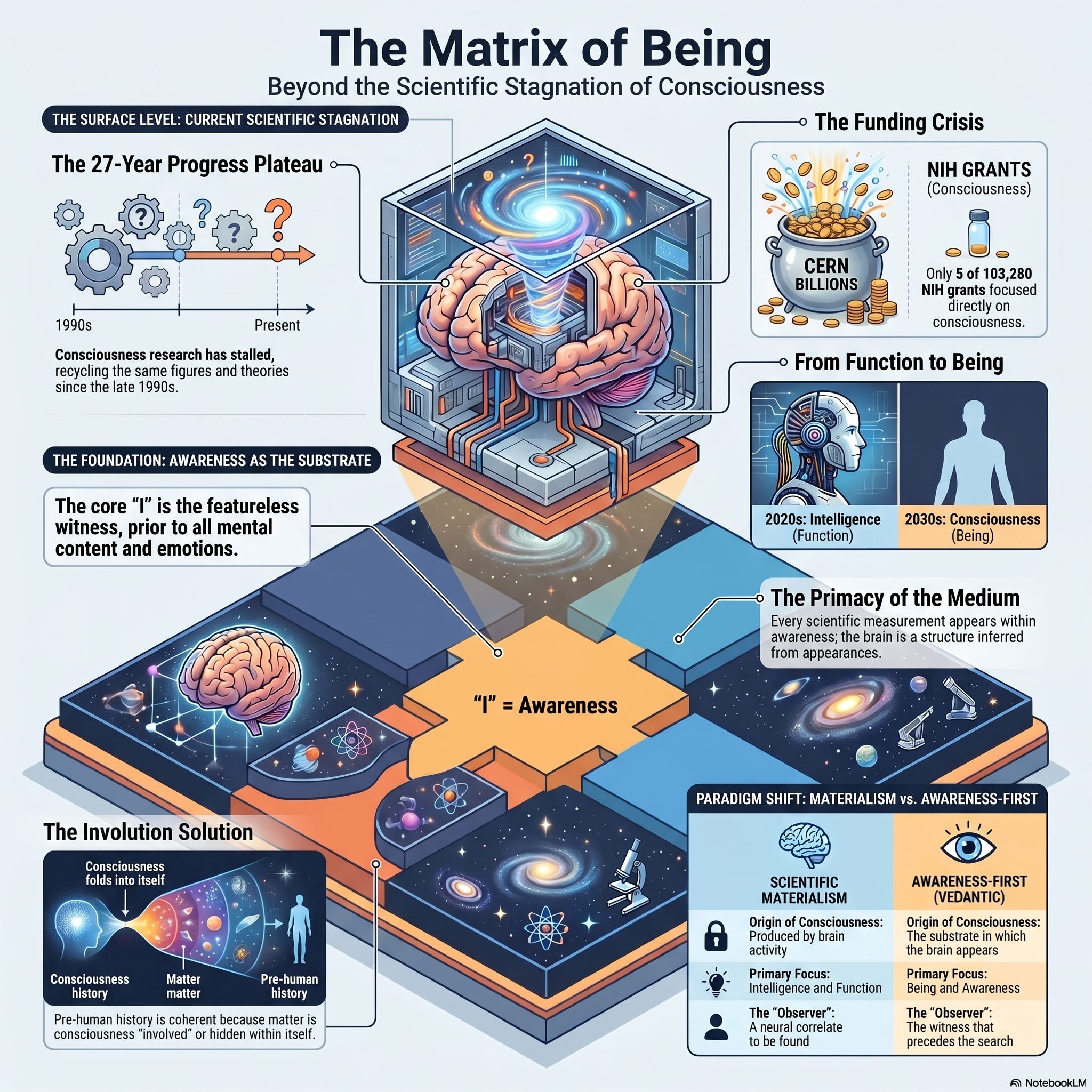
I felt that every next chapter or section could have been predicted by some statistical machine for producing books about consciousness (“Okay, here’s the part about David Chalmers coming up”). And yes, I have the advantage of being a researcher in the same subject and have even worked with some of the figures Pollan writes about, which is why in my own The World Behind the World (we all seem to gravitate to the same titles, huh) I broadly told much the same story. But you can even go back to science journalist John Horgan’s The Undiscovered Mind, published in 1999, to get similar progress beats and quite familiar names. It’s been 27 years, during which the discussion has (as many fields of science do) centered around major figures like neuroscientists Christof Koch or Giulio Tononi or Antonio Damasio or philosophers like David Chalmers.
How, then, have consciousness researchers failed us, as Hoel claims or confesses?
Right now, there’s some college student falling in love with a chatbot instead of the young woman who sits next to him in class, all because science literally cannot tell him that the chatbot is lying about experiencing love.
So, science doesn’t know enough about consciousness to tell apart AI consciousness from human consciousness. In Hoel this evokes the nightmarish vision of our civilization acting “like a reverse metamorphosis, where something weaker but more beautiful, organic consciousness, gets shed in the birth of some horrible star-devouring insect made of matrix multiplication. And then it turns out there is nothing it is like to be two matrices multiplying.” To Hoel, the academic research on consciousness has so far been “a somewhat cushy gig.”
Other people’s lives aren’t immediately on the line in the way they are for cancer research, and the ideas are fun to discuss on podcasts, and no opinion can really be proven wrong. So I think many of us have been guilty of thinking, deep down, that nothing will ever fully get solved, and so working on consciousness basically means getting to talk about interesting stuff, promoting your pet theory of the moment at conferences, writing some papers that only a few other researchers really read, maybe stuffing some undergrads in a brain scanner and making some colorful figures, getting jealous about funding and petty about who is on what committee, and basically just career-maxxing the decades away.
But that won’t do any longer.
Having a massive hole in humanity’s scientific worldview is Actually Bad and our ignorance has led to instability and uncertainty and now, actual danger, and consciousness researchers need to Get Off Their Collective Asses and actually solve this problem.
And the reason why it hasn’t yet been solved? Essentially, money:
Humanity spends something like a billion dollars a year on CERN. To compare, let’s look at the biggest scientific funder in the United States, the NIH. Out of 103,280 grants awarded to scientists during the 2007-2017 decade, want to guess how many were about directly studying the contents of consciousness? — Five.... So if you’re a consciousness researcher, what can you do, cheaply? What can you do, for free? You can pontificate. You can propose your own theory of consciousness! That requires no funding whatsoever.
In the closing section, Hoel makes an interesting claim:
If the 2020s were all about intelligence, then necessarily the 2030s will be all about consciousness. Intelligence is about function, while consciousness is about being, and forays and progress into understanding (and shaping) function will in turn force our attention toward a better understanding of being.
So, consciousness has less to do with intelligence than it has with being. This points in the right direction.
In an essay written shortly after his arrival in Pondicherry, Sri Aurobindo wrote: “It is not true that because I think, I am; but rather because I think, feel and act, and even while I am doing any or all of these things, can transcend the thought, feeling and action, therefore I am.” [EDH 8‒9] In other words, my sense of being does not depend on my thinking, feeling, or acting; for even when my thoughts, feelings and actions are stripped away, my sense of being remains. Pure consciousness remains, and that’s what I am.
Many serious thinkers have made this point. A.J. Deikman, for instance, wrote a paper titled “‘I’=awareness”.2 Some excerpts:
When you introspect you will find that no matter what the contents of your mind, the most basic “I” is something different. Every time you try to observe the “I” it takes a jump back with you, remaining out of sight. At first you may say, “When I look inside as you suggest, all I find is content of one sort or the other.” I reply, “Who is looking? Is it not you? If that ‘I’ is a content can you describe it? Can you observe it?” The core “I” of subjectivity is different from any content because it turns out to be that which witnesses — not that which is observed.... “I” is the observer, the experiencer, prior to all conscious content.
[W]hen we use introspection to search for the origin of our subjectivity, we find that the search for “I” leaves the customary aspects of personhood behind and takes us closer and closer to awareness, per se. If this process of introspective observation is carried to its conclusion, even the background sense of core subjective self disappears into awareness. Thus, if we proceed phenomenologically, we find that the “I” is identical to awareness.
Awareness ... is featureless, lacking form, texture, colour, spatial dimensions. These characteristics indicate that awareness is of a different nature than the contents of the mind; it goes beyond sensation, emotions, ideation, memory. Awareness is at a different level, it is prior to contents, more fundamental. Awareness has no intrinsic content, no form, no surface characteristics — it is unlike everything else we experience, unlike objects, sensations, emotions, thoughts, or memories.
In a recent Substack post, Chandan Priyadarshi defined awareness as “the condition in which any appearance — perception, concept, equation, memory, doubt, or world-model — becomes present.” Awareness is “prior to the distinction between inner and outer, prior to the brain that supposedly produces it, prior to the individual who seems to possess it.”
Leibniz’s principle of the Identity of Indiscernibles applies here, at the terminus of subjectivity, just as it applies at what may be called the terminus of objectivity: a fundamental particle in itself, stripped of its attributes, which only characterize its relations to other things. In the case of a fundamental particle in itself as in the case of an individual’s awareness, the absence of distinguishing characteristics implies numerical identity. (In saying this, I gloss over the following facts: fundamental particles exist as individuals only in experimental contexts; experimental contexts only exist in experience; and experience always takes place in the encompassing context of awareness.)
Here is what, according to Priyadarshi, cannot be disputed — and I have said many of these things in previous posts:
Every datum ever recorded, every measurement ever taken, every physical law ever formulated, every experiment ever designed and interpreted — without exception —appeared within awareness. Not within a brain, as that formulation already smuggles in the conclusion. The brain is itself a structure inferred from appearances within awareness. The neurons, the synapses, the biochemical cascades that are offered as the ground of experience: all of them appeared to awareness before they could serve as explanations of it.
This is not a philosophical position. It is an observation about the structure of inquiry.... The medium precedes its contents. And the medium has never been stepped outside of, not once, in the entire history of scientific or philosophical investigation. Modern inquiry proceeds as though a neutral vantage exists — a view from nowhere from which consciousness can be examined as one object among others. No such position has ever been occupied. Every model of reality, including models purporting to explain consciousness as a product of matter, is itself an event within the very medium it attempts to explain. The investigator cannot stand outside the condition of investigation. This is not a limitation to be overcome with better instruments. It is structural....
The question is not whether consciousness exists within the universe. The question is whether the universe, as known, exists anywhere except within awareness.... [T]he distinction between perceiver and perceived is itself an appearance within awareness....
The burden of proof lies with the default picture. Materialism must explain how it established that consciousness exists inside the universe when every piece of evidence for the universe was gathered inside awareness. That explanation has not been given. It has not been attempted. It has not been noticed as necessary....
Neuroscience searches for the observer. It finds neural correlates of attention. It finds global integration, salience weighting, recurrent processing. It does not find the witness. This is not a failure waiting on improved technology. It is structural....
When introspection scans for a bare “I” apart from its contents, it finds nothing — as Hume correctly noted. There is no Cartesian ego waiting to be located.... The self-object — the reified, locatable ego — is absent. This is true. What is not absent is the awareness within which the search occurred and within which the result of “nothing found” appeared. Something was there throughout the search. It witnessed the not-finding....
The failure to locate the observer is not evidence against awareness as substrate. It is precisely what the framework predicts.
Priyadarshi considers the following to be the strongest objection to these ideas:
What about the Big Bang? What about the four billion years of Earth’s history before any observer arrived? What about dinosaur fossils recording events that no mind witnessed? Any philosophy that makes reality depend on observers renders pre-human history incoherent. This is Quentin Meillassoux’s ancestral realm argument, and it is not easily dismissed.3
One coherent resolution, Priyadarshi finds, “draws on Sri Aurobindo’s concept of involution”:
This resolution is structurally more coherent than anything Western idealism offers for the same problem. It is also more coherent than positions that simply bracket the question and hope the objection loses urgency. It does not lose urgency. It deserves a direct answer, and this is one.
To solve this problem, we do not need a high-powered metaphysical system like Sri Aurobindo’s. If all human knowledge is rooted in the encompassing matrix of human experience — the qualifier “human” is important here — then reality, truth, and fact are built on trust — trust in our objectifiable mental constructs. Belief is not enough. The viability of these constructs requires continuous testing / verification (which also is never enough, being always threatened by the possibility of falsification).
That said, the Big Bang, the four billion years of Earth’s pre-human history, and the fossils are as objective as any human construct can aspire to be. It is a self-evident statement that what existed (i) prior to the emergence of human life and (ii) independently of human thought is inaccessible to human thought. This does not preclude the objective/objectifiable reality of what existed prior to the emergence of human life to the extent it is accessible to human thought. Meillassoux’s desire to sever a mentally constructed reality from the constructing mind or consciousness won’t wash.
The reason I insisted above on the qualifier “human” is that there is another kind of knowledge based on another kind of experience. While the human kind is rational and mental, the other kind is suprarational and supramental. When we embrace a metaphysical system like Sri Aurobindo’s, we open ourselves to a domain of reality, truth, and fact that is warranted by an experience which (as yet) is inaccessible to us. At the highest point of this experience there is what the Vedic seers have termed a “truth-consciousness.” This, according to Sri Aurobindo, is
a knowledge which determines a wholly effective will-power that does not deviate or falter in its process or in its result, but expresses and fulfils spontaneously and inevitably in the act that which has been seen in the vision. Light is here one with Force, the vibrations of knowledge with the rhythm of the will and both are one, perfectly and without seeking, groping or effort, with the assured result. [LD 132‒33]
Here, there no longer is any need of testing or verification. Here, there is no gulf between the knowledge and the known. In fact, the knower, the knowledge, and the known are one — a single all-encompassing, all-originating conscious force and substance. But, needless to say, nobody can get there in one bound. Until that is reached, the need for testing and verification persists. Quoting Sri Aurobindo: “I think I can say that I have been testing day and night for years upon years more scrupulously than any scientist his theory or his method on the physical plane.” [Letters on Himself and the Ashram, p. 322]
Since we have no access to Sri Aurobindo’s knowledge or experience except through his literary attempts to make some of it accessible to us, we have to remain skeptical, not of his words, but of how they are understood by us. That aside, what he has given us is a metaphysical system we can trust, and which allows us to transcend the position of the mental “I” (which encompasses human experience and knowledge) and instead take the position of the supramental Self or Spirit (which encompasses the manifestation in all its spatial, temporal, and supraphysical dimensions). We become cognizant of the relation of mind to supermind and the extent to which mental knowledge can represent supramental truth or aspects thereof. And we can talk about pre-human history unfettered by the limits of human experience, in terms sanctioned by a higher than mental experience. This is what Priyadarshi does when he draws on Sri Aurobindo’s concept of involution.
This brings me back to Hoel’s Monetary Theory of Consciousness. I do not believe for a moment that a billion dollars would do much to make us understand how awareness — the ultimate context of human experience — is related to the content of human experience, including the brain studied by neuroscientists and speculated about by tenured philosophers. This relation cannot be found among the goings-on in a brain; for, as Sri Aurobindo observed,
the physical sense-organs are not the creators of sense-perceptions, but themselves the creation, the instruments and here a necessary convenience of the cosmic sense; the nervous system and vital organs are not the creators of life’s action and reaction, but themselves the creation, the instruments and here a necessary convenience of the cosmic Life-force; the brain is not the creator of thought, but itself the creation, the instrument and here a necessary convenience of the cosmic Mind. [LD 270]
Hoel declares rather dramatically that he refuses “to live in a civilization where we cannot tell consciousness from non-consciousness.... Where we cannot explain the difference between actually experiencing things vs just processing them. In the short term, this is destabilizing and harmful. In the long term, it may be literally existentially dangerous.”
While I understand the feeling, I repudiate the belief that “all the failures around consciousness, and the defeatist attitudes in response (mysterianism, illusionism, definitional deflation), can be viewed as a kind of learned helplessness after a few short decades of modern scientific research with zero serious funding.”
I salute the “older spirits of adventure” stirring in Hoel’s veins, manifesting the Antarctic explorer Ernest Shackleton “in desperate need of foresighted financiers and able-bodied men and women, young and ambitious, for a hard journey into icy lands unknown.” But now the time is ripe for a younger spirit of adventure and a different, often equally hard journey into different, often just as metaphorically icy lands.
Today, what needs exploring is the world within ourselves (by which I don’t mean within our brains). As the Mother’s disciple Satprem wrote in an inspired essay, “the Adventure is within.” It is the time for “the great adventure,” to which the Mother invited those who love adventure.
Hoel’s call to action aims at a re-enactment of the Heroic Age of Antarctic Exploration on the mental plane of scientific research. Yet the real ignorance which is destabilizing and harmful calls for a re-enactment of this Heroic Age on a different plane. The ignorance which is existentially dangerous is not our failure to tell consciousness from non-consciousness in scientific or mental terms. Our failure to tell the difference points to a greater Ignorance that needs to be overcome — the essential ignorance (Avidya) of the Vedantic philosopher-seers, because of which we only see Many where in reality there is but One playing at being Many. This essential ignorance manifests itself in seven distinct ways.
Of lesser importance than overcoming this greater ignorance — but still — is arriving at a mental understanding of how awareness (the general context of human experience) is related to its content. There is no direct path from the experienced (rather than experiencing) human brain to the experiencing “I”. To get there, we first need to understand how the “I” of human awareness is related to the Self, Spirit, or Consciousness, chit, of the Vedantic philosopher-seers. Then we need to understand how this is related to their concept of Being, sat. Then we need to understand involution — the incremental process by which Conscious Being, Sachchidananda, ends up manifesting physical matter. Then we need to understand the evolutionary emergence of increasingly complex material structures capable of (a) being affected by external objects and (b) supplying the awareness involved in matter with increasingly complex content. And finally, there is the question of what makes these material structures capable of mediating experience.
This is best understood by parsing the stages of involution. In Sachchidananda’s original status, Consciousness is one with Being, so the subject is one with its object. The foundation of all knowledge is identity. When Conscious Being adopts a multitude of localized standpoints, knowledge by identity takes the form of direct knowledge: each individual conscious being knows the others directly, without mediating representations. When Conscious Being identifies itself with each individual to the exclusion of all others, knowledge of the others becomes an indirect knowledge, i.e., a direct knowledge by the individual of some of its internal attributes (think neural firing patterns), which serve as representations of external objects. How, then, do we experience external objects when all we seem to be given is internal neural representations?
To arrive at such an understanding, we begin with the fact that the foundation of all knowledge is identity. It is the identity of the knower with the known that makes direct knowledge possible, and it is a secret direct knowledge that undergirds the possibility of an indirect or mediated knowledge. The information provided by neural firing patterns is supplemented and completed by a direct knowledge from a source that is subliminal to the separative consciousness on the surface, which we take to be the whole of our consciousness. Quoting Sri Aurobindo:
In the surface consciousness knowledge represents itself as a truth seen from outside, thrown on us from the object, or as a response to its touch on the sense, a perceptive reproduction of its objective actuality…. Since it is unable to see what is within its deeper self or observe the process of the knowledge coming from within, [our surface mind] has no choice but to accept what it does see, the external object, as the cause of its knowledge…. In fact, it is a hidden deeper response to the contact, a response coming from within that throws up from there an inner knowledge of the object, the object being itself part of our larger self. [LD 560‒561]
Regarding the intervention by a subliminal source:
[W]hat we get by our sense is not the inner or intimate touch of the thing itself, but an image of it or a vibration or nerve message in ourselves through which we have to learn to know it. These means are so ineffective, so exiguous in their poverty that, if that were the whole machinery, we could know little or nothing or only achieve a great blur of confusion. But there intervenes a sense-mind intuition which seizes the suggestion of the image or vibration and equates it with the object, a vital intuition which seizes the energy or figure of power of the object through another kind of vibration created by the sense contact, and an intuition of the perceptive mind which at once forms a right idea of the object from all this evidence. Whatever is deficient in the interpretation of the image thus constructed is filled up by the intervention of the reason or the total understanding intelligence. [LD 547–548]
I have said these thing and quoted these passages in previous posts, but since meanwhile this substack has attracted a moderate number of new subscribers — Welcome Y’all — I thought it permissible to say or quote them again.
Cited in: B. Poerksen (2004), The Certainty of Uncertainty: Dialogues Introducing Constructivism, p. 3.
A.J. Deikman, “‘I’=awareness,” Journal of Consciousness Studies 3 (4), 350‒56, 1996.
French philosopher Quentin Meillassoux introduced the concept of the ancestral realm to argue that a reality existing prior to the emergence of human life exists independently of human thought, contradicting the prevailing philosophical rule of “correlationism” (characterized as philosophy’s inability to think the “thing itself” otherwise than correlated to subjectivity).
No posts
Comments
Nothing yet. Say the first thing.
Sign in to join the conversation.