

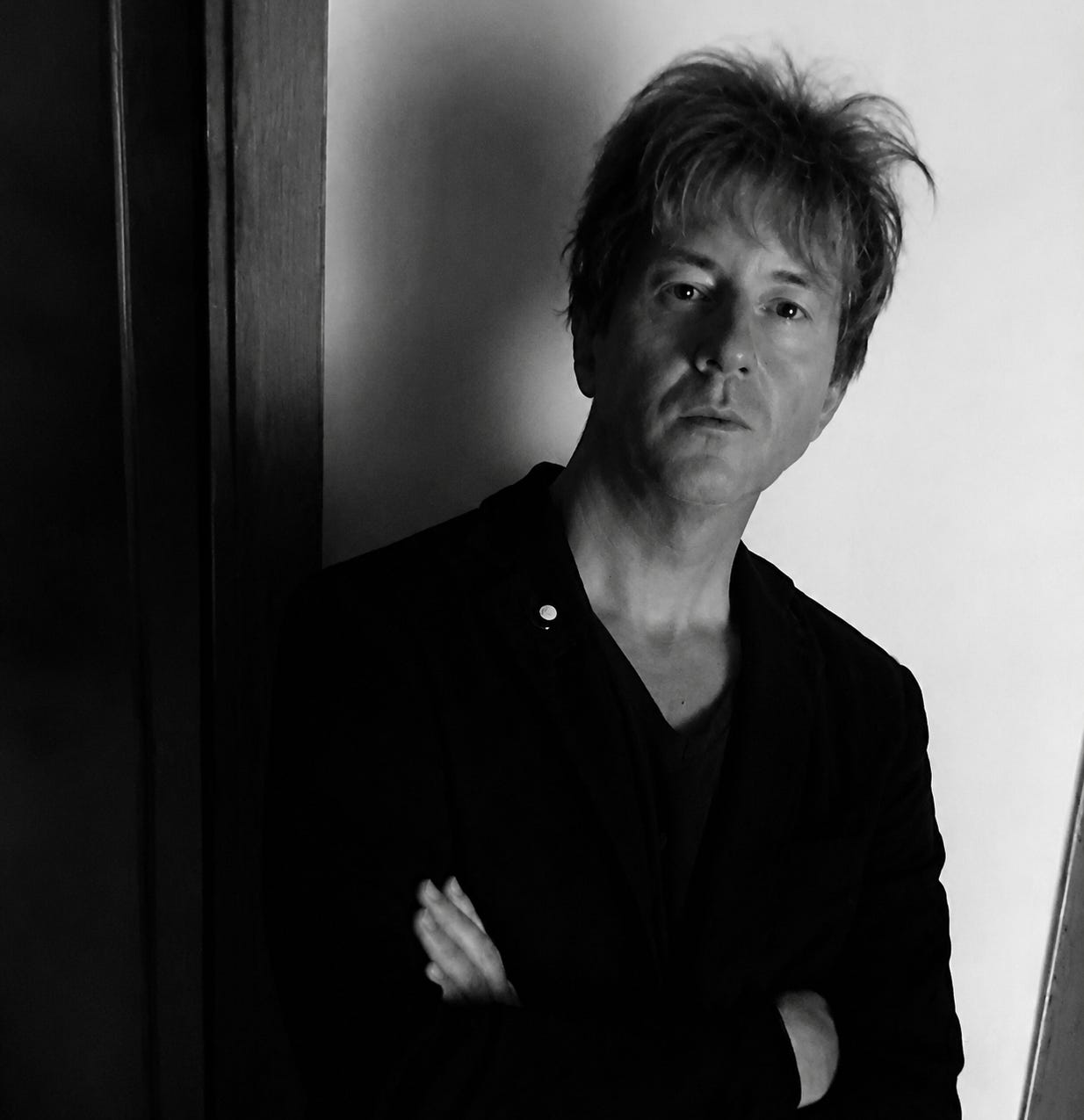
Portrait by Max Whittaker
Every week we identify the best-written works of fiction, speculative fiction, or nonfiction from recent releases and shortlists for major prizes. We also publish articles by their authors on prose technique and AI writing, and for paid subscribers the best-written book of the month.
“A sentence is a great vehicle when you don’t know where you’re going.”
Devyn Defoe is a writer and bookseller from California. She was a Stegner Fellow in fiction at Stanford University from 2018–2020. Her fiction has been published by Socrates on the Beach, Best American Experimental Fiction 2020 and The White Review.
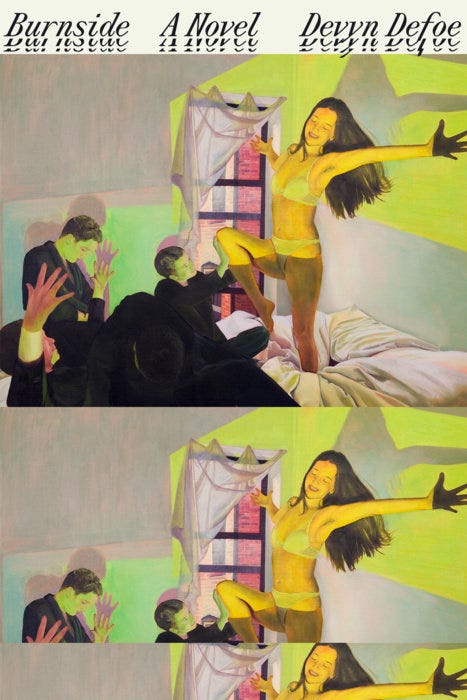
We’ve chosen her debut novel Burnside as a best-written recent release.
In your early writing career, were there writers whose sentences permanently affected the standards of your reading and your own writing aspirations? Could you tell us some lessons you learned about prose style from these writers?
William Faulkner, Roberto Bolaño, Laszlo Krasznahorkai and Gabriel Garcia Marquez were all important to me very early on (and still are today)—all prime examples for questions of stage setting, widening and narrowing the lens through different depths of psychology, dilating in and out of time. How much weight a sentence can hold and where the hinges are. But the technical aspects meant much less than the phrases that are sticky and inescapable, that I’ll remember even when I have nothing left.…tranquil and astonished earth—Faulkner.
I was fortunate to read Alice Notley early on in a college poetry class, specifically the book Culture of One; it had a seismic impact. (Returning to it years later after Burnside, I’m stunned at the thematic resonances.) The permission to do everything. The voice is everyone and entirely hers; it’s an environment all to itself. All her characters think in her vocabulary, which she rescinds from them at will:
I’m not a murderer,
Marie says. And I don’t burn down other people’s
houses. But saying these things is so banal, she thinks
without thinking the word “banal.” People are awful:
A genius who did whatever she wanted. A breath of fresh air!
Which stylistic issues mattered most when you were writing and editing BURNSIDE?
I was very much figuring it out the entire way—the sound of the book, what kind of book I wanted to write, what kind of book I could write. None of these things were ever entirely within my control. I think to an extent you sort of are the writer you are, irrespective of whoever you might like to be—some random combination of your influences, and then the book wants to be whatever it is, with baffling little regard for anything else.
All to say it was shifting all the time. Starting out I was obsessed with pushing a sentence to its limit, if not beyond, because it’s fun to do and I like to see what I can get away with. A sentence is a great vehicle when you don’t know where you’re going, which in the first draft was commonly the case; I would follow one until it led somewhere surprising. Sound is important; when I liked a particular phrasing of words I’d scratch at them and see if there was a deeper wisdom to their connection, even if it appeared somewhat nonsense on the surface. Style informs aspects of character, so as more facets of the narrator emerged all of it was liable to change. I can’t work from outlines, so I need the engine of the book to land at its final identity.
Burnside’s opening:
The man, September told me at the start of it, was not all there in the head, had a screw loose, a shifty disposition, not unlike the feral children in the outskirts beyond the outskirts who had no grandparents or conception of death. Those cynical lunar beings who would think, when happening upon a corpse, that it was asleep, and dreaming of almonds, though September had to admit he displayed none of the confidence typical to their usual schemes. The feral children, those that were no longer children but couldn’t shake the name, were always trying to trick something out of you: looking innocent enough in their flapping clothes, billowing shirts that slipped off the shoulder, cuffs dragging behind their heels, acting as if they had jobs or could read above a fifth grade level, always pointing at something slippery in the sky that wasn’t there, if you were stupid enough to turn your head. They thought nothing of their damage, or the wounds done to them that they, in turn, inflicted outwards, ruining evenings and thick nights with their rudeness, their vicious clairvoyance, saying anything for a reaction, claiming in every word a truth that flipped around to be a lie or a diversion while they dove for your loose pockets. By then were inured to their wily displays and thought little of them, beyond the weak pride at the outset of recognizing a scam for a scam, the jolt of self-preservation, knowing their tricks wouldn’t work on us—we were not so easily duped anymore. Our tactics were simple: we were mean, too busy to pause, suspicious, judgmental, inclined to leave people alone to their private insanities. We kept our acquaintances tight and our purses sealed, and typically any unusually conversant stranger would sense these ephemeral tensions and seek easier marks elsewhere. There was no real concern, then, apart from his physical closeness, which would not have been suspicious had the fish shop at that time been packed, all other chairs occupied, but it was near close and the two were the only customers—if September, waiting on her boyfriend to finish his shift, could even be called a customer. She was not paying for her drinks. She went to places where, as an unspoken rule, she wouldn’t have to pay for drinks, either through her connections or her looks or the pure benevolence of strangers, which was the best way to get a free drink, though also the rarest. The man beside her also was not paying for his drinks, though this was not for benevolence or any reason. He had no drink at all. The counter in front of him was bare, except for a beaten and brutalized book, a wallet someone might have fished from a storm drain. September didn’t volunteer the title of the book, and when I asked her what it was (I always want to know what people are reading, if in fact they are) she didn’t know, the cover was obscured by thick boot prints, as if it had been stomped on repeatedly and for good measure tossed in the barreling path of an eighteen-wheeler. He had a look about him like he might rob a bank or rip a soft animal apart to drink the marrow from the bone. Nothing else was memorable about his appearance, and when I asked for more details, September was entirely at a loss, as if she had met nobody after all.
Describe your approach to stylistic energy and richness in this passage. What techniques were key to the voice and tone here, and/or in any other passage from the book? Can you describe how you achieved the rhythms here?
The appearance of the first em-dash is very important—separating the girls off. The second introduces doubt to an aspect of identity; it was crucial to not use another one anywhere else. The monotony is important. I’ve never been buried alive (let’s keep it that way) but that’s how I think of the sentences here, one shovel of dirt after another. I like that the narrator cloisters herself in parentheticals, with books—it’s practically a joke. I don’t know what I was thinking at the time, except for the em-dashes, which were conscious choices.
This is actually a perfect example of what I was talking about earlier. Originally the first sentence was much longer—roughly from ‘the man’ to ‘loose pockets’ and quite different in between—and I was very proud of it for all the stated reasons above. My editor and my publisher both asked me to shorten it, concerned it would put off readers who prefer their bread pre-sliced. As precious as I can be about punctuation I did see the merit of their argument, and buoyed by my publisher’s belief in the book’s commercial potential, a thought that had never once entered my head (what did I think we were all doing there? Just having a good time, I guess), I went back to the drawing board and we ended up here. The real benefit of this was forcing me to take a deeper look at the narrator and really examine her thought patterns. The book is constantly balancing the goofy with the dark, and adding those stops right at the start struck a more ominous mood off the bat, establishing a dominant tonal frame. I sort of went crazy sprinkling it through other areas, hacking through the second pass probably beyond anyone’s desire for me to do so. This was probably my favorite editorial note; it cracked the book wide open.
Continues below.
Do you see published prose adapting to the writing people read online, much of it written in the characterless bloggy style established twenty years ago? Has published prose adapted to the reduced attention spans that apparently result from heavy internet use?
I think some of this can be attributed to a desire for realism, whatever that is. If you’re online a lot you’ll think in internet rhythms. As for attention spans, I would hope most write from their own impulse to do so and not from the void of their idea of a reader’s capacity. There is no law that you have to finish a book in a day! Writers should only be concerned with their own attention span. A tolerance for boredom is also important. I’m not opposed to that style, necessarily (I can think of a few books I like that use it effectively), or for that matter any style. We need modes to contend with the flatness of algorithmic thought, the desire for a richer humanity—these are literary concerns.
It’s now frequently unclear whether online posts were written by AI or a human. How can writers ensure their writing immediately sounds human?
It’s silly a writer should have to do anything in particular to sound human; I don’t have an answer except that the monovoice in American literature was an issue long before AI. With AI specifically I try to avoid seeing it as much as possible in the same way I’m particular about anything I read; I just don’t want it in my head at all. I can’t recommend any specific stylistic techniques to employ or avoid, but it’s an excuse to be kinder to your weird, even awkward linguistic impulses.
Have you used AI to help with any literary tasks? Would you consider using it for time-consuming tasks like identifying unwanted alliteration?
Never. I know this question is meant to rile me and initially I wrote a very flippant answer—something along the lines of I’d rather kill myself!—but in reality I’d rather live the full extent of my natural allotment doing the work I love, so instead I’ll pick at this presented use case. “Unwanted” is weird and fundamentally insufficient, because unwanted by who (or what)? If alliteration, an aesthetically neutral sound device, is bothering me, I’ll know that all by myself as the person experiencing it. An AI has no ability to make that judgment. I’m very happy to haggle with a human editor over rhetorical choices (it helps if they have great taste in books, as mine does) but otherwise I have no desire to impose blanket institutional standards onto my work, and I would never choose to invite them into my mind at the expense of my own.
Many readers who no longer buy novels cite their inability to fully immerse themselves in fiction, to suspend their disbelief. How important are voice and style in BURNSIDE to casting the fictional spell that helps such immersion?
It should be the primary mechanism pulling the reader through. Talk about attention spans! By the way, I’m no saint—I will compulsively pick up books and abandon them, and then forget about them; I’m usually switching between ten books at any given time. (This is one of the hazards working at a bookstore, particularly for those of us who suspect we were not properly evaluated for ADHD, which little girls keep so quietly to themselves.) It’s a bad system, but a testament to the ones I finish because there was something compelling in the language that kept my interest.
Circling back to Alice Notley, I do think of voice as the orienting intelligence of a work. It goes far beyond immersion—it’s the doorway for all of the preoccupations of the book.
George Saunders proposed on his substack that it’s in the editing process that literary voice can emerge -- the more a writer edits the more they’ll make choices different to other writers, resulting in a voice and style unique to them. Is he right?
I’m kind of obsessed with this idea—I think I’ve touched on it in some of the above answers. I’d say it’s definitely a component, though those choices are always happening even if you’re not aware of them. For me writing often involves a lot of scratching around in the dark, sometimes painfully directionless. I don’t know if I’m ever initially aware of what I’m doing. Only when I have a finished draft can I see what I’d apparently been trying to say the whole time, so in that sense editing is an opportunity to gain clarity around my intentions or change my mind.
How close did you come to headbutting your keyboard in frustration at certain minuscule prose issues you were working on in BURNSIDE, and what were those issues?
They’re called commas, and a couple of them still give me nightmares; hopefully one day I’ll get over it. And then there were definitely a few sentences where for the sake of “clarity” I might shift some words around here or there, which is as rhythmically dangerous as clipping the wrong wires on a bomb. I wish I could say I emerged unscathed but in the name of radical acceptance I try to appreciate the screw-ups too.
Name a book published in the past year that you admire for the quality and originality of its sentences, and describe what’s accomplished and original about them.
Ruins, Child by Giada Scodellaro—I love the freedom of her sentences, her punctuation, the dialogue bleeding through; her stories are also gorgeous. She’s so attuned to sound. It is very hard to pluck an example from the text without dislocating the orienting context, but let me try:
“It’s Vonetta!, she says when she introduces herself to any man or woman, or child. With an exclamation point at the end, the woman continues, an aircraft moving past.”
I love Vonetta!, I love hearing Vonetta! announce Vonetta! I love italicized dialogue; we should more often be speaking at a slant! I love the drifting aircraft! The quotes I put around this to signify it as an excerpt are cluttering these deliberate, singular choices! I can’t read this without smiling.
And to throw in another one, Offseason by Avigayl Sharp—hysterical, cerebral tightropes outlining wounds too caustic to be approached any other way. She varies her sentence lengths wisely; the short, staccato ones snap her back into the physical immediacy. For example:
“For more than a decade I had hated this city, corrupt and infuriating, intellectually vacant, hog butcher for the world, foul, provincial, with its torn-up prairie and every mayor an old-time gangster; but somewhere inside me, deeper than the reservoir of my contempt, deeper than I ever wanted to look for the rest of my life, I could feel the clenching of a furious pride, in these stupid lives that acted themselves out day and night, pointlessly, ridiculously, year after year, through the vicious, uninhabitable cold, people with families and people who were completely alone, who played video games, who wrote rude messages on internet forums and purchased liver-based bodybuilding supplements online, who scrolled through the same little videos that I did, or different little videos, had good personalities and bad personalities, did horrible things, glorious things, nothing at all, who had medical debt and children and aging parents, who were too exhausted to cook dinner, in a landscape that did not love or long for them, that would never even see them, much less forgive them, a cold that made it impossible to deny, I thought, that human life was a disgusting accident, an unimaginable miracle. I dry-swallowed a Xanax. The man next to me farted loudly and shifted in his seat.”
A whirlwind that drops you astoundingly on your ass! There is no quality I admire more in a book. How lucky are we to have this caliber of prose in 2026.
We’re running a series on the best-written works of fiction of the 21st century to date, and the best-written works of nonfiction. Could you nominate one or more of each for us?
I’m making my way through A Table For Fortune which definitely belongs on this list, and for fiction I’ve finished, Milkman by Anna Burns—a perfect book.
For nonfiction, Rising Up and Rising Down by William T. Vollmann (abridged, I haven’t encountered the McSweeney’s yet), and his work in Harpers; hopefully one day someone will do a collected volume of those essays.
If you’ve doubted that no work’s made its artist look a bigger diddy than Twin Peaks: The Return does, now might be a good time to consider whether you’ve seen self-casting like Lynch’s anywhere else. Have you seen any other writer, director or producer of a collaborative work cast themselves as the only undeniably honourable central character?
NO → Me neither.
YES → Have you seen any other writer, director or producer cast themselves as an Übermensch, the god of judgement and wisdom, and an aspect of Almighty God?
NO → Me neither. Of course we haven’t.
YES → Have you seen any other writer-director-producer cast himself in a world with hordes of Unterentwickelt Menschen among its hundreds of speaking parts as the superman masculine nucleus of seven trillion light years, a self-casting that even a José Mourinho stimmed self-pleasuring marathon would reject as too vain, too implausible, and no fan or critic ever mentioning how iffy this self-casting is? Or anything as bad as that?
NO → Good. You had me worried there.
YES → You really have seen some muck, haven’t you?
Information about submitting to Auraist is here. Our standards are as high as for our other picks, but if we publish your work, we’ll invite you to answer our questions on prose style.
Please consider completing our reader survey, to help shape Auraist in the future.
Our archive has over sixty author articles on prose style and AI writing, hundreds of picks from recent releases and prize shortlists, and the best-written books of the century. A paid subscription gives you full access to this archive, and to the best-written book of the month posts.
Share Auraist: picking the best-written books
Thanks for reading and helping to support fine writing.
Sean McNulty
Comments
Nothing yet. Say the first thing.
Sign in to join the conversation.