
Every week we identify the best-written works of fiction, speculative fiction, or nonfiction from recent releases and shortlists for major prizes. We also publish articles by their authors on prose technique and AI writing, and for paid subscribers the best-written book of the month.
“AI is the ultimate plagiarist.”
Sabrina Hicks’ work has appeared in Milk Candy Review, Cleaver, Reckon Review, Split Lip Magazine, Best Small Fictions and Best Micro Fiction anthologies, Wigleaf’s Top 50, as well as numerous journals, both online and in print. More of her stories can be found at sabrinahicks.com.
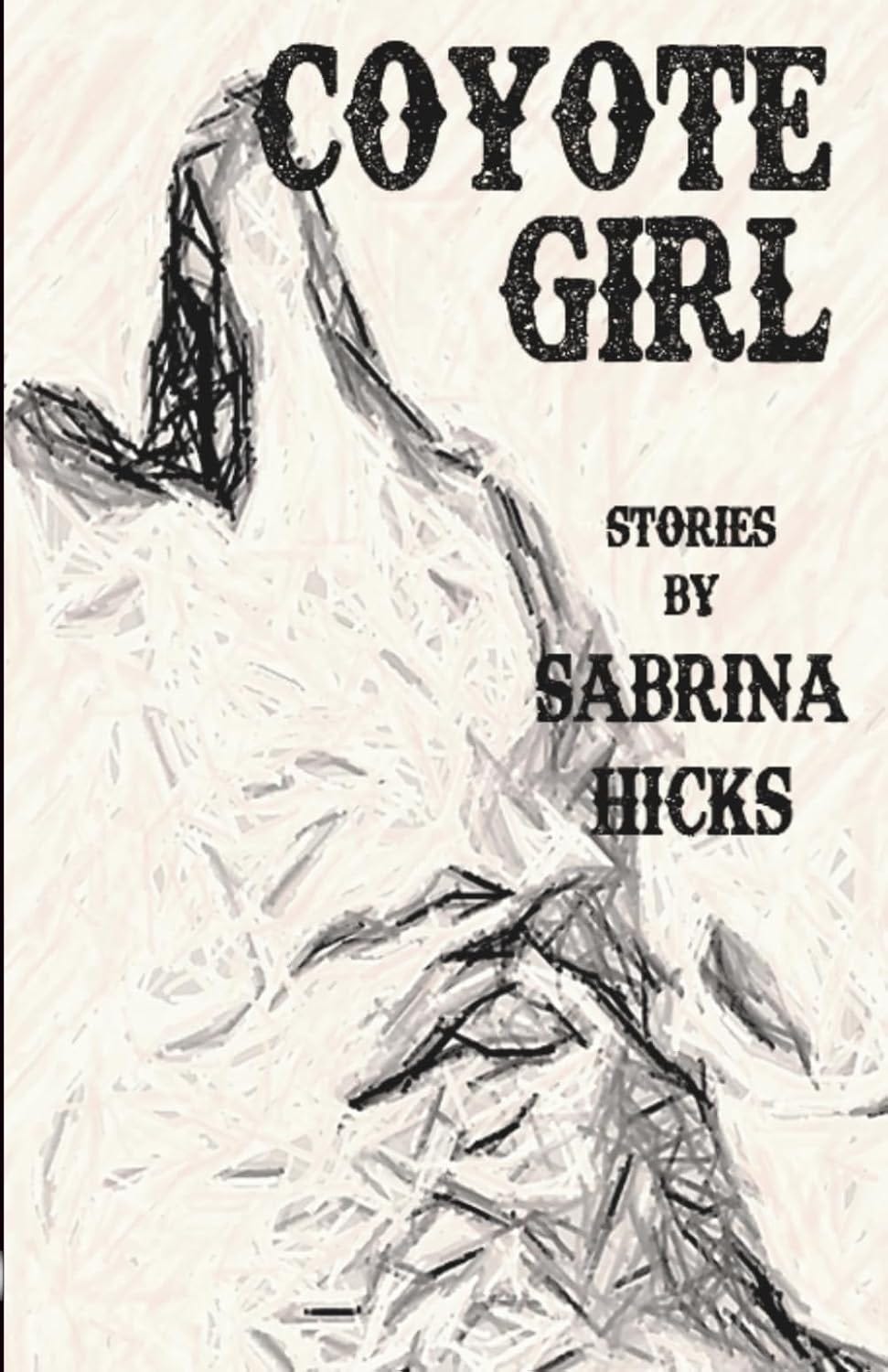
We chose Hicks’ Coyote Girl as the best-written book of the month.
In your early writing career, were there writers whose sentences permanently affected the standards of your reading and your own writing aspirations? Could you tell us some lessons you learned about prose style from these writers?
I was first drawn to writers like Larry McMurtry, Willa Cather, Charles Portis, and Wallace Stegner, all capturing the grit of the American West and its cast of characters, and to language that reveals something seemingly indescribable, until a writer comes along and nails the feeling with stunning precision. Starting with the angst of youth, then all the revelations and heartaches of being human.
I am always seeking answers to questions, or questions I should be asking. McMurtry dug into character in a way that inspired me after reading LONESOME DOVE. I’d never seen third-person omniscient done with such skill and fluidity, the way he moved from one character to the next with an ease that seemed otherworldly. That really affected me.
Cather and Stegner were so lyrical and profound. They have some of my most highlighted passages of prose. And what Portis accomplished in TRUE GRIT let me see how stripped-down language could be stunning, that it can elevate your setting and characters.
Without being prompted to copy the style, could AI ever write as well as such writers?
Artificial, by design, doesn’t conceive naturally. There can be no spontaneous, personal, profound revelations created, only a regurgitated theft of prose reaped from the collection of authors who have dedicated their life to their craft. AI is the ultimate plagiarist.
The very act of writing is a willingness to exam all the tender spots of being alive. It requires an amount of bravery, self-sacrifice, that is only admirable coming from, as Mary Oliver reminds us, “the soft animal of your body”.
The mechanics are less impressive. The paint by numbers approach is boring. If we are to bleed there must be a heart attached to the body of work. Let it sort through numbers and algorithms, not the human experience of which it knows nothing. In all our imperfections, I would rather typos and heartache, mistakes and messes.
Which stylistic issues mattered most when you were writing and editing COYOTE GIRL?
The stylistic choices I made with editing and writing COYOTE GIRL were organic in nature, occurring over a decade, as many of the stories are previously published in literary journals. If you write long enough, there is a commonality to your work, themes that rise to the surface, a stylistic identifier just by the sheer volume you are creating. Your words will identify yourself before you’re even able to articulate what moves and motivates you.
When compiling the stories for this collection, the themes of childhood and loneliness repeated, burying a howl that lives within us. There is a line in the title piece “Coyote Girl” in which the mother says to her daughter, “We should howl and get lost and find ourselves again and again.” I began to see the pieces differently after that line stood out. From there, each piece is essentially a howl.
Talk us through the stylistic choices you made for its opening lines:
The prickly pear fruit stained everything red—fingers, our clothes, the air. Our stomachs louder than the thunderclap, that maw inside us, clawing like root sprawl until the sky broke. A year older than you, I was used to dropping to the desert floor, ear to sand, listening for the pulse of water. I saw you’d followed me into the dry wash only after I climbed the limbs of a cottonwood. You stood for a second—my slack-jawed baby brother, looking up at me just before a river raged between us. I remember that first rush of water, a scream inside me, filling my lungs where it would stay.
A lot of those stylistic choices come naturally after years of writing. Take the first sentence, in which prickly pear fruit instantly grounds the reader in the desert. Then stained — an event that will alter the narrator, and red — a bleeding, a death. Right away we sense a foreboding, a reckoning with just that first, brief line.
From there each detail works to build tension with thunderclap, maw, a sky breaking. At the same time the tone and voice are one of resignation, which leads us to believe this happened long ago for the narrator, sensing the loss before we get to the action, and filling the space with a mournful reckoning.
What techniques were key to the voice and tone here, and/or in any other passage from the book?
I used second person here to create immediate intimacy. The reader doesn’t sense the “you” here is them. It’s quite clear the “you” is a person important to the narrator, someone whom they had been responsible for. I should mention, too, second person, for me, works best this way, where the “you” is immediately established—and preferably not the reader, which can feel like an indictment—and the work is a piece of short fiction, otherwise it can become too gimmicky or tiresome.
The only novel I’ve read that used second person throughout was Ocean Vuong’s, ON EARTH WE’RE BRIEFLY GORGEOUS, where the narrator is addressing his mother. But unless you’re a skilled poet and novelist like Vuong, I wouldn’t pick up a book told entirely in the second person. Some people don’t care for this POV. Some love it. But I’m of the mind, if you use it wisely, it can be very effective in short prose.
In COYOTE GIRL, the first story is “Eight Seconds” in which I chose second person to address the narrator’s brother. I wanted that story to be a breathless piece that mimicked the pace of eight seconds, almost like the narrator would lose her nerve if she didn’t get it out fast enough. Second person got me to the action faster than any other POV. I also used this method in “Scar Tissue,” another story in the collection, where right away there is a defensiveness to the narrator and an apology is buried in a painful past.
Once a piece is drafted, I will read it aloud to hear the musicality of the prose to make sure it’s interesting and there is a mix of long and short sentences, almost like sheet music to ensure the melody isn’t one tiresome note, and that there are risks and breaks, and pauses which set the right tone for the piece. Short, short, long. Or a breathless run-on with maybe some gulps of air.
In short prose I like that you can be more playful, engage the surreal, switch perspectives, dodge and weave language in a way that might be too risky in a longer piece. The goal of short prose is to get in and out, which means you can’t be too precious about eliminating anything that doesn’t get the reader to the heart of the piece.
I feel like this type of writing serves me well with my setting in the Sonoran Desert. Your setting has to match your prose, and in the desert, there isn’t the moodiness of weather. It’s blazing hot, unrelenting, dry, and the sheer amount of light will expose your bones if you linger. So, it’s best to say what you need to say and get the hell back into air conditioning. Also, sometimes what isn’t said is the most interesting part of a piece.
Do you see published prose adapting to the writing people read online, much of it written in the characterless bloggy style established twenty years ago? Has published prose adapted to the reduced attention spans that apparently result from heavy internet use?
I think writers who are making the most stylistic choices are flash writers who are primarily published online, so what people read online is a choice. Read indie presses and journals. Read indie writers. They aren’t beholden to the whims of the establishment. Like the underground bands of the 80s and 90s, they’re not people playing by industry rules. And the work is brief enough to satisfy our shortening attention spans.
Maybe there’s still a stigma of writing shorter prose, but if you read the curated lists of short prose in the “Best of” anthologies and Wigleaf’s Top 50, you will see writers playing with language in a way that is unique and interesting, who don’t require a lot of space to create an entire world or to say what they want to say in a substantive way.
Reduced attention spans may have altered our tastes, but like everything, writing tastes naturally evolve and adapt with our times. I do not want to read about the indulgences we used to afford writers of yesteryears who were often paid by the word. We are too busy, too tired, too distracted, and there is too much information we are being fed. You have a limited time to grab a reader and keep their attention by writing sharper prose.
That’s not a bad thing in my opinion. I am impatient with too much narrative, too much exposition. I don’t want to read about the entire contents of a home. Give me people. Give me dialogue and tension. Give me a room I have never walked into.
Continues below.
“Too many opinions coming at you in a workshop can lead to paralysis and self-doubt”
Have you used AI to help with any literary tasks? Would you consider using it for time-consuming tasks like identifying unwanted alliteration?
I’ve never used AI. What is the point of reading, writing, and creating if you need to employ short cuts? Maybe don’t become a writer if you need to rely on AI. Being a writer just for the sake of being called a writer is a pointless, soulless pursuit. If you use it to seek out problems in your manuscript, it means you aren’t seeing the problems. And if you aren’t seeing the problems, like an ungodly amount of alliteration, then maybe read more and write less.
I fear a great amount of laziness awaits us in this brave new world of AI employment. I’d rather read revolting amounts of rhyming revelations and alliteration (inserting proof I am human) than the sterilized sameness generated in data centers littering the land, hogging water and resources so that we may stare idly into the abyss.
If a panel of AI judges awarded you a prestigious literary prize, would you accept it? If so, how would you thank them?
I feel like I would have to accept this prize on the grounds that they have achieved a high level of intellect that is both frightening and apocalyptic. Accepting said award seems keen on my survival to maintain my cover as leader of the underground rebellion to overthrow our overlords and their elitist literary tastes.
I would thank them with side-eye, then retreat to my bunker for strategy. Maybe hurl copies of Infinite Jest or War and Peace at them to take out their main controls. I have already said too much here.
Erik Hoel has stated that the MFA’s domination of modern literature has produced writers trained through grueling workshopping to minimize their work’s ‘attack surface’. We might note the parallel influence of focus groups on political discourse and of test audiences on cinema. Has too much workshopping added to the volume of flavourless published prose?
I do not come from an MFA background, but there are definitely books and stories where there is a stale sense of over-workshopped prose. Personally, I write and write and revise and read and beat myself over the head with self-loathing until I start to suck less and less. Believe it or not, if you are stubborn and a bit of a masochist, you will eventually get there. And sometimes the less you know, the more likely you are to stick with it and take risks.
Too many opinions coming at you in a workshop can lead to paralysis and self-doubt; and how are you to know who to trust when maybe it’s your gut you should be trusting? I never want to be beholden to a strict set of rules.
If you want voices of the working class, the diversity of writers everyone claims to love, then often there is no MFA teaching them to be precious about their prose. And if you’re a writer of grit-lit, who wants precious prose to begin with? Read. Read a lot. Learn the rules. Then break every one of them—with intention.
Is there anything else you’d like to tell aspiring writers about prose style?
I love all these questions you pose on style. I’m afraid I don’t have specific advice on style. Style often emerges for each writer differently. It has been my experience that style and stylistic choices are an evolution that cannot be rushed. Which is why I think it’s such an exasperating pursuit that is often abandoned before a writer’s own true sense of style even begins to take shape and flourish.
I’m not fully in agreement with George Saunders when he says literary voice can emerge in the editing process. I guess it depends on how long you plan to edit and your willingness to let go of sentences that only serve your ego. What brings a writer to the page in the first place when by all accounts, the blank page is terrifying, labor intensive, unruly, unresponsive, unappreciative of the time you are willing to stare at it.
That is why I think writers should be more willing to play with shorter prose at the start of their literary journey. I guess I do have advice! What has worked for me is to begin an idea in my Notes app on my phone just so I don’t feel intimidated by the blank screen of my computer. I start in a small, secret space where there is a sense of control. I can always swipe it away out of existence and no one is the wiser. But if I begin a piece, and it’s opening something inside me I didn’t know was there, I know I’m on to something worthy of pursuit, and maybe even worthy of the page.
I don’t believe being too conscientious of prose style will serve any new writer. Aspiring writers need time to play, to make mistakes, emerge, hone their perceptiveness to make the connections in life worthy of a story. No writer starts out great. You just need to be brave and be willing to write terribly until it isn’t. Until you start to see where your pieces of prose are stilted and stale, where there is work to be done.
But I view writing like I view any artistic pursuit—if you can do anything else, do that. For the love of your sanity. If you can’t, then buckle yourself in for the long haul and some therapy.
In Twin Peaks: The Return humans are portrayed as ugly, phoney, petty, infantile, hysterical, solipsistic, or brainwashed plectoids, perverts, parasites, pushovers, dotards, bozos, ballbusters, bimbos, ciphers, slobs, psychopaths, junkies, fembots and other replicants, and underclass people presented as subhuman—basically how you’d expect our species to be portrayed by a demon.
That’s the modern-day world, this auteur informs us: multitudes of risible or vile or in other ways underevolved lowlifes, with exceptions like the odd stunner, child or authority figure, and above all the FBI Deputy Director played by the auteur: Gordon Cole.
Cole isn’t underevolved. He’s the only wholly admirable central character in the series, a principled, dignified, witty, generous, wise, visionary, cultured, courteous, transdimensional-masterplan-orchestrating gentleman-genius who might have an eye for the tasty ladies half his age, cuties who keep their mouths shut and nod and gaze admiringly at the savvy alpha chap in the room, a man who might be quite hands-on with his tasty young subordinate—and what red-blooded FBI Deputy Director wouldn’t be?—but who’s overcome his hearing problems to reach such spiritual heights that he’s primarily, even fanatically, concerned with the salvation of his fellow citizens. A miracle of manhood, an unrivalled saviour-shaman, clearly, a modern-day saint if he wasn’t such a seductive old stud.
If this prize specimen was in your social circle everyone in it would go on about what an incredible person he is and how grateful they are to be his acquaintance in this world apparently dominated by clowns and scumbags, and so would you, and so would I, vermin that we are.
He’s too good for this lowlife-infested world, really, a highly evolved, transcendent spirit. Basically an Übermensch.
Number of corporate critics who’ve acknowledged this enormous difference in worth between Cole and virtually all the remaining 237 speaking parts: zero. Not a word from any of them.
Information about submitting to Auraist is here. Our standards are as high as for our other picks, but if we publish your work, we’ll invite you to answer our questions on prose style.
Please consider completing our reader survey, to help shape Auraist in the future.
Our archive has over fifty author articles on prose style and AI writing, hundreds of picks from recent releases and prize shortlists, and the best-written books of the century. A paid subscription gives you full access to this archive, and to the best-written book of the month posts.
Share Auraist: picking the best-written books
Thanks for reading and helping to support fine writing.
Sean McNulty
Comments
Nothing yet. Say the first thing.
Sign in to join the conversation.