
If you’re a yoga teacher or an experienced practitioner, adding gentle, fully supported backbends to your practice can be a quiet revolution. With the right props and mindful pacing, these restorative heart openers soften chronic tension, deepen the breath, and create a sense of spacious calm.
Why supported backbends matter
Simple and supported backbends are particularly beneficial — a natural antidote to accumulated tension and the “closed chest” posture so common in our screen-based lives.
After practicing, many students describe feeling lighter, more open, and able to breathe more freely.
Key benefits include:
Enhancing oxygenation through deeper breathing
Stimulating abdominal organs and circulation
Counteracting the effects of prolonged sitting
Boosting energy and mood, especially during periods of fatigue or low motivation
Common mistakes to avoid
It’s tempting to invite students to “open the heart” at all costs, but in restorative yoga, less is more.
When dealing with stress or strong emotions, expansion must happen gradually. Our bodies, often used to slouching for hours, need a smooth transition — not a push.
Extra precautions:
Avoid backbends where the head drops below the heart if you have sinus congestion.
Be mindful of cold floors and firm props under the shoulder blades. Comfort is key.
How to progress safely
Backbends in Restorative Yoga should be practiced intentionally, lifting the restrictions that block full, deep breathing. Think of it as a gentle unwrapping: as the body is supported, the belly softens, the ribcage opens, and the breath deepens effortlessly.
Supporting your body
For a truly relaxing posture, every part of your body must feel held. Here are a few simple techniques:
1. Add gentle weight on the head
Place a yoga block or small sandbag on the forehead. The soft pressure helps the mind settle.
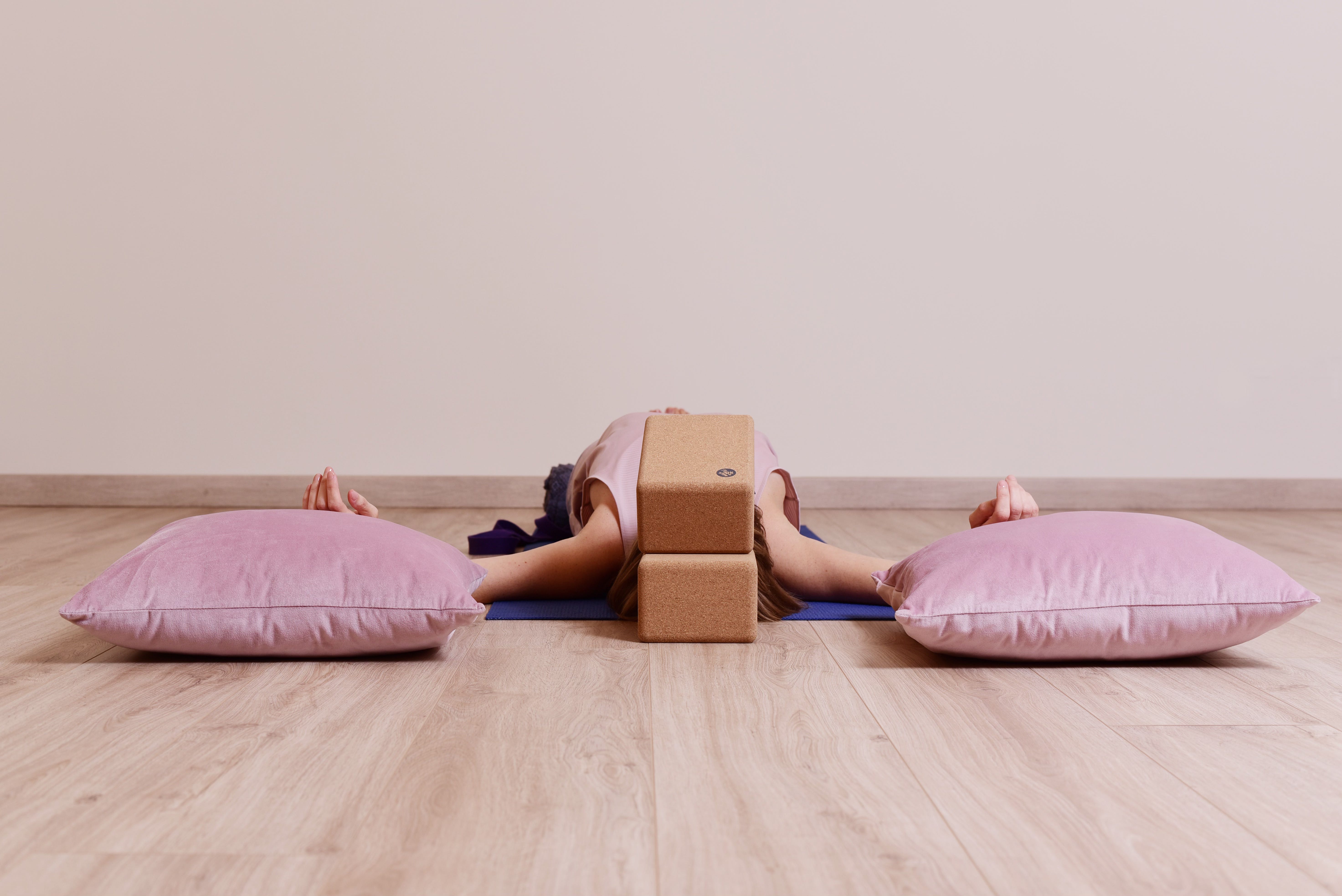
(photo: Carlo Cattadori)
2. Support the ankles
A rolled blanket under the Achilles tendons allows the legs to release without tension.
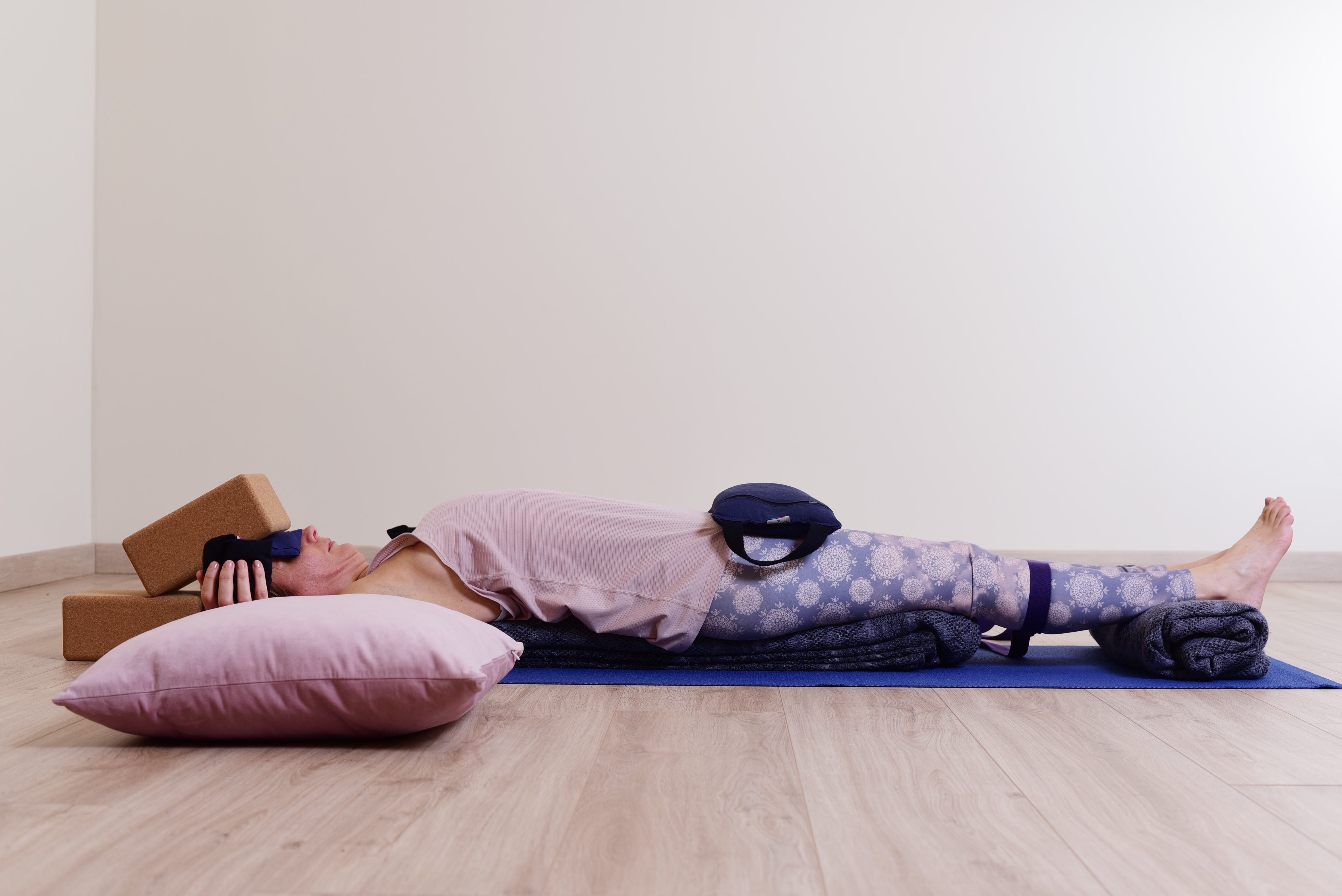
(photo: Carlo Cattadori)
3. Create a cocoon of support
A folded blanket along the spine, a strap around the shins, and a sandbag on the hips together provide a grounding, comforting setup.
When to adapt or avoid
Avoid or modify supported backbends in the following cases:
Pregnancy
Menstruation
Sinusitis or nasal congestion
Gastroesophageal reflux (GERD)
Spondylolysis or spondylolisthesis
Chronic neck pain or injury
Retinal detachment or glaucoma
Always prioritize ease and breath over depth.
The essence of Restorative Yoga is comfort and safety — not performance.
Can you practice every day?
Absolutely. Short daily sessions (5–10 minutes) are safe and deeply beneficial, especially as we age and tend toward hyperkyphosis.
The goal isn’t to stretch, but to regulate the nervous system and restore inner balance.
Learn more
If you’d like to explore these poses in depth — how to use props, sequence intelligently, and guide others safely — join my course:
Join Restorative Yoga, the foundations
My new book — The Art of Restorative Yoga
I’m thrilled to share that my new book, The Art of Restorative Yoga, will be published by North Atlantic Books in Summer 2026.
It explores the science, subtle art, and spiritual depth of rest — from the fascia to the nervous system, and from silence to surrender.
Thanks for reading Audrey’s Substack! Subscribe for free to receive new posts and support my work.
Thanks for reading Audrey’s Substack! This post is public so feel free to share it.
Comments
Nothing yet. Say the first thing.
Sign in to join the conversation.