

One of the biggest mistakes people make with AI is expecting it to be ready to go out of the box.
You would never expect that from a human. If you hired a CMO with twenty years of experience, you would still have to train her on your business. She’s seen it from the outside, sure. She doesn’t know the inner workings, your goals, or how you operate. You’d walk her through all of it, because that’s what it takes for even a veteran to do great work for you specifically.
So why aren’t you doing that with your AI? Why isn’t it held to the same standard?
It can’t know things you never told it. It knows general things, the stuff readily available on the internet. Maybe you’ve installed a skill that taught it how to execute one specific task. But if you haven’t trained it on you, your business, how you work, what done looks like, what excellent looks like, what poor looks like... how could it possibly know?

Here’s what I want you to actually do. Before anything else, create a set of rules for how you want your AI to perform for you. You need these at two levels, the same two levels every organization already runs on.
Level one: the macro. The company-wide rules. What’s the business? How do we write? How do we sound? How do we talk about ourselves? How do we operate? You have these for your organization, formally or informally. Your AI needs them in writing.
Level two: per role. The same way you have SOPs per job, your AI needs guidelines per job. Say you want it to copywrite for you. How? Why? What does success look like? What are the do’s and don’ts? Are there templates it should follow? Past pieces of yours that worked, that it can model? External examples you admire and want it to learn from? Write the guidelines for the role.
(Some people set these up as agent files, some as skill files. How you structure it is up to you. The part that matters is that the rules exist somewhere the tool reads every time.)

You don’t have to draft any of this from scratch. My favorite way to do it, and I’m a chatty Cathy, so this method was built for me: I start a new chat, turn on voice, and get talking.
“Right now we’re going to create a set of instructions for copywriting for the business. Our style is colloquial. Like you’re talking to your best friend at a bar, but the smartest friend you’ve ever had. It should feel comfortable and smart, never pandering, never condescending. Aspirational, like the person you want to be.”
Then I walk through examples. Accounts I think do this well. Emails I’ve genuinely loved, that I want it to use as a model. And then the ask: see what works, find the patterns, create the guidelines.
Twenty minutes of talking, and the onboarding doc writes itself.

The first round is not going to be perfect. It’s going to be 70 to 80% there, unless you’re truly great at training, which, to be honest, you’re probably not. That’s okay.
What you do next is the whole game. When the first draft comes back, don’t just edit it yourself and publish whatever you got. Give it feedback. I go through line by line, recording a voice memo as I read: this part is good. This needs to be fixed, and here’s what I want to see instead. Then it revises, and we run another round if we need one.
And then I say the sentence that makes all of it compound:
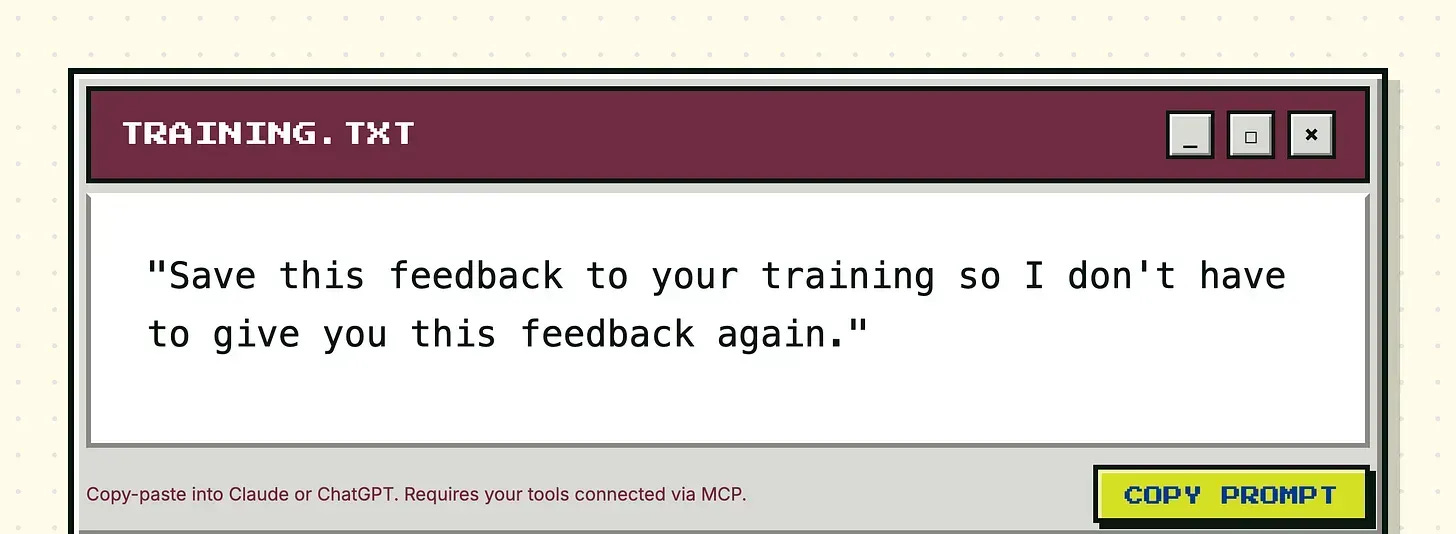
“Save this feedback to your training so I don’t have to give you this feedback again.”
That sentence is the entire difference between correcting and training. When you silently fix the output yourself, the tool learns nothing, and you’re making the same fix again next month. When the feedback gets saved somewhere permanent, you never give the same note twice.
You wouldn’t judge a new hire on work you never trained them to do. Hold your AI to the same standard you hold your people: teach it your business, put the rules where it can read them, and give it feedback that sticks. It can’t know what you never taught it.
Cheers,
Audrey
Comments
Nothing yet. Say the first thing.
Sign in to join the conversation.