
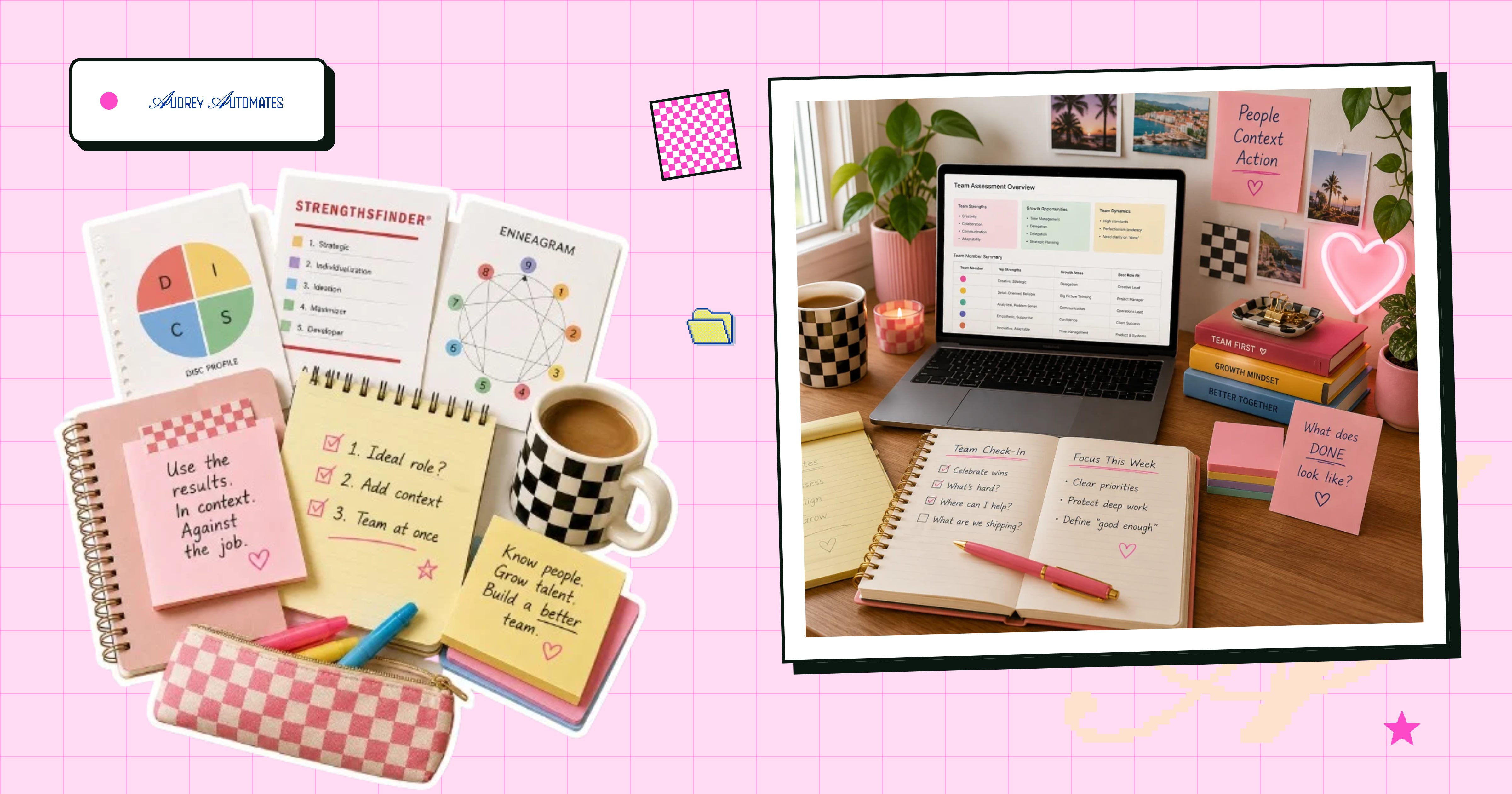
I love a personality assessment. DISC, Enneagram, StrengthsFinder… I’ve done them all. And I’ve had my whole team take them, too.
For a long time we did exactly what most people do. Everybody takes the assessment, they get a nice PDF with their type on it, we all say “oh my god that’s so accurate,” and then the results go into a folder and nobody opens them again.
That’s a waste, and it’s a particularly expensive waste on a small team.
When you work in an office you learn people by accident. You see who’s stressed about their move, excited about a new puppy, who’s scrolling on TikTok all day, and who’s so stressed they look like they’re going to pull their hair out.

But when you’re remote, you get scheduled calls, which can default into a bit of a performance. Everyone’s on. You’re seeing what they want you to see.
Assessments are the shortcut to another side of their personality and habits. But only if you actually use them, in context, against the job the person is doing.
So let’s dig into how to make these actually useful.

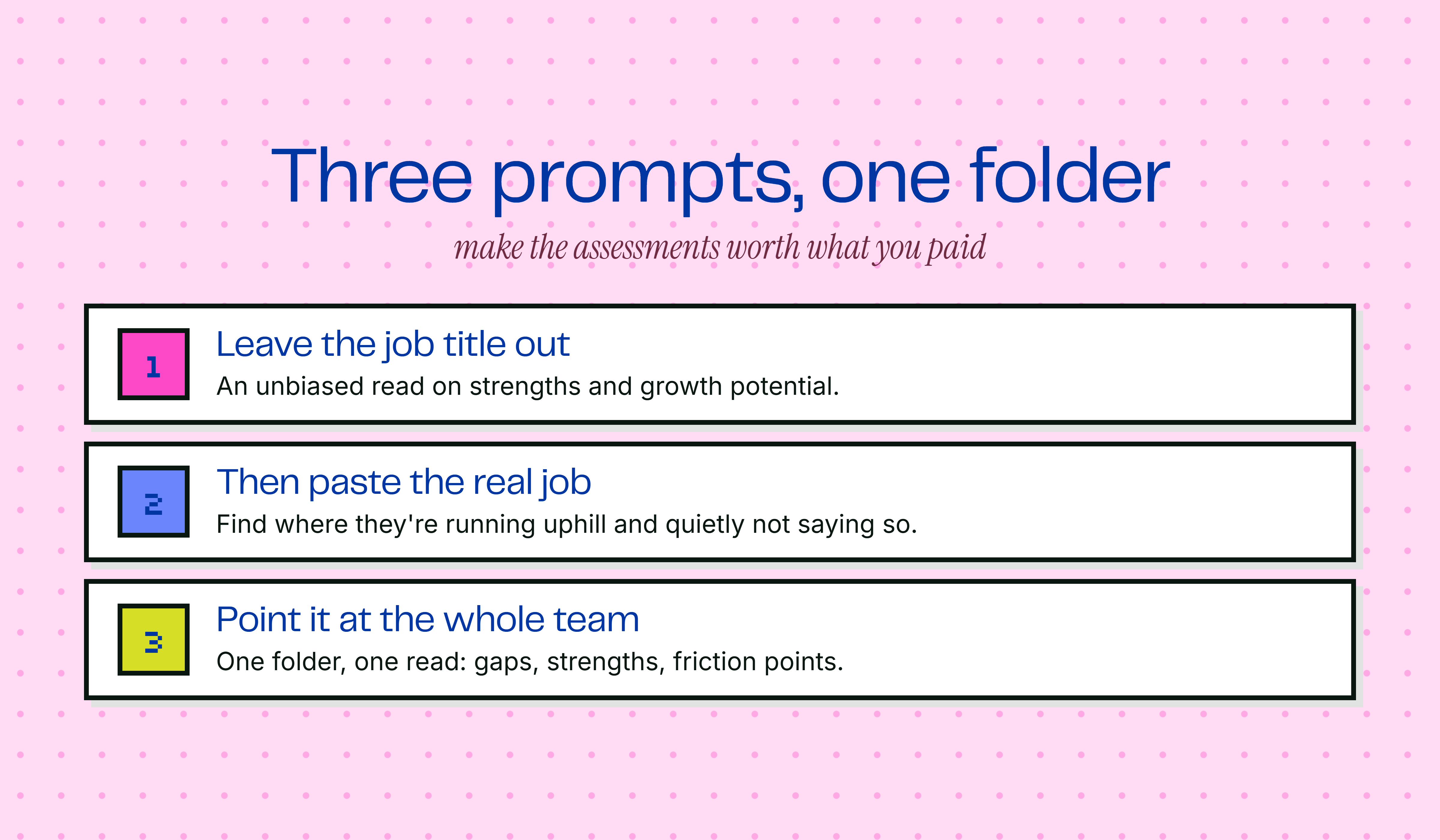
Take all of the results you have for one of your team members (or yourself). All the assessment results, the full PDFs if you have them. Put them into Claude or ChatGPT and ask:
“Based on the results of these assessments, what type of role would suit this person best? Where are they likely to be strongest, and where is their growth potential?”
Notice their job title is missing from this prompt. You want to start with an unbiased answer before you anchor it to what they currently do. What comes back is a read on their skills with none of your history attached, which is a thing you cannot produce on your own about someone you talk to every week.
For me it’s lined up with their actual job almost every time. (Thank goodness!) And the most useful addition is the insight into their growth potential, because it’s important for me to always be thinking of how to nurture the talent on my team.

In that same chat, paste in their actual job description and their roles and responsibilities, and ask:
“Given this role, where is this person strongest? What are their biggest opportunities? Is there anything about this job they’re likely not naturally set up for, that I should keep an eye on?”
This maps a person against their real work. And the third question can be a major unlock, because it tells you where somebody is running uphill in a way they’d probably never volunteer in a check-in, especially if they’re a high achiever.
Knowing that in advance changes how you delegate. It changes what you put on their plate on a bad week.

This is where you can supercharge your results.
Put every team member’s assessment results and job description in one folder. Open Cowork and point it at that folder. Then ask:
“These are the assessments and job descriptions for my full team. Put together an assessment of us as a team. Where are our skill gaps? Where are we strongest? Where are the friction points, and where could collaboration break down? Context: we’re a fully remote team.”
Don’t forget to customize the prompt to include necessary context: Remote, hybrid, half contractors, growing fast, whatever is important.
Individual assessments tell you about people. This tells you about the shape of the group and how you can best work together.

My team came back highly creative with a strong pull toward perfectionism, and the flag was that the combination could make it hard for us to ship.
(Thankfully, that hasn’t been our problem. We looooove to ship.)
But it did make me realize I’d never actually told anyone what finished looks like. So I went and did that. What “done” means and what “good enough” means for the kind of work where good enough is the right call. I wasn’t fixing anything. I could just see the shape of a problem we’d have eventually if we didn’t identify it.

If results are already sitting somewhere, run step one on one person today. Four minutes, and you’ll know whether the other two are worth your afternoon.
If nobody has taken anything yet, pick one and send it around this week.
Cheers,
Audrey
Comments
Nothing yet. Say the first thing.
Sign in to join the conversation.