
You’ve thought about starting a podcast. Maybe you got as far as researching what it actually takes. Booking guests, chasing confirmations, editing, clips, show notes, social posts, promo emails. And somewhere in that list, you quietly put the idea back on the shelf.
Not because you had nothing to say. Because the machine around the microphone looked like another part-time job.
I want to tell you something: your instinct was right. It was a part-time job. I know because I ran that machine for years, and it beat me three separate times.
My first try was in the early 2010s, when marketing podcasts were exploding. I recorded twenty episodes. I published zero.
Every one of them sounded like everything else being made at the time. Everyone was learning the same things and teaching them back to each other, and my episodes didn’t clear the bar I hold for anything I publish: would someone watch this and walk away with real value? They wouldn’t have. So they never saw daylight.
The second attempt never found its fit. It happens.
The third one worked. The Mess in the Middle was a show about what’s actually hard in business. Not the shiny wins and the success theater, but the struggles, the decisions, the learning that goes into actually growing something. It resonated because it was honest. I published 44 episodes and met some amazing people I now call friends.
And then I stopped. Not because the show stopped working. Because I got tired.
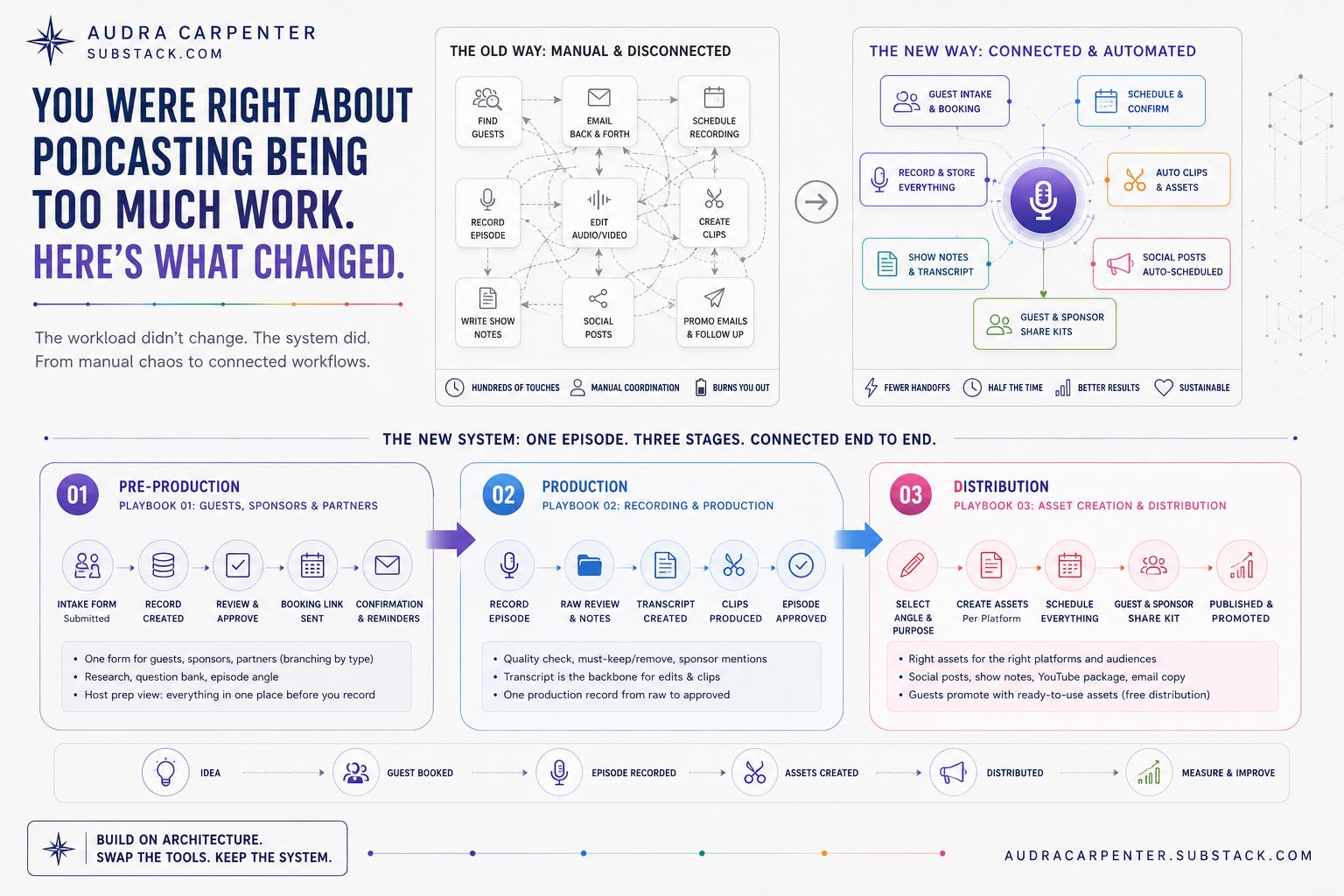
Even with parts of it outsourced, the manual coordination never went away. Finding a recording time meant email back-and-forth. Guest details lived in one tool, scheduling in another, the episode files somewhere else, the social content somewhere else again. Every episode required me to be the glue between systems. Forty-four hour-long episodes, and behind them hundreds of clips, hundreds of emails, hundreds of social posts. All of it coordinated by hand. I was done.
Here’s what I understand now that I didn’t then: I never had a content problem or a commitment problem. I had a coordination problem.
The recording was the easy part. An hour of good conversation. What wore me out was everything around it, and the reason it wore me out is that none of it was connected. Every handoff between tools was work I did by hand. Every guest email was written fresh. Every episode’s assets were assembled from scratch.
That coordination tax is invisible when you’re planning a podcast and relentless when you’re running one. It’s why so many shows go quiet around episode 30 or 40. The host didn’t run out of ideas. They ran out of glue.
I’m getting ready to launch a new show, The Next Blueprint. And the reason I’m willing to get back in is that the thing that beat me last time doesn’t exist in the same form anymore.
With AI and a connected system, the machine around the microphone no longer requires a small team or a full day per episode. I know because I built it before recording a single episode, and I’ve watched what it does to the workload.
Here’s what that looks like across the three stages of a podcast.
Pre-production without the back-and-forth. A guest applies through a form and a record is created. I review, decide, and send one email carrying a booking link. They pick a time, a confirmation with a calendar invite fires automatically, and a reminder goes out 24 hours before we record. The email chains, the “does Tuesday work,” the confirmation I used to forget: none of it involves me anymore.
Production in one place. The episode, the guest record, the files, the clips, the notes. One record that carries through from scheduled to recorded to ready. Nothing gets extracted and re-entered. Nothing goes missing between tools.
Distribution in half the time. Social content is written and scheduled inside the system. The distribution tools still exist, but they just execute. The thinking happens in one place. And when the episode goes live, the guest gets their links, clips, and ready-to-use copy in one email. Guests who are handed their promo assets actually share the episode.
Getting from a recorded episode to fully distributed assets used to take me a full day. Now it’s half that. Not because the work vanished. Because the handoffs did.
That barrier is genuinely smaller now. Not hypothetically, not someday. I rebuilt the entire machine before launching this show, and the coordination load that ended my last podcast is now handled by the system instead of by me.
If you’ve always wanted to do this but could never justify the operational weight, this is the most interesting moment there’s ever been to reconsider.
I’ve mapped the full system as three playbooks, one per stage in the Content Hub OS Membership.
This is the playbook that ends the back-and-forth. It builds the intake and prep layer, so that by the time you sit down to record, the episode is already organized.
You get the public intake form done right: one form that asks guests, sponsors, and partners only for what they can actually give you, branching by type so a guest never sees sponsor fields and a sponsor never sees interview questions. Then the internal prep layer your team adds after submission: confirmed recording time, research generated from the links they shared, a question bank so the host shows up prepared without scripting the conversation, and the episode angle that keeps the interview from becoming a generic bio walkthrough.
The result is a host prep view. One screen before the call that tells you who you’re talking to, why the episode matters, what to ask, what to mention, and what’s already been approved. Recording day stops depending on memory, DMs, and last-minute research.
This is the playbook that ends the scavenger hunt between “we recorded” and “this is ready.” It builds one production record that follows the episode from raw files to approved media.
You get the raw review workflow that protects quality before the editor spends a minute on the episode: files confirmed usable, must-keep and must-remove moments timestamped, sponsor mentions flagged. The transcript becomes the searchable backbone for edit points and clip selection. And short clips get produced here, while the team is still inside the raw footage, tracked in their own table connected to the episode so you can see exactly how much usable media each recording produces.
The result is that you always know where an episode sits. No mystery files, no “did this get reviewed,” no version confusion about what “done” means. The episode arrives at distribution approved and complete.
This is the playbook that turns one approved episode into the right assets instead of all the assets. It builds a selection layer: before anything gets generated, you choose the platform, the purpose, the angle, and who it’s for. A LinkedIn authority post and a community-building email should not sound the same, and in this system they don’t.
You get the full YouTube package built from the transcript: description, chapters, title options, thumbnail headlines, and the pinned first comment. Social posts created one record per asset, each linked back to the episode. And the piece almost nobody does: the guest and sponsor share kit. When the episode goes live, they receive the links, the best quotes, the finished clips, and platform-ready copy in one send. Guests who get handed their assets promote the episode. That’s free distribution most shows leave on the table.
The result is a clean distribution package per episode, with every asset owned by a person and a date, instead of a folder of drafts nobody publishes.
~ Audra ✌️
Comments
Nothing yet. Say the first thing.
Sign in to join the conversation.