
We’re using audit thinking to examine what the order directs, how it’s enforced, and what structures guide its impact:
Does the legal framework align with its stated goals?
Where are the control points and where are the gaps?
What evidence supports or challenges the underlying assumptions?
1. Zoom Out: Understand the System
Order Issued: July 24–25, 2025 - Executive Order (EO) signed by Trump administration
Main Directives
Federal agencies instructed to clear homeless encampments
The order loosens restrictions so that local officials can place individuals in psychiatric facilities without consent, often by sidestepping traditional court review.
People classified as mentally ill, addicted, or "unable to care for themselves" could be sent to institutions with no standard oversight, reviving a flawed system where victims remain invisible.
Prioritize law enforcement over harm reduction
Punish noncompliant cities by cutting grants (Reuters), (Washington Post)
Key Players and Red Flags
Pam Bondi (U.S. Attorney General) tasked with dismantling past court rulings that protect civil liberties
Federal penalties may apply to cities that prioritize:
Housing First: Provides permanent housing before requiring addiction treatment or other conditions.
Harm reduction: Focuses on safety, support, and survival, rather than criminalization or forced treatment.
Civil rights and homelessness advocates, including the National Homelessness Law Center, National Alliance to End Homelessness, and ACLU, have raised alarm over legality and harm
2. Trace the Controls: Where Oversight Should Be
Legal Guardrails Around Involuntary Commitment
Federal standards have long required clear evidence that a person poses a danger to themselves or others before being placed in psychiatric custody.
The 1999 Olmstead v. L.C. ruling reinforced that institutionalization must be a last resort, not a default.
The executive order calls for revisiting these protections and lowering barriers to civil commitment. (Washington Post)
Key Oversight Issues
No new federal law was passed, only executive direction. It leans on reinterpretation of existing court decisions rather than legislative change.
Oversight remains fragmented: Local jurisdictions still control how and when commitment occurs, with few federal checks built into this rollout.
Evidence-based alternatives are deprioritized: The order pushes agencies away from Housing First models, without providing a funded replacement (EndHomelessness critique), (Guardian)
3. Track the Trail: From Policy to Public Impact
Policy Shift in Action
The executive order emphasizes dismantling homeless encampments and placing individuals into treatment facilities, often through involuntary civil commitment. Enforcement is prioritized over long-term care solutions. (Reuters)
Incentives for Enforcement
Federal grants are now set to prioritize cities enforcing public camping bans, sobriety-first policies, and anti-drug-use laws, systematically deprioritizing every approach that doesn’t rely on enforcement. (Reuters)
Defunding Proven Programs
The order ends support for long-standing Housing First and harm reduction models without replacing them with new service or housing funding. (NLIHC)
4. Check Yourself: Validate Framing With Evidence
Executive Messaging vs. Historical Context
The executive order describes expanded civil commitment as “humane treatment” for disorder, framed as a tool to restore public order. Critics, including legal and homelessness advocacy groups, point out that involuntary institutionalization has historically been used to control marginalized people. Institutional commitment has disproportionately affected LGBTQ+, disabled, and racially minoritized groups. This echoes discriminatory precedents. (AXIOS)
Root Cause Misalignment
Advocacy organizations and researchers emphasize that homelessness stems primarily from housing affordability, not untreated mental health or substance use issues. Roughly 25–30% of people experiencing homelessness have severe mental illness; substance use disorders often develop after housing loss, not before. (NHCHC)
The order assumes mental illness causes homelessness. But many experts argue it’s the other way around. Homelessness often leads to mental distress, especially when systems fail. (The Marshall Project)
Mixed Implementation Realities
Supporters say the order reinforces the Supreme Court’s 2024 ruling allowing cities to ban encampments (Grants Pass v. Johnson), framing it as alignment with public safety norms. Meanwhile, critics highlight defunding of Housing First and harm reduction programs, many of which rely on Medicaid and community support, cutting key funding streams without replacing effective models.
Takeaways
Risk of repeating history: It removes court protections that were meant to safeguard civil rights before someone can be committed.
Misaligned focus: Evidence shows homelessness is rooted in structural issues like affordability, not just personal health crises.
Shift in resource flow: Funds move away from proven care systems into enforcement-driven frameworks.
5. Translate the Impact: Where This Could Lead
Key Findings
No Legislative Safeguard
No new laws were passed. The executive order prompts local governments to reinterpret mental health legislation, potentially expanding the use of civil commitment without new legislative oversight. (AKIN)
Human Rights at Risk
The EO encourages involuntary institutionalization of vulnerable individuals, including unhoused people, substance users, or mentally ill, often with reduced procedural protections. Critics warn this revives eras of discriminatory commitment. (The Marshall Project)
Program Disruption
Federal support for Housing First and harm-reduction models is being removed without new alternatives. This shift jeopardizes community service networks. (Smart Cities Dive)
Civil Liberties Threat
Expanded authorization for arrest or detention based on housing status, even without clear imminent danger, opens the door to inequalities in how the law is applied. (PBS)
Why This Matters
The order shifts decision-making from courts to executive discretion, weakening due process protections.
Coercive measures may replace voluntary care, pushing communities toward institutional rather than supportive responses.
By redirecting funds away from preventive housing programs toward enforcement, vulnerable systems risk collapse under growing demand.
Reliance on housing status as grounds for commitment threatens civil liberties and privacy, especially for those most marginalized.
Takeaways
Administrative control expands, judicial and legislative checks remain underdeveloped.
Care becomes coercion. The system begins with enforcement, not support.
Evidence-based strategies lose funding, leaving gaps in mental health and housing support.
Civil rights become conditional, tied to permanence of housing or sobriety rather than human need.
Recommendations Snapshot
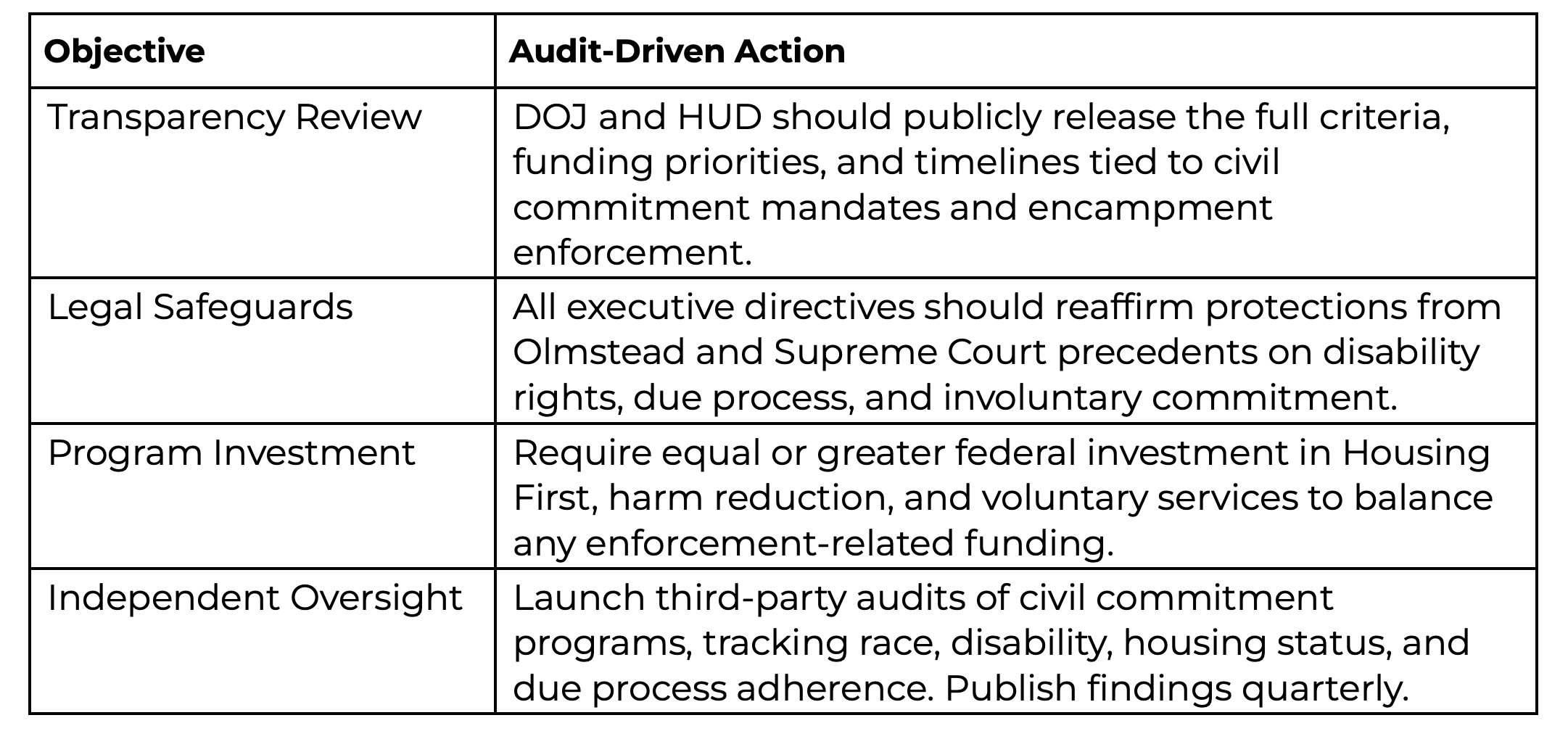
Final Take
This executive order introduces a system built for enforcement over care. It shifts authority from courts to executive discretion, expands civil commitment power, and undermines proven housing strategies, while the support systems shrink.
That structure reflects control-bypass logic: rapid action, minimal oversight, and promises of safety without the systems to back them.
Audit Thinking detects broken systems before they break communities. In this case, the evidence points toward a design that favors speed over safety, efficiency over humanity. The next step must be accountability.
Free U.S. Executive Order Review Tool
Laws move fast. This helps you think faster. Is this Executive Order protecting your rights or eroding them? Before you decide, audit the structure. Download the worksheet.
Comments
Nothing yet. Say the first thing.
Sign in to join the conversation.