
This is a field‑level forensic audit of how the 2025 Texas congressional redistricting unfolded, and the institutional breakdown that followed.
We ask:
Does the legal framework match the public claims?
Were control checkpoints followed or bypassed?
What does the timeline show? Landmark or logjam?
Time to read: ~ 6 minutes.
GOP-led legislative override of redistricting norms (five extra seats), mass Democratic walkout shuts down quorum (two-thirds majority required to conduct business), DOJ flags racial risk. Accountability hinge still missing.
In August 2025, the Texas Legislature convened a special session to redraw its 38 U.S. House districts, just four years after the 2021 map, aiming to swing five more seats into GOP control (supported publicly by President Trump). (Houston Chronicle)(The Texas Tribune)
As the House lacked the two‑thirds attendance (quorum) needed to vote, 62 Democratic members fled the state, prompting arrest warrants and threats of removal by Gov. Abbott. (Reuters)(The Texas Tribune)
The U.S. Department of Justice flagged four districts for potentially violating the Voting Rights Act by dismantling coalition Black–Hispanic districts. Texas officials pushed ahead, citing federal court precedent. (Jacksonville Journal-Courier)
Texas’s redistricting followed a control‑bypass pattern (fast execution, limited transparency, public justification pitched as democratic protection) while experts warned of racial map dilution.
What follows is a breakdown using the field-tested lens examining system design, control strength, evidence flow, bias, and public impact, known as the Five Pillars of Audit Thinking.
Gov. Greg Abbott (R): drove the emergency session after pressure from Trump’s team. (AP News)
President Trump: publicly encouraged Texas GOP to redraw the map for advantage. (TIME)
Texas Democrats (62 state reps): fled across state lines (Illinois, New York, Massachusetts) to deny a quorum. (The Washington Post)
U.S. DOJ: objected to four districts under Voting Rights Act Section 2 for weakening coalition voting power. (The Texas Tribune)
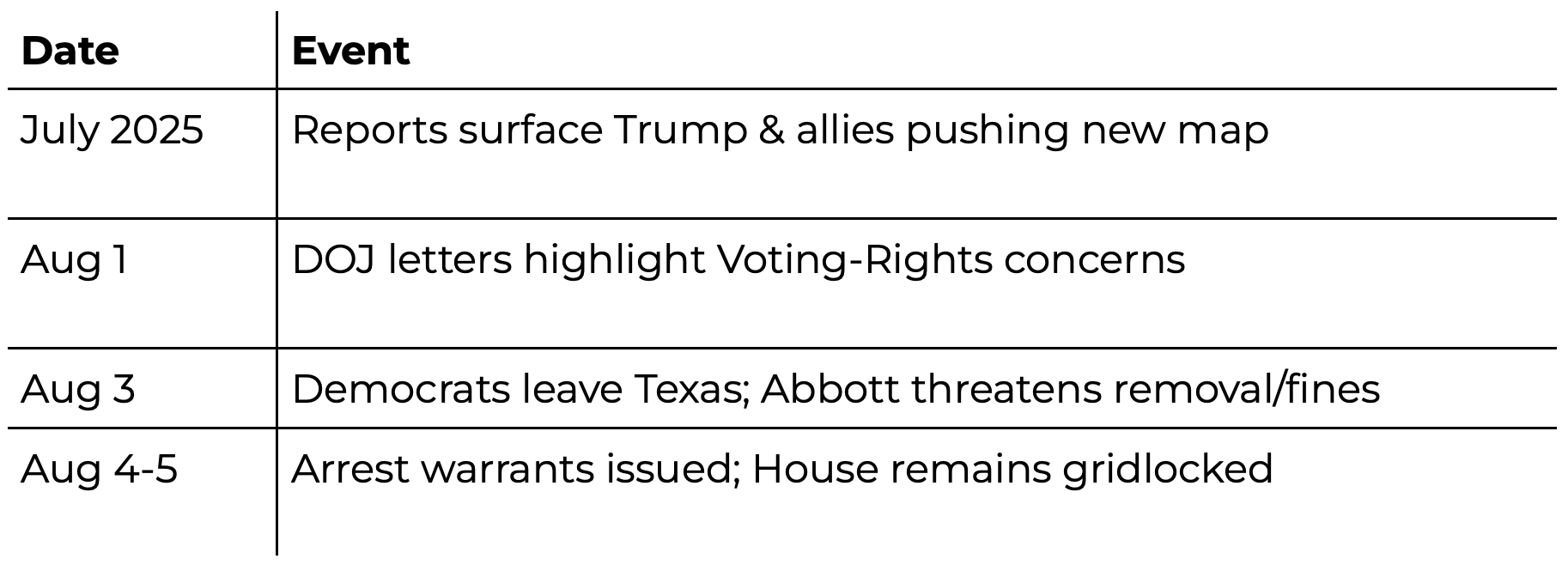
(Vox) (The Guardian)(AP News)
The Voting Rights Act (Section 2) requires protection against minority vote dilution. DOJ claimed coalition districts were endangered. (The Texas Tribune)
The Texas Constitution mandates a two‑thirds quorum (100 of 150 members in House) to take legislative action; absence is legal, but enforcement is restricted to state lines. (Jacksonville Journal-Courier)
There was no independent redistricting commission, therefore, legislators themselves drew and passed the map without expert or public review.
The Department of Justice formally raised concerns about racial gerrymandering before the session began, but those warnings were ignored and the redraw moved ahead anyway.
Quorum was blocked deliberately by Democratic legislators, triggering penalties under rules passed in 2021 (fines and potential removal). Those same rules were created by the majority party to enforce quorum, but were applied against dissent in this crisis, revealing enforcement bias. (Jacksonville Journal-Courier)
Draft maps were released under compressed timeframe and pushed to guarantee five new GOP seats in 2026. (AP News)
Democratic walkout succeeded, therefore no quorum meant no vote despite special session.
Enforcement threatened with an internal rules slap of $500-per-day penalties, arrest warrants, and calls for legal consequences. (The Guardian)
Here’s what emerged:
Map drafting without delay, testing, or outside review.
Quorum rules weaponized and enforced internally but weak across state lines.
Public messaging framed as protecting democracy, while the process constricted it.
Are coalition (Black‑Hispanic) districts automatically illegal?
What the DOJ said:
In a July 2025 letter, DOJ’s Civil Rights Division, led by Assistant Attorney General Harmeet K. Dhillon, warned Texas that at least four districts (the 9th, 18th, 29th, and 33rd) were likely unconstitutional race-based “coalition” districts. They said these lines diluted minority voting power in violation of Section 2 of the Voting Rights Act (Election Law Blog)
What the courts have said:
Earlier, in August 2024, the Fifth Circuit ruled in Petteway v. Galveston County that “coalition districts” (where no single minority group is a majority but groups vote together) are not guaranteed protection under Section 2. The court said the Voting Rights Act does not require states to preserve or create these districts, overturning decades of earlier precedent.
What does this mean for interpretation?
DOJ flagged specific coalition districts as potential violations, making their action active enforcement.
Fifth Circuit law says coalition protections aren’t automatic, and Texas’s legal team has argued DOJ misinterpreted that precedent.
Audit Thinking Lens
Bias risk: Is the justification used selectively and embraced when convenient, then discarded when it isn’t?
Assumption behind strategy: Are these districts dismantled to follow court precedent or to achieve partisan advantage?
How it breaks logic: If coalition protection isn't required, the DOJ warning loses legal force, but Texas’s lawmakers still leaned into it to justify the redraw.
Is this just partisanship versus historical strategy?
Quorum-denial is a long-standing Texas tactic (dating to 1870, renewed in 2003). It’s constitutional; enforcement lies with state troopers. (The Texas Tribune)
What’s public versus private impact?
Public rationale: “protect rural voters and flatten illegal districts.” Private outcome: GOP seats projected to jump from 71% of state map with 56% of statewide vote to up to 79%, a disproportionate advantage. (The Washington Post)
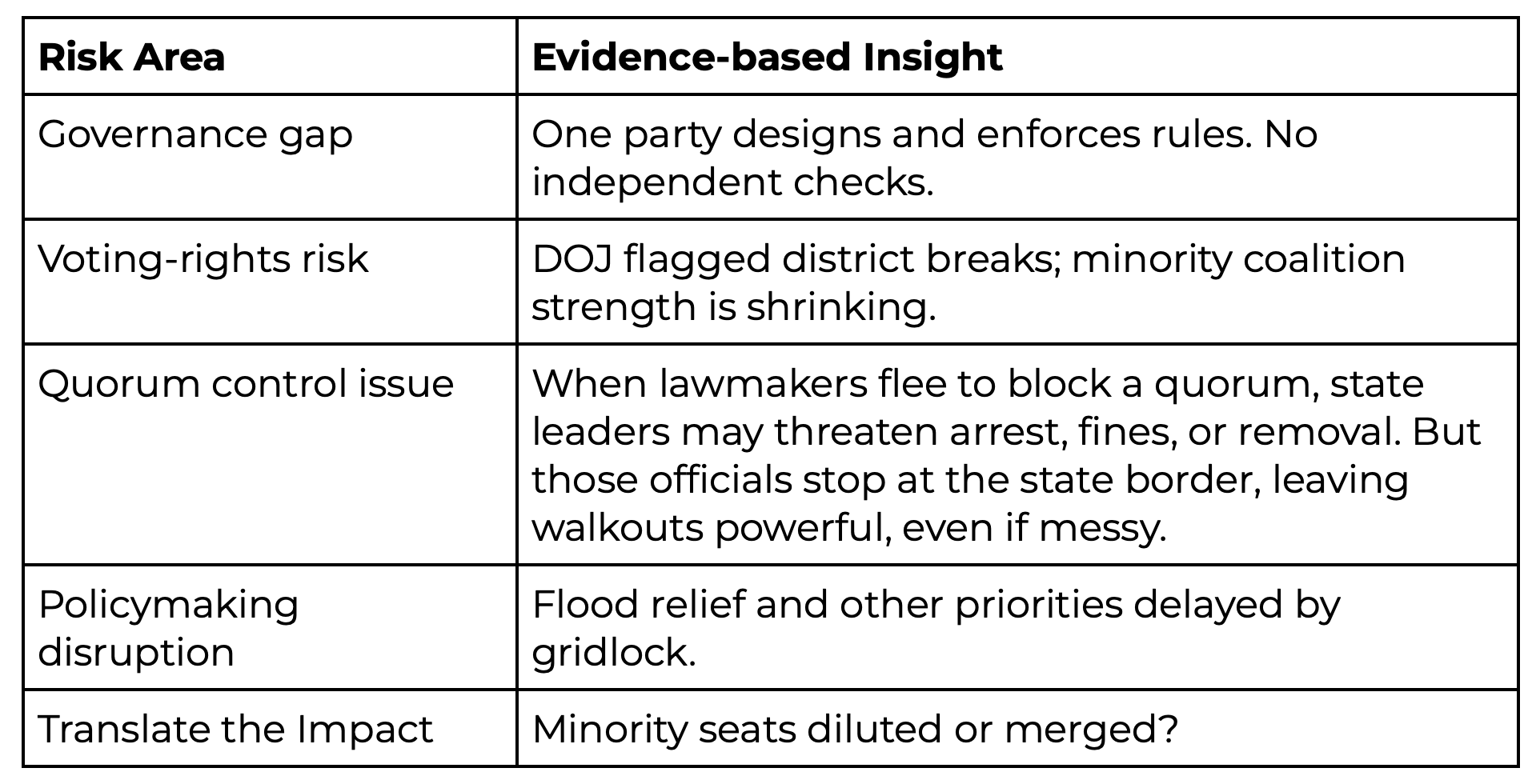
A structure was built to move fast, with limited oversight.
Checks meant to balance votes are tied to partisan enforcement.
Minorities in Black–Hispanic districts face legal and political jeopardy.
Community trust and democratic norms weaken with institutional speed.
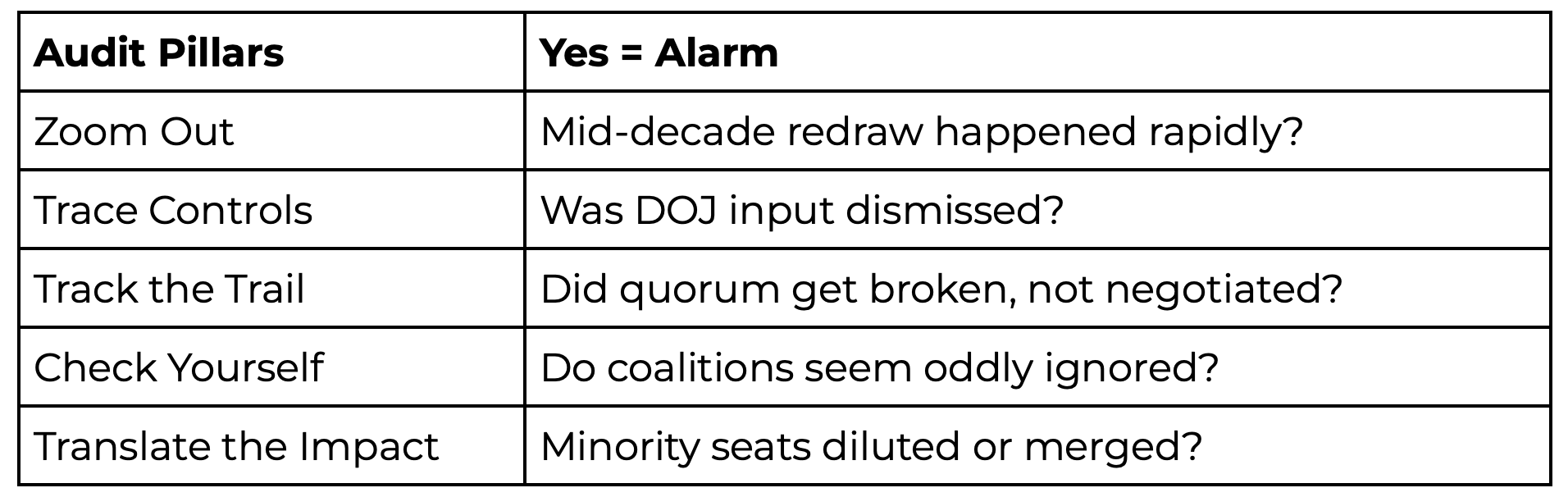
3+ Yes answers? You’re looking at a system beyond representation. It’s engineered for control.
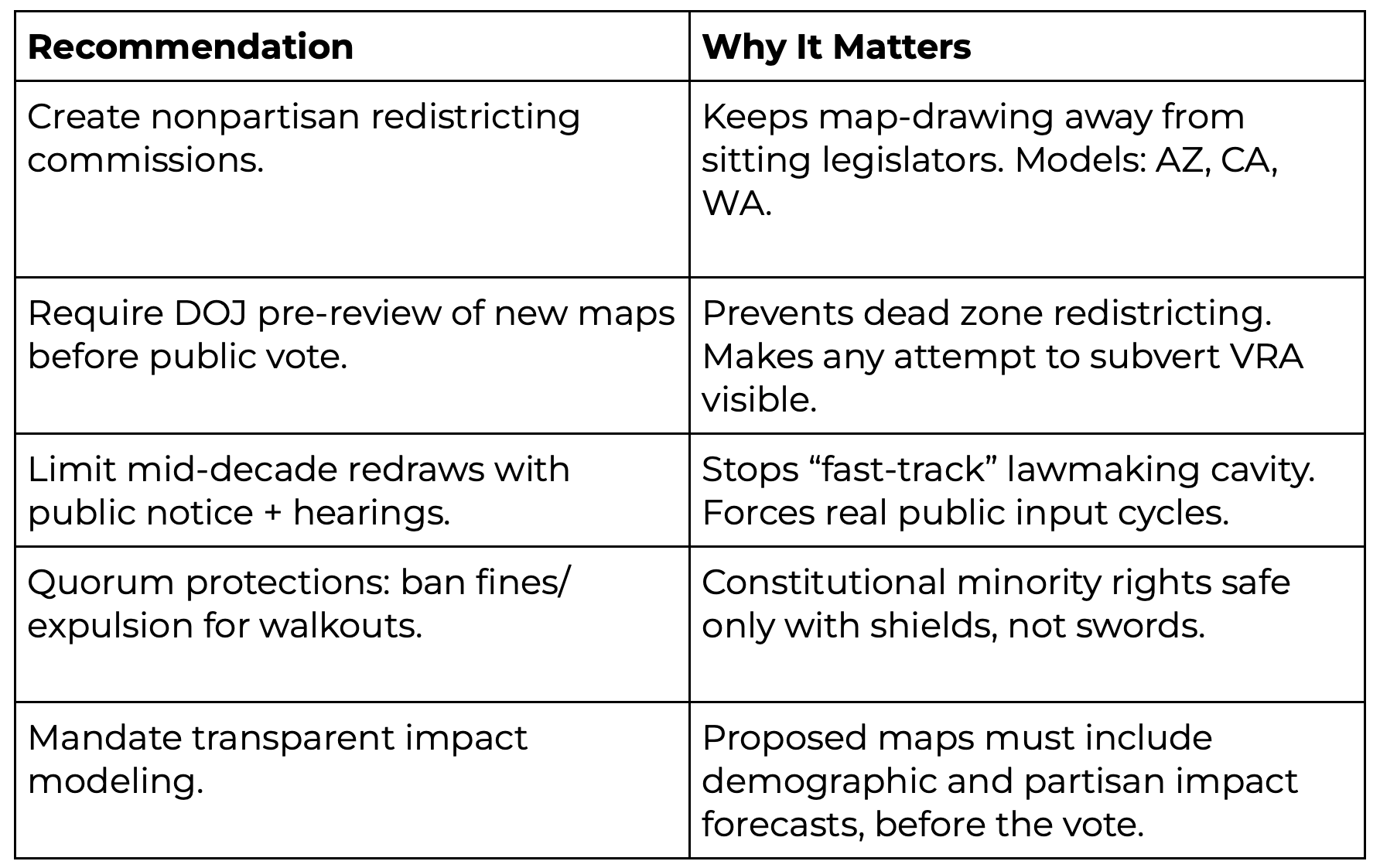
Demand real transparency on proposed maps before the floor vote.
Request DOJ review before voting starts, forward-looking oversight needs teeth.
Support independent commissions in redistricting to curb partisan extremes.
Protect quorum rights and limit punitive rules that punish walkouts.
Monitor emergency sessions labeled “time‑sensitive,” but ignore community crisis.
What Texas illustrates is a classic utility of Audit Thinking: systems built for control, not for representation. A fast-track map drafting process, quorum manipulation backed by legal muscle, and public assurances of legality, while DOJ warnings and coalition communities are excluded from the discussion.
Audit Thinking alerts us before communities lose voice, not after ballots are printed. Now that the cracks have surfaced, accountability must follow before the lines become law.
An honest audit demands action, because this is about about preventing structural abuse.
Download the free U.S. Map Audit Checklist. It’s a three-page tool built on the Five Pillars of Audit Thinking. Use it to assess any state’s proposed maps, spot structural risks, and hold policymakers accountable before lines become law.

Hint for code to access the the file: what is the first pillar of audit thinking (all lowercase, no spaces)
No posts
Comments
Nothing yet. Say the first thing.
Sign in to join the conversation.