
“Hello Party People! This is captain Kim speaking. Welcome aboard Venga Airways. After take off we’ll pump up the sound system… Cause We’re Going To Ibiza! #1 Summer Anthem, 1999 / Danski & DJ Del'mundo'.
Ibiza is a world famous destination for “party people” and the “lure to escape” remains as enchanting as it did in 1999 (We're Going To Ibiza). One tiny island in the Mediterranean Sea that has been described as many things beautiful and wild, including as the “golden egg” of Spain’s economy — worth a whopping 4.3 billion euros worth tourism in 2023. That economic sum-total does not account for the value of narcotrafficking and it’s corresponding black market in the island. Yet this story is not about Ibiza, nor the involved tourism or the “party peoples” who exit their boring lives every summer heading for the proverbial “playa paraiso” (paradise beach). It’s about exodus, the dynamics of frontiers and the interaction between the migrant and the native. Stories of “leaving home forever”, the European border regime, the do-or-die spirit of the migrant, the Mediterranean Sea and the “islands of pure chance” (unnamed migrant).
What is often called a “refugee crisis” in Europe, remains clueless about the background of the crises in terms of the exit, transit and arrival of migrants — human beings who succeed in reaching the outer periphery of Europe, only after crossing vast distances, following non-negotiable routes, through borders and regions where people speak many languages but the person’s native tongue. And there is no turning back!
Every exit from “homeland” followed by every transit through the “unknown” and eventually every “contact with the foreign” on arrival — makes each case a unique record of abandonment, survival, resilience and hope of resettlement. The recent case of 34 men who reached Ibiza of all places, on two rubber rafts, equates to a microscopic part of the global displacement crisis. The following investigation reveals the loss, risks and severity of such situations — in three parts as the exit, transit and arrival.
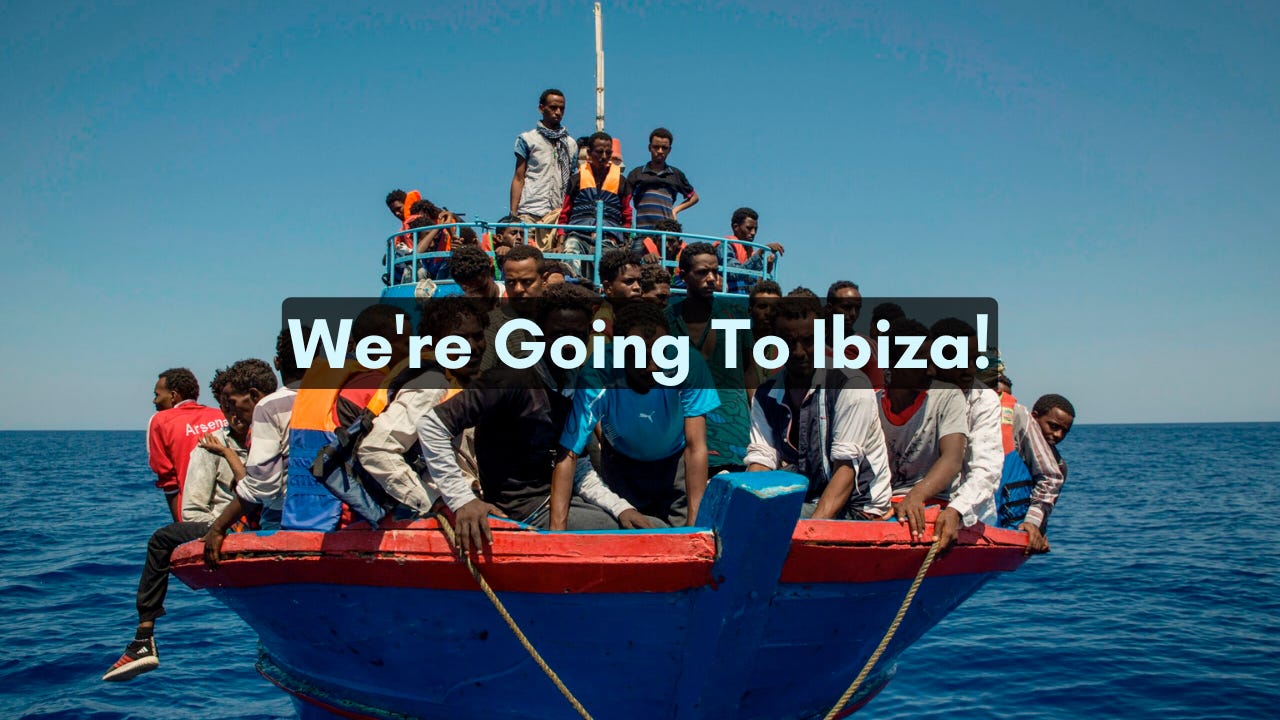
Background. Early hours of 7th July this year, two rubber rafts carrying 34 men (all Bangladeshis) landed near about ‘Cala D’Hort’ at the southern edge of Ibiza. Both the rafts had left Chéraga (Algeria) days ago, yet without a fixed destination and so it happened that the passengers found their way to the island of Ibiza, a place they were absolutely clueless about. A third raft, carrying 21 people (Algerian women, children and men) had landed in Formentera just a few hours earlier. A fourth raft, carrying a mix bag of nationalities landed near Almeria, a few hours later. Back to our Bangladeshi crew, all of them had the same questions — was this Europe? Had they finally arrived? What next? What to do? Where to go?
Word of their arrival went out like a forest fire, and by the next day all of them had been apprehended by the local police, detained and handed over to the Policia Nacional of Spain. “All of us were escorted by the police to a center, where we could finally make a phone call back home… we were so tired and most of us were sick…” (unnamed migrant). Obviously none them spoke Spanish, very few spoke basic English and following the “International Protection Act” all of them were shipped off to Valencia after 3 days and placed inside the “Centro De Internamiento Por Extranjeros” (Center For Undocumented Immigrants).
There started the process of interviewing each of them, seeking asylum in Spain, according to the EU protocols. Part of my work as an interpreter, for the migrants and the police reveals many experiences that go unheard of, however “officially documented”. Migrant narratives are a collusion of many things visible and invisible. Of race, language, religion, nationality, political opinion, persecution, stories of collapse, shared myths, the involved bureaucracy, protocols, police and invisible boundaries, altogether make “a wet ontology of exodus… fluid hybrid borders…” (Bertille Motte). Is what compelled me to write this narrative as a short interpretation.
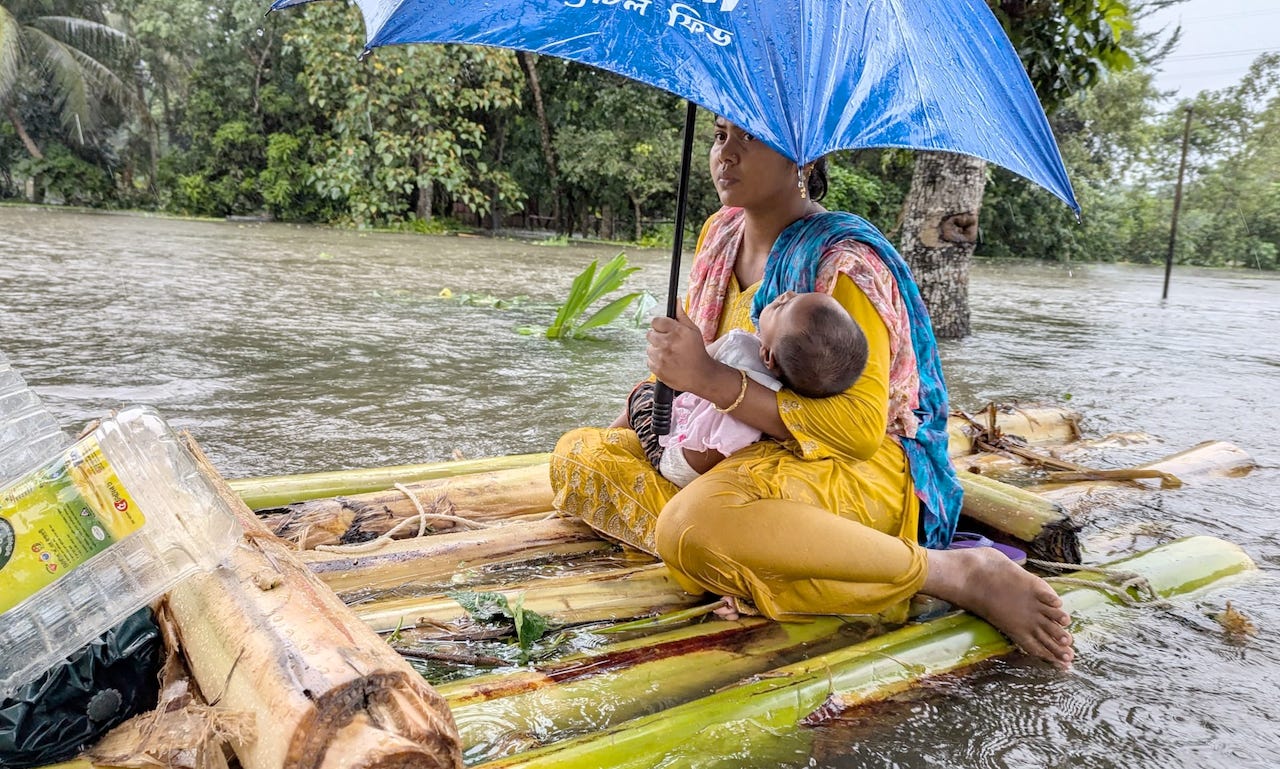
The Exit. Not as an alarmist but objectively summing up a catastrophe is worth the effort. Like Syria, Venezuela and Ukraine, Bangladesh too is a prime example of abandonment and exodus. The case with Bangladesh, an outcome of unsustainable poverty, political instability and climate change. Decades of disastrous neoliberal policies backed by the IMF, World Bank and signed by every incoming regime in Bangladesh has underwritten the above crisis. The population of Bangladesh (172 million) is greater than that of entire Russia (142 million) and conversely the size of Bangladesh is approximately 0.9% of Russia. “More Bangladeshis are abandoning the rural parts than from India and Pakistan… Human trafficking from Bangladesh alone is worth more than a 500 million dollars.” (Migrant Smuggling Across the Mediterranean Sea, Ballard Brief). The human trafficking networks, their vast outreach and unaccounted for business would be preposterous in value to say the least, according to Hope For Justice “illicit profits of well over US$200 billion every year”.
Bangladesh is also emptying out, bit by bit due of rising ocean levels in the south and ever extreme floods in the north. “Alarming rate of farmland depletion in Bangladesh since 2010…” (Farmland Depletion Report 2020). Worth noting that more than 750,000 Rohingyas entered Bangladesh fleeing the Genocide in Myanmar (Buddhist Clergy) during 2016-2019. In a world full of statistics, there is no tangible figure as to how many Bangladeshis abandon their country on an annual basis.
The most common reasons for abandoning their country are “political persecution” and “death threats” as declared by Bangladeshis seeking international protection. A strange travesty of politically motivated revenge, sectarian violence, assassinations, kidnapping, looting and rioting shows up as the exchange of power, between the Awami League (AL) and the Bangladesh Nationalist Party (BNP).
The last 20 years of continuous political battles, encapsulated as “extreme difficulty for anybody to achieve electoral success or even undertake the promises made by the government…” (unnamed migrant). The majority of Bangladeshi asylum seekers are male, belonging to the lower economic strata, between ages 18 to 45 years. “Less than 5% of all Bangladeshi migrants intercepted by the various bodies of European security are women and children” (Frontex, 2021). The interviews often reveal a mix, of background conditions and shared myths, that obfuscate the investigation as well as the person’s lived experience back home. Under what extreme circumstances did these men decide to abandon their native lands? The circumstances can be political, economic, based on destitution, even extreme events and at times exaggerated and inconsistent.
“Some of us have big loans to pay back home… agriculture had failed… sold off all the cattle.. can’t we declare that as a reason?” (Unnamed Migrant).
“Students and young volunteers are blacklisted by the BNP as well as the AL, not just in Dhaka, but also in the interiors… just depends with which party we were associated with… there are no jobs or opportunities for us back there.” (Unnamed Migrant).
“My elder brother (BNP cadre) was assassinated in 2019 and if I did not escape, the same would happen to me… my family is better off without me… i left in mid-2020 and eventually reached Spain in early-2024.” (Unnamed Migrant).
“My destination was London, but they refused entry on some basis I did not understand well and so I turned to Spain” (Unnamed Migrant)
“About 33,000 square kilometers were flooded in Bangladesh in 2019… As landless farmers we moved to the outskirts of Dhaka… from there we moved to India… 2 years later I made my way to Turkey and then to Algeria… my wife and children are still in India.” (Unnamed Migrant).
The reasons to exit are many, and so are the routes, depending on how much money one is willing to spend. Above all else, is that what is at stake? To put it simply, the transit equates to a one-time “risk” that each migrant decided to take, borrow, sell and beg, still allude the “situations” they are fleeing from. Is important to note that most Bangladeshi migrants without work permits and little money, prefer to enter nations like Saudi Arabia, Kuwait, UAE, Oman and Yemen (dominant Sunni nations like Bangladesh). Yet religious fraternity alone does not guarantee a successful migration. “The principle reason most Bangladeshis find it difficult to find an opportunity in the Middle-East is because the market is saturated with labor from Pakistan, Afghanistan and India… regions like Iraq, Syria and Jordan are even more risky to cross… instead navigating towards Egypt, Turkey, the Sahel region and North Africa, with the intent to reach European borders.” (Ruud Lubbers, former UNHCR).
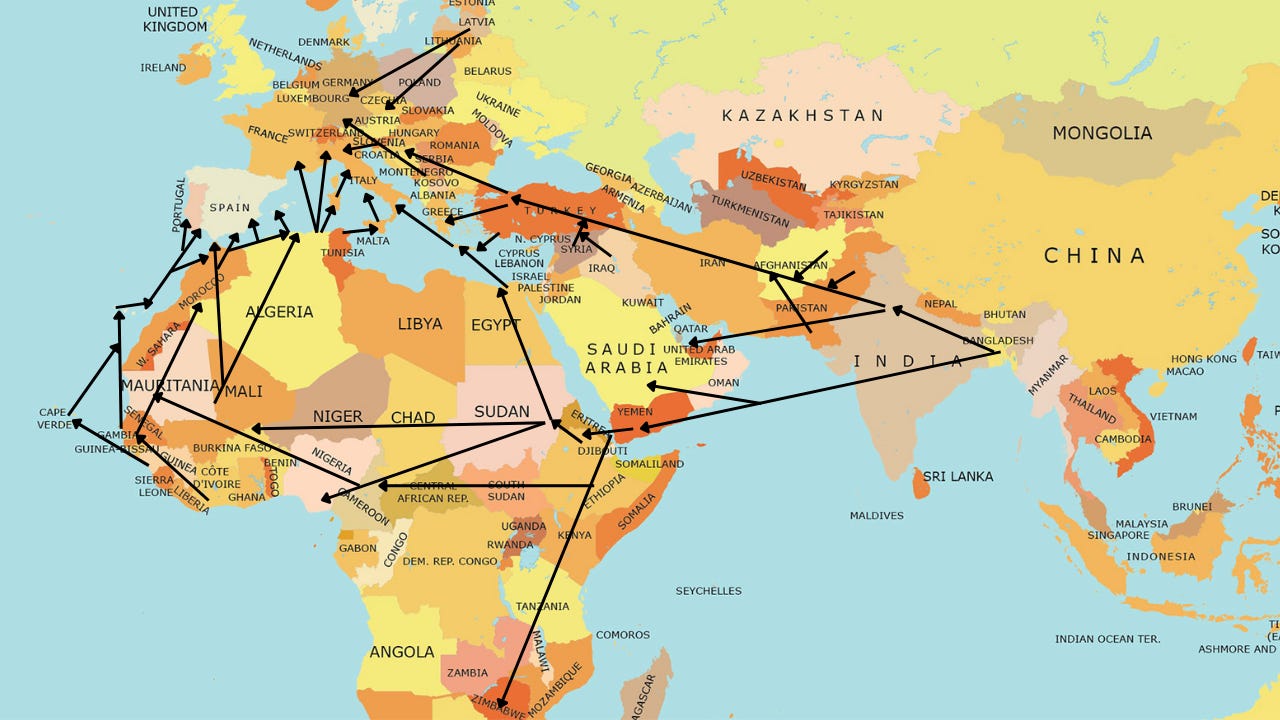
The transit. This part of the story literally unravels dozens of migration routes over land, sea and air. Check the map below which highlights some of the popular routes taken by Asian and African migrants. Dozens of other extended routes can take a migrant as far as South Africa, Mexico, the Caribbean or towards South America. Over long periods of time and untold hardship to be clear. Yet numerically speaking the majority converges at select zones dotted along the Mediterranean shores of Africa and in Turkey. “Where the sun sets is our home at that moment…” (Unnamed Migrant).
Less expensive, yet longer and way more treacherous routes exist between Yemen, Eritrea, Ethiopia, South Sudan, Sudan cutting across Chad, Nigeria, Burkina Faso towards Algeria and Morocco. “I left Bangladesh in September 2020, taking a flight to Jeddah and then to Sanaa (Yemen). From there a boat ride across the Red Sea towards Asmara (Eritrea) followed by a long road trip lasting days to Khartoum… over the next two years I crossed many nations that I cannot remember… got to know many other migrants along the way… found some work in a garage while I was in Nigeria… reached Morocco in November 2023… earned enough to pay an agent in Rabat… Was detained a few hours after the flotilla dropped us off on an unknown beach (Motril, Spain) in February 2024” (Unnamed Migrant).
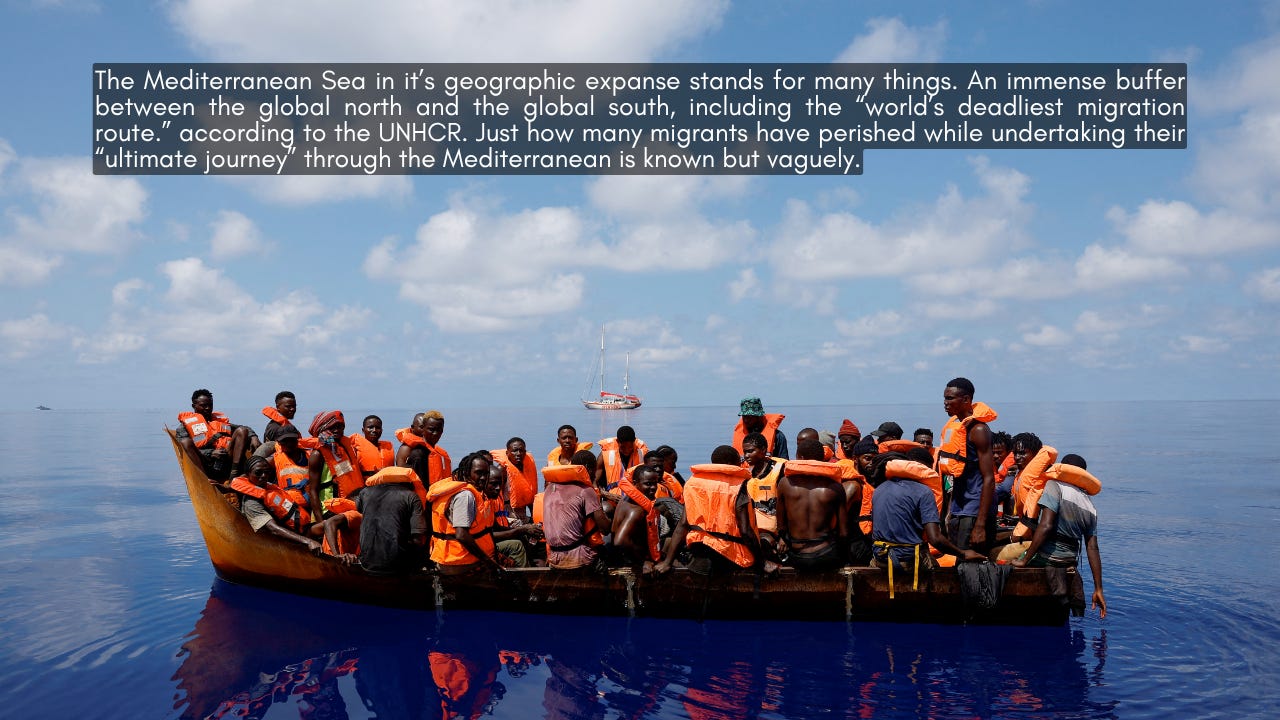
The Mediterranean Sea in it’s geographic expanse stands for many things. An immense buffer between the global north and the global south, including the “world’s deadliest migration route.” according to the UNHCR. Just how many migrants have perished while undertaking their “ultimate journey” through the Mediterranean is known but vaguely. “Approximately 211,000 crossed the Mediterranean during 2020-2023. Over 3,200 died in 2014, and approximately 4,170 in 2020” (Human Rights Watch). Ever so many little flotillas that cross the central Mediterranean and the continental periphery of the North Atlantic, together symbolize a “harrowing journey as nothing short of a geopolitical travesty” (Hilary Damissah, Nigeria).
The role of the Mediterranean Sea in producing “migratory experiences” includes people from many nationalities and ethnicities — channeled towards Europe yet without any guarantees nor rights along the way. A majority of migrants give up their passports and personal ID at some point or another, before they reach the final point of departure for the European frontier.
European state and “suprastate institutions” literally utilize the sea and its environmental properties to kill, disappear, and conceal the deaths of migrants crossing the sea. Documentation of the transit undertaken by millions of “stateless people” or call them “the undocumented” discounts all those who perished along the way. “The sea acts on bodies and is in turn acted upon as these bodies become nutrients for fish and other marine non-human life” (Dziuban and Dead 2023).
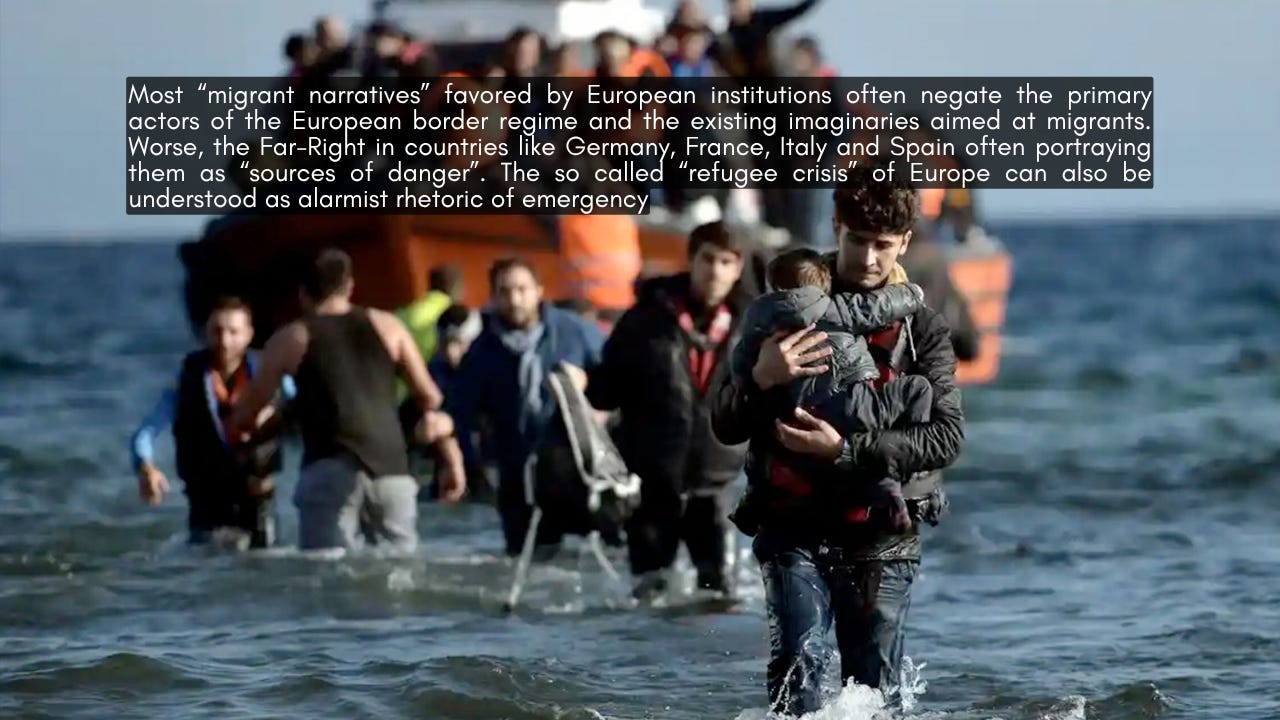
Most “migrant narratives” favored by European institutions often negate the primary actors — the European border regime and the existing imaginaries aimed at migrants. Worse, the Far-Right in countries like Germany, France, Italy and Spain often portraying them as “sources of danger”. The so called “refugee crisis” of Europe can also be understood as alarmist rhetoric of emergency. Harsher migration policies and practices? More European border patrols situated deep in the Sahara? That can hardly thwart the mass devaluation and ongoing abandonment in the global south, especially in a country far away like Bangladesh.
The Arrival. The final stage of the migration, involves two choices above all else. One is to self-declare as “undocumented” and other is to remain in hiding as the “undetected”. By and large, a majority of migrants are intercepted by a robust security net — the European Border and Coast Guard Agency (Frontex) that helps EU countries to “manage their external borders”. The Mediterranean Sea “is our busiest zone of activity and surveillance.” (Frontex). While a range of humanitarian institutions, the mainstream media, even the Spanish police as well as Frontex insist on “migrants’ urgent need for humanitarian assistance from European nation-states” the process of documentation and integration “erases migrants’ genuine experiences, demands, needs, and feelings” (Mediterranean Necropolitics as a European Strategy of Migration Deterrence). More specifically, such humanitarian aid fails to provide durable solutions while rejecting a majority of asylum petitions, as seen recently in France, Germany, Portugal, Italy, Greece and Spain. Yes they are provided medical assistance, new clothes, food, psychological counseling and shelter, for the moment.
Back to our 34 men from Bangladesh, who landed in Ibiza, yet make up a fraction of the “9660 Bangladeshis intercepted in the Mediterranean region during 2022 - 2024” (data by Frontex). One standard procedure is laid out for the vulnerable, passive and lacking agency. The interview must be documented in the presence of the assigned lawyer, an interpreter and two police officials. Two hours at the most, to tell the entire story. Purely as a matter of efficiency, the Spanish police treats every asylum seeker with a friendly attitude, albeit the underlying vibe is more like “don’t bore us, just get to the chorus”. The following questions frame every asylum plea.
Under what conditions did you decide to abandon your nation?
What would have happened if you decided to remain back there?
Why did you choose this country specific for international protection?
Did you belong to any ethnically persecuted group in your nation?
Your entire migration route with dates?
Anything you wish to add from your side.
9 out 10 migrants who seek asylum end up believing that the interview with the police will be the “final resolution” of their petition. While that is absolutely untrue, there seems no particular obligation by anyone, to prepare asylum seekers for the exchange and interview. Let alone make sure that a migrant knows beforehand, that 99% of asylum seekers, regardless of the eventual decision delivered by the State (positive or negative), will receive a “legal stay permit” for 11 months, including the last 4 months of the period to seek employment with contract. Just to tell every migrant in bold letters that “Asylum is a fundamental right and an international obligation for every European member-state.” (EU Commission For Migrations).
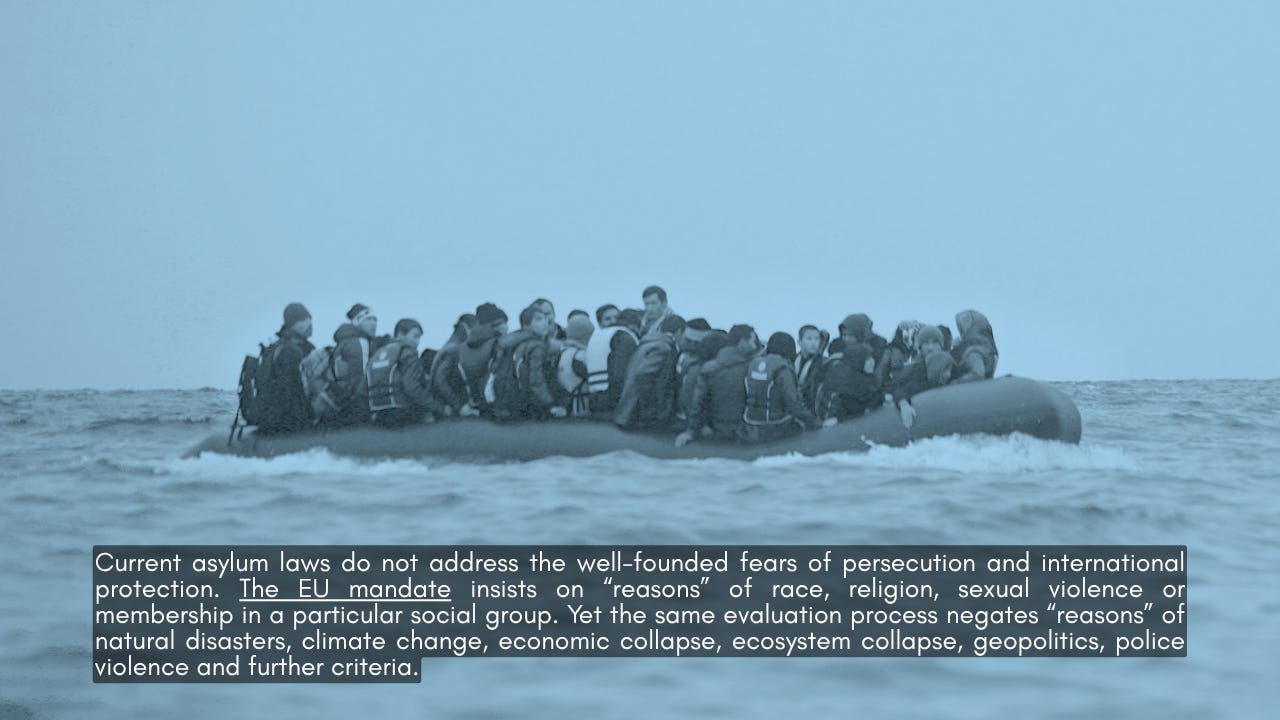
Current EU asylum laws do not address the well-founded fears of persecution and international protection. The EU mandate insists on “reasons” of race, religion, sexual violence or membership in a particular social group. Yet the same evaluation process negates “reasons” of natural disasters, climate change, economic collapse, ecosystem collapse, geopolitics, police violence and further criteria. The argument is for a humanitarian framework of integration and not just documentation or deterring the entry of migrants. Obviously the State wants “harsher border practices to deter migrants from attempting to cross and risking their lives” (Achille Mbembe). Severely critical of European border regulations, Mbembe condemns the current framework, disregarding the asylum structure, as “border regulation policies that can simultaneously extend and delimit the right to life… What they are about enhances the effective management of its external borders”.
All 34 of the Bangladeshi asylum seekers that I interviewed recently, received negative resolutions. Part of the norm, the assigned lawyers immediately rejected the judgement by requesting the “right to appeal against the decision.” Most of the rejection letters appear like a copy-paste job. The “consistent criteria” appears aligned with rejection rather than acceptance. What if the decision making process itself has been outsourced to machine intelligence? But nothing useful will come of such bureaucratic back-n-forth, and eventually in a matter of weeks all the detained individuals will be set free by the police. They will be free, however without a safety net or legalization. What about their representative embassy? Under no particular obligation but to issue a new passport, at least.
There starts a whole new chapter, not for just these Bangladeshis but hundreds of thousands of other migrants who remain within Spain, suspended in a semi-legal universe, trying to navigate (and integrate into) existing society, using every possible coping mechanism. Less than 2% of all documented migrants are actually expelled from the EU, most often those facing major extradition charges or individuals who “pose a risk to national security”. By all means the situation within Spain or for that matter in most EU member-states is not like the U.S. and how the ICE currently detains and deports thousands of foreigners. However, there are those who do become the “beneficiaries of international protection.” At the top of the list are an outstanding number of Ukrainians (22,500), followed by Afghans (10,134), Syrians (3,044), Venezuela (1,800) Palestine (349) and Somalia (180). “EU countries granted protection status to 437,900 asylum seekers, up 6.8% compared to 2023-2022” (EU Asylum Roundup).
The rest can effectively disappear for years to come — evading the law, the police and the enforcement agencies yet not facing any real threat of immediate deportation. Once inside the enclosure of Europe, millions of undocumented evade the dragnet in many ways known and unknown. The climate of uncertainty and the absence of identity goes hand in hand. Way past the exit, a fading memory of the transit and whatever follows post arrival.
“The number of Bangladeshi migrants seeking international protection has nearly doubled over the last 10 years… our focus is on social inclusion, learning language and understanding basic human rights, in order rehabilitate families and individuals… Funding is scarce yet the collective is growing with new members, especially with Bangladeshi women and girls…” (Valienté Bangla, Madrid).
Hence, the enclosure of space and all the moving bodies within, native or foreign, migrant or tourist, European or non-European, brings me back to Ibiza — where they say “the sky is blue and the beach is waiting for you”. For Who?
“I came to Ibiza in 2016 as undocumented… my cousin never made it because the boat he was on, sank out there… but now I am legal here and work at the Jatayu, Indian Restaurant… managed to get my wife here in 2022 but never went back to Bangladesh.” (Hassan Islam). There are thousands if not more such migration narratives and memories. “A place to not just party but also rejuvenate and escape from the grind and routine… I have returned to Ibiza so many times I can’t remember.” (Christoph Abicht, resident of Berlin). The high contrast, of lives which exist in the same spatial dimensions however separated in terms of class and it’s corresponding needs and consciousness. The migrant and the tourist eventually conform, if not on the same beach, but at two ends of the same economic system and the same multicultural precarity. Facing the same Mediterranean Sea, the vast blue expanse, still as a concealment and erasure of those who never made it…
Whoah! We're going to Ibiza
Whoah! Back to the island
Whoah! We're gonna have a party!
Whoah! In the Mediterranean Sea…
🌴🛥️🌏🚤🌎🛶🌍🚔⚠️🌴
In case you wish to pledge support with a paid subscription 😌 CLICK HERE 🙏🏽
(yes it helps a lot )
Comments
Nothing yet. Say the first thing.
Sign in to join the conversation.